How to Scale Marketing Without Scaling Headcount: The AI-Native Operating Model
So when the company wanted marketing to do significantly more, the answer was usually:
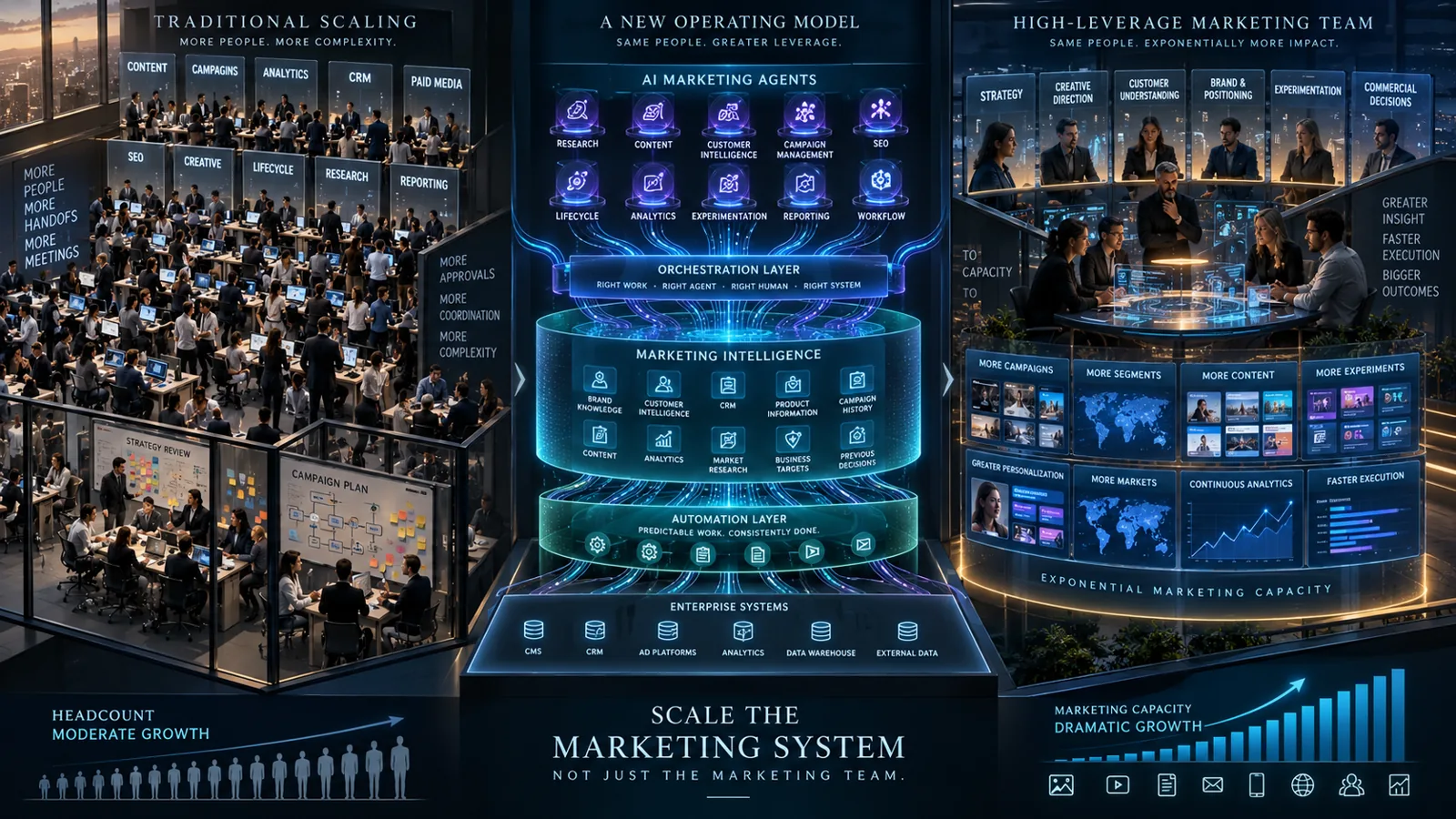
For most of modern marketing history, growth followed a predictable equation.
More channels meant more specialists.
More campaigns meant more campaign managers.
More content meant more writers and designers.
More data meant more analysts.
More customers meant more lifecycle marketers.
More complexity meant more marketing operations.
So when the company wanted marketing to do significantly more, the answer was usually:
hire more people.
That equation is beginning to change.
Generative AI, automation and AI agents are creating the possibility of a different marketing model—one in which marketing capacity can grow faster than marketing headcount.
This does not mean eliminating marketing teams.
It does not mean expecting five people to absorb the workload of twenty.
And it certainly does not mean replacing judgment, creativity or customer understanding with software.
The opportunity is more structural.
Scaling marketing without scaling headcount means increasing marketing's ability to research, create, execute, analyze and optimize work without increasing human coordination and staffing at the same rate.
That requires more than AI tools.
It requires redesigning the marketing operating model.
Marketing Has Traditionally Scaled Through People
Imagine a startup with a three-person marketing team.
The team handles:
content;
email;
social;
campaigns;
analytics;
and website updates.
Then the company grows.
Marketing expands internationally.
Paid media becomes important.
CRM gets more sophisticated.
SEO matters.
Customer marketing appears.
Events begin.
More content is required.
More segments need different messaging.
Leadership wants better reporting.
Soon the organization hires:
a content marketer;
performance marketer;
designer;
marketing operations specialist;
SEO lead;
product marketer;
lifecycle marketer;
analyst;
social-media manager;
and several agencies.
This is not necessarily inefficient.
Specialization creates expertise.
But there is a hidden problem.
As the team becomes larger, marketing does not merely gain more productive capacity.
It also gains more coordination overhead.
More meetings.
More briefs.
More handoffs.
More approvals.
More project-management work.
More context switching.
More reporting.
More managers.
More people who need to understand what everyone else is doing.
At some point, headcount can grow faster than actual marketing leverage.
The Goal Is Operating Leverage
A useful concept here is marketing operating leverage.
Marketing operating leverage is the ability to increase marketing output and business impact faster than the resources required to produce them.
Suppose a 10-person marketing team can manage 20 meaningful campaigns per quarter.
The traditional scaling model may require roughly doubling staff to manage 40.
A more leveraged operating model might allow the same team—or a moderately larger team—to manage substantially more activity because AI and automation absorb much of the repetitive execution and coordination.
The important metric is not simply:
output per employee.
That can encourage organizations to overload people.
A better question is:
How much valuable marketing capacity does each additional human create when supported by the right systems?
The difference matters.
We are not trying to make humans work twice as hard.
We are trying to redesign the system so they do less low-value work.
Why This Is Becoming a CMO Priority
The economic environment makes this increasingly important.
Marketing leaders are being asked to simultaneously:
drive growth;
increase efficiency;
adopt AI;
improve customer experience;
prove ROI;
and manage constrained budgets.
Gartner's 2026 CMO Spend Survey puts the tension clearly.
Average marketing budgets sit at approximately 7.8% of company revenue.
More than half of surveyed CMOs report insufficient resources.
At the same time, 70% say becoming an AI leader is critical.
That creates an uncomfortable mandate:
create more business impact without assuming resources will expand proportionally.
The wrong response is:
"Make everyone work harder."
The better response is:
redesign how marketing work gets done.
AI Tools Alone Do Not Create Scalability
This distinction is essential.
Imagine every employee gets an AI assistant.
The content marketer writes faster.
The strategist researches faster.
The analyst summarizes reports faster.
The social-media manager generates captions faster.
The account manager produces meeting notes faster.
Everyone experiences productivity gains.
But the workflow remains unchanged.
Humans still:
assign every task;
transfer information;
check every deadline;
retrieve client context;
route work;
manage approvals;
monitor dashboards;
consolidate feedback;
prepare reports;
and decide what happens next.
The company becomes AI-assisted.
It has not necessarily become AI-native.
Individual productivity is useful.
Scalability comes when the operating system itself changes.
Microsoft's 2026 Work Trend Index makes a similar distinction: the largest opportunity appears when organizations redesign workflows around AI and agents rather than limiting AI to individual assistance.
Where Marketing Headcount Actually Goes
To understand how AI creates leverage, separate marketing work into different categories.
1. High-Value Human Judgment
Examples:
brand strategy;
positioning;
customer understanding;
creative direction;
commercial decisions;
leadership;
relationship management;
major budget decisions;
sensitive communications.
These areas should remain highly human.
2. Skilled Production
Examples:
writing;
design;
research;
campaign development;
analysis;
video production;
SEO;
personalization.
AI can substantially augment these activities.
3. Coordination
Examples:
routing work;
checking status;
consolidating feedback;
creating briefs;
updating systems;
tracking dependencies;
preparing meeting summaries.
Much of this can increasingly be automated or agent-assisted.
4. Repetitive Execution
Examples:
formatting;
tagging;
uploading;
basic adaptation;
standard reporting;
data synchronization;
routine campaign configuration.
Traditional automation and AI can absorb significant portions of this work.
5. Continuous Monitoring
Examples:
checking campaign performance;
watching competitor activity;
monitoring SEO;
tracking customer signals;
looking for anomalies;
checking budgets.
AI agents are particularly well suited to monitoring because software does not need to repeatedly open a dashboard and remember to look.
The opportunity becomes clear.
Most marketing organizations do not need to remove all humans from the system.
They need to move human attention upward.
The Five-Layer Model for Scaling Marketing
A scalable AI-native marketing organization can be thought of as five connected layers.
Layer 1: Shared Marketing Intelligence
The first constraint on AI-powered scale is context.
Every marketer currently carries context inside their head.
They know:
the brand;
the product;
the customers;
the strategy;
previous campaigns;
what leadership approved;
what failed previously;
what the sales team hears;
what competitors are doing;
and what objectives matter.
When a new employee joins, much of this knowledge must be transferred manually.
When a new AI tool is introduced, employees frequently have to prompt the context repeatedly.
That does not scale.
A shared marketing intelligence layer should contain authorized access to:
brand knowledge;
customer intelligence;
CRM data;
campaign history;
performance data;
content libraries;
product information;
market research;
competitive intelligence;
business targets;
previous decisions;
and organizational knowledge.
This turns context from an individual possession into an organizational asset.
And it means every workflow does not need to start from zero.
Layer 2: Specialized AI Agents
The next layer contains AI agents with specific responsibilities.
A mature marketing organization might eventually use agents for:
market research;
customer intelligence;
competitive intelligence;
SEO;
content strategy;
content development;
campaign management;
lifecycle marketing;
analytics;
experimentation;
and reporting.
The important word is specialized.
Do not imagine one enormous chatbot acting as an artificial marketing department.
Different marketing activities involve different:
data;
tools;
objectives;
permissions;
quality standards;
and risk profiles.
Specialized agents allow those responsibilities to be managed more deliberately.
Layer 3: Orchestration
This is where much of the real scaling advantage appears.
Someone currently coordinates marketing.
Humans decide:
who should work on something;
what information they need;
what happens next;
whether another task is complete;
whether an approval is missing;
whether the campaign can launch;
and who needs to be notified.
As marketing complexity increases, orchestration becomes a major source of headcount.
An AI orchestration layer can increasingly manage:
workflow state;
agent selection;
dependencies;
routing;
priorities;
permissions;
quality checks;
escalations;
and completion.
Instead of humans managing every step, humans define the system and intervene where judgment is required.
That is fundamentally different from merely generating content faster.
Layer 4: Execution and Automation
Marketing already has powerful execution infrastructure.
CRM.
Marketing automation.
Advertising platforms.
CMS.
Email platforms.
Social tools.
Analytics.
Project management.
AI does not have to replace these systems.
It can operate through them.
Traditional automation remains ideal for deterministic processes.
If:
X always means Y,
use automation.
For example:
an approved campaign asset moves into the CMS;
a completed form updates CRM;
a lifecycle event triggers an email;
a lead reaches a threshold and enters a workflow.
AI agents become useful where the system must interpret context before deciding what action is appropriate.
Layer 5: Human Governance and Decisions
The final layer protects the organization from an obvious mistake:
automating decisions simply because technology makes automation possible.
Humans should remain deliberately involved where there is meaningful:
financial risk;
brand risk;
legal risk;
customer impact;
strategic importance;
or subjective judgment.
The future marketing organization is not:
humans or AI.
It is a designed allocation of work between:
humans + agents + automation + enterprise systems.
What This Looks Like in Practice
Consider launching a new product.
Traditional Marketing Model
A strategist researches the market.
Another employee researches competitors.
Someone creates customer personas.
The strategist prepares a campaign brief.
Content receives the brief.
Copy is created.
Design begins.
Campaign operations waits for assets.
Lifecycle creates emails separately.
Paid media adapts creative.
SEO creates another workstream.
Analytics prepares tracking.
Project managers coordinate deadlines.
Leadership reviews.
Feedback returns.
Revisions occur.
Campaigns launch.
Analysts build reports.
The team meets to decide what happened.
The organization may have excellent specialists.
But humans are involved at almost every transfer point.
AI-Native Marketing Model
Product information, customer intelligence, brand knowledge and historical campaigns already exist in shared context.
Market, customer and competitive agents research in parallel.
A strategy agent synthesizes findings.
Human strategists make the positioning and campaign decisions.
Once approved, orchestration activates specialized workflows.
Content agents prepare drafts.
Creative workflows produce variations.
SEO intelligence informs search assets.
Lifecycle agents prepare customer journeys.
Quality agents check outputs against brand and campaign requirements.
Humans approve high-value creative.
Execution systems publish the work.
Analytics agents continuously monitor results.
Unexpected changes are investigated automatically.
Leadership receives only material risks, opportunities and decisions.
Same business objective.
Completely different coordination model.

Scale the Workflow Before Scaling the Team
This leads to an important management principle.
Before opening another role, ask:
What exactly is creating the capacity constraint?
Suppose the content team says it needs another employee.
Why?
Because it cannot write enough?
Because briefs arrive incomplete?
Because revisions take too long?
Because stakeholders cannot approve quickly?
Because distribution is manual?
Because the team spends one day each week reporting?
Because assets constantly need reformatting?
Because people cannot find existing content?
Different bottlenecks require different solutions.
Some need hiring.
Some need process redesign.
Some need automation.
Some need AI.
Some should simply disappear.
Headcount should solve genuine capability gaps.
It should not become the permanent integration layer for broken workflows.
Use the Eliminate → Automate → Agentize → Human Framework
Before scaling headcount, map major marketing workflows and place each activity into four categories.
Eliminate
Does this activity need to exist?
Examples might include:
duplicate reporting;
low-value status meetings;
unused dashboards;
unnecessary approval stages;
content nobody distributes.
The cheapest workflow is the one you remove.
Automate
Is the activity deterministic?
Examples:
routing files;
updating CRM;
campaign naming;
notifications;
standard data transfers;
scheduled reporting.
Use reliable automation.
Agentize
Does the task require interpretation but operate within defined boundaries?
Examples:
research;
monitoring;
content QA;
performance analysis;
feedback consolidation;
campaign coordination;
opportunity detection.
AI agents may be appropriate.
Keep Human
Does the work require:
strategy;
accountability;
taste;
negotiation;
relationships;
leadership;
major risk decisions;
or genuinely original thinking?
Protect human attention for it.
This framework prevents a common mistake:
using expensive people for tasks software should perform while using AI for decisions humans should own.
The New Marketing Manager May Manage Agents Too
This operating model also changes management.
Historically, a marketing manager might manage:
five employees;
an agency;
several freelancers;
and multiple technology vendors.
Increasingly, that manager may also coordinate a portfolio of AI agents.
Their job shifts toward:
defining objectives;
designing workflows;
setting standards;
granting permissions;
reviewing exceptions;
evaluating output;
allocating human attention;
and improving the system.
Microsoft describes a similar change in its 2026 research: as agents absorb more tactical execution, human involvement shifts toward direction, standards and outcome evaluation.
This is why the future marketing manager needs more than prompting skills.
They need systems thinking.
Scaling Without Headcount Does Not Mean Zero Hiring
This distinction deserves emphasis.
AI does not make hiring obsolete.
Growth creates new capability requirements.
A company entering a new geography may need local expertise.
A stronger brand ambition may require an exceptional creative leader.
A complex enterprise product may require product marketing expertise.
New categories may require new specialists.
AI can amplify expertise.
It cannot automatically create organizational expertise where none exists.
So the question should not become:
“How do we avoid hiring?”
It should become:
“Where does another human create uniquely valuable capacity, and where should technology create the capacity instead?”
That is a healthier way to think about leverage.
Avoid the Productivity Trap
There is another risk.
Companies often evaluate AI by measuring:
hours saved;
drafts created;
tasks completed;
content volume;
or cost reduction.
Those matter.
But Gartner reports that 81% of marketing leaders evaluate AI-driven automation on time savings and 68% on cost efficiency—an approach it describes as a productivity trap when organizations fail to connect those improvements to strategic outcomes.
Imagine AI saves the marketing department 1,000 hours.
What happened to those hours?
Did the company:
run more meaningful experiments?
improve positioning?
talk to more customers?
launch faster?
increase revenue?
improve customer retention?
build stronger brand assets?
Or did people simply create more low-value content?
Capacity is valuable only when it is redirected toward useful outcomes.
Measure Marketing Leverage Differently
As operating models change, marketing leaders will need better measures.
Revenue or Pipeline per Marketing Employee
Not as an individual performance metric, but as an organizational leverage indicator.
Campaign Capacity
How many meaningful campaigns can the organization manage simultaneously?
Cycle Time
How quickly does an opportunity become a live campaign?
Human Coordination Hours
How much time is spent chasing, routing and manually updating work?
Automation Rate
How much deterministic work runs without human intervention?
Agent-Assisted Workflow Rate
What percentage of relevant workflows involve AI performing meaningful multi-step work?
Strategic Time
How much senior team capacity is spent on strategy, customer understanding and high-value decisions?
Rework Rate
How much capacity disappears into avoidable revisions?
Decision Velocity
How quickly can the organization identify an opportunity and decide what to do?
The goal is not maximizing every metric.
It is understanding whether the operating model is actually creating leverage.
The Lean Team Advantage
There is another interesting possibility.
Historically, large marketing teams often had a significant resource advantage over smaller companies.
They could afford:
more researchers;
more writers;
more analysts;
more campaign specialists;
more creative production;
and more agencies.
AI begins to compress some of that advantage.
A smaller team with:
strong customer knowledge;
clear strategy;
excellent proprietary context;
well-designed agent workflows;
high-quality automation;
and strong human judgment
may increasingly compete with substantially larger organizations.
Not because the smaller team has more people.
Because each person operates with more leverage.
That could be especially important for:
startups;
SMBs;
boutique agencies;
consultancies;
and lean SaaS companies.
AI democratizes some capabilities that previously required organizational scale.
But Complexity Can Eat the Productivity Gain
There is a warning.
AI itself can become another source of operational complexity.
More tools.
More agents.
More generated output.
More integrations.
More workflows.
More things requiring review.
If every marketer adopts five disconnected AI applications, the company may increase individual productivity while making organizational coordination worse.
That is why orchestration matters more than tool count.
A genuinely scalable marketing system should reduce the number of things humans need to coordinate manually.
If AI makes everyone busier, something is wrong.
The CMO Becomes an Architect of Capacity
The CMO's job is therefore changing.
Marketing leadership traditionally focused heavily on:
strategy;
brand;
budget;
channels;
teams;
and performance.
Those remain essential.
But another responsibility is emerging:
designing the system through which marketing capacity is created.
Which work belongs to humans?
Which belongs to agents?
Which belongs to automation?
What organizational context should be shared?
Where are human approvals required?
How should agents coordinate?
Where should AI never operate autonomously?
Which capabilities deserve new hires?
Which processes should disappear?
Those are operating-model decisions.
Gartner's 2026 guidance similarly recommends that CMOs define what an AI-powered marketing team should look like, prioritize agentic use cases, strengthen governance and update roles around hybrid human-AI teams rather than simply buying more tools.
Frequently asked questions
Can a company scale marketing without increasing headcount?
Yes, to a degree. Marketing capacity can grow faster than headcount when organizations remove unnecessary work, automate deterministic processes, use AI to augment skilled work and deploy AI agents for appropriate monitoring and coordination. However, genuine capability gaps may still require hiring.
How can AI increase marketing team capacity?
AI can accelerate research, content development, personalization, analysis and creative production. AI agents can also monitor performance, retrieve context, coordinate workflows, perform quality checks and surface decisions, reducing human coordination work.
What is marketing operating leverage?
Marketing operating leverage is the ability to increase marketing output and business impact faster than the resources required to produce them. AI, automation and better workflows can increase operating leverage by reducing repetitive execution and coordination.
Will AI allow companies to reduce marketing headcount?
Some organizations may restructure roles as AI adoption increases, but reducing headcount should not be treated as the primary objective of AI transformation. The larger opportunity is increasing capacity, improving decisions and reallocating human attention toward higher-value work.
What marketing activities should be automated first?
Start with high-volume, predictable and low-risk tasks such as data synchronization, routing, notifications, standardized reporting, asset formatting and routine campaign operations. Simplify or eliminate unnecessary processes before automating them.
What marketing activities should remain human?
Strategic positioning, leadership, brand judgment, major creative direction, sensitive customer communication, negotiation, major budget decisions and high-risk approvals should generally retain meaningful human involvement.
What is an AI-native marketing team?
An AI-native marketing team is designed around collaboration between humans, AI agents, automation and enterprise systems. AI is integrated into workflows and organizational context rather than used only as isolated productivity tools.