AI Copilots vs AI Agents: What’s the Difference—and When Should Marketers Use Each?
Agents are being positioned as systems that can research, use tools, perform multi-step work, interact with business systems and sometimes operate with significant independence.
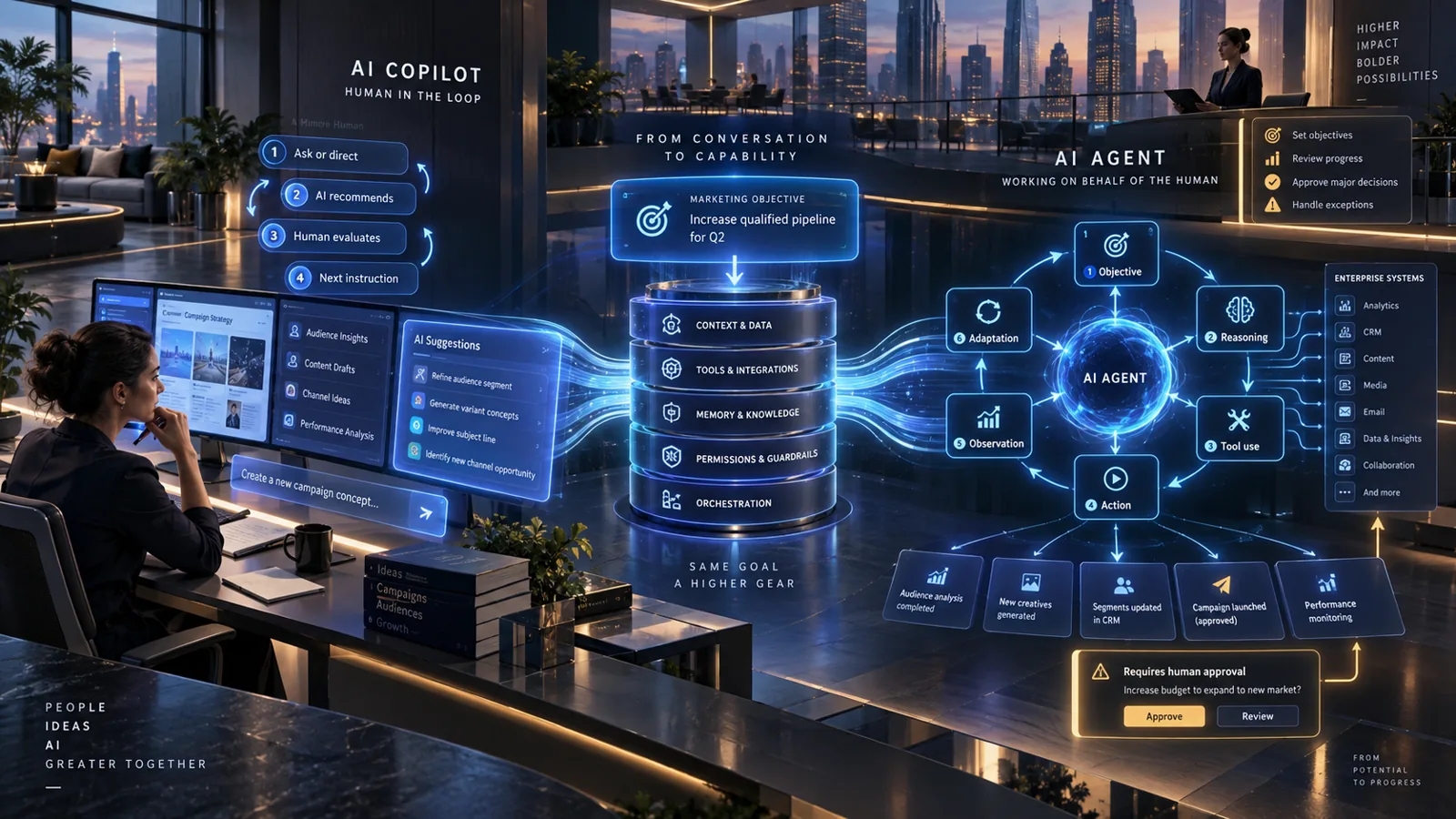
For the first phase of generative AI, the dominant metaphor was the copilot.
The name made sense.
A human remained in control.
AI sat beside them.
The human asked.
AI answered.
The human created.
AI accelerated.
The human decided.
AI assisted.
Now another term is rapidly becoming central to enterprise AI:
agents.
Agents are being positioned as systems that can research, use tools, perform multi-step work, interact with business systems and sometimes operate with significant independence.
That creates an obvious question:
What is actually different?
Is an agent simply a more advanced copilot?
Does a copilot become an agent when it can use tools?
Are agents autonomous while copilots are not?
And for a marketing team, when should you use one rather than the other?
The answer is more nuanced than many comparison charts suggest.
There is no universal technical standard that says every “copilot” must behave one way and every “agent” another. Product terminology increasingly overlaps. Microsoft, for example, now allows specialized agents to operate directly inside Copilot, and describes agents as ranging from simple prompt-and-response systems to more autonomous systems that execute processes on behalf of people or organizations.
So instead of focusing too heavily on branding, focus on the underlying operating model.
A useful distinction is:
A copilot primarily helps a human perform work.
An agent can increasingly be delegated responsibility for performing work.
That difference has major implications for marketing.
What Is an AI Copilot?
An AI copilot is an AI-powered assistant designed to work alongside a human by providing information, generating outputs, analyzing context or helping complete tasks while the human remains the primary driver of the workflow.
Microsoft describes Copilot as an AI assistant that uses large language models to respond to questions and prompts and help users complete tasks more efficiently.
For a marketer, a copilot might help:
- summarize research
- rewrite an email
- analyze a spreadsheet
- generate campaign ideas
- draft social posts
- create presentation content
- summarize meetings
- explain analytics
- brainstorm positioning
The human usually initiates the interaction.
The pattern looks like:
human request → AI assistance → human review → human next step
This can be extremely valuable.
The marketer remains the operator.
The AI increases their leverage.
What Is an AI Agent?
An AI agent is an AI-powered system that can pursue an objective by reasoning about the task, using tools, performing multiple steps, observing results and determining what to do next within defined boundaries.
OpenAI describes agents as systems capable of performing workflows on a user's behalf with a high degree of independence, supported by tools that allow them to retrieve information and take actions in external systems.
Anthropic draws an important architectural distinction between predefined workflows and agents: workflows follow coded paths, while agents can dynamically decide how to use tools and how to accomplish a task.
The operating pattern becomes:
objective → reasoning → tool use → action → observation → next action → result
The human may still be deeply involved.
But they no longer need to initiate every intermediate step.
The Simplest Difference: Assistance vs Delegation
Imagine a marketing leader preparing a competitor analysis.
With a Copilot
The marketer asks:
Summarize these competitor websites.
Then:
Compare their positioning.
Then:
Turn this into a table.
Then:
Suggest implications for our messaging.
AI helps at each stage.
But the human manages the workflow.
With an Agent
The marketer could give a broader objective:
Analyze our five major competitors, identify meaningful positioning changes during the last quarter and flag anything that should influence our enterprise messaging.
An agent could potentially:
- 1identify relevant sources
- 2gather information
- 3compare current and historical messaging
- 4determine meaningful changes
- 5relate them to company positioning
- 6create a prioritized report
- 7escalate the strongest strategic signals
The human manages the objective.
The agent manages more of the process.
That is the core shift.
AI Copilots vs AI Agents: Key Differences
This table is useful, but the boundary is increasingly fluid.
Copilots Can Contain Agents
One reason the terminology is confusing is that copilots and agents are not always competing products.
An agent can operate inside a copilot environment.
Microsoft 365 Copilot is a good example.
Microsoft describes Copilot as the general AI productivity environment, while specialized agents extend it with additional knowledge, actions and automation for particular business workflows. Those agents can access data, execute actions and automate multi-step processes while still surfacing through the Copilot interface.
So the architecture can look like:
Human
↓
Copilot interface
↓
Specialized agent
↓
Enterprise tools and data
This is why saying:
“Copilots are chatbots and agents are autonomous”
is too simplistic.
The better distinction is based on responsibility and execution.
The Real Spectrum of AI Work
Instead of two boxes, think about a spectrum.
Level 1: AI Assistant
AI responds to direct prompts.
Example:
Give me five campaign ideas.
Level 2: Copilot
AI becomes embedded in the human's working environment and assists with context-aware tasks.
Example:
Review this campaign plan and identify weaknesses.
Level 3: Tool-Enabled Copilot
AI can retrieve information or perform actions, but the human still actively directs the workflow.
Example:
Pull last month's campaign data and prepare an analysis.
Level 4: Agent
AI receives an objective and manages multiple steps independently.
Example:
Investigate why enterprise conversion declined.
Level 5: Bounded Autonomous Agent
AI can monitor and execute an extended workflow, escalating only defined exceptions.
Example:
Monitor campaign performance continuously and optimize approved variables within these thresholds.
Real products may sit between these levels.
What matters is not the label.
It is:
How much responsibility has moved from the human to the AI system?
How Copilots Work Best in Marketing
Copilots are particularly powerful when the work benefits from continuous human judgment.
Creative Development
A copywriter can explore:
- hooks
- headlines
- positioning
- alternatives
The human provides taste.
AI provides velocity.
Strategy Development
A strategist may ask a copilot to:
- challenge assumptions
- summarize research
- compare alternatives
- structure frameworks
But the strategist still determines direction.
Executive Analysis
A CMO can use a copilot to interpret reports, ask follow-up questions and explore scenarios.
Writing and Editing
AI can operate as:
- first-draft partner
- editor
- research assistant
- summarizer
The user stays close to the output.
This is a feature, not a limitation.
For ambiguous, creative or politically sensitive work, continuous human participation can be desirable.
How Agents Work Best in Marketing
Agents become more valuable when the work can be delegated as a bounded responsibility.
Continuous Market Monitoring
Instead of repeatedly asking for competitor research, an agent can monitor changes and surface only meaningful developments.
Campaign Diagnosis
Instead of manually checking five dashboards, an agent can investigate anomalies across connected systems.
Content Operations
An agentic workflow can potentially:
research → create brief → prepare draft → check requirements → route for review.
CRM and Lifecycle Work
Agents can interpret customer context and determine which approved workflow or intervention makes sense.
SEO and GEO Monitoring
An agent can continuously track:
- search performance
- topic gaps
- entity coverage
- AI-search visibility
Experimentation
An agent can identify opportunities, prepare experiments, monitor results and store learning.
One Important Difference: Agents Operate on the Environment
A copilot primarily changes what the human knows or creates.
An agent can increasingly change what the surrounding system does.
This is why tools are so important.
OpenAI divides agent tools into categories such as tools for retrieving data and tools that perform actions—for example, querying a CRM versus updating a CRM record or sending a message.
That distinction dramatically increases both capability and risk.
A copilot suggesting:
Reduce the campaign budget.
is different from an agent actually changing the budget.
Once AI has write access, marketing governance changes.
Agents Need Stronger Guardrails
Greater autonomy requires stronger boundaries.
An agent may technically be able to:
- publish content
- modify CRM data
- email customers
- change advertising
- update records
That does not mean it should have unrestricted permission.
OpenAI's guidance emphasizes that agents capable of planning and acting across multiple tools require explicit guardrails, access controls and human oversight. High-risk or irreversible actions are especially appropriate triggers for human intervention.
In marketing, that might mean:
Agent Can Execute Automatically
- analyze performance
- classify feedback
- monitor competitor changes
- prepare reports
Agent Can Execute Within Limits
- update CRM fields
- schedule approved assets
- make small optimization adjustments
Human Approval Required
- launch a major campaign
- publish a new brand claim
- significantly increase ad spend
- communicate with sensitive customer groups
Human Owned
- brand strategy
- market entry
- crisis response
- major positioning
The more agentic the system becomes, the more important decision rights become.

Copilot vs Agent Example: Content Marketing
The difference becomes especially clear when we examine one workflow.
Copilot Model
The content strategist asks:
What topics should we cover?
AI suggests topics.
The strategist selects one.
The strategist asks:
Build the outline.
AI creates an outline.
The strategist asks:
Write the article.
AI creates a draft.
The strategist reviews it.
The marketer remains the workflow orchestrator.
Agent Model
The agent receives:
Build the highest-priority content asset for enterprise buyers this week based on our current business priorities.
It could potentially:
- inspect customer questions
- review search demand
- analyze existing content
- identify gaps
- consult product priorities
- choose an opportunity
- prepare the brief
- create a draft
- run defined quality checks
- present the finished asset for human approval
The human's involvement becomes more concentrated around direction and quality.
Copilot vs Agent Example: Marketing Analytics
Copilot
The analyst opens analytics and asks:
Explain why conversion dropped last week.
The copilot helps analyze the data.
Agent
The performance agent continuously watches conversion.
When it detects an unusual decline, it independently investigates:
- acquisition mix
- landing pages
- conversion funnels
- campaign changes
- audience differences
Then it surfaces:
What changed
Likely cause
Estimated business impact
Recommended response
The difference is persistence and initiative.
The copilot waits to be asked.
The agent can be assigned responsibility for watching.
Copilot vs Agent Example: Campaign Execution
Copilot
A marketer asks AI to:
- write ads
- create campaign structure
- suggest audiences
The marketer launches everything.
Agent
A campaign agent can potentially:
- receive the approved objective
- gather customer context
- coordinate creative preparation
- configure approved campaign components
- trigger deterministic workflows
- monitor results
- escalate anomalies
Again:
copilot = work with me
agent = handle this for me within these rules
Will AI Agents Replace Copilots?
Probably not.
In many cases, the two models will converge.
The user-facing environment may remain a copilot.
Behind it, multiple agents may perform specialized work.
Microsoft's current architecture already points in this direction: Copilot functions as an AI productivity surface while agents bring specialized organizational knowledge, actions and workflow capabilities into that environment.
The future interaction may therefore look like:
Human → Copilot → Agent Network → Enterprise Systems
A marketing leader might work through one conversational environment while dozens of specialized capabilities operate beneath it.
That is much cleaner than managing dozens of separate AI tools.
Which Should Marketing Teams Use?
The answer depends on the work.
Use a Copilot When:
- human judgment should remain continuous
- exploration matters
- the task is creative
- the user wants iterative discussion
- the workflow changes through conversation
- delegation adds little value
Use an Agent When:
- the outcome is clearly defined
- the workflow requires several steps
- tools need to be used
- conditions may change
- monitoring should be continuous
- human coordination is currently expensive
Use Automation When:
- the process is predictable
- no model reasoning is required
- reliability and consistency matter most
This gives us three distinct operating modes:
Copilot → collaborate
Agent → delegate
Automation → execute rules
Advanced marketing systems need all three.
Where Copilots and Agents Fit Into the AI CMO
The AI CMO can combine these modes into one operating model.
Human Leadership
Determines strategy.
↓
Copilot Layer
Provides an interactive interface for:
- questions
- analysis
- creative collaboration
- decision exploration
↓
Agent Layer
Owns bounded responsibilities such as:
- research
- campaigns
- customer intelligence
- analytics
- lifecycle
↓
Automation Layer
Executes predictable tasks.
↓
Enterprise Systems
CRM, CMS, advertising, analytics and other MarTech.
This architecture solves an important problem.
Marketing leaders do not need to choose:
human interaction or autonomy.
They can use both.
Copilots Change Productivity. Agents Change Operating Models.
This may ultimately be the most important distinction.
Copilots primarily increase individual leverage.
A marketer can:
- research faster
- write faster
- analyze faster
- think faster
Agents have the potential to increase organizational leverage.
Entire responsibilities can become persistent.
Research no longer happens only when someone asks.
Performance monitoring no longer happens only when someone opens a dashboard.
Campaign preparation no longer requires every handoff to be manually coordinated.
This is why agents may have a larger impact on organization design than copilots.
Copilots change how individuals work.
Agents can change how work flows through the company.
The Human Role Moves From Operator to Director
The evolution can be summarized through four stages.
Stage 1 — Creator
Human produces the work.
Stage 2 — Copilot User
Human produces with AI assistance.
Stage 3 — Agent Director
Human defines outcomes while AI executes larger assignments.
Stage 4 — System Orchestrator
Human manages a portfolio of agents, workflows and decision rights.
This does not mean every marketer reaches Stage 4.
Many tasks should remain highly collaborative.
But the direction changes the skills marketers need.
Knowing how to write a good prompt remains useful.
Knowing how to define:
- objectives
- context
- permissions
- success criteria
- escalation
becomes even more important.
The Wrong Question Is “Which Is Better?”
An agent is not automatically more advanced in a useful sense.
Autonomy introduces complexity.
Anthropic explicitly recommends choosing the simplest architecture that works, noting that agents are appropriate when flexible decision-making is required but can introduce additional cost and the possibility of compounding errors.
Sometimes a copilot is exactly what you want.
Sometimes deterministic automation is better than either.
Technology design should follow the problem.
Not the hype cycle.
Conclusion
AI copilots and AI agents represent two different relationships between humans and artificial intelligence.
A copilot primarily helps a person perform work.
An agent can increasingly be delegated responsibility for performing work.
The practical distinction is:
Copilot:“Help me do this.”
Agent:“Handle this objective within these boundaries.”
Copilots are ideal when:
- collaboration
- creativity
- exploration
- human judgment
should remain continuous.
Agents become more useful when:
- work is multi-step
- tools are required
- monitoring must persist
- the path cannot always be predetermined
- human coordination can be reduced
And traditional automation remains superior when predictable rules are sufficient.
The future marketing organization will therefore not be built around a choice between copilots and agents.
It will combine them.
Humans define strategy.
Copilots help humans think.
Agents take on bounded responsibilities.
Automation executes predictable processes.
Governance controls the entire system.
That combination is what turns AI from an assistant into an operating model.
FAQs
1. What is the difference between an AI copilot and an AI agent?
An AI copilot primarily assists a human performing work, while an AI agent can be delegated an objective and independently perform multiple steps or actions toward completing it.
2. Is an AI copilot the same as an AI assistant?
The terms often overlap. A copilot usually describes an AI assistant embedded more deeply into the user's workflow or applications, where it provides context-aware help while the human remains in control.
3. Can a copilot contain AI agents?
Yes. Modern enterprise architectures increasingly allow specialized agents to operate through a copilot interface. Microsoft 365 Copilot, for example, supports agents that add specialized knowledge and workflow actions.
4. Are AI agents fully autonomous?
Not necessarily. Agents exist on a spectrum. Some primarily assist, while others independently perform extended workflows. Their authority should be limited through permissions, guardrails and human approval requirements.
5. When should marketers use a copilot?
Copilots are useful for creative collaboration, writing, analysis, strategy exploration and tasks where continuous human judgment improves the result.
6. When should marketers use AI agents?
Agents are most useful for bounded multi-step responsibilities such as research, campaign monitoring, competitive intelligence, lifecycle analysis or workflow coordination.
7. Are AI agents better than copilots?
Not inherently. Agents introduce more autonomy and complexity. A copilot may be better for collaborative work, while automation may be better for predictable processes.
8. How do copilots and agents fit into an AI CMO?
A copilot can provide the conversational interface through which marketing leaders interact with an AI CMO, while specialized agents perform research, analysis, campaign and operational work underneath that interface.