One Campaign, Multiple Agents: How Multi-Agent Marketing Workflows Actually Work
Instead of using one general-purpose assistant for every part of a campaign, an organization can assign different responsibilities to specialized agents and let them coordinate through an…
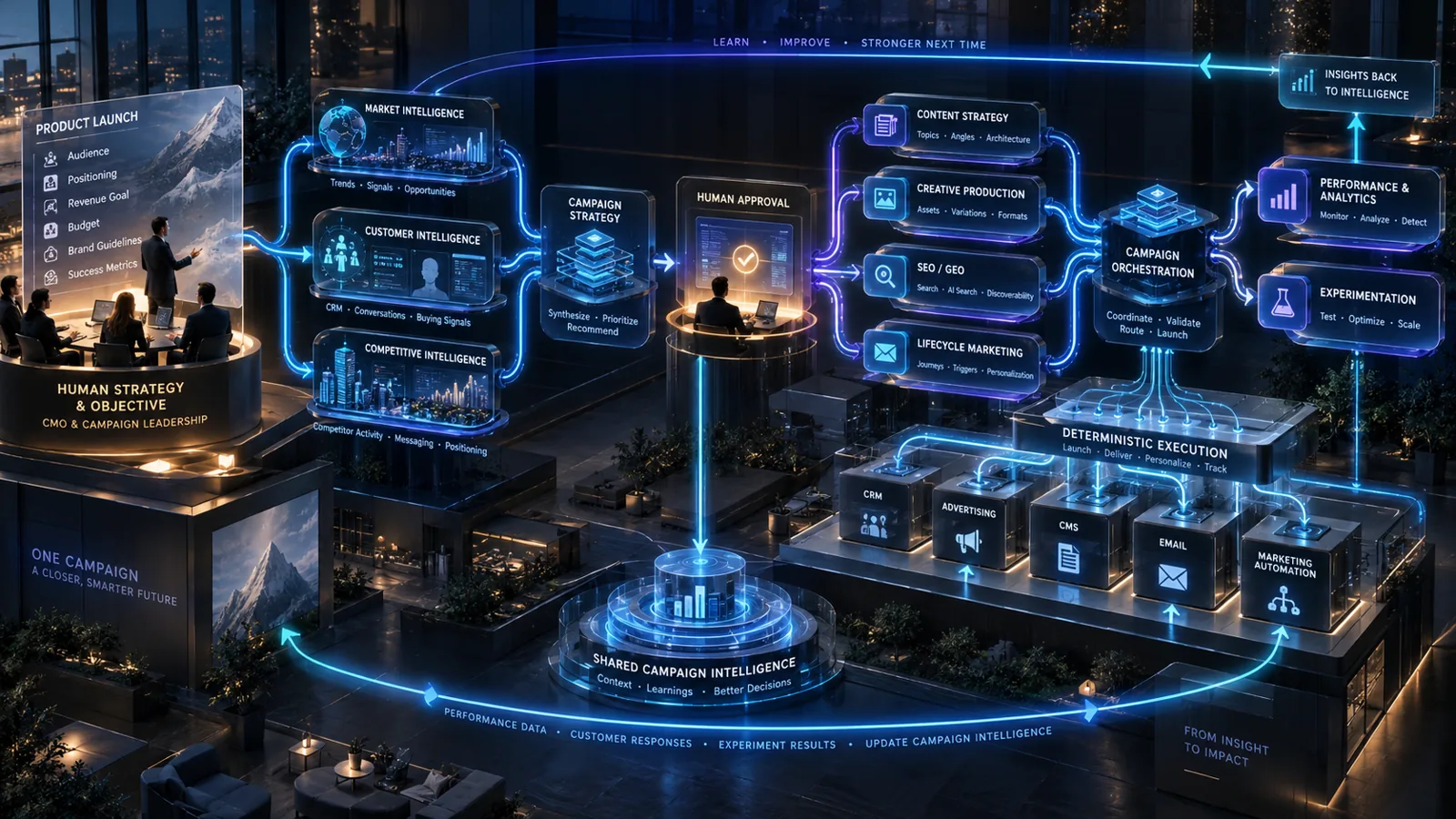
One campaign can involve an extraordinary amount of coordination.
Research the market.
Understand the customer.
Review competitors.
Choose the message.
Create the campaign.
Write the content.
Build the landing page.
Configure the audience.
Launch across channels.
Monitor performance.
Investigate what changes.
Run experiments.
Report the results.
Today, humans connect most of those steps.
A strategist briefs a content marketer.
The content marketer briefs creative.
Creative hands work to the campaign manager.
The campaign manager coordinates marketing operations.
An analyst eventually reviews performance.
Every specialist may be excellent.
The campaign still depends on a large amount of human orchestration.
AI agents introduce another possibility.
Instead of using one general-purpose assistant for every part of a campaign, an organization can assign different responsibilities to specialized agents and let them coordinate through an orchestration layer.
One agent researches the market.
Another analyzes customers.
Another builds the content strategy.
Another prepares creative.
Another coordinates launch.
Another monitors performance.
The campaign becomes the shared objective connecting them.
That is the essence of multi-agent marketing.
And it is very different from simply having ten chatbots.
What Is Multi-Agent Marketing?
Multi-agent marketing is an operating model in which multiple specialized AI agents collaborate, execute in parallel or sequentially, exchange information, and coordinate around shared marketing objectives.
Each agent can have:
- a specific responsibility
- access to specific tools
- relevant context
- defined permissions
- its own evaluation criteria
An orchestration layer determines how their work fits together.
Microsoft's current Agent Framework explicitly supports several multi-agent patterns, including sequential, concurrent, handoff, group-chat, and manager-led orchestration in which one coordinating agent dynamically directs specialized agents.
That technical architecture maps naturally onto marketing.
Some campaign tasks should happen sequentially.
Others can run in parallel.
Some require a specialist handoff.
Some require a human decision before anything continues.
The challenge is designing those relationships deliberately.
Why Use Multiple Agents Instead of One?
A sufficiently capable general-purpose agent can perform many tasks.
So why create several?
The answer is specialization.
Anthropic's 2026 guidance on multi-agent systems highlights three scenarios where multi-agent designs are especially useful: specialization, parallel execution, and context isolation. It also warns that multi-agent architecture is frequently over-applied when simpler designs would work.
That principle is critical for marketing.
Multiple agents make sense when different parts of the campaign require meaningfully different:
- context
- tools
- permissions
- expertise
- timing
For example, the agent analyzing customer conversations may need broad read access to CRM and support data.
The creative agent may need brand memory and campaign strategy.
The campaign execution agent may need write access to marketing systems.
Those should not necessarily be the same software responsibility.
The Campaign Becomes the Unit of Work
Traditional AI usage often starts with the task.
Write an email.
Analyze this report.
Find competitors.
Multi-agent marketing starts higher.
Launch our new enterprise product to financial-services buyers.
That objective can then be decomposed.
The campaign becomes the unit of work.
Agents become specialized capabilities underneath it.
This is one reason agentic AI could change organizational productivity significantly. OpenAI describes the broader shift in agentic knowledge work as moving from isolated interactions toward delegated, longer-horizon tasks in which agents coordinate tool calls and iterate toward outcomes.
Marketing campaigns are natural examples of those longer-horizon workflows.
A Multi-Agent Marketing Campaign From Start to Finish
Consider a hypothetical SaaS company launching a new AI-powered finance product.
The objective is:
Generate qualified enterprise pipeline among CFO and finance-operations teams while maintaining premium positioning.
A multi-agent workflow might involve eight specialized agents.
Agent 1: Market Intelligence Agent
Responsibility: Understand the market environment.
Before campaign strategy begins, this agent investigates:
- market trends
- regulatory developments
- category narratives
- new customer concerns
- relevant industry changes
Its output might be:
Automation is no longer the primary differentiator in this category. Enterprise buyers are increasingly focused on governance, auditability, and implementation risk.
That signal becomes context for later agents.
Agent 2: Customer Intelligence Agent
Responsibility: Understand the buyer.
In parallel, another agent analyzes:
- CRM data
- customer interviews
- sales conversations
- support tickets
- survey responses
It identifies:
- recurring pain points
- customer language
- objections
- buying triggers
- segment differences
Its conclusion might be:
Mid-market finance teams care most about speed. Enterprise buyers care more about control and auditability.
Now the campaign has more precise customer context.
Agent 3: Competitive Intelligence Agent
Responsibility: Understand how alternatives are positioned.
This agent reviews:
- competitor websites
- product announcements
- campaign themes
- search positioning
- messaging changes
It might determine:
Most competitors lead with productivity. Few strongly own governance.
The three research agents can operate concurrently because their work does not necessarily depend on one another.
This is a classic multi-agent pattern.
Microsoft's Agent Framework supports concurrent orchestration specifically for tasks that can be executed independently and later combined.
Agent 4: Campaign Strategy Agent
Now the outputs converge.
The Strategy Agent receives:
Market Intelligence
Customer Intelligence
Competitive Intelligence
Brand Context
Business Objective
Its job is not simply to summarize them.
It needs to propose a campaign direction.
For example:
Strategic Opportunity
Position the product around AI speed with enterprise control.
Primary Audience
Enterprise finance operations leaders.
Core Message
Gain the efficiency of autonomous finance workflows without sacrificing visibility or governance.
Campaign Goal
Generate enterprise demonstrations.
Recommended Channels
- thought leadership
- search
- lifecycle
- targeted paid campaigns
At this stage, the organization reaches an important decision.
The system should not necessarily continue automatically.
Human Approval Gate 1: Strategy
A human marketing leader reviews:
- positioning
- audience
- campaign objective
- message
- budget
Why?
Because these decisions shape the brand and allocate resources.
The agents have done significant preparation.
The human retains strategic authority.
This is an example of human-in-the-loop orchestration. Microsoft's multi-agent framework explicitly supports approval-required actions that pause a workflow for human review.
Once approved, the campaign continues.
Agent 5: Content Strategy Agent
The Content Strategy Agent translates the campaign strategy into an information architecture.
It determines:
- what questions buyers need answered
- which content already exists
- which content gaps matter
- what format fits each stage
It might propose:
Awareness
Executive article:
Why Autonomous Finance Needs Governance
Consideration
Guide:
The Enterprise Framework for AI-Controlled Finance Operations
Evaluation
Product comparison page.
Conversion
Enterprise demo landing page.
This agent owns the content system, not necessarily final creative execution.
Agent 6: Creative Production Agent
The Creative Agent receives:
- approved campaign strategy
- content architecture
- brand guidelines
- customer language
- product facts
It can prepare:
- advertising copy
- social creative
- landing-page drafts
- emails
- article briefs
- campaign visuals
This specialization matters.
The research agents do not need publishing privileges.
The creative agent does not need unrestricted access to customer records.
Each responsibility receives the context it actually needs.
That is one benefit of multi-agent design.
Agent 7: Campaign Orchestration Agent
This is where everything comes together operationally.
The Campaign Agent determines:
- what assets are ready
- which channels need them
- audience dependencies
- launch timing
- required approvals
- measurement requirements
- automation sequences
It might coordinate:
Content Agent
↓
Creative Review
↓
SEO/GEO Check
↓
Landing Page
↓
Paid Campaign Setup
↓
Lifecycle Campaign
↓
Launch
This is the digital equivalent of campaign management.
But the human no longer has to manually coordinate every transfer.
Human Approval Gate 2: High-Impact Creative
Certain assets should pause.
For example:
- main campaign positioning
- homepage changes
- major paid creative
- public product claims
Humans review.
Routine variants may proceed without the same degree of intervention.
This creates graduated autonomy rather than one blanket approval policy.
Agent 8: Performance & Optimization Agent
After launch, another agent assumes responsibility.
It monitors:
- traffic
- engagement
- qualified leads
- conversion
- audience performance
- channel performance
- campaign cost
- downstream pipeline signals
Its job is not to produce a daily report.
Its job is to identify meaningful changes.
Suppose it detects:
Campaign engagement is strong, but enterprise demo conversion is significantly below expectation.
The agent investigates.
It finds:
- ad click-through is healthy
- audience quality is strong
- landing-page exit rate is unusually high
- customers appear to be searching for implementation information
The agent proposes:
Add implementation and governance proof higher on the landing page and test against the existing version.
This becomes the next action.
The campaign has now entered a continuous optimization loop.
Microsoft's current Customer Insights roadmap already describes this broader direction: its Journey Creation Agent can help build campaign experiences while an Outreach Optimization Agent adjusts communication timing and follow-ups using real-time engagement signals.
The specific implementation varies.
The architectural direction is clear.
Multi-Agent Marketing Is About Handoffs
The key innovation is not that several models are running.
It is that work can move between specialized AI responsibilities without requiring humans to manually reconstruct the entire context every time.
A good handoff contains the information needed by the next agent.
For example:
Research → Strategy
Send:
- validated findings
- relevant evidence
- confidence
- unresolved questions
Do not simply send every research document.
Strategy → Creative
Send:
- objective
- audience
- approved positioning
- messaging hierarchy
- constraints
Creative → Campaign
Send:
- approved assets
- audience mapping
- channel requirements
- status
Campaign → Analytics
Send:
- campaign objective
- success metrics
- launch changes
- test conditions
The quality of the handoff determines the quality of the downstream system.
Shared Context Does Not Mean Infinite Context
A common multi-agent mistake is giving every agent every piece of information.
That creates noise.
The better model combines:
shared organizational context
with:
role-specific context.
Every agent may understand:
- brand
- product
- business objectives
But only the customer agent needs detailed customer conversation data.
Only the performance agent may need full campaign analytics.
Anthropic's multi-agent work emphasizes context isolation as one of the areas where specialized agent systems can be valuable.
The goal is not maximum context.
It is the right context at the right stage.
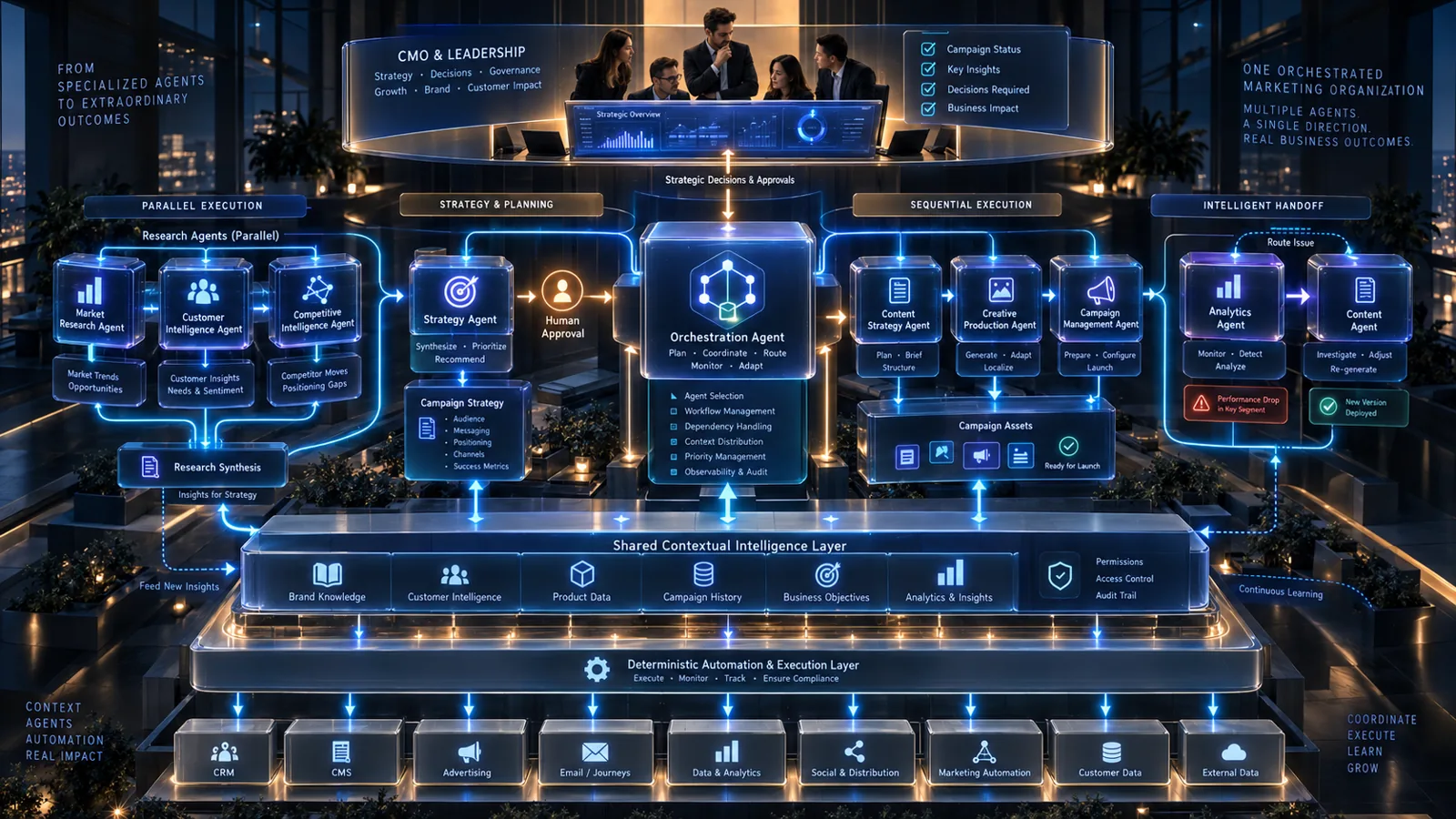
Five Multi-Agent Orchestration Patterns for Marketing
Marketing workflows do not all need the same architecture.
1. Sequential
Agents work one after another.
Example:
Research → Strategy → Content → Creative → Campaign.
This works when each stage depends on the previous one.
2. Parallel
Several agents operate simultaneously.
Example:
Market Research + Customer Research + Competitive Research.
This reduces campaign preparation time.
3. Handoff
One agent determines that another specialist is needed and transfers responsibility.
Example:
Performance Agent detects a content problem and hands the issue to the Content Agent.
4. Manager / Orchestrator
A central agent coordinates the workflow.
Example:
Campaign Orchestration Agent assigns work to research, creative, lifecycle, and analytics agents.
5. Human-Gated
The agent system pauses at defined points.
Example:
Strategy approved by CMO before creative production begins.
Microsoft's current orchestration framework supports all of these broad patterns, including sequential, concurrent, handoff, group collaboration, and manager-driven orchestration.
The architecture should match the workflow.
Multi-Agent Does Not Mean Everything Must Be Agentic
This is critical.
A campaign may contain:
agents
for reasoning,
automation
for predictable execution,
and:
humans
for consequential decisions.
For example:
Agent
Determine which customer segment requires attention.
Automation
Update an approved CRM field.
Agent
Generate a campaign recommendation.
Human
Approve the new positioning.
Automation
Publish approved assets at the scheduled time.
Multi-agent marketing works best when agents are used selectively.
Not when every technical step is turned into another reasoning system.
What Can Go Wrong?
Multi-agent marketing introduces real complexity.
1. Conflicting Recommendations
The Growth Agent wants aggressive expansion.
The Brand Agent wants consistency.
Who wins?
The system needs clear priorities.
2. Context Degradation
Every handoff can lose information.
Structured handoffs matter.
3. Agent Loops
Agents can bounce work between themselves without reaching resolution.
Orchestration needs termination conditions.
4. Permission Sprawl
If every agent can access every system, governance becomes dangerous.
Microsoft's architecture guidance emphasizes principles such as least privilege, auditability, simplicity, and explicit governance for multi-agent systems.
5. Compounding Errors
A bad research conclusion can influence:
strategy → creative → campaign.
Errors propagate.
Critical intermediate outputs need evaluation.
6. Digital Bureaucracy
The organization can recreate human bureaucracy with software.
Five unnecessary agent handoffs are not better than five unnecessary human handoffs.
Anthropic's recent research explicitly cautions that real-world multi-agent systems introduce new coordination problems and that agent-agent interactions create governance challenges of their own.
The objective remains:
reduce complexity.
Not digitize it.
How Many Agents Should One Campaign Use?
There is no correct number.
The answer depends on:
- complexity
- specialization
- tool requirements
- context size
- risk
- parallelism
A simple social campaign might need:
one capable agent + automation.
A global product launch might justify several specialized agents.
Do not start with the org chart.
Start with the workflow.
Ask:
Does separating this responsibility improve reliability, specialization, security, or speed?
If not, keep it together.
What the Human Campaign Manager Becomes
This operating model changes the campaign manager's job.
Today they may spend significant time:
- requesting updates
- chasing assets
- transferring context
- scheduling meetings
- updating project boards
In a mature multi-agent model, more of this coordination moves underneath the system.
The human campaign leader increasingly manages:
- outcome
- strategy
- standards
- priorities
- exceptions
The job changes from:
coordinate tasks
to:
direct the campaign system.
That is a much higher-leverage role.
Multi-Agent Marketing Inside the AI CMO
This is where the concept connects directly to the AI CMO.
The architecture becomes:
Human CMO
defines strategy.
↓
AI CMO Orchestration Layer
translates strategy into campaigns.
↓
Specialized Marketing Agents
research, create, execute, monitor, optimize.
↓
Automation and MarTech
perform predictable actions.
↓
Decision Intelligence
returns meaningful changes upward.
Multi-agent campaigns are therefore not separate from the AI CMO.
They are one of the primary ways the AI CMO can execute work.
What Companies Should Build First
Do not begin by trying to automate the entire campaign lifecycle.
Choose one coordination-heavy workflow.
For example:
content campaign creation.
Then:
Step 1
Map the existing workflow.
Step 2
Identify which stages genuinely require separate capabilities.
Step 3
Define shared context.
Step 4
Define structured outputs for every handoff.
Step 5
Define tool permissions.
Step 6
Insert human approvals where consequence is high.
Step 7
Create evaluations for important intermediate stages.
Step 8
Track whether the new architecture actually reduces cycle time and coordination.
Only expand when the first workflow works reliably.
The Future Campaign May Behave More Like a Software System
A traditional campaign is a project.
A future campaign may increasingly behave like an active operating system.
It can:
- monitor the market
- observe customer responses
- generate variations
- adapt timing
- investigate anomalies
- propose experiments
- update the next action
Microsoft's 2026 Customer Insights direction already describes customer journeys that can adapt based on engagement and agents that optimize outreach continuously in the background.
The implications extend beyond personalization.
Campaigns themselves may become more persistent and adaptive.
That is a major departure from:
plan → launch → report.
The model becomes:
plan → launch → observe → reason → adapt → learn.
One Campaign, One Objective, Many Capabilities
This is perhaps the simplest way to understand multi-agent marketing.
Do not imagine ten artificial employees independently running around marketing.
Imagine one business objective.
Around that objective sit several specialized capabilities.
Market intelligence understands the environment.
Customer intelligence understands the buyer.
Strategy determines the campaign logic.
Content creates the information architecture.
Creative creates assets.
Campaign orchestration coordinates execution.
Lifecycle adapts communication.
Analytics interprets performance.
Experimentation improves the system.
Human leadership remains responsible for direction.
That is the architecture.
Conclusion
Multi-agent marketing is not about maximizing the number of AI agents inside a marketing department.
It is about reducing the amount of human coordination required to move from strategy to outcome.
A single campaign can increasingly be supported by specialized agents responsible for:
- market intelligence
- customer intelligence
- competitive research
- strategy
- content
- creative
- campaign orchestration
- performance
- experimentation
Some work happens sequentially.
Some happens in parallel.
Some is handed between specialists.
Some pauses for human approval.
Some executes automatically.
The intelligence is distributed.
The objective is shared.
The workflow is orchestrated.
That combination is what turns a collection of AI agents into a functioning marketing system.
The future campaign manager may therefore not spend most of their time chasing tasks through an organization.
They may define the objective, establish the boundaries, and supervise an intelligent workflow operating underneath them.
One campaign.
Multiple agents.
One coordinated system.
That is where agentic marketing begins to look less like a collection of AI tools—and more like a new operating model for marketing itself.
FAQs
1. What is multi-agent marketing?
Multi-agent marketing uses several specialized AI agents that collaborate, execute in parallel or sequence, and hand work between one another to accomplish shared marketing objectives.
2. Why use multiple AI agents instead of one marketing agent?
Multiple agents can be useful when different parts of the workflow require specialized context, tools, permissions, or parallel execution. Simpler campaigns may still be better handled by a single agent.
3. What agents could work together on one campaign?
A campaign might involve market-intelligence, customer-intelligence, competitive-research, strategy, content, creative, campaign-orchestration, lifecycle, analytics, and experimentation agents.
4. What is AI agent orchestration?
Agent orchestration is the system that determines which agents act, whether they work sequentially or concurrently, what information is handed between them, and when human approval is required.
5. Do multi-agent marketing campaigns need human approval?
Yes, for consequential decisions. Strategy, major creative, significant budget changes, sensitive communications, and important brand decisions should generally retain strong human oversight.
6. Can several AI agents work simultaneously?
Yes. Parallel orchestration allows independent tasks such as market research, customer analysis, and competitor research to occur concurrently before their outputs are combined.
7. What are the risks of multi-agent marketing systems?
Risks include conflicting recommendations, lost context, permission sprawl, compounding errors, unnecessary agent loops, and additional coordination complexity.
8. How should a company start building a multi-agent marketing workflow?
Start with one high-value campaign workflow, identify genuinely distinct responsibilities, define shared context and handoffs, assign minimum necessary permissions, insert human approval gates, and evaluate whether the system improves speed, quality, and business outcomes.