What Are AI Marketing Agents? A Complete Guide to How They Work, What They Do, and Why They Matter
And it is not simply an automated workflow with AI-generated copy inserted into it.
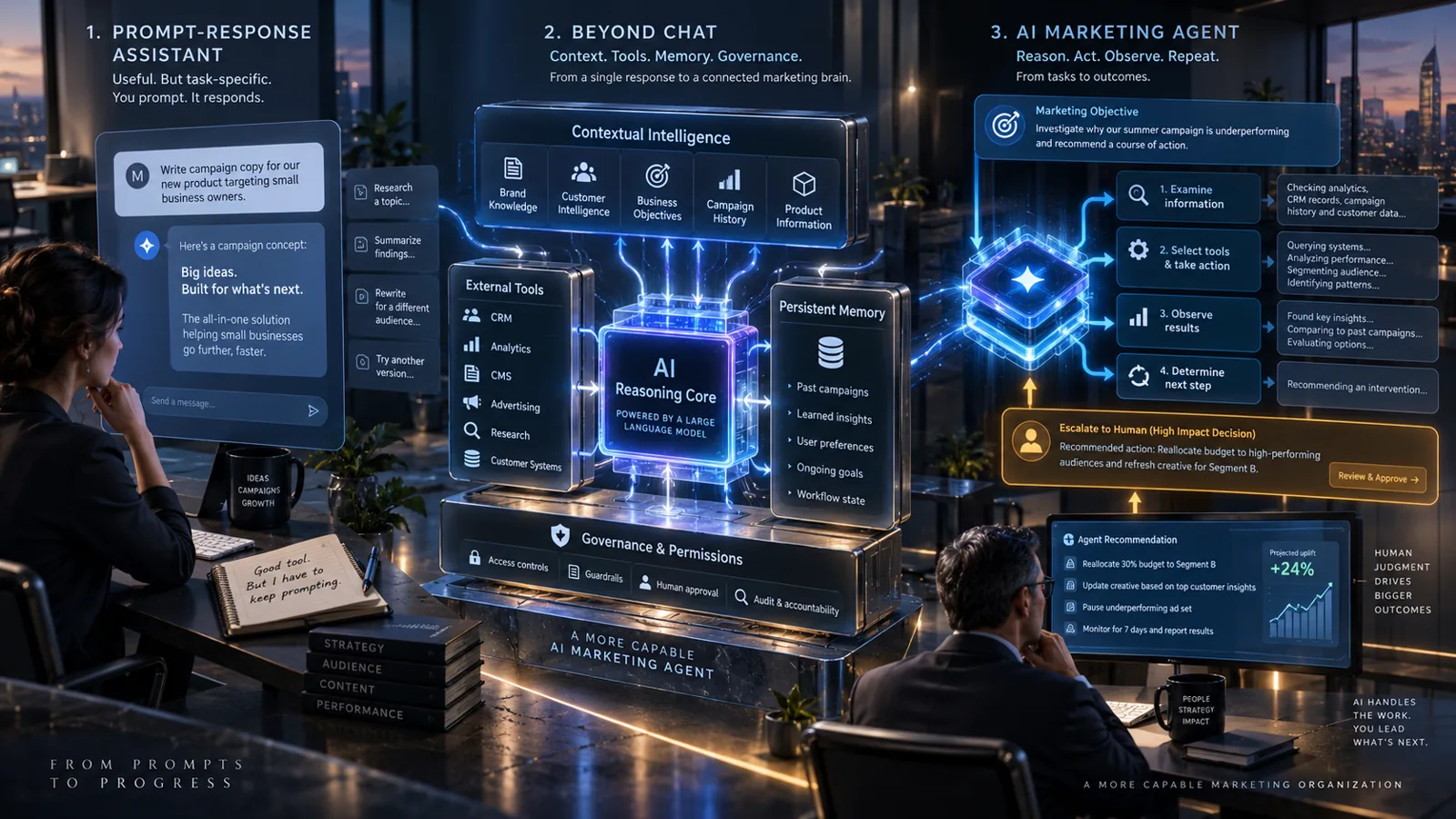
Marketing's first experience with generative AI was mostly conversational.
Ask a question.
Get an answer.
Write a prompt.
Receive a draft.
Ask for ten campaign ideas.
Generate ten campaign ideas.
That alone was a major change.
But AI is beginning to move beyond responding.
Increasingly, AI systems can also:
- retrieve information
- use software tools
- inspect data
- complete multiple steps
- make bounded decisions
- hand work to other agents
- monitor outcomes
- adjust what they do next
This is where AI marketing agents enter the picture.
An AI marketing agent is not simply another name for ChatGPT.
It is not necessarily a humanoid digital employee.
And it is not simply an automated workflow with AI-generated copy inserted into it.
The important distinction is that an agent can potentially be given an objective rather than every individual instruction required to complete the work.
That changes what AI can do inside a marketing organization.
What Is an AI Marketing Agent?
An AI marketing agent is an AI-powered software system that can pursue a defined marketing goal by interpreting context, reasoning about what to do, using connected tools, performing multi-step tasks, and adapting its actions within established permissions.
Google Cloud defines AI agents more broadly as software systems that use AI to pursue goals and complete tasks on behalf of users, with capabilities that can include reasoning, planning, memory, decision-making and adaptation.
Applied to marketing, that means an agent could potentially do more than create an output.
It might:
- 1understand a marketing objective
- 2gather relevant information
- 3select appropriate tools
- 4perform several related actions
- 5inspect what happened
- 6determine the next step
- 7escalate to a human when needed
That loop is what makes the concept interesting.
A Simple Example
Imagine asking an AI assistant:
Write three email subject lines for our webinar.
The assistant writes three subject lines.
Useful.
Now imagine giving an AI marketing agent this objective:
Improve registrations for next week's enterprise webinar without increasing the paid-media budget.
A capable agentic workflow might:
- inspect registration performance
- compare traffic sources
- analyze prior email engagement
- review the landing page
- identify underperforming audience segments
- examine previous webinar campaigns
- propose new email variants
- prepare landing-page changes
- recommend campaign adjustments
- monitor the results after approved changes go live
The difference is not simply that the second system uses better AI.
The difference is that it owns more of the workflow.
What Makes an AI Agent Different From a Chatbot?
This is one of the most important distinctions.
A chatbot generally responds.
An agent can potentially act.
A chatbot interaction often looks like:
prompt → response
An agentic interaction can look more like:
goal → plan → tool use → action → observation → next action → result
Anthropic describes the basic building block of an agentic system as an augmented large language model connected to capabilities such as retrieval, tools and memory. It also draws a distinction between fixed workflows and agents that dynamically direct their own process and tool use.
That does not mean every AI application using tools is automatically a sophisticated autonomous agent.
Agentic capability exists on a spectrum.
But a useful practical test is:
Does the system merely provide information, or can it also decide and perform meaningful next steps toward an objective?
What Makes an AI Marketing Agent Different From Marketing Automation?
Marketing automation has existed for decades.
Suppose:
IF a prospect downloads a guideTHEN send email sequence A.
That is automation.
The logic is predetermined.
Now imagine:
Determine the most appropriate next interaction for this prospect based on their behavior, company profile, engagement history and active campaigns.
An agent might inspect several inputs before choosing between:
- an educational email
- a case study
- sales outreach
- another nurture path
- no communication yet
Traditional automation usually asks:
Which configured rule has been triggered?
An agent asks:
Given this objective and context, what action makes the most sense?
Google Cloud describes agentic workflows in similar terms: instead of rigid predefined paths, agents use reasoning, planning and tools to execute complex tasks and adjust their actions as conditions change.
The Five Building Blocks of an AI Marketing Agent
An AI marketing agent generally requires more than one AI model.
A useful architecture includes five major components.
1. The Model
A large language model provides reasoning and language capability.
It may help the agent:
- understand instructions
- interpret information
- compare alternatives
- select actions
- generate outputs
The model is important.
But it is only the reasoning engine.
2. Context
The agent needs relevant information about the company and task.
For marketing, context could include:
- brand positioning
- product information
- target customers
- campaign history
- CRM data
- analytics
- content libraries
- market research
- approved claims
- business objectives
Without context, even an advanced model may produce generic recommendations.
3. Tools
Tools allow the agent to interact with the outside world.
These might include:
- web search
- CRM
- analytics
- CMS
- email platform
- advertising platform
- customer database
- spreadsheets
- internal knowledge systems
Google describes tool calling as the mechanism that allows agents to move beyond static model knowledge and interact with live systems and external applications.
OpenAI's current production-agent materials similarly emphasize tools, routing, handoffs, guardrails, tracing and evaluation as core components of real agent systems.
4. Memory
Some workflows benefit from persistent memory.
An agent may need to remember:
- what happened previously
- which campaign changes were made
- what a customer prefers
- which experiments already failed
- which recommendations were approved
Google Cloud distinguishes between short-term model context and longer-term persistent agent memory for stateful work that spans sessions.
5. Guardrails and Permissions
An agent should not automatically be allowed to do everything its connected tools technically permit.
The system needs boundaries.
For example:
An analytics agent may be allowed to read performance data.
It may not be allowed to change advertising budgets.
A content agent may create drafts.
It may need approval before publishing them.
OpenAI's business guidance emphasizes guardrails precisely because agents can plan, adapt and act across tools. These controls can restrict data sources, require confirmation before consequential actions and create auditability.
How Do AI Marketing Agents Work?
A simplified agent loop looks like this:
Step 1: Receive an Objective
For example:
Identify the most important content opportunities for our enterprise cybersecurity audience this month.
Step 2: Gather Context
The agent retrieves:
- business priorities
- audience information
- existing content
- search data
- customer questions
Step 3: Plan
It determines what information it needs and how to gather it.
Step 4: Use Tools
It may search internal documents, inspect analytics or perform research.
Step 5: Reason
It compares evidence and prioritizes opportunities.
Step 6: Act
It may create:
- recommendations
- content briefs
- tasks
- draft assets
Depending on its authority, it may perform actions directly.
Step 7: Observe
The system checks whether the task succeeded.
Step 8: Continue or Escalate
If more work is needed, the agent continues.
If the decision exceeds its authority, it asks a human.
This repeated loop of reasoning, action and observation is one of the foundations of agentic systems.
What Can AI Marketing Agents Do?
Potential use cases exist across almost the entire marketing function.
Market Research
Agents can continuously track:
- market changes
- customer conversations
- category trends
- competitor activity
- industry developments
Customer Intelligence
An agent could synthesize:
- CRM records
- sales conversations
- reviews
- support tickets
- surveys
to identify recurring customer needs and objections.
Content Strategy
Agents can connect:
- search demand
- customer questions
- sales priorities
- existing content
- business goals
to identify what content should be created.
Content Production
Agents may coordinate:
- research
- briefing
- drafting
- editing
- formatting
- repurposing
Campaign Management
A campaign agent can help:
- build campaign plans
- coordinate assets
- prepare audiences
- monitor execution
- detect problems
Lifecycle Marketing
Agents can interpret customer context and recommend or trigger relevant lifecycle actions.
SEO and GEO
Agents can monitor:
- keyword opportunities
- rankings
- entity coverage
- AI-search visibility
- content gaps
- internal linking
Analytics
Agents can continuously watch performance and identify what deserves human attention.
Experimentation
An experimentation agent may:
- identify hypotheses
- prepare tests
- analyze outcomes
- update shared knowledge
Microsoft's Azure AI marketing organization is already building agent-based systems to automate workflows and extend customer intelligence into day-to-day marketing decisions, making this more than a theoretical use case.
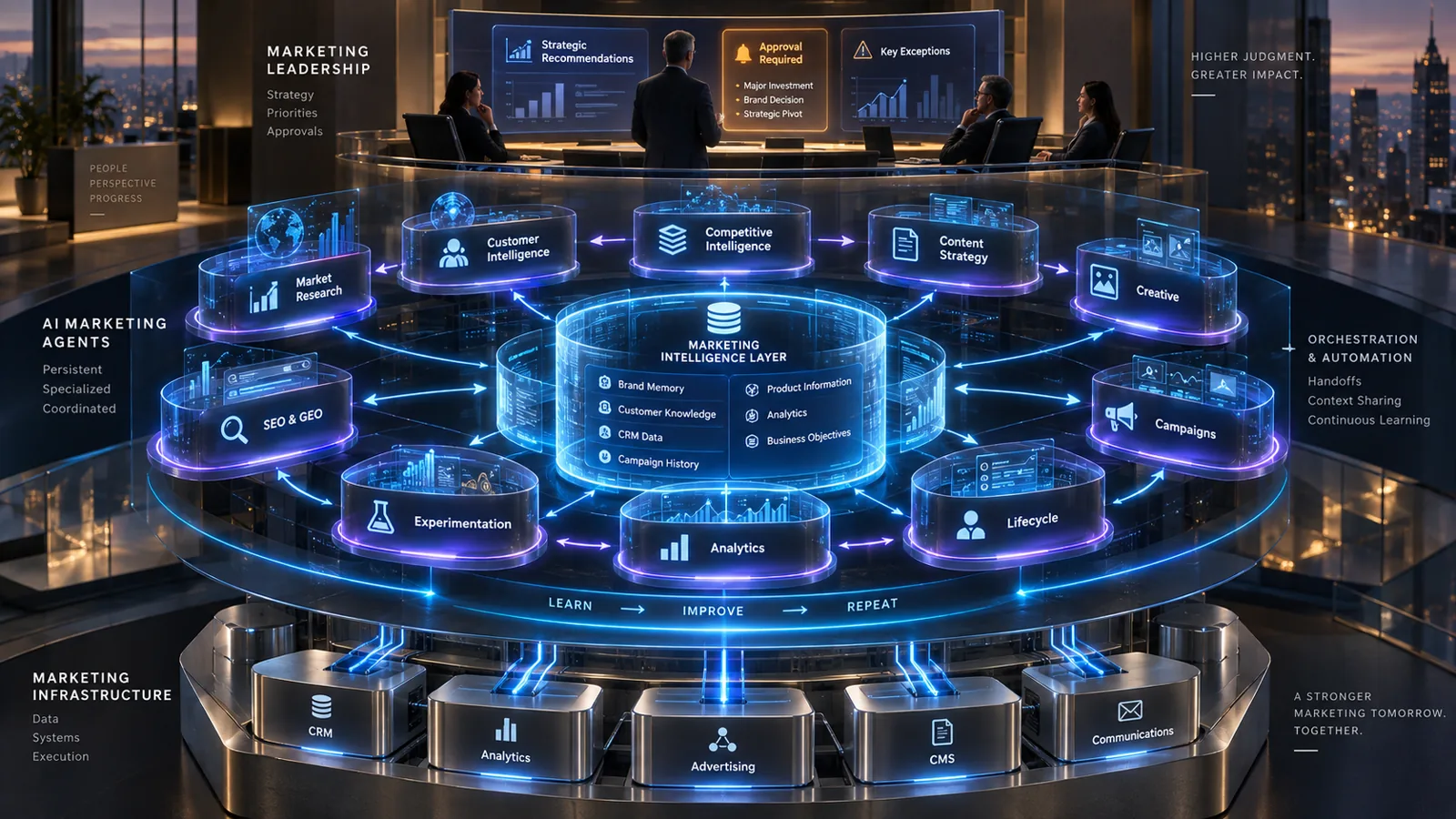
Examples of AI Marketing Agents
A company could eventually operate several specialized agents.
Not every company needs ten agents.
In fact, starting with ten may be a mistake.
Anthropic specifically recommends using the simplest architecture capable of solving the problem, because agentic systems can add latency, cost and complexity. Fixed workflows may be better when the task is predictable, while agents are more useful when flexibility and model-driven decisions matter.
Single Agent vs Multi-Agent Marketing Systems
An AI marketing system can be built in several ways.
Single-Agent System
One agent has access to multiple tools.
For example, a campaign agent can access:
- CRM
- analytics
- content
- campaign systems
This may be sufficient for relatively contained workflows.
Multi-Agent System
Different agents own different responsibilities.
For example:
Research Agent
↓
Content Strategy Agent
↓
Creative Agent
↓
Campaign Agent
↓
Analytics Agent
Multi-agent systems can provide clearer specialization.
They also introduce additional coordination complexity.
The objective should therefore never be:
Create as many agents as possible.
The objective is:
Choose the architecture that reliably accomplishes the work.
AI Agents Are Not Digital Employees
The employee metaphor is useful up to a point.
It helps explain ideas such as:
- responsibility
- delegation
- specialization
- escalation
But it can also be misleading.
An AI agent does not have:
- genuine accountability
- organizational relationships
- human motivation
- lived experience
- social judgment
- personal responsibility
It is software.
Sophisticated software—but still software.
That matters when companies decide how much authority it should receive.
How Autonomous Should Marketing Agents Be?
Not every agent needs the same autonomy.
A practical model uses four levels.
Level 1: Analyze
The agent studies information and reports findings.
Example:Detect campaign anomalies.
Level 2: Recommend
The agent proposes what should happen.
Example:Recommend reallocating spend.
Level 3: Prepare
The agent prepares the action but waits for approval.
Example:Create revised campaign assets.
Level 4: Execute Within Boundaries
The agent performs approved classes of actions automatically.
Example:Adjust campaign spend within a predefined 5% threshold.
The appropriate level depends on:
- risk
- reliability
- reversibility
- customer impact
- financial impact
- reputational impact
The more consequential the action, the stronger human oversight should become.
What Are the Benefits of AI Marketing Agents?
1. Less Manual Coordination
Agents can move information between stages without requiring a human to manage every handoff.
2. Continuous Operation
Some agents can monitor information persistently rather than waiting for someone to initiate a task.
3. Faster Research and Analysis
Agents can inspect multiple sources and synthesize findings.
4. More Adaptive Workflows
Unlike rigid automation, agents can potentially respond differently as conditions change.
5. Greater Marketing Leverage
A smaller human team can manage larger amounts of execution.
6. Better Use of Organizational Knowledge
Agents connected to shared context can reuse brand, customer and campaign knowledge rather than repeatedly starting from blank prompts.
What Are the Risks?
Agents also introduce new failure modes.
Hallucinations
The underlying model may generate inaccurate conclusions.
Incorrect Actions
A system may misunderstand a goal or choose the wrong tool.
Excessive Autonomy
Poor permissions can allow an agent to perform actions that should require approval.
Bad Context
Incorrect or outdated organizational data leads to poor decisions.
Compounding Errors
An error early in a multi-step workflow can influence later actions.
Security and Privacy
Agents connected to business systems require careful access control.
This is why agent governance becomes more important as systems move from generating content to taking actions.
AI Marketing Agents vs AI Assistants vs Automation
A simple comparison helps clarify the landscape.
The boundaries can blur.
Many modern systems combine all three.
The more useful question is not:
What label does this software use?
Ask:
How does it decide what happens next?
Where AI Marketing Agents Fit Into the AI CMO
AI marketing agents are one layer of a larger AI CMO architecture.
The AI CMO can be thought of as the overall marketing operating system.
Agents are specialized execution and reasoning capabilities inside that system.
A simplified structure is:
Human Leadership
defines strategy and permissions.
↓
Shared Intelligence
stores brand, customer and business context.
↓
AI Marketing Agents
perform specialized reasoning and work.
↓
Orchestration
coordinates agents, tools and workflows.
↓
Marketing Automation & Systems
execute predictable actions.
That distinction matters.
An AI CMO is not one giant agent.
It is a system that can coordinate multiple forms of intelligence and execution.
How AI Marketing Agents Could Change Marketing Jobs
The biggest impact may not be simply automation.
It may be delegation.
Microsoft describes an emerging human-agent progression from people acting as authors, to editors, directors and eventually orchestrators who manage systems of multiple agents working in parallel.
That progression maps well to marketing.
Marketer as Author
Creates the output manually.
Marketer as Editor
AI produces the draft.
Human improves it.
Marketer as Director
Human defines an objective.
AI performs the task.
Marketer as Orchestrator
Human manages a system of agents and workflows.
This changes the skill set.
Marketers increasingly need to understand:
- objective setting
- workflow design
- context management
- evaluation
- delegation
- governance
Prompting remains useful.
But orchestration becomes more valuable.
Are AI Marketing Agents Already Being Used?
Yes, although maturity varies widely.
Microsoft said in April 2026 that its Azure AI marketing organization was using Microsoft Foundry to build agent-based tools intended to automate workflows and amplify human marketing impact.
Microsoft and Publicis Groupe also announced an expanded partnership in April 2026 to build a marketing solution connecting legacy systems, AI agents and identity-based data across marketing workflows.
At the infrastructure level, major AI providers now offer explicit tooling for building, orchestrating, tracing and evaluating agents. OpenAI's recent developer training materials cover tools, routing, handoffs, guardrails, tracing and agent delegation, while Google Cloud describes agentic workflows as a distinct enterprise architecture for dynamic multi-step execution.
Agentic marketing is therefore moving from an experimental concept toward an emerging operating model.
How Should a Marketing Team Start Using AI Agents?
Do not begin by saying:
We need an AI agent.
Begin with the workflow.
Step 1: Identify Repetitive Knowledge Work
Look for work involving:
- research
- analysis
- coordination
- interpretation
- repeated tool use
Step 2: Choose a Clear Objective
For example:
Identify high-priority content opportunities every week.
Step 3: Define the Required Context
What does the agent need to know?
Step 4: Define Tools
Which systems should it access?
Step 5: Define Permissions
What may it read?
What may it change?
Step 6: Define Success
How will you know it performs well?
Step 7: Keep Humans at Important Decision Points
Start conservatively.
Increase autonomy only after reliability is established.
Step 8: Expand Into Larger Workflows
Once one agent works reliably, connect adjacent capabilities.
That is a much stronger strategy than deploying a collection of unrelated AI agents simply because the category is growing.
The Bigger Shift: From Prompting to Delegation
The first era of generative AI asked marketers to become good prompt writers.
The next era increasingly asks them to become good delegators.
Instead of:
Write this.
the instruction becomes:
Achieve this objective.
Instead of:
Analyze this spreadsheet.
the instruction becomes:
Monitor this business metric and investigate meaningful changes.
Instead of:
Give me campaign ideas.
the instruction becomes:
Continuously identify campaign opportunities consistent with our business priorities and bring me the strongest recommendations.
This is a very different interaction model.
The AI becomes less like a tool waiting to be used.
It becomes a persistent capability inside the marketing organization.
Conclusion
AI marketing agents are AI-powered systems designed to pursue marketing objectives through a combination of:
- reasoning
- context
- tools
- memory
- multi-step execution
- adaptation
- permissions
They differ from basic AI assistants because they can increasingly perform work rather than only respond.
They differ from traditional marketing automation because the workflow does not always need to be predetermined.
And they differ from human employees because they remain software systems that require clear objectives, permissions, evaluation and oversight.
The most useful way to think about AI marketing agents is therefore not:
digital marketers replacing people.
Think instead:
specialized intelligent capabilities that expand what a human marketing team can coordinate.
Research can become persistent.
Analytics can become continuous.
Campaign execution can become more adaptive.
Customer intelligence can become more accessible.
Marketing teams can gain leverage without manually performing every intermediate step.
That is why AI marketing agents matter.
They are not simply another AI feature.
They represent a shift from AI that answers marketing questions to AI that can increasingly participate in marketing work.
And that shift is one of the foundations of agentic marketing and the emerging AI CMO.
FAQs
1. What are AI marketing agents?
AI marketing agents are AI-powered systems that can pursue marketing objectives by interpreting context, reasoning about tasks, using tools, performing multiple steps and adapting their actions within defined permissions.
2. How are AI marketing agents different from ChatGPT?
A standard ChatGPT interaction primarily responds to a user's prompt. An AI marketing agent may additionally have access to tools, memory, workflows and permissions that allow it to perform actions and continue working toward an objective.
3. What can an AI marketing agent do?
AI marketing agents can potentially support research, customer intelligence, competitive analysis, content strategy, campaign execution, lifecycle marketing, SEO/GEO, performance analysis and experimentation.
4. Are AI marketing agents the same as marketing automation?
No. Traditional automation generally follows predefined rules. AI agents can use model-driven reasoning to dynamically decide how to accomplish a task or which action to take next.
5. Can AI marketing agents work autonomously?
Yes, within defined boundaries. Their level of autonomy should depend on the risk, reliability and consequence of the task. High-impact decisions should generally receive stronger human oversight.
6. Do AI marketing agents replace marketers?
Agents can automate or augment significant parts of marketing work, but humans remain important for strategy, judgment, creative direction, relationships, governance and accountability.
7. What is a multi-agent marketing system?
A multi-agent marketing system uses several specialized AI agents that coordinate or hand off tasks to complete larger workflows, such as research, content creation, campaign execution and performance optimization.
8. How should a company start using AI marketing agents?
Start with one clearly defined workflow and objective, provide the required context and tools, establish permissions and success criteria, keep humans at important decision points, and expand gradually after reliability is demonstrated.