Your Marketing Team Doesn’t Need More AI Tools. It Needs Fewer Workflows.
A fragmented marketing process does not become efficient simply because artificial intelligence is inserted into every step.
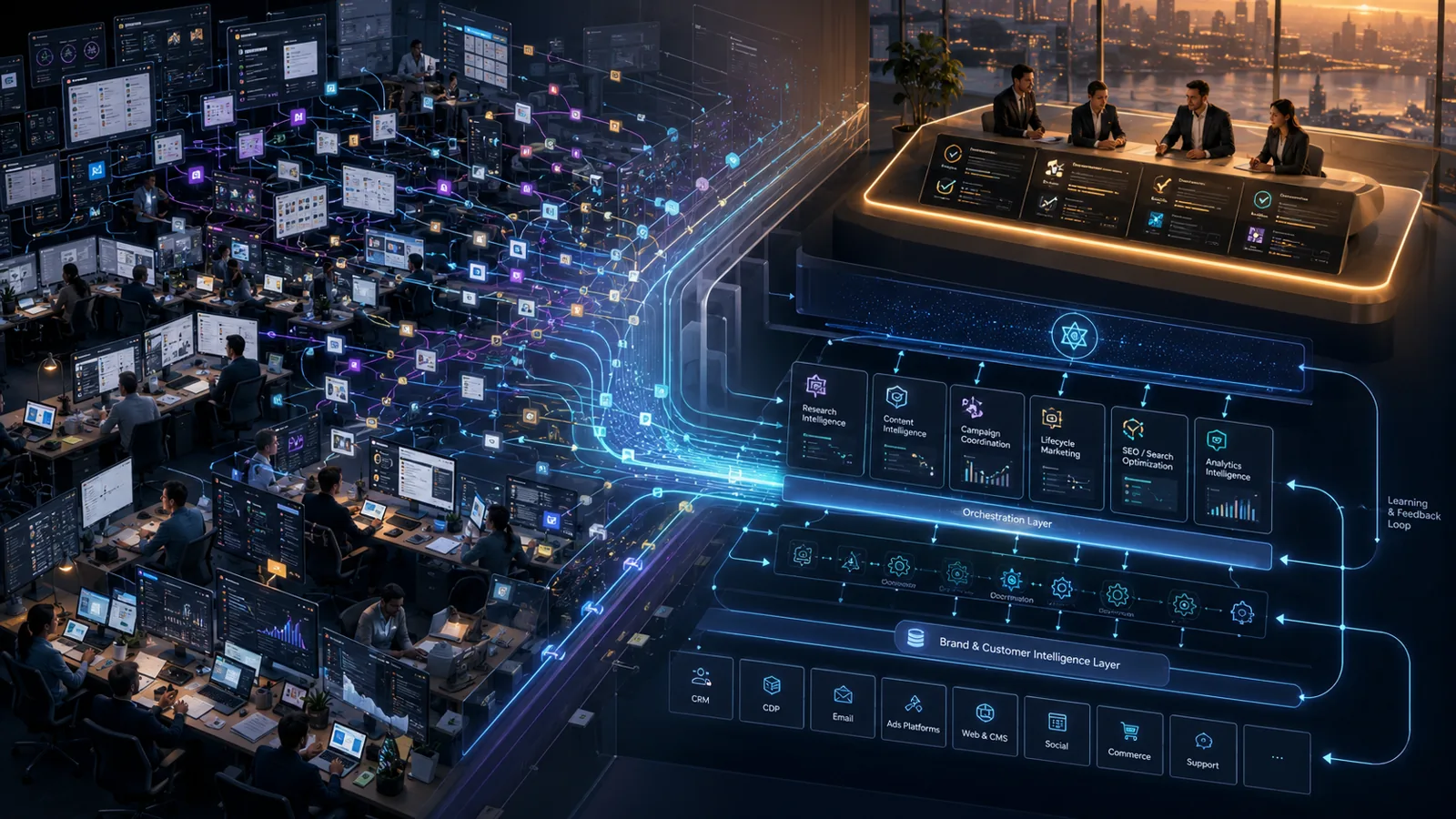
Marketing teams have never had more software.
Now they have AI too.
An AI writer for content.
An AI research assistant.
An AI design tool.
An AI meeting assistant.
An AI SEO platform.
An AI analytics copilot.
An AI campaign tool.
An AI agent.
Then another AI agent.
Every new application promises to save time.
Yet many marketing teams somehow feel busier.
That contradiction tells us something important:
The problem may no longer be a lack of tools.
The problem may be the way the work itself is designed.
A fragmented marketing process does not become efficient simply because artificial intelligence is inserted into every step.
If a campaign still moves through twelve systems, eight handoffs, six approval loops and twenty manual decisions, AI may make individual tasks faster while leaving the underlying organizational complexity untouched.
The next stage of AI marketing therefore requires a different mindset.
Do not start by asking:
“Which AI tool should we add?”
Start by asking:
“Why does this workflow require so many steps in the first place?”
That difference could determine which organizations actually capture value from AI.
The AI Tool Paradox
The first generation of generative AI adoption happened primarily at the individual level.
People discovered ChatGPT.
Teams experimented with Claude.
Designers added AI tools.
Marketers adopted content generators.
Software vendors embedded copilots.
These tools created real productivity gains.
But individual productivity and organizational productivity are not the same thing.
A copywriter producing a draft twice as quickly does not necessarily mean a campaign launches twice as quickly.
The draft may still need to move through:
content strategist → brand review → product review → legal review → design → campaign manager → marketing operations → channel platform → analytics.
The bottleneck simply moves somewhere else.
This is becoming increasingly important as organizations move deeper into AI adoption.
Microsoft's 2026 Work Trend Index explicitly argues that leaders need to rearchitect work, not simply deploy more technology. Its research found that 66% of surveyed AI users said AI allowed them to spend more time on high-value work, but the broader organizational opportunity depends on redesigning processes so AI and humans work together effectively.
That is the central distinction.
AI can optimize a task.
Workflow redesign optimizes the system.
What Is an AI Marketing Workflow?
An AI marketing workflow is a sequence of marketing activities in which humans, AI systems, agents, automation and business software work together to achieve a defined marketing outcome.
The important word is outcome.
A workflow should exist because the business needs something accomplished.
For example:
- launch a campaign
- qualify a lead
- publish a piece of content
- respond to a customer signal
- optimize advertising
- identify an emerging market opportunity
The problem is that many workflows were never intentionally designed.
They accumulated.
One tool was added.
Then another.
A spreadsheet solved a temporary problem.
Someone created an approval step after a mistake.
Another team introduced a separate dashboard.
Another system required data to be copied manually.
After five years, what looks like a workflow is often organizational archaeology.
AI gives companies an opportunity to reconsider that entire structure.
Why More AI Tools Can Make Marketing Worse
AI tools do not automatically create AI-native organizations.
Sometimes they create another layer of fragmentation.
Imagine a marketer preparing a campaign.
They might:
- 1open analytics
- 2export performance data
- 3paste it into an AI assistant
- 4ask for insights
- 5copy those insights into a document
- 6open another tool for competitor research
- 7send findings to a colleague
- 8draft the campaign in another AI application
- 9move the copy into project management
- 10send it for approval
- 11copy approved content into marketing automation
- 12manually configure distribution
- 13open analytics three days later
- 14repeat the process
Several steps contain AI.
The workflow is still inefficient.
Microsoft described this precise organizational problem in April 2026: AI may generate an insight in one environment, but workers still have to switch applications and reconstruct context before they can take action elsewhere. Its current agent strategy is partly aimed at connecting those actions into the actual flow of work.
The important issue is therefore not:
How many AI capabilities exist?
It is:
How much distance exists between intent and execution?
Tool Optimization vs Workflow Optimization
Consider two approaches.
Approach A: Optimize Every Task
The organization adds:
- an AI writing tool
- an AI research tool
- an AI presentation tool
- an AI reporting tool
- an AI meeting assistant
- an AI analytics platform
Each tool improves one activity.
Approach B: Redesign the Workflow
The organization asks:
What is the minimum sequence required to move from business objective to approved campaign to measurable result?
Then it redesigns the process around that objective.
Some steps disappear.
Some combine.
Some become automated.
Some become agentic.
Some remain human.
Approach A makes existing work faster.
Approach B changes how much work needs to exist.
That is a much bigger opportunity.
The Real Cost of Fragmented Marketing Workflows
Workflow complexity creates several hidden costs.
1. Context Switching
Every application switch requires someone to reconstruct context.
What campaign are we working on?
Which version is approved?
What did analytics show?
What did the product team say?
Where is the newest brief?
The problem grows as tool counts increase.
2. Repeated Context
Marketing teams continuously re-explain the same information.
Brand voice is pasted into prompts.
Customer personas are uploaded again.
Product information is copied.
Campaign objectives are rewritten.
AI without shared organizational context can actually increase this duplication.
3. Excessive Handoffs
Every handoff introduces:
- delay
- information loss
- misunderstanding
- another status check
AI might accelerate individual tasks while leaving those coordination costs untouched.
4. Duplicate Decisions
Different people may repeatedly answer the same questions.
Who is the audience?
Which message matters?
What content already exists?
What does the campaign optimize for?
A well-designed intelligence layer should make those decisions reusable.
5. Tool Administration
Tools themselves require:
- accounts
- permissions
- integration
- procurement
- governance
- training
- data management
Adding software has organizational cost.
6. Measurement Fragmentation
When every system measures a different part of the journey, nobody has a clear view of whether the workflow itself is effective.
AI Should Remove Work, Not Just Accelerate It
This is one of the most useful principles for evaluating AI transformation.
Suppose a marketer spends two hours creating a weekly report.
AI reduces that to twenty minutes.
Useful.
But ask another question:
Why does the report exist?
Perhaps a director reads it to determine whether any campaigns need attention.
If an analytics agent could continuously monitor performance and surface only meaningful anomalies, maybe the weekly reporting workflow should disappear.
That is a different type of productivity.
The first approach says:
Perform the task faster.
The second asks:
Does the task need to exist?
AI makes the second question increasingly practical.
From 12 Steps to 5
Consider a simplified content-marketing workflow.
Traditional Workflow
- 1strategist identifies topic
- 2researcher investigates topic
- 3strategist writes brief
- 4writer creates draft
- 5editor reviews
- 6writer revises
- 7SEO specialist reviews
- 8writer revises
- 9brand lead approves
- 10CMS manager publishes
- 11social manager repurposes
- 12analyst reviews performance
There may be valid reasons for each role.
But the workflow deserves examination.
An AI-native version might look like:
Redesigned Workflow
1. Opportunity Detection
A research and intelligence system continuously identifies customer questions, search opportunities and business priorities.
2. Strategy
A human strategist validates the opportunity and defines the core point of view.
3. Production
An AI-supported content workflow produces a grounded first version using approved brand and product context.
4. Approval & Distribution
Humans review strategically important content while deterministic systems handle formatting, publishing and distribution.
5. Learning
Performance signals return automatically to the intelligence layer.
The point is not that AI replaces six people.
The point is that the workflow becomes fundamentally shorter.
The Best AI Workflow May Have No AI Agent
This is where the conversation becomes more nuanced.
Not every workflow requires agents.
Anthropic recommends increasing architectural complexity only when the business problem justifies it. Predictable workflows benefit from simple, composable systems, while more flexible agents become useful when tasks require reasoning and dynamic decision-making.
That principle should apply directly to marketing.
If every new email subscriber needs the same CRM field updated:
Use automation.
If campaign data needs a predefined transformation:
Use deterministic code.
If an executive needs a monthly scheduled report:
Use a workflow.
If the system must investigate why performance changed across several systems:
An agent may make sense.
The goal is not:
More AI.
The goal is:
Less unnecessary complexity.
The Four Types of Marketing Work
A useful redesign exercise is to place marketing work into four categories.
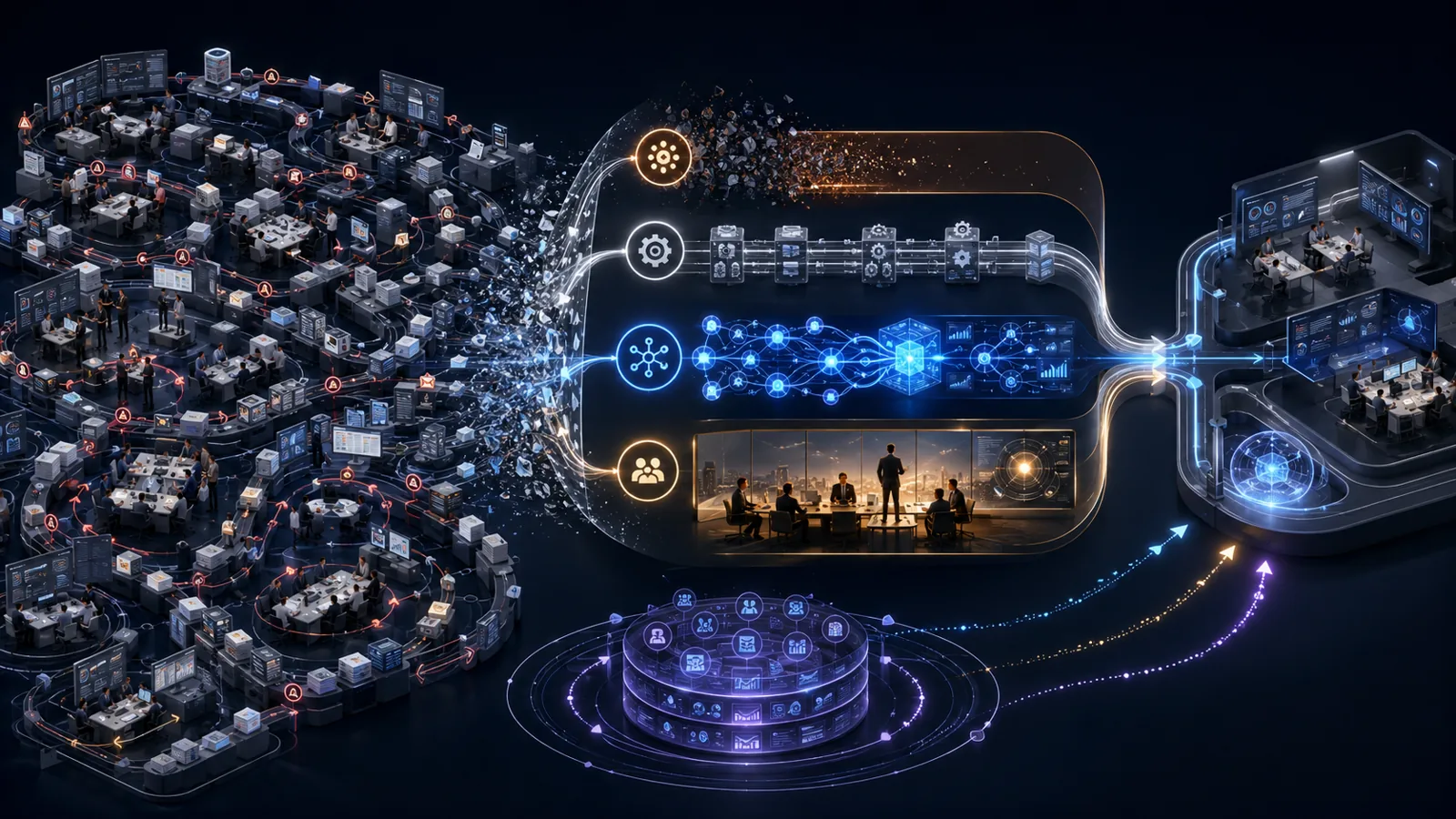
1. Eliminate
Does the work need to happen at all?
Examples might include:
- redundant status reports
- duplicate data entry
- repeated formatting
- approval steps that add no decision value
This category should come first.
You should not automate work that should disappear.
2. Automate
Is the work predictable?
Examples:
- CRM updates
- scheduling
- standard notifications
- data synchronization
- recurring exports
- predefined publishing steps
Use reliable automation.
3. Agentize
Does the work require interpretation or flexible decision-making?
Examples:
- campaign diagnosis
- research
- competitive monitoring
- content opportunity identification
- customer-signal analysis
Agents may add value.
4. Keep Human
Does the activity require strategic judgment, accountability or creative direction?
Examples:
- positioning
- major campaign direction
- sensitive customer decisions
- budget trade-offs
- brand decisions
- high-risk publishing
Keep humans responsible.
This creates a much cleaner question than:
“Where can we put AI?”
Ask:
“What operating mode should this work use?”
Why This Matters for the AI CMO
This principle sits at the center of the AI CMO model.
An AI CMO should not become another enormous platform that adds twenty more workflows to marketing.
Its purpose should be the opposite.
It should reduce coordination.
Think of the system as an intelligence and orchestration layer.
Instead of individual marketers constantly navigating between:
CRM → analytics → ChatGPT → project management → CMS → advertising → email → dashboards,
the AI CMO can increasingly connect information and work across those systems.
The underlying MarTech may remain.
What changes is how frequently humans have to manually coordinate it.
From Tool-Centric Marketing to Outcome-Centric Marketing
Most technology stacks are designed around applications.
You have:
- CRM software
- analytics software
- SEO software
- CMS software
- email software
- advertising software
The marketer becomes the integration layer.
Humans manually transfer intent between systems.
This is beginning to change.
AI agents increasingly provide a potential interface between business intent and multiple software systems.
Microsoft's current enterprise AI strategy describes agents as systems capable of executing business processes rather than merely generating insights. Its 2026 marketing team is also using agent-based tools to automate workflows and amplify marketers' work.
That opens a different operating model.
Instead of saying:
Open analytics, find the declining campaigns, export the data, analyze it, open the ad platform, change the campaign, document the change.
A marketer might eventually say:
Investigate underperforming campaigns and bring me the three interventions most likely to improve qualified pipeline.
The software complexity still exists.
But it moves beneath the interface.
MarTech Is Becoming Infrastructure
This does not mean marketing technology disappears.
Quite the opposite.
CRM, analytics, content platforms, customer data systems and automation engines remain important.
Their role changes.
Instead of every platform being a separate destination where marketers spend significant time, they increasingly become infrastructure available to intelligent workflows.
Chiefmartec's research shows this transition is still early. Its 2025 study of 96 marketing technology and operations leaders found widespread standalone AI-assistant adoption, while deeper integration into the existing stack remained less mature. Existing SaaS marketing platforms were still the most common environment for AI workflows.
That is useful context.
The industry has not completed this transformation.
But the architectural direction is increasingly clear.
A Workflow-First AI Strategy
Before buying another AI marketing tool, map one important workflow.
For example:
Campaign creation.
Document every:
- step
- person
- application
- approval
- data source
- handoff
- delay
- repeated decision
Then ask seven questions.
1. What outcome does this workflow create?
If nobody can answer clearly, start there.
2. Which steps can disappear?
Do this before discussing automation.
3. Which steps are deterministic?
Automate those.
4. Which steps require interpretation?
These may benefit from AI or agents.
5. Which steps require human judgment?
Protect them.
6. Where is context repeatedly reconstructed?
Create shared memory or intelligence.
7. How can feedback return automatically?
Every workflow should learn from its outcome.
This gives organizations something more valuable than another AI deployment.
It gives them a better operating model.
Fewer Workflows Does Not Mean Fewer Capabilities
This distinction matters.
The objective is not to simplify marketing until sophisticated capabilities disappear.
The opposite is possible.
A company may have more capability with fewer workflows because intelligence coordinates complexity underneath the system.
Think about a modern smartphone.
The device performs thousands of technical operations.
The user does not manually manage most of them.
Good software hides unnecessary operational complexity.
AI could do something similar for knowledge work.
Marketing operations may become technically more sophisticated while feeling simpler to marketers.
That is the ideal.
The New Marketing Productivity Metric
Marketing organizations frequently measure productivity through output.
How many:
- blogs
- campaigns
- emails
- creatives
- social posts
AI makes those numbers easy to increase.
That does not necessarily mean marketing became better.
A more interesting productivity metric is:
How much organizational effort is required to achieve a meaningful business outcome?
Can a campaign launch with:
fewer meetings?
fewer handoffs?
less repeated context?
fewer manual actions?
fewer approval loops?
less reporting?
less tool switching?
If yes, AI is changing the operating model.
If all AI does is generate more assets inside the same fragmented system, the organization has automated production without transforming marketing.
The Future Marketing Team Will Manage Systems, Not Apps
The marketing role itself is likely to change as workflows become more integrated.
Microsoft's 2026 research describes advanced AI users as people who routinely rethink workflows, use agents for multi-step processes, and establish shared standards for human-AI work.
That is a useful picture of where marketing may be heading.
Marketers increasingly become designers of:
- objectives
- context
- workflows
- agent responsibilities
- evaluation criteria
- approval boundaries
The question moves from:
“Which tool do I open?”
toward:
“What outcome should the system produce?”
That is a significant shift.
More Tools Are Easy. Better Work Is Hard.
Buying software is relatively easy.
Redesigning work is difficult.
It requires challenging processes people have grown accustomed to.
It requires asking why approvals exist.
It requires connecting teams.
It requires improving information quality.
It requires deciding which responsibilities belong to humans and which belong to machines.
It may require eliminating work that once justified entire routines.
That is why AI transformation is ultimately an organizational problem, not merely a software problem.
The companies that gain the most from AI may not be those with the largest AI stacks.
They may be the ones willing to redesign how work happens.
Conclusion
Marketing teams do not need another AI tool simply because another AI capability has become available.
They need to understand the system of work surrounding those tools.
Adding AI to every existing task can make individual activities faster.
But it can also preserve—and sometimes amplify—the fragmentation already inside marketing.
A better approach is:
Eliminate unnecessary work.
Automate predictable work.
Use agents for work requiring reasoning.
Keep humans responsible for judgment and direction.
Then connect those components into shorter, more intelligent workflows.
The future of AI marketing is therefore not primarily a story about having more software.
It is a story about requiring less coordination to accomplish better work.
The winning marketing organization may still have a sophisticated technology stack underneath it.
But to the human team, marketing should increasingly feel simpler.
Fewer handoffs.
Fewer repeated decisions.
Fewer dashboards.
Fewer workflows.
More intelligence.
More leverage.
And more time spent on the decisions that actually matter.
FAQs
1. Why don't marketing teams need more AI tools?
Many marketing teams already have powerful AI capabilities but still operate through fragmented processes. Adding more tools may improve individual tasks without fixing duplicated work, excessive handoffs, context switching or inefficient workflows.
2. What is an AI marketing workflow?
An AI marketing workflow is a process in which humans, AI models, agents, automation and business software coordinate to achieve a defined marketing outcome such as launching a campaign, producing content or responding to a customer signal.
3. How can AI simplify marketing workflows?
AI can help eliminate repetitive analysis, connect information across systems, automate predictable tasks, support decisions and allow agents to perform multi-step work that would otherwise require manual coordination.
4. Should every marketing workflow use AI agents?
No. Predictable processes are usually better handled with deterministic automation. Agents are most useful when work requires interpretation, changing context, multiple tools or flexible decisions.
5. What should companies do before buying another AI marketing tool?
Map an important workflow first. Identify unnecessary steps, repeated context, manual handoffs, deterministic tasks, decisions requiring reasoning and actions that must remain under human control.
6. Will AI reduce the number of marketing tools companies use?
Possibly at the application layer, but underlying systems may remain extensive. CRM, analytics and other platforms can increasingly function as infrastructure accessed through intelligent workflows rather than destinations that marketers manually operate throughout the day.
7. What does workflow redesign mean in AI transformation?
Workflow redesign means reconsidering the complete sequence of work rather than simply applying AI to existing steps. It can involve removing tasks, combining stages, changing responsibilities, introducing automation and establishing new human-AI operating models.
8. How does workflow simplification relate to an AI CMO?
An AI CMO can operate as an intelligence and orchestration layer across marketing systems, reducing the need for humans to manually coordinate data, applications, agents and workflows while preserving human control over strategic decisions.