7 Marketing Workflows That Shouldn’t Require Manual Human Execution in 2026
There are still marketers in 2026 manually downloading campaign data into spreadsheets.
There are still marketers in 2026 manually downloading campaign data into spreadsheets.
Manually resizing and adapting approved content.
Manually routing briefs.
Manually checking whether fields synced correctly.
Manually preparing weekly dashboards.
Manually assigning repetitive campaign tasks.
Manually watching performance metrics to notice whether something changed.
This is increasingly difficult to justify.
Not because humans are unnecessary.
Because human attention is too valuable to spend on work that software can now reliably coordinate.
AI has reached a point where the marketing conversation should move beyond:
“Can AI help me do this task faster?”
A more important question is:
“Why does a human need to perform this step at all?”
That does not mean removing humans from marketing.
It means distinguishing between two fundamentally different kinds of work.
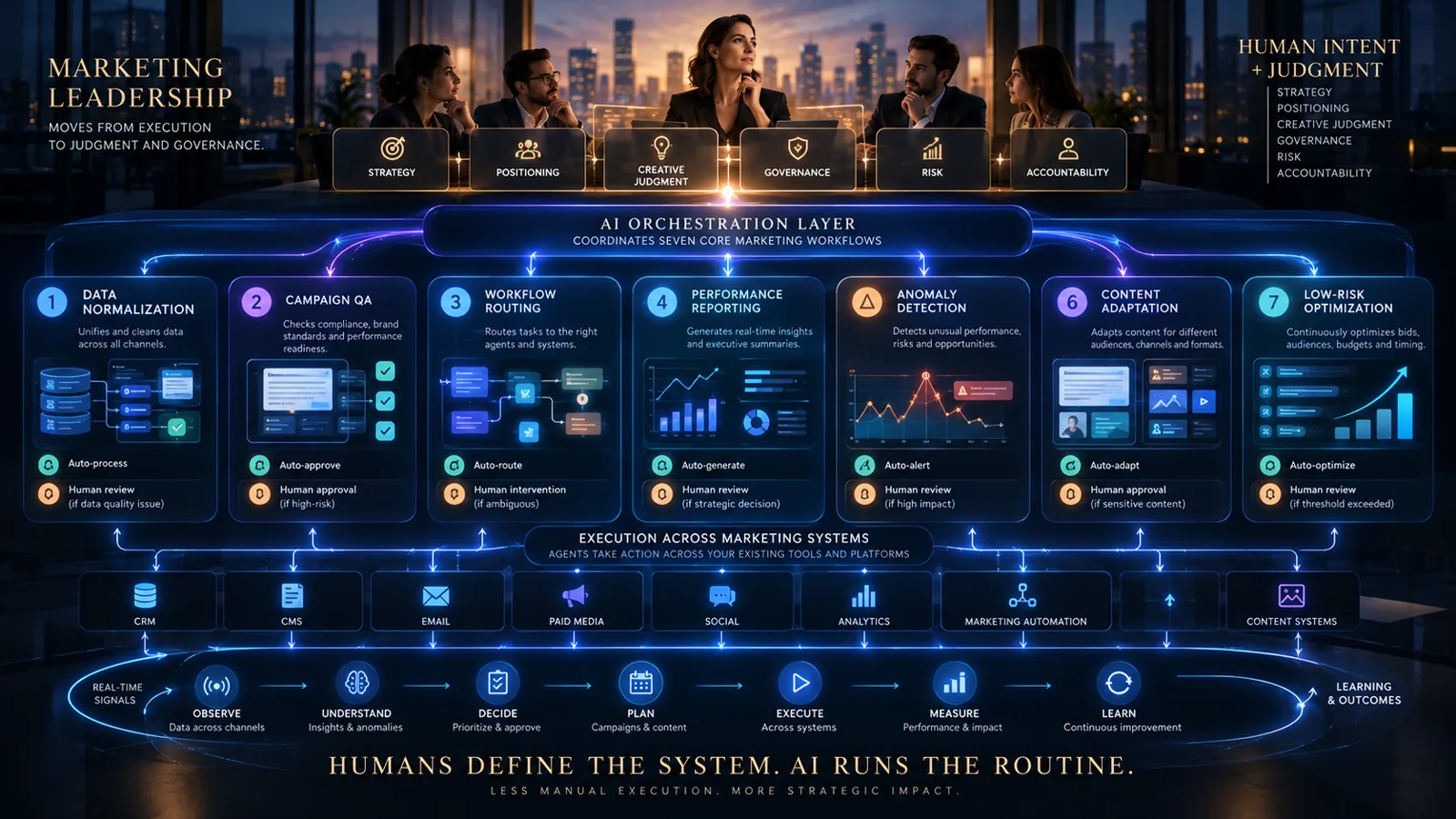
Humans should increasingly own:
- strategy
- positioning
- creative judgment
- customer understanding
- quality standards
- major trade-offs
- risk
- governance
- accountability
AI agents and automation should increasingly own:
- monitoring
- retrieval
- normalization
- routing
- repetitive transformation
- synthesis
- predictable execution
- low-risk coordination
McKinsey estimates that generative AI alone could affect a substantial share of marketing tasks, but argues that the larger value comes from rewiring complete workflows around human–AI collaboration, not simply automating isolated activities. Adobe's 2026 marketing operations releases similarly focus on automating work such as data normalization, campaign QA, program creation, handoffs, and execution-heavy operational tasks while keeping marketers in control of strategy and oversight.
So which workflows should already be moving away from routine human execution?
Here are seven.
1. Marketing Data Collection and Normalization
Marketing teams operate across enormous amounts of fragmented data.
CRM.
Email.
Advertising.
Web analytics.
Social.
Commerce.
Content performance.
Customer activity.
Historically, marketers or analysts have spent hours:
- downloading files
- combining datasets
- renaming fields
- fixing formatting
- removing duplicates
- mapping campaign names
- normalizing values
- checking missing fields
- preparing datasets for reporting
This is exactly the kind of work that should require less routine human involvement.
What the AI-Native Workflow Looks Like
The system continuously retrieves data from approved sources.
It identifies:
- inconsistent schemas
- duplicate records
- missing information
- naming inconsistencies
- unexpected values
Deterministic rules handle predictable transformations.
AI handles cases that require contextual interpretation.
For example:
Enterprise-US-Q3Q3 Enterprise USAEnt_US_2026Q3
may all refer to the same campaign.
The system can normalize them against approved campaign taxonomy and flag uncertain matches.
Humans intervene only when confidence is insufficient or a genuinely new classification is required.
Adobe now explicitly identifies data normalization as one of the execution-heavy marketing operations processes where AI can reduce repetitive work.
Humans Should Still Own
- data definitions
- taxonomy design
- privacy policies
- identity rules
- edge cases
- data quality standards
Humans should design the data system.
They should not have to clean the same spreadsheet every Monday.
2. Routine Campaign QA
Campaign quality assurance is essential.
But much of QA is deterministic.
Is the correct UTM structure present?
Does the URL work?
Is the required tracking configured?
Is the subject line missing?
Does the campaign follow naming conventions?
Are mandatory fields complete?
Is an audience accidentally empty?
Is the approved asset attached?
Does the campaign violate a defined frequency rule?
Historically, people have manually inspected these details.
That does not scale.
The Better Model
Before a campaign reaches a human approval gate, AI and deterministic validation should automatically inspect:
- configuration
- links
- metadata
- audience settings
- tracking
- campaign taxonomy
- required assets
- formatting
- brand-rule compliance
- obvious inconsistencies
Only exceptions should surface to marketers.
Instead of:
Human checks 42 fields.
The workflow becomes:
System checks 42 fields → human reviews the 2 uncertain exceptions.
That is exactly the direction current enterprise marketing platforms are taking. Adobe has highlighted program QA as one of the recurring marketing operations tasks that agentic AI can increasingly handle.
Humans Should Still Own
- strategic quality
- creative judgment
- sensitive claims
- major launches
- high-risk audiences
- regulatory interpretation
AI should check whether everything is configured correctly.
Humans should decide whether the campaign is actually good.
3. Workflow Routing and Task Coordination
This is one of the least glamorous but most expensive forms of marketing work.
Someone finishes a brief.
Then someone needs to:
send it to content,
notify design,
create a project-management task,
update the status,
assign the reviewer,
wait for approval,
route revisions,
notify the campaign team,
update another system.
None of that is marketing strategy.
It is coordination.
Yet entire layers of marketing operations exist partly because work does not move automatically.
AI Agents Should Handle State
A modern orchestration system should know:
- what has been completed
- what remains
- which dependencies exist
- who or what should act next
- whether approval is required
- whether something is blocked
- whether deadlines are at risk
A completed strategy should automatically trigger the appropriate downstream workflow.
Content and creative tasks can launch in parallel where possible.
High-risk content can route to legal.
Approved assets can move toward campaign preparation.
Late work can trigger escalation.
Humans should not be manually acting as APIs between departments.
Adobe and Omnicom have described this emerging model very clearly: agentic systems are particularly suited to routing work, managing metadata, scaling volume, and synthesizing information, allowing humans to concentrate on thinking and creative judgment.
Humans Should Still Own
- priority changes
- resource trade-offs
- unusual dependencies
- interpersonal issues
- strategic escalation
The system should manage routine coordination.
Humans should manage exceptions.
4. Standard Reporting and Performance Summaries
One of marketing's strangest recurring rituals is still the manual weekly report.
Open advertising dashboards.
Export numbers.
Open analytics.
Find conversions.
Open CRM.
Check pipeline.
Update spreadsheet.
Build charts.
Write commentary.
Send deck.
Repeat next week.
In 2026, the routine part of this should be largely automated.
Reporting Should Become Continuous
An intelligent reporting workflow should:
- retrieve approved metrics
- validate the data
- compare against targets and historical periods
- identify significant changes
- segment those changes
- investigate likely causes
- summarize what matters
- surface unresolved questions
Instead of receiving a spreadsheet containing 80 metrics, leadership could receive:
Enterprise pipeline increased 14% this week. Most of the increase came from paid search and two high-intent content journeys. SMB conversion declined 6%, primarily after mobile form abandonment increased. No action is recommended for enterprise acquisition; the SMB form should be investigated.
That is not merely reporting.
It is decision intelligence.
Adobe's current workflow tools emphasize automating reporting bottlenecks and surfacing real-time insights rather than requiring marketers to manually assemble the information themselves.
Humans Should Still Own
- interpretation of ambiguous strategic signals
- deciding whether a metric actually matters
- major investment decisions
- challenging model assumptions
Humans should debate decisions.
They should not spend Wednesday morning copying numbers into PowerPoint.
5. Performance Anomaly Detection and First-Level Investigation
Marketing teams should not need humans staring at dashboards waiting to notice that something went wrong.
Software can monitor continuously.
Humans cannot.
This makes anomaly detection one of the clearest high-autonomy use cases.
The Workflow
AI should continuously monitor metrics such as:
- conversion
- CAC
- ROAS
- pipeline
- lead quality
- email engagement
- landing-page performance
- unsubscribe rates
- spend pacing
- journey completion
When something materially changes, the system should investigate before escalating.
Suppose conversion drops 18%.
The system could check:
- traffic mix
- audience quality
- landing-page changes
- device mix
- campaign modifications
- creative rotation
- geographic shifts
- previous comparable events
Then it might report:
Conversion declined 18%, concentrated among mobile paid-social traffic. Desktop and organic traffic are stable. The decline began after the new mobile landing-page version was deployed. High likelihood that the landing-page change is the primary cause.
Now the human begins with a hypothesis rather than a dashboard.
Adobe describes agentic marketing systems in similar terms: agents can interpret marketing signals, recommend changes, and support guided or automated campaign adjustments rather than leaving all analysis and execution to humans.
Humans Should Still Own
- expensive corrective actions
- strategic reallocations
- brand consequences
- uncertain diagnoses
- high-risk interventions
Machines should detect.
Machines should investigate.
Humans should decide when the consequence is significant.
6. Approved Content Adaptation and Distribution Preparation
This one requires an important distinction.
AI should not necessarily autonomously determine the core creative idea for a major brand campaign.
But once humans have approved the core idea, there is enormous execution work that should no longer require repeated manual intervention.
Consider one approved campaign asset.
It may need to become:
- LinkedIn copy
- X posts
- Instagram captions
- email copy
- landing-page variations
- ad formats
- shorter versions
- channel-specific CTAs
- metadata
- alt text
- SEO descriptions
- regional adaptations
Historically, humans recreate these manually.
The Better Model
Human approves:
- central idea
- claims
- messaging hierarchy
- tone
- creative direction
Then AI adapts the approved asset according to predefined channel and brand rules.
A quality-control system verifies:
- approved claims
- prohibited language
- character limits
- brand terminology
- required disclosures
- URL structure
Only uncertain adaptations return for review.
This is where content scale becomes useful without turning marketing into uncontrolled AI generation.
McKinsey's agentic-workflow research specifically describes a future in which marketers retain responsibility for brand integrity and strategic guidance while agents orchestrate much of ongoing production work.
Humans Should Still Own
- campaign concept
- positioning
- original creative direction
- brand-defining assets
- culturally sensitive adaptations
- major claims
Humans create the standard.
AI scales the standard.
7. Low-Risk Campaign Optimization Within Approved Guardrails
This may be the most consequential workflow on the list.
Marketing teams frequently operate by:
launching,
waiting,
checking dashboards,
meeting,
adjusting,
waiting again.
AI agents can compress this loop.
Once a human has defined:
- objective
- approved audiences
- budget ceiling
- minimum performance thresholds
- brand rules
- allowable experiments
- escalation conditions
certain optimizations should be able to happen without repeated manual approval.
Examples could include:
- reallocating a small amount of spend within predefined limits
- pausing clearly broken variants
- adjusting send timing
- routing traffic between already approved variants
- suppressing audiences that have reached frequency thresholds
- escalating unusually strong or weak performance
- triggering predefined experiments
The important phrase is:
within approved guardrails.
This is not:
“Let AI run the entire marketing budget however it wants.”
It is:
Humans define the playing field. AI can operate inside it.
Adobe's recent work on agentic campaign optimization explicitly describes agents supporting both guided and automated workflows, including campaign adjustments and repetitive execution, while preserving enterprise controls.
Humans Should Still Own
- overall budget
- strategic channel allocation
- large spend changes
- new audience strategies
- new claims
- major campaign pivots
- risk thresholds
The marketer becomes the architect of optimization rather than the person clicking every button.
The Pattern Behind All Seven Workflows
These seven examples share several characteristics.
They are generally:
Repetitive
They happen frequently.
High-volume
The organization performs them many times.
Structured
There are defined inputs, outputs, and rules.
Observable
The system can determine whether they succeeded.
Reversible or Low-Risk
Many actions can be undone or constrained.
Context-Rich but Not Deeply Strategic
They may require information, but not necessarily original strategic judgment.
These characteristics make them good candidates for AI agents and automation.
The wrong question is:
“Can AI do marketing?”
Marketing contains hundreds of different cognitive activities.
The better question is:
“Which decisions actually require human deliberation?”
That produces a much more useful automation strategy.
What Should Still Require a Human?
The fact that more workflows can operate autonomously does not mean marketing should become human-free.
Quite the opposite.
As execution becomes cheaper, human judgment becomes more valuable.
Humans should remain heavily involved in several categories.
Strategy
Which market should we enter?
Which customers should we prioritize?
Where should we compete?
What should we deliberately avoid?
These are consequential choices.
Positioning
AI can generate 50 positioning ideas.
That does not mean it should decide what the company stands for.
Creative Taste
AI can generate almost unlimited output.
Someone still needs to determine what is distinctive, memorable, culturally appropriate, and worth publishing.
Customer Understanding
Quantitative signals can reveal behavior.
Humans remain particularly valuable for understanding emotional nuance, relationships, and context that data does not fully capture.
High-Consequence Decisions
Large budgets.
Sensitive communications.
Major product claims.
Reputational risk.
Strategic partnerships.
These require accountable human ownership.
Governance
Someone must decide what AI is allowed to do.
AI cannot define its own ultimate authority.
The Right Model Isn't Human-in-the-Loop Everywhere
“Human in the loop” has become a default phrase in AI discussions.
But it can be interpreted badly.
If a human must approve every action an AI system performs, the organization has not necessarily automated much.
It may have simply created an extremely productive junior employee requiring constant supervision.
A more mature model is risk-based human involvement.
Level 1 — Fully Automated
Routine, deterministic, low-risk work.
Examples:
data formatting,
metadata,
routine routing.
Level 2 — Automated With Monitoring
AI acts, but results are logged and sampled.
Examples:
routine adaptations,
standard reporting.
Level 3 — AI Recommends, Human Approves
Moderate-consequence decisions.
Examples:
meaningful campaign optimizations,
new experiments,
customer-segment changes.
Level 4 — Human Leads, AI Assists
Strategic or creative decisions.
Examples:
positioning,
brand strategy,
major campaign concepts.
Level 5 — Human Only / Highly Restricted
Extremely consequential decisions.
Examples:
sensitive crisis communications,
major ethical judgments,
certain legal or regulatory decisions.
This is a more scalable governance model than putting a mandatory approval box after every agent action.
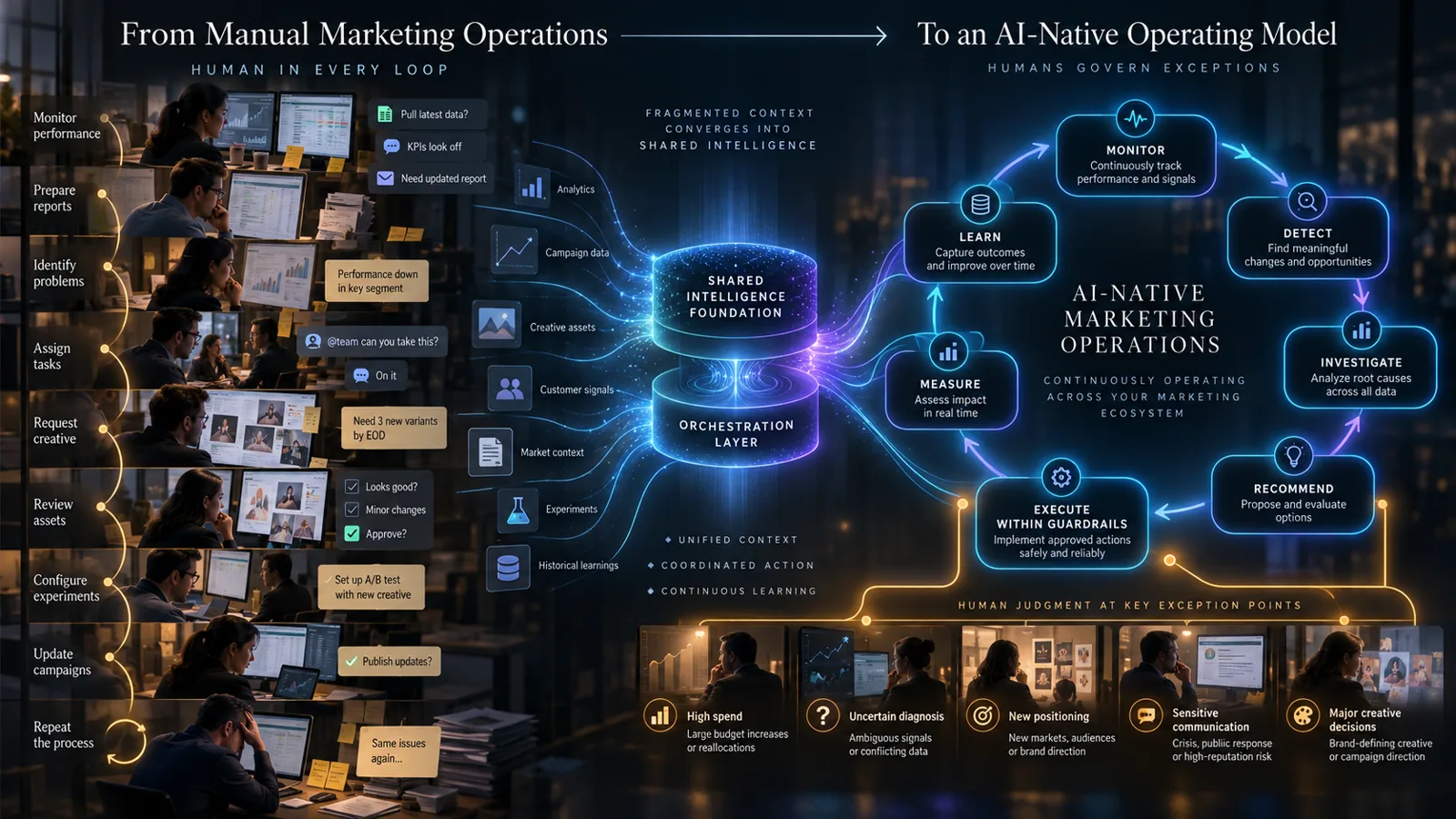
Humans Should Govern Exceptions, Not Routine Flow
This is the deeper operating-model shift.
Traditional marketing routes almost everything through people.
Future marketing should route exceptions through people.
For example:
Traditional:
Human reviews every campaign configuration.
Future:
System validates every campaign configuration; humans receive unusual or risky exceptions.
Traditional:
Analyst manually checks every metric.
Future:
System continuously monitors everything; analysts investigate material anomalies.
Traditional:
Manager manually assigns every task.
Future:
The orchestration layer routes routine work; the manager resolves priority conflicts.
Traditional:
Marketer manually adapts every approved asset.
Future:
AI adapts within brand rules; humans inspect uncertain cases.
The organization becomes exception-driven rather than task-driven.
That can dramatically increase human capacity.
AI Agents Change Marketing Automation
Marketing has used automation for years.
So what is new?
Traditional automation primarily follows rules.
For example:
IF lead score > 75THEN notify sales.
AI agents introduce reasoning.
They can potentially interpret:
Why did the score change?
What other information matters?
Should this lead be routed differently?
Does recent activity suggest another next action?
The future stack therefore combines:
AI intelligence
for interpretation,
agents
for dynamic coordination,
and
deterministic automation
for reliable execution.
The goal is not to replace automation with AI.
It is to add intelligence above automation.
What an Autonomous Marketing Workflow Could Look Like
Consider weekly campaign optimization.
Traditional Model
Analyst exports performance.
Analyst builds report.
Campaign manager reviews.
Team schedules meeting.
Performance problem is identified.
Creative team receives request.
New variation is produced.
Manager reviews.
Campaign manager uploads asset.
Test launches.
A week passes.
AI-Native Model
System continuously monitors performance.
An Analytics Agent identifies meaningful creative fatigue.
It verifies the issue against audience and traffic changes.
The Creative Agent adapts an already approved concept into three variants.
Brand checks run automatically.
The Experimentation Agent creates a controlled test within the approved budget.
Results are monitored.
The winning variation receives more traffic within predefined limits.
The human leader receives:
Creative fatigue identified Tuesday. Three approved variants tested. Variant C increased conversion 9%. Allocation has increased from 25% to 40%, within approved experimental limits. No action required.
That is what autonomy should achieve.
Not more AI output.
Less human coordination.
What Makes a Workflow Safe to Automate?
Before giving an AI system more autonomy, ask seven questions.
1. Is the Objective Clear?
AI needs to know what success means.
2. Are the Inputs Reliable?
Poor context creates poor action.
3. Are the Boundaries Explicit?
The agent needs defined permissions.
4. Can Success Be Measured?
The organization needs observable outcomes.
5. Is the Action Reversible?
Reversible actions are easier to automate safely.
6. What Is the Maximum Downside?
Autonomy should decrease as potential harm increases.
7. When Must the System Escalate?
Uncertainty should be a designed trigger—not an unexpected failure.
These questions create a better automation roadmap than simply asking:
“What can our AI model do?”
Why Unified Data Matters
There is one major dependency behind almost all seven workflows:
reliable context.
Salesforce's 2026 India marketing research found that 81% of marketers have adopted AI and 86% would trust AI to respond to customers to help scale engagement, but many remain constrained by disjointed or irrelevant customer data.
This illustrates a critical point.
AI autonomy is not primarily constrained by intelligence.
It is often constrained by:
- incomplete data
- disconnected systems
- inconsistent definitions
- missing permissions
- weak governance
You cannot build reliable autonomous workflows on unreliable foundations.
The Goal Is Not to Remove Humans
This point is worth repeating.
The goal is not:
zero humans.
The goal is:
zero unnecessary human involvement.
There is an enormous difference.
A talented marketing strategist should not be spending time renaming spreadsheet columns.
A creative director should not be manually checking UTM structures.
A senior analyst should not be copying dashboard numbers into a slide deck.
A campaign manager should not be manually routing the same five steps every week.
Those are not examples of human value.
They are symptoms of workflows waiting to be redesigned.
Adobe describes the emerging human-agent model similarly: agents participate alongside marketers and return completed work rather than simply offering suggestions, while humans remain responsible for leadership, standards, and oversight.
The Future Marketing Team Will Manage Outcomes, Not Tasks
This is the larger consequence.
As low-level execution becomes increasingly automated, marketing roles shift.
Instead of:
Did you complete the report?
the question becomes:
What did we learn?
Instead of:
Did you build the campaign?
the question becomes:
Is the strategy right?
Instead of:
Did you update every channel?
the question becomes:
Is customer experience consistent?
Instead of:
Did you check the dashboard?
the question becomes:
Which decision requires our attention?
Humans move from operating the workflow to governing its outcomes.
That is a much more valuable use of talent.
By the End of 2026, Manual Work Should Be the Exception
Marketing teams should begin treating repeated manual execution as a design problem.
Every recurring activity deserves the question:
Why does a person still need to do this?
Sometimes there will be a strong answer.
Because judgment matters.
Because risk is high.
Because the customer needs empathy.
Because creativity matters.
Because accountability cannot be delegated.
Good.
Keep the human.
But sometimes the answer will be:
“That is just how we have always done it.”
Those are the workflows AI should eliminate.
The next generation of marketing organizations will not necessarily have no humans.
They will have humans positioned much higher in the operating model.
AI monitors.
Agents investigate.
Systems coordinate.
Automation executes.
Humans define intent, standards, risk, and judgment.
That is not autonomous marketing replacing marketers.
It is marketing finally stopping the use of expensive human intelligence for work that never required it in the first place.
Frequently asked questions
What marketing workflows should AI automate in 2026?
Strong candidates include data normalization, routine campaign QA, workflow routing, standard reporting, anomaly detection, approved content adaptation, and low-risk campaign optimization within predefined guardrails.
Should marketing workflows operate without humans?
Some low-risk and repetitive workflows can operate with high autonomy, but humans should still define objectives, permissions, quality standards, risk thresholds, and escalation rules.
What is human-in-the-loop marketing?
Human-in-the-loop marketing combines AI execution with human oversight. More mature implementations use risk-based oversight so humans review high-consequence or uncertain decisions rather than every routine action.
What marketing tasks should humans still own?
Humans should remain responsible for strategy, positioning, creative direction, customer empathy, major budget decisions, high-risk communication, governance, ethics, and final accountability.
What is an autonomous marketing workflow?
An autonomous marketing workflow can monitor inputs, reason about context, perform actions using connected tools, measure results, and escalate exceptions without requiring a human to manually initiate every step.
What is the difference between AI agents and marketing automation?
Traditional marketing automation follows predefined rules. AI agents can interpret context, reason about changing situations, choose tools, and coordinate multi-step work within defined boundaries.
Is autonomous marketing safe?
It can be appropriate for low-risk, measurable, reversible processes when permissions, guardrails, monitoring, auditability, and escalation rules are properly designed. Higher-consequence activities require stronger human involvement.
Why is data important for autonomous marketing?
Agents require reliable customer, campaign, product, brand, and performance context. Fragmented or poor-quality data can produce incorrect decisions and limits how safely workflows can be automated.
Will AI marketing automation replace marketers?
The larger shift is likely to be in the division of work rather than the complete removal of marketers. AI can handle more repetitive execution and coordination while humans focus on strategy, creativity, judgment, relationships, governance, and accountability.