A Day in the Life of a Modern Marketing Team: How Humans and AI Agents Work Together in 2026
Overnight, AI agents monitored campaigns, customer activity, CRM signals, website behavior, search performance, content engagement, and market changes.
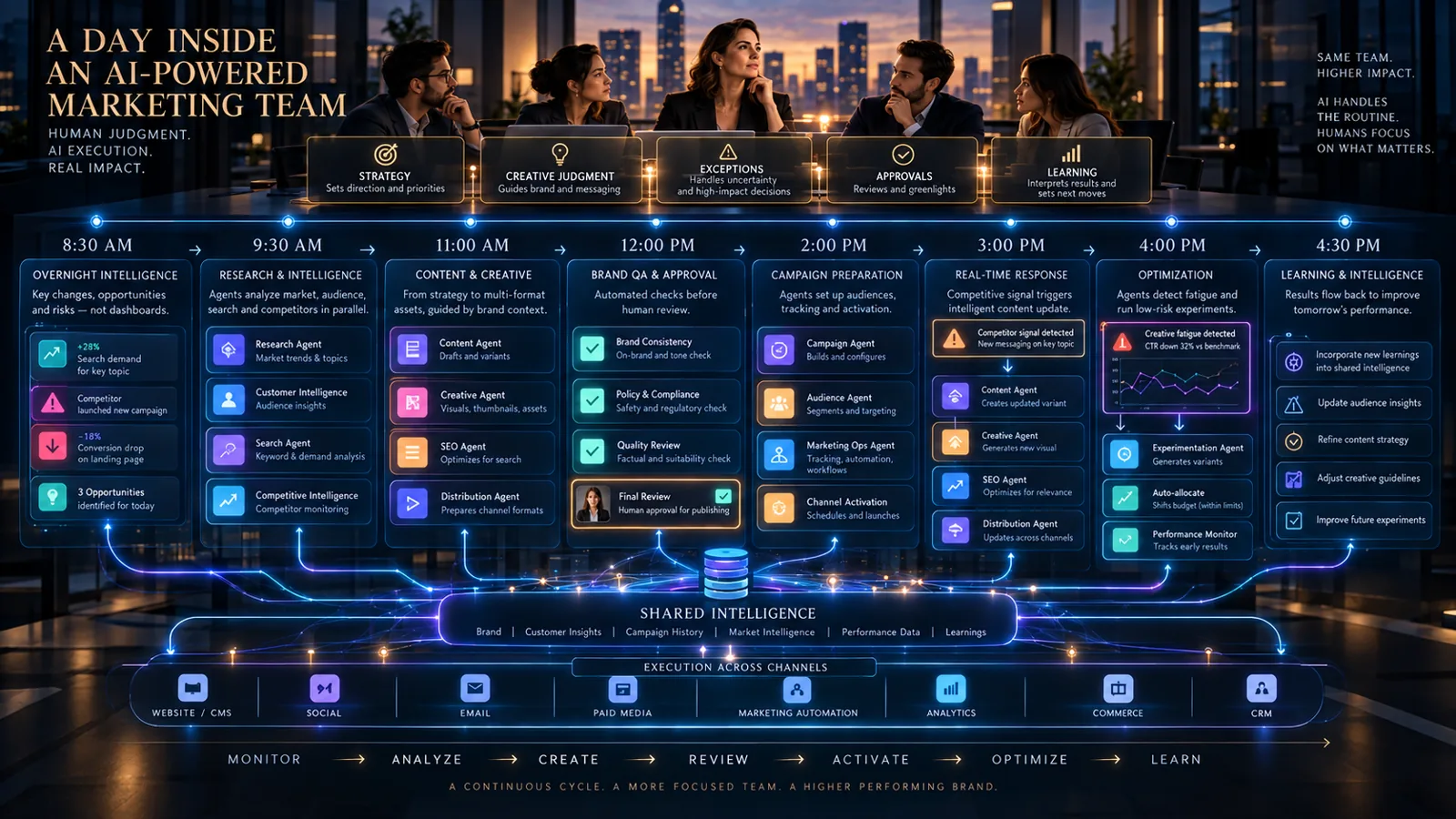
It is 8:30 AM.
The marketing team has not yet opened ten dashboards.
Nobody is downloading yesterday's campaign results into a spreadsheet.
Nobody is manually assembling a report for the morning meeting.
And the first question of the day is not:
“What happened yesterday?”
The system already knows.
Overnight, AI agents monitored campaigns, customer activity, CRM signals, website behavior, search performance, content engagement, and market changes.
Most of it was normal.
So most of it stayed invisible.
Three things were not.
Enterprise conversion declined unexpectedly on one landing page.
A new customer question began appearing across search and sales conversations.
And one campaign creative started outperforming its historical baseline.
By the time the team starts work, these signals have already been investigated.
The marketing leader sees three decision cards.
Not 47 charts.
Not eight dashboards.
Three decisions.
This is what a modern marketing team increasingly looks like.
Humans are still central.
But they are no longer required to manually operate every step of marketing.
The team is becoming a hybrid system of:
human intent
shared intelligence
AI agents
workflow orchestration
automation
human judgment
And that changes not only what marketers do.
It changes what a normal marketing day feels like.
8:30 AM — The Day Starts With Decisions, Not Dashboards
The traditional morning often begins with checking systems.
Open CRM.
Check paid media.
Check web analytics.
Check email.
Check social.
Check pipeline.
Read Slack.
Open the project-management tool.
Try to understand what changed.
The modern marketing team should increasingly avoid this.
Its intelligence layer has been monitoring continuously.
An analytics agent has already compared:
- current performance
- historical baselines
- campaign targets
- customer segments
- traffic sources
- creative variants
- landing pages
Routine fluctuations were ignored.
Only meaningful exceptions reached the team.
The morning briefing might say:
Decision 1
Enterprise landing-page conversion declined 13% overnight.
The decline is concentrated among mobile paid-search traffic and began after yesterday's headline change.
Traffic quality appears stable.
Recommended action:
Run a controlled test between the previous headline and the new version.
Decision 2
“AI marketing governance” increased sharply across customer questions.
The signal appears in:
- sales conversations
- search queries
- website searches
- social discussion
Recommended action:
Evaluate it as a content and campaign opportunity.
Decision 3
Creative Variant C is outperforming the control by 17%.
Confidence has crossed the predefined threshold.
Recommended action:
Increase traffic allocation within the existing experimentation limits.
Now the team begins with decisions.
The data still exists.
The dashboards still exist.
But the dashboards have moved into the background.
9:00 AM — The Human Team Sets Direction
The morning leadership meeting is shorter than it used to be.
Not because strategy matters less.
Because less meeting time is spent reconstructing what happened.
The team focuses on:
- priorities
- trade-offs
- customer implications
- strategy
- creative judgment
- risk
The CMO decides that the emerging governance topic aligns strongly with the company's positioning.
The Content Lead believes it deserves a deeper educational piece rather than a quick trend post.
The Demand Generation Lead wants to test it against an enterprise audience.
The Brand Lead says the framing should avoid fear-based AI messaging.
Those are human decisions.
The system cannot simply optimize its way to them.
This is where the human team creates value.
They determine:
What matters?
What do we believe?
What should the brand say?
Which opportunity deserves resources?
What should not be optimized?
Once those decisions are made, the system can handle far more of the mechanics underneath.
9:30 AM — Research Agents Go to Work
In a traditional marketing team, someone may now spend several hours gathering research.
Search reports.
Competitor websites.
Customer feedback.
Existing content.
Sales notes.
Industry publications.
The modern workflow starts differently.
The marketing leader defines the question:
What are enterprise marketing leaders actually trying to understand about AI governance, and where is the existing content market weak?
The orchestration layer activates several specialized agents in parallel.
Customer Intelligence Agent
Analyzes:
- CRM notes
- customer interviews
- support conversations
- website search behavior
- sales call themes
Search Intelligence Agent
Examines:
- queries
- topic clusters
- intent
- related questions
- existing ranking patterns
Competitive Intelligence Agent
Maps how competitors are discussing the topic.
Content Intelligence Agent
Reviews the company's existing library to prevent duplication and identify internal-link opportunities.
These agents work simultaneously.
Nobody manually moves each request from one department to another.
This parallelism is one of the major advantages of agentic work.
The workflow becomes faster not only because AI works quickly, but because multiple forms of work no longer have to happen sequentially.
10:00 AM — Humans Review the Insight, Not the Raw Research
Twenty minutes later, the system does not return 200 pages of research.
It returns a synthesis.
For example:
Primary customer concern: marketers are comfortable with generative AI but uncertain about where agent autonomy should stop.
High-intent question: “What marketing decisions should AI be allowed to make?”
Content gap: competitors focus heavily on AI policy but rarely explain operational approval thresholds.
Recommended angle: a practical framework for risk-based marketing autonomy.
Supporting evidence: strongest among enterprise marketing operations and CMO audiences.
The strategist reviews the conclusion.
She challenges one assumption.
The system expands the underlying evidence.
She changes the recommended framing.
This interaction matters.
The agent did the information-heavy work.
The human decides what is strategically interesting.
That is the emerging division of labor:
AI expands intelligence.
Humans determine meaning.
10:30 AM — Strategy Becomes the Input to the System
The strategist approves the content angle.
That decision now becomes structured context.
The workflow knows:
- audience
- objective
- positioning
- messaging
- claims
- tone
- CTA
- channels
- success metric
In many traditional organizations, this would become a brief.
The brief would be emailed.
Or placed in project management.
Someone would notify content.
Someone would notify design.
Someone would ask which version is final.
In a modern marketing system, the approved strategy becomes the trigger.
The orchestration layer automatically creates the appropriate downstream work.
That may include:
- long-form content
- social assets
- email copy
- paid-media variants
- visual concepts
- landing-page content
The important point is not that AI writes everything.
The important point is that humans no longer have to manually coordinate every handoff.
11:00 AM — Content and Creative Work in Parallel
The traditional workflow often waits.
Copy first.
Then design.
Then review.
Then revision.
The modern workflow can operate more in parallel.
A Content Agent drafts the long-form structure based on the approved strategy.
A Creative Agent develops visual directions.
A Distribution Agent prepares preliminary channel adaptations.
An SEO Agent evaluates:
- search intent
- topic coverage
- relevant entities
- internal links
- FAQ opportunities
All four share the same approved context.
This is important.
Without shared context, multiple agents would simply create multiple forms of inconsistency.
The content agent might use one positioning.
The ad agent another.
The social agent a third.
A modern marketing system needs shared intelligence so specialized agents behave like one coordinated team.
11:30 AM — Humans Apply Taste
The first draft is ready.
So are three visual concepts.
This is where the creative lead enters.
She is not asked to start from a blank page.
She is asked to make judgments.
Which opening is strongest?
Which idea feels generic?
Which visual looks too much like every other AI company?
Which argument needs more evidence?
Which sentence actually sounds like the brand?
AI can generate abundance.
The human role increasingly becomes selection and elevation.
This may be one of the largest changes in creative work.
Historically:
creation was scarce.
With generative AI:
creation becomes abundant.
What becomes scarce?
Taste.
Originality.
Clarity.
Cultural understanding.
The ability to say:
This is technically good, but we should not publish it.
12:00 PM — Brand and Quality Agents Run Before Approval
Before the work reaches final human review, quality agents inspect it.
They check:
- brand terminology
- factual consistency
- product names
- approved claims
- prohibited language
- links
- channel requirements
- metadata
A separate policy or compliance layer can flag sensitive areas.
Most routine issues are resolved before humans ever see them.
The creative director does not need to spend time finding a missing link.
The senior marketer does not need to check whether the CTA uses the approved wording.
Humans review the things that genuinely require judgment.
Adobe's 2026 marketing operations work reflects this direction: AI is increasingly being applied to program QA, data normalization, campaign setup, and other execution-heavy processes so marketers can spend more time on strategy, quality, and performance.
1:00 PM — Lunch Happens Without Marketing Stopping
This sounds trivial.
It is not.
Traditional marketing operations depend heavily on synchronous human coordination.
If someone is at lunch:
the approval waits.
The routing waits.
The campaign waits.
Agentic systems allow more workflow state to persist independently of individual availability.
An approved draft can automatically progress into:
- formatting
- CMS preparation
- channel adaptation
- metadata generation
- QA
The system knows what can continue and what must wait for a person.
That reduces one of marketing's most persistent sources of latency:
waiting for someone to move the work forward.
2:00 PM — Campaign Preparation Happens Mostly Underneath the Team
The team has approved the campaign direction.
Now dozens of execution details must happen.
Traditionally, marketing operations might handle:
- campaign creation
- naming conventions
- audience preparation
- tracking configuration
- link verification
- asset attachment
- workflow setup
- channel scheduling
Many of these activities are structured and repetitive.
They are increasingly suitable for agents and automation.
The Campaign Agent prepares the program.
The system validates taxonomy.
Audience logic is checked.
Tracking parameters are generated.
Required fields are validated.
Unexpected configurations are flagged.
Instead of manually building the entire campaign, the Marketing Operations Lead reviews exceptions.
This is a crucial shift.
The role changes from:
builder of every campaign
to:
governor of the campaign system.
2:30 PM — The Team Works by Exception
One campaign has a problem.
The audience logic conflicts with a new customer exclusion rule.
The system cannot confidently determine which rule should take priority.
It escalates.
The Marketing Operations Lead sees:
Exception: Audience configuration conflicts with Q4 exclusion policy. Automated execution paused.
This is what human-in-the-loop should increasingly mean.
Not:
Humans approve everything.
But:
Humans handle exceptions, uncertainty, and consequence.
If every action requires human approval, AI has not removed much coordination.
A mature operating model routes routine work automatically and escalates only what deserves judgment.
3:00 PM — A Market Signal Appears
Something changes outside the company.
A competitor announces a significant product update.
Traditional workflow:
Someone notices it.
Shares it in Slack.
Someone else researches it.
Marketing leadership discusses it later.
Maybe a response happens next week.
Modern workflow:
The Competitive Intelligence Agent identifies the announcement.
It evaluates whether the change affects:
- positioning
- existing content
- active campaigns
- customer objections
- sales messaging
The system determines that one active comparison page is now outdated.
It prepares:
- the change summary
- business implication
- affected content
- recommended update
Leadership receives one question:
Competitor X changed its pricing model. Our comparison page now contains one outdated claim. Approve revision?
This is where continuous intelligence becomes operational.
Marketing stops relying entirely on humans to notice every important external change.
3:30 PM — An Agent Can Launch Work From the Signal
Leadership approves the update.
That decision triggers:
Content Agent → revises relevant section.
SEO Agent → ensures page intent remains intact.
Brand Agent → validates language.
Web workflow → stages change.
Human → reviews final high-impact claim.
Approved update → publishes.
The entire workflow may complete within the same afternoon.
Adobe's September 2026 work on agentic workflows describes precisely this broader shift: brands can increasingly connect trend detection to campaign planning, content creation, approvals, and activation in one coordinated workflow rather than losing time across manual handoffs.
4:00 PM — Performance Optimization Happens Continuously
Meanwhile, yesterday's campaigns have continued running.
Nobody waited until 4 PM to inspect them.
The Analytics Agent continuously monitored:
- conversion
- spend
- pipeline
- channel efficiency
- customer segments
- creative performance
Most changes remained within normal ranges.
One did not.
An ad creative showed strong evidence of fatigue.
The system compared:
- frequency
- CTR
- conversion
- historical creative decay
- audience mix
The likely diagnosis was strong enough to act.
Because the team had predefined a low-risk optimization policy, the system did not require a meeting.
It reduced traffic to the declining asset and shifted a limited portion toward two approved alternatives.
That action was logged.
The human sees:
Creative fatigue detected. Allocation adjusted within approved bounds. No action required.
Adobe describes this same evolution from manual analysis and execution toward agent-supported, guided, or automated campaign optimization.
This is a very different marketing environment.
Humans do not have to personally touch every optimization for humans to remain accountable for the system.
4:30 PM — The Team Reviews Learning, Not Activity
The afternoon team review does not focus on:
How many posts were published?
How many tasks were completed?
How many prompts were used?
Instead, it asks:
What did we learn today?
The system summarizes:
Learning 1
Enterprise visitors responded better to outcome-focused messaging than feature-heavy messaging.
Learning 2
AI governance is emerging as a stronger customer concern than anticipated.
Learning 3
Creative Variant C performs particularly strongly among mid-market customers but not enterprise accounts.
These insights are validated by humans and added to shared intelligence.
That means tomorrow's agents begin with more context than today's agents had.
The marketing system learns.
Not because the model magically knows everything.
Because validated organizational knowledge persists.
5:00 PM — Humans Spend More Time on Tomorrow
This is perhaps the biggest difference.
When routine execution consumes less time, the team can work further ahead.
The CMO considers:
Where is the market moving?
The strategist asks:
Which customer problem are we underestimating?
The creative lead explores:
What should the next campaign feel like?
The product marketer asks:
How is the category changing?
The analyst designs:
Which experiment would actually change our understanding?
These are difficult questions.
They require:
- imagination
- judgment
- interpretation
- trade-offs
- taste
They are exactly the kinds of questions humans should spend more time answering.
What the AI Agents Did All Day
It may help to step back.
During this single day, AI agents handled parts of:
- performance monitoring
- anomaly detection
- customer research
- search research
- competitive intelligence
- content preparation
- SEO analysis
- brand QA
- campaign setup
- workflow routing
- channel adaptation
- optimization
- reporting
- organizational learning
No single giant AI chatbot did all of this.
Different specialized agents owned different capabilities.
The orchestration layer coordinated them.
Shared intelligence provided common context.
Enterprise platforms executed actions.
Humans controlled the important decisions.
That is what an AI-native marketing team increasingly looks like.
What the Humans Did All Day
Now compare the human workload.
Humans spent their time on:
- prioritization
- strategy
- positioning
- creative judgment
- exceptions
- high-consequence approvals
- interpretation
- experimentation
- learning
- future planning
Notice what is missing.
Humans spent far less time:
- downloading reports
- manually routing tasks
- copying information
- building routine campaign configurations
- checking every metric
- preparing repetitive updates
- switching between systems simply to find context
The purpose of AI is not simply to make each of these activities faster.
It is to make many of them unnecessary.
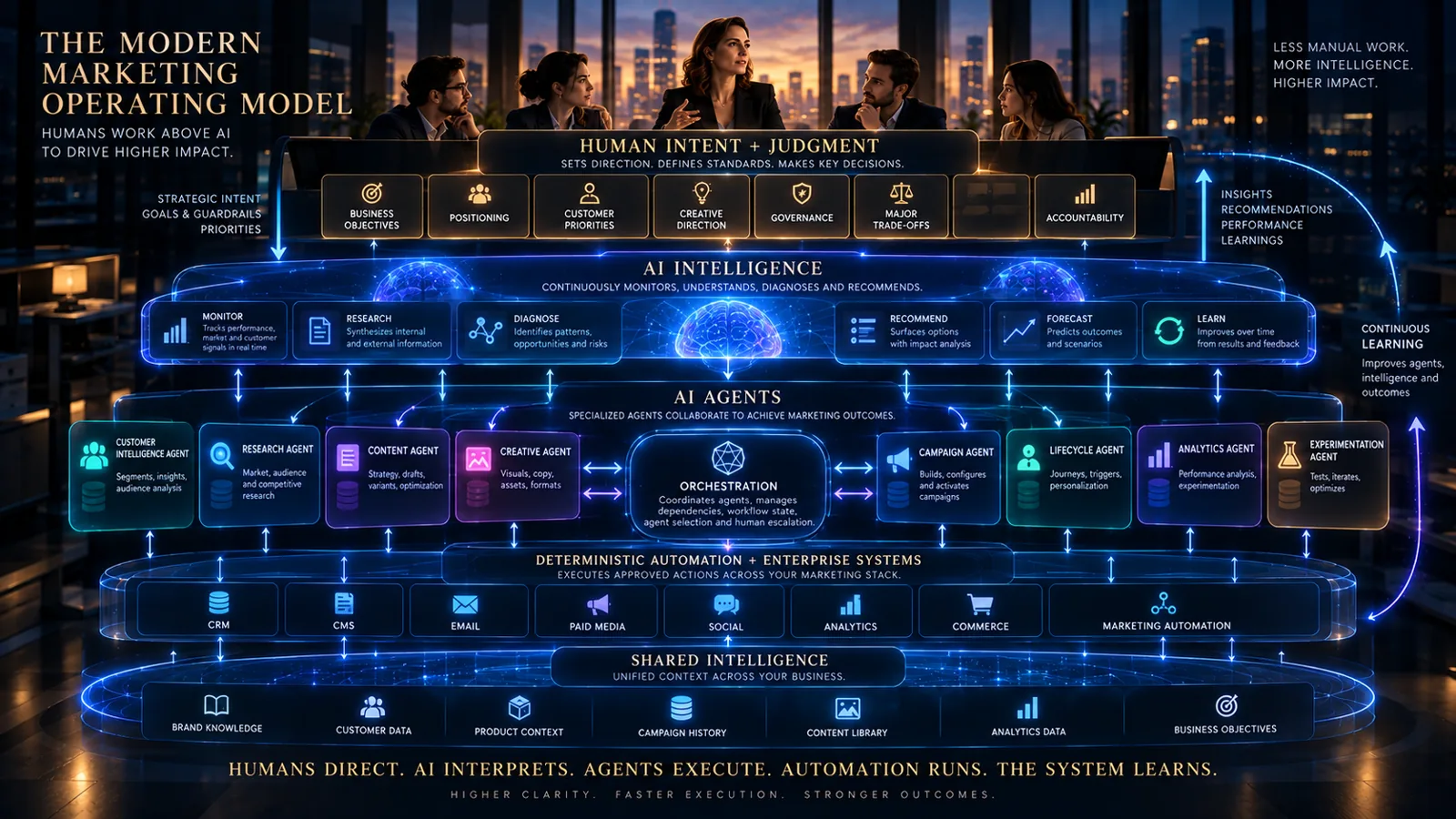
The Modern Marketing Team Has Four Types of Work
This future becomes clearer if marketing work is divided into four layers.
1. Human Intent
Humans define:
- business objectives
- customer priorities
- positioning
- strategy
- creative direction
2. AI Intelligence
AI helps:
- monitor
- research
- synthesize
- diagnose
- recommend
- forecast
3. Agent Execution
Agents handle:
- workflow coordination
- content preparation
- campaign building
- optimization
- adaptation
- analysis
4. Deterministic Automation
Reliable systems execute:
- triggers
- data updates
- publishing
- routing
- scheduled processes
This division allows people to move upward.
It Is Not Humans vs AI
The day described above does not show AI replacing a marketing team.
It shows AI changing where that team's time goes.
This distinction is crucial.
The future is not:
human marketer or AI agent.
It is:
human marketer + AI agent + automation + software.
Each operates at the layer where it creates the most value.
Humans are good at:
- ambiguity
- values
- taste
- strategy
- empathy
- accountability
AI is increasingly good at:
- synthesis
- pattern recognition
- generation
- monitoring
- flexible reasoning
Automation is good at:
- predictable execution
- repeatable rules
The best operating model combines all three.
Marketing Managers Become Orchestrators
This changes management as well.
Traditional managers spend significant time asking:
Who owns this?
Where is it?
Has it been approved?
Why is it late?
Who needs to review it?
The modern manager should increasingly supervise:
- outcomes
- standards
- exceptions
- system performance
- agent performance
- priorities
Adobe now explicitly describes this emerging model as human-agent work, where agents participate in the same operating environment, work from shared context, and complete real work rather than merely offering suggestions.
Management shifts from coordinating every task to governing the system that coordinates the tasks.
Marketing Operations Becomes More Strategic
Marketing operations may experience one of the largest changes.
Historically, Marketing Ops often became responsible for:
- platform configuration
- workflow maintenance
- campaign setup
- troubleshooting
- data hygiene
- reporting
Those responsibilities remain important.
But agents can increasingly handle parts of repetitive execution.
Marketing Ops then moves toward:
- workflow design
- system architecture
- data quality
- governance
- orchestration
- agent permissions
- measurement architecture
That elevates the function.
Marketing operations becomes less about keeping software running and more about designing how modern marketing runs.
Analysts Move From Reporting to Decision Intelligence
The same shift happens in analytics.
The analyst's old week may have contained:
- data pulls
- dashboard maintenance
- recurring reporting
- spreadsheet work
The modern analyst spends relatively more time:
- designing experiments
- validating AI hypotheses
- identifying causal relationships
- improving measurement
- challenging assumptions
- advising strategic decisions
AI performs more first-level investigation.
Humans perform deeper reasoning.
Creatives Move From Production Scarcity to Judgment Scarcity
Generative AI changes creative work differently.
Production becomes abundant.
The team can create:
100 headlines.
50 visual directions.
20 campaign variants.
That does not make creativity easier.
It makes selection more important.
Creative leaders increasingly decide:
What is distinctive?
What is boring?
What feels human?
What deserves to exist?
What fits the moment?
The scarce skill becomes taste.
That may ultimately increase the importance of strong creative leadership.
Shared Context Is What Makes the Team Work
There is one major dependency behind this entire day:
shared intelligence.
Without it, the system breaks down.
Agents need common access to:
- brand knowledge
- customer intelligence
- product information
- campaign history
- CRM data
- analytics
- business objectives
- approved policies
Otherwise, every agent becomes what Adobe calls a kind of “brilliant stranger”—capable, but unaware of how the organization actually operates.
This is why the future marketing team is not simply a collection of agents.
It is an architecture.
The Modern Marketing Team Runs Continuously
There is another subtle shift.
Traditional teams largely operate during human working hours.
An AI-supported marketing system does not have to.
While the team sleeps:
- monitoring continues
- signals are classified
- reports update
- low-risk processes execute
- anomalies are detected
- research can run
Humans return to work with the environment already understood.
This does not mean teams should operate at unhealthy speed.
It means machines can maintain continuity so humans do not have to.
The system works continuously.
Human attention remains finite.
That is an important design principle.
What Should Never Become Fully Autonomous?
Even in a highly agentic marketing organization, certain areas should remain strongly human-led.
These include:
- business strategy
- positioning
- major budget decisions
- brand-defining campaigns
- sensitive communications
- major customer promises
- ethical decisions
- ambiguous high-risk decisions
- accountability
The goal is not maximum autonomy.
It is appropriate autonomy.
Routine activity can flow.
Important judgment should rise.
From Marketing Team to Marketing System
This may ultimately be the biggest change.
Historically, the marketing team was the system.
People held the context.
People moved the work.
People noticed the signals.
People connected the software.
People maintained continuity.
AI allows more of that operating logic to exist in infrastructure.
The marketing organization increasingly becomes:
humans + shared intelligence + agents + automation + enterprise systems.
This makes knowledge less dependent on individuals.
It makes workflows less dependent on manual coordination.
And it allows human talent to concentrate higher in the stack.
The Best Modern Marketing Team May Look Surprisingly Small
This does not necessarily mean every marketing department becomes tiny.
But team size becomes less tightly connected to execution volume.
Historically:
More campaigns required more campaign managers.
More content required more writers.
More reporting required more analysts.
More coordination required more managers.
Agentic systems weaken some of those relationships.
A relatively small team may be able to direct much larger execution capacity.
That changes the question from:
How many people do we need to produce this much marketing?
to:
How much judgment do we need to govern this marketing system well?
That is a fundamentally different way to design an organization.
What Does a Modern Marketer Actually Do?
The simplest answer is:
Less operating.
More deciding.
Less copying.
More interpreting.
Less reporting.
More learning.
Less routing.
More prioritizing.
Less repetitive creation.
More creative direction.
Less dashboard watching.
More judgment.
The modern marketer does not become less important.
The marketer moves upward.
A Day in the Life of Marketing Is Becoming a Day of Decisions
The traditional marketing day was filled with tasks.
The modern AI-enabled marketing day increasingly revolves around decisions.
What deserves attention?
What should we believe?
What opportunity matters?
What should the brand say?
Which risk needs intervention?
What did we learn?
The rest increasingly becomes infrastructure.
AI monitors.
Agents coordinate.
Automation executes.
Systems remember.
Humans judge.
That is the emerging architecture of the modern marketing team.
And if we design it well, the greatest benefit of AI may not be that marketers produce more.
It may be that marketers finally spend more of their day doing the work humans are actually best at.
Frequently asked questions
What does a modern marketing team look like in 2026?
A modern marketing team increasingly combines human leaders and specialists with shared business intelligence, AI agents, automation, analytics, and enterprise platforms. Humans focus more on strategy, creative judgment, governance, and high-consequence decisions.
How are AI agents used in marketing teams?
AI agents can support research, monitoring, analytics, content preparation, campaign operations, workflow routing, optimization, customer intelligence, and experimentation within defined permissions and guardrails.
Do AI agents replace marketing employees?
Not necessarily. They change the division of work. AI can handle more repetitive execution, monitoring, and coordination while humans concentrate on strategy, creativity, relationships, judgment, and accountability.
What should humans still do in an AI-powered marketing team?
Humans should retain strong ownership of business objectives, positioning, strategic priorities, creative standards, major trade-offs, sensitive communications, governance, and final accountability.
How does agentic AI change marketing operations?
Agentic AI can reduce manual campaign setup, QA, workflow routing, data normalization, reporting, and repetitive operational tasks. Marketing Operations can then focus more on system architecture, orchestration, governance, and measurement.
How does AI change the role of marketing analysts?
AI can automate recurring reporting and first-level investigation, allowing analysts to spend more time on experimentation, measurement design, causal analysis, strategic interpretation, and validating AI-generated conclusions.
What is shared intelligence in a marketing team?
Shared intelligence is a common contextual layer containing relevant brand, customer, product, campaign, CRM, analytics, and business knowledge that humans and AI agents can use consistently.
What is human-agent collaboration?
Human-agent collaboration is an operating model in which AI agents participate directly in workflows alongside humans, handling appropriate tasks while people provide strategy, standards, oversight, judgment, and accountability.
Will modern marketing teams need fewer people?
AI may reduce the amount of human labor required for certain repetitive or coordination-heavy processes, allowing some teams to increase output without proportional headcount growth. However, the appropriate team structure depends on the business, strategy, complexity, and required human expertise.