AI Adoption vs AI Transformation: Why Using AI Is Not the Same as Changing How Your Business Works
AI appears in CRM systems, productivity software, analytics platforms, advertising tools, and enterprise applications.
Almost every company can now say it is using AI.
Employees use AI assistants.
Marketing teams generate content.
Sales teams summarize calls.
Developers use coding copilots.
Analysts use AI to interpret data.
Customer-service teams experiment with agents.
AI appears in CRM systems, productivity software, analytics platforms, advertising tools, and enterprise applications.
By one measure, this looks like extraordinary transformation.
But there is a problem.
Many companies are using AI while continuing to operate almost exactly as they did before AI existed.
The same workflows remain.
The same approval chains remain.
The same teams own the same handoffs.
The same data remains fragmented.
The same dashboards require human interpretation.
The same organizational bottlenecks continue.
AI has been added.
The organization has not necessarily changed.
That is the fundamental difference between AI adoption and AI transformation.
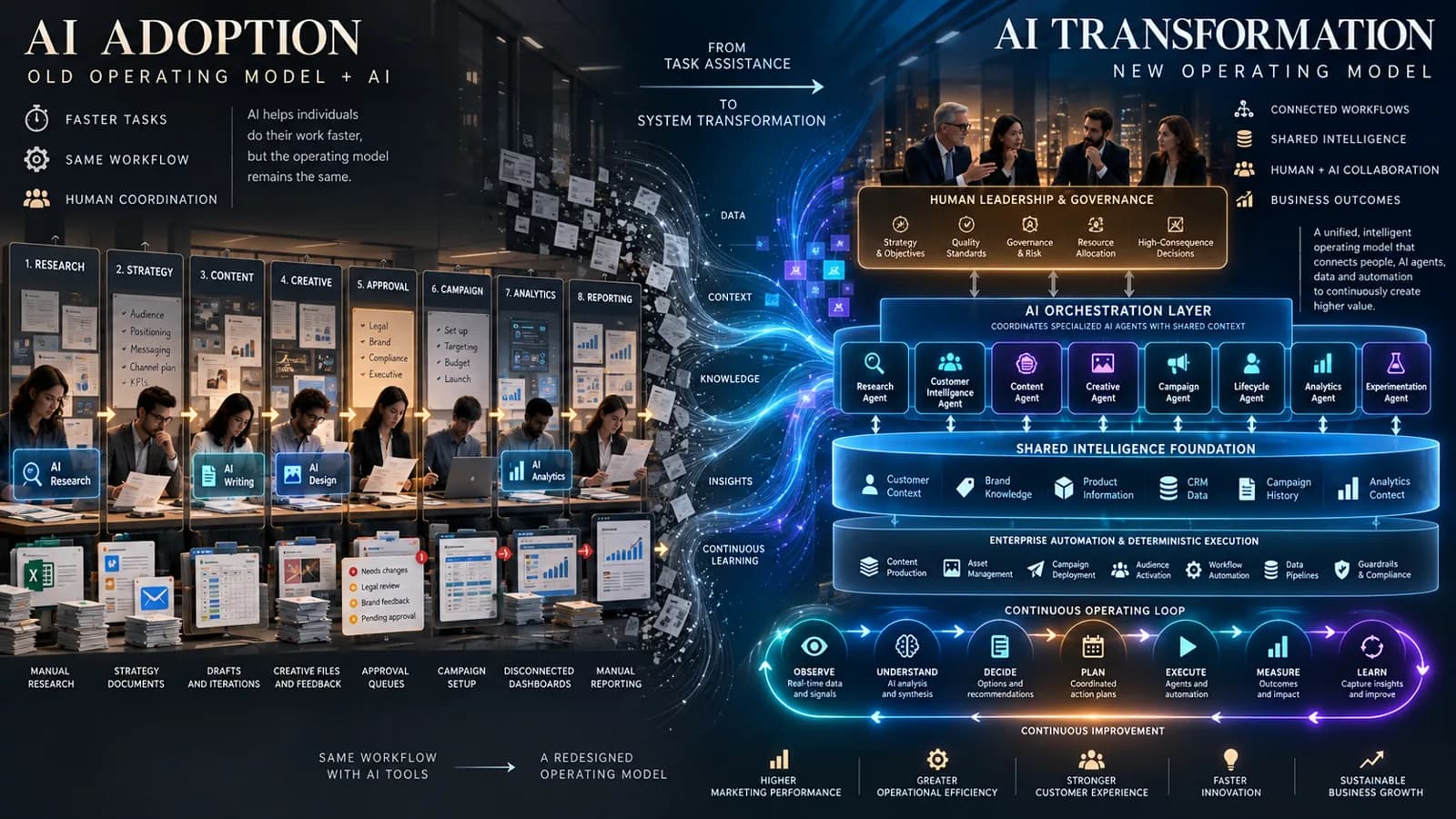
AI adoption means people are using AI.
AI transformation means the organization operates differently because AI exists.
The distinction may determine which companies actually create value from artificial intelligence—and which simply add another generation of tools to an unchanged operating model.
What Is AI Adoption?
AI adoption is the introduction and use of artificial intelligence tools, capabilities, or features within an organization.
Examples include:
- employees using ChatGPT or similar assistants
- marketers using AI to generate content
- designers using generative image tools
- salespeople using AI call summaries
- developers using coding copilots
- analytics platforms generating AI insights
- CRM systems recommending next actions
- customer-service teams experimenting with AI agents
These activities can produce real value.
People may work faster.
Content production may increase.
Research may take less time.
Repetitive tasks may decline.
But none of those outcomes automatically mean the organization has transformed.
Adoption answers the question:
Are people using AI?
Transformation asks something much harder:
Has AI changed how work actually gets done?
What Is AI Transformation?
AI transformation is the redesign of an organization's workflows, roles, decision processes, data architecture, technology, governance, and operating model around the capabilities AI makes possible.
It goes beyond introducing tools.
It changes the system.
Consider marketing.
AI adoption might mean:
The content team uses AI to draft an article.
AI transformation might mean:
A customer-intelligence agent continuously identifies new audience questions.
Those insights automatically inform the content strategy.
A content agent creates drafts using shared brand and product context.
An SEO agent evaluates search opportunities.
A brand system reviews outputs.
High-risk claims go to a human.
Approved content moves into publishing workflows.
Performance is monitored automatically.
New insights update future strategy.
The transformation is not the AI-written article.
The transformation is the redesigned workflow around it.
The Simplest Difference: Tool Usage vs Operating Model Change
A useful way to understand the distinction is:
AI Adoption
Old Operating Model + AI
AI Transformation
New Operating Model Designed Around AI
That is the entire argument in two lines.
Many organizations currently sit in the first category.
They have taken existing processes and added AI at selected points.
A workflow previously looked like:
Research → Brief → Draft → Review → Design → Approval → Publish → Report
Now it looks like:
AI Research → Brief → AI Draft → Review → AI Design → Approval → Publish → AI Report
There is much more AI.
But the workflow is fundamentally unchanged.
People still:
- initiate the work
- transfer context
- route tasks
- chase approvals
- interpret outputs
- move assets
- coordinate systems
- determine what happens next
This is adoption.
Transformation begins when the workflow itself is redesigned.
The Adoption-Value Gap Is Already Visible
The industry is producing an important contradiction.
AI usage is high.
AI transformation is much lower.
Salesforce's 2026 State of Marketing found that 75% of marketers have adopted AI, yet 84% still report running generic campaigns. Disjointed systems and poor-quality data remain major barriers to more responsive, personalized marketing.
McKinsey reports an even more striking gap.
Although 90% of CMOs are experimenting with AI use cases, fewer than 10% have either scaled AI or captured value across marketing workflows. Only 28% of surveyed organizations said they were pursuing fundamental rewiring of their marketing teams and workflows.
This is the adoption-transformation gap.
Companies have deployed the technology.
They have not yet redesigned the organization around it.
Why Adoption Is So Much Easier Than Transformation
The explanation is straightforward.
Buying technology is relatively easy.
Changing organizations is difficult.
A company can deploy an AI assistant in weeks.
But transformation may require changing:
- data architecture
- workflows
- job responsibilities
- approval structures
- performance metrics
- governance
- management practices
- technology integrations
- incentives
- team structures
It may also challenge assumptions employees have developed over years.
Who owns this step?
Who approves this?
What happens to this role?
Can the AI act independently?
Who is accountable when it fails?
Which data can it access?
Transformation forces organizations to answer these questions.
Adoption often does not.
Stage 1: AI as a Personal Productivity Tool
Most companies begin here.
Individuals use AI to accelerate their own work.
A marketer asks AI to:
- write copy
- summarize research
- brainstorm campaigns
- analyze customer feedback
- create images
- generate social posts
An analyst asks AI to explain data.
A manager asks it to summarize meetings.
These are valuable use cases.
They increase individual productivity.
But the unit of change is still:
the employee.
The workflow around that employee remains intact.
This is often the first stage of AI adoption.
It should not be mistaken for organizational transformation.
Stage 2: AI Inside Existing Software
The next stage occurs when AI becomes embedded inside enterprise platforms.
CRM gets AI.
Analytics gets AI.
Email gets AI.
Design gets AI.
Project management gets AI.
Marketing automation gets AI.
Now AI becomes part of existing processes.
But a structural limitation remains.
Each platform may optimize its own piece of the workflow.
The CRM AI understands CRM.
The analytics AI understands analytics.
The advertising AI understands paid media.
The content AI understands content.
Humans remain responsible for coordinating the whole.
Adobe's 2026 marketing research found exactly this pattern: AI adoption is occurring through existing martech platforms, individual subscriptions, and enterprise systems simultaneously. Adobe concludes that adoption without coordination keeps AI tactical rather than transformative.
This is where many organizations are today.
Stage 3: AI Automates Existing Workflows
The next stage is workflow automation.
Companies begin connecting AI to processes.
For example:
A form submission triggers AI lead qualification.
AI-generated content moves into review.
Analytics automatically produces campaign summaries.
Customer-service interactions are classified automatically.
This is more advanced.
But there is still an important question:
Is the workflow itself good?
Automating a poor workflow does not transform it.
If a campaign has seven unnecessary approval stages, automating the routing between those seven stages does not eliminate the problem.
If customer data is fragmented, generating faster recommendations does not unify the customer.
If teams are measuring the wrong KPI, faster analytics does not create better decision-making.
Transformation requires asking:
If we were designing this workflow from scratch today, knowing what AI can do, would we design it this way?
Often, the answer is no.
Stage 4: Workflows Are Redesigned Around Human-AI Collaboration
This is where genuine transformation begins.
Instead of asking:
Where can we insert AI into the existing process?
the organization asks:
What is the best way for humans, AI agents, automation, and software to accomplish this outcome?
Consider customer research.
Traditional workflow:
Research team gathers information.
Analysts synthesize findings.
Marketing leaders review a presentation.
Campaign teams receive the insights.
Months later, the process repeats.
AI-transformed workflow:
AI agents continuously analyze:
- customer conversations
- CRM data
- search behavior
- reviews
- support tickets
- campaign responses
- sales feedback
Important changes are surfaced automatically.
Humans evaluate strategic implications.
Validated insights update shared customer intelligence.
Every relevant workflow can use the updated context.
The task was not simply automated.
The entire operating model changed.
Stage 5: AI Becomes Part of the Operating Model
The deepest transformation occurs when AI is no longer treated as a special project.
It becomes infrastructure.
The organization has:
- shared intelligence
- reusable AI capabilities
- specialized agents
- workflow orchestration
- deterministic automation
- governance
- human approval structures
At this stage, teams do not constantly ask:
“Can we use AI for this?”
AI is already part of how the organization operates.
The more useful question becomes:
What should the optimal division of work be between humans and machines?
That is a much more mature question.
AI Transformation Changes the Unit of Work
Traditional organizations think largely in tasks and roles.
Writer writes.
Analyst analyzes.
Campaign manager manages campaigns.
Researcher researches.
AI creates a different possibility.
Work can be decomposed into capabilities.
For example, launching a campaign might involve:
- market research
- customer intelligence
- strategic reasoning
- copy generation
- creative production
- brand validation
- channel configuration
- measurement
- optimization
Now ask:
Which of these requires human judgment?
Which can an AI agent perform?
Which should use deterministic automation?
Which should happen in parallel?
Which requires approval?
Transformation redesigns the flow of capabilities.
The existing job description becomes less important than designing the best workflow.
AI Transformation Changes Roles
This naturally changes jobs.
AI adoption adds AI to someone's current role.
AI transformation changes what the role exists to do.
Consider a marketing analyst.
Adoption
The analyst uses AI to summarize reports faster.
Transformation
AI continuously monitors performance, identifies anomalies, investigates likely causes, and prepares recommendations.
The analyst increasingly focuses on:
- validating conclusions
- designing measurement frameworks
- challenging assumptions
- investigating unusual cases
- connecting analysis to business decisions
The role moves upward.
The same pattern can happen across marketing.
Content creators shift toward editorial judgment.
Campaign managers shift toward orchestration.
Marketing operations shifts toward systems design.
Analysts shift toward decision intelligence.
Leaders shift toward governance and high-consequence decisions.
Transformation therefore affects organization design, not simply productivity.
AI Transformation Changes the Data Problem
AI adoption can happen with fragmented data.
Open an AI assistant.
Paste information into it.
Get an answer.
AI transformation cannot scale that way.
Agents need reliable organizational context.
Marketing systems need access to:
- customer intelligence
- brand knowledge
- CRM data
- product information
- campaign history
- analytics
- content
- business objectives
Salesforce's findings demonstrate why this matters.
Marketing teams satisfied with their unified customer data were 42% more likely to regularly respond to customers and 60% more likely to use AI agents to scale their work than teams without sufficiently unified data.
AI transformation therefore depends as much on information architecture as model capability.
The model may be brilliant.
But fragmented context limits what it can accomplish.
AI Transformation Changes Decision-Making
One of the biggest opportunities lies beyond task automation.
It lies in compressing the distance between:
signal → insight → decision → action
Traditional marketing may look like:
Campaign performance changes.
Analyst notices.
Report gets prepared.
Meeting gets scheduled.
Team discusses.
Leader decides.
Manager assigns action.
Campaign changes.
AI-native decision-making can look very different:
System detects change.
Analytics agent investigates.
Customer and campaign context are retrieved.
Potential causes are ranked.
Recommended actions are generated.
Low-risk actions execute within approved boundaries.
High-consequence actions surface to humans.
That is not simply faster analytics.
It is a redesigned decision system.
AI Transformation Changes Management
Managers traditionally spend considerable time coordinating work.
Who owns this?
Has this been completed?
What is blocked?
Where is the latest version?
Who needs to approve it?
What happens next?
Agentic systems can increasingly manage parts of this coordination.
That changes management itself.
Instead of constantly routing tasks, managers can focus more on:
- priorities
- outcomes
- exceptions
- quality
- coaching
- judgment
- resource allocation
The role moves from task coordination toward system governance.
This does not eliminate managers.
It changes where management adds value.
AI Transformation Changes Metrics
Another sign that a company is stuck at the adoption stage is how it measures success.
Common AI metrics include:
- employees using AI
- prompts submitted
- AI tools purchased
- content generated
- hours theoretically saved
These can help track adoption.
They do not demonstrate transformation.
Transformation should eventually appear in business and workflow outcomes such as:
- revenue
- conversion
- cycle time
- cost to serve
- campaign speed
- customer satisfaction
- marketing capacity
- error rates
- decision speed
- employee productivity
- learning velocity
Adobe's 2026 research describes a similar shift in emphasis: the measure of AI success is moving from outputs toward outcomes.
The key question is not:
How much AI did we use?
It is:
Did the organization become meaningfully better?
AI Transformation Requires Governance
The more deeply AI enters workflows, the more important governance becomes.
A personal AI assistant creates limited operational risk.
An agent capable of:
- publishing content
- modifying campaign budgets
- contacting customers
- changing targeting
- accessing sensitive information
creates a very different risk profile.
Transformation therefore requires explicit rules around:
- permissions
- data access
- budget authority
- publishing rights
- approval thresholds
- escalation
- audit trails
- security
- compliance
This is another reason why transformation moves slower than adoption.
More autonomy requires better control.
AI Transformation Is Also a People Transformation
Technology discussions frequently understate this.
Employees must understand:
- why the operating model is changing
- which responsibilities remain human
- how performance expectations will change
- what skills become more valuable
- how AI decisions will be reviewed
McKinsey's 2026 research emphasizes that becoming AI-ready is as much a people challenge as a technology challenge. It found a notable gap between leadership perceptions and workforce experience, including significant anxiety among individual contributors about AI-related change.
Transformation cannot simply be imposed through software deployment.
People need:
- clarity
- training
- incentives
- new role definitions
- trust
- governance
- leadership
Otherwise, sophisticated systems can remain unused or be resisted informally.
The Five Signs You Have AI Adoption but Not AI Transformation
An organization is probably still in the adoption stage if:
1. AI Depends on Individual Employees
AI usage disappears if the employee who created the prompts leaves.
There is little organizational memory or reusable infrastructure.
2. Every AI Interaction Starts From Zero
Teams repeatedly explain:
- the brand
- the customer
- the product
- the objective
There is no shared intelligence.
3. The Same Workflow Still Exists
AI makes individual steps faster, but the sequence of work and number of handoffs are unchanged.
4. Humans Still Coordinate Everything
AI generates outputs, but people remain responsible for routing, approvals, context transfer, and follow-up.
5. AI Success Is Measured by Usage
Management celebrates adoption rates instead of business outcomes.
Those are all signs of progress.
But they are not yet transformation.
Seven Signs Real AI Transformation Is Happening
Transformation looks different.
1. Workflows Are Being Redesigned
Teams question whether legacy processes still make sense.
2. Shared Context Exists
AI systems can access consistent brand, customer, product, and business knowledge.
3. Agents Work Across Multiple Steps
AI begins coordinating work rather than only producing isolated outputs.
4. Human Roles Are Changing
People move toward higher-value judgment, strategy, creativity, and governance.
5. Decision Cycles Become Shorter
Insights connect more directly to actions.
6. Governance Is Built Into Workflows
AI autonomy exists within explicit boundaries.
7. Business Outcomes Improve
Revenue, productivity, speed, customer experience, or cost materially changes.
That is transformation.
The AI Transformation Maturity Model
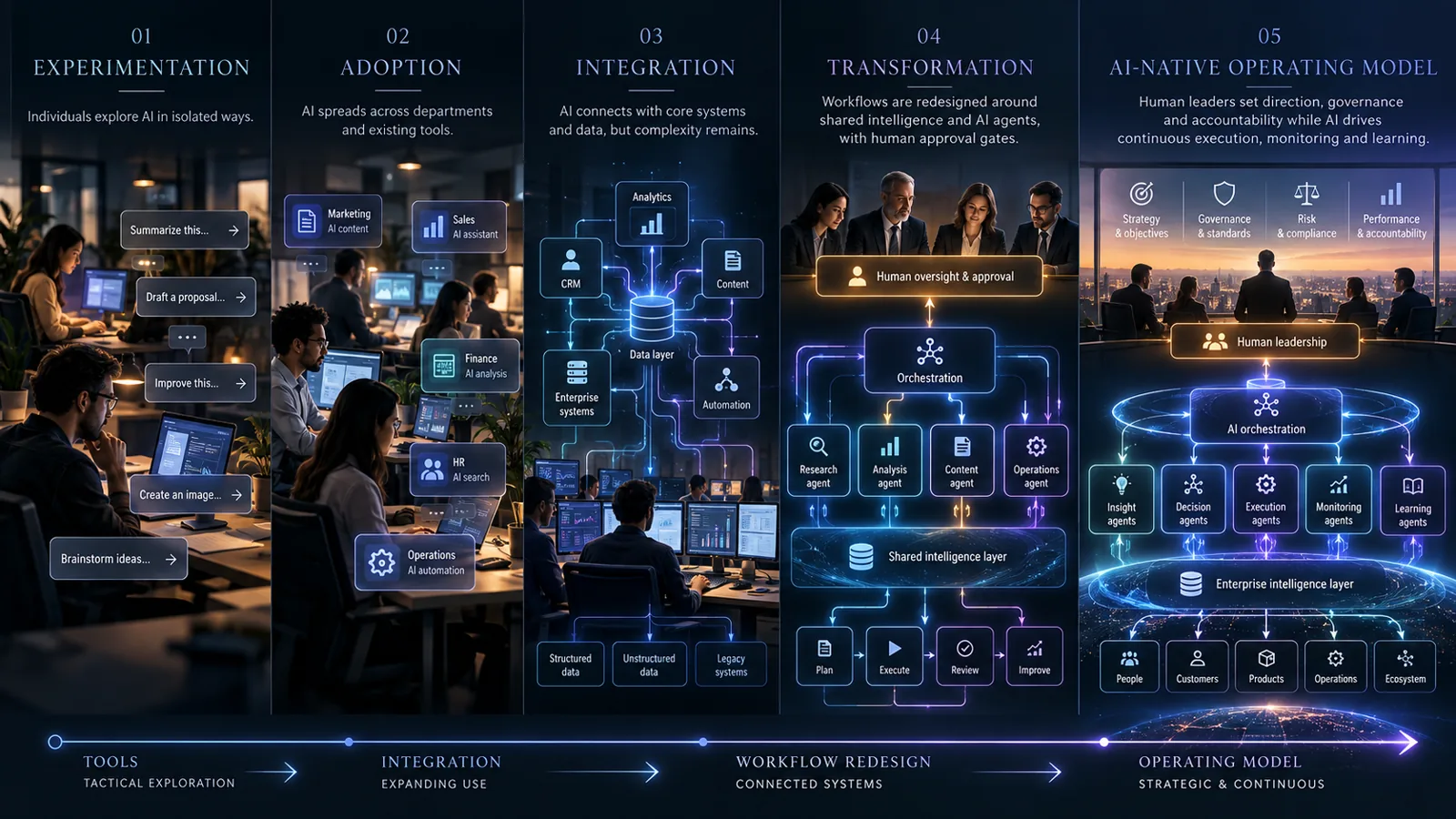
A useful framework is to think of AI maturity in five stages.
Level 1 — Experimentation
Individuals test AI.
Primary question: What can AI do?
Level 2 — Adoption
AI becomes common across teams.
Primary question: Where can AI make us faster?
Level 3 — Integration
AI connects to enterprise systems and workflows.
Primary question: How can AI participate in our processes?
Level 4 — Transformation
Workflows, roles, and decision systems are redesigned.
Primary question: How should work happen now that AI exists?
Level 5 — AI-Native Operating Model
Human and machine capabilities operate together by design.
Primary question: How do we continuously improve the system?
Most organizations will move through these stages gradually.
Trying to jump directly from experimentation to autonomy is usually unrealistic.
But knowing the destination matters.
Marketing Provides a Perfect Example
Marketing demonstrates the difference especially clearly.
Imagine three companies.
Company A: AI Adoption
Marketers use AI to write:
- articles
- social posts
- emails
- ad copy
Productivity rises.
But campaigns operate exactly as before.
Company B: AI Integration
AI connects to CRM, analytics, and content workflows.
Reports are automated.
Some campaigns use AI recommendations.
Marketing becomes faster.
Company C: AI Transformation
Shared customer intelligence feeds specialized agents.
Research happens continuously.
Content and campaign agents collaborate.
Performance changes trigger investigation.
Decision intelligence reaches leaders automatically.
Low-risk optimizations happen within boundaries.
Humans focus on:
- strategy
- positioning
- creative judgment
- governance
- major trade-offs
All three companies use AI.
Only Company C has fundamentally changed how marketing operates.
Don't Automate the Past
One of the biggest risks of the current AI wave is that companies use powerful new technology to preserve outdated operating models.
We take:
old workflows,
old approval structures,
old dashboards,
old organizational boundaries,
old metrics,
and put AI inside them.
That may produce incremental productivity.
But it misses the larger opportunity.
McKinsey makes this distinction explicitly, arguing that the opportunity is not merely to automate marketing workflows but to redesign marketing as a continuous AI-powered growth engine.
The key principle is:
Do not use AI simply to automate how work used to happen.
Ask how work should happen now.
How to Move From AI Adoption to AI Transformation
Transformation does not require automating the whole company at once.
Start with one important workflow.
Step 1: Choose a High-Value Business Outcome
Do not begin with:
“Where can we use AI?”
Begin with:
“What outcome needs to improve?”
Examples:
- increase campaign speed
- improve conversion
- reduce reporting effort
- improve personalization
- shorten content production
- improve customer response
Step 2: Map the Current Workflow
Document:
- people
- steps
- systems
- inputs
- outputs
- approvals
- delays
- decisions
Step 3: Question Every Step
Ask:
Why does this exist?
Does it still need to?
Could AI eliminate it?
Could two steps become one?
Could several activities happen simultaneously?
Step 4: Assign Work by Capability
Separate tasks into:
Human work
Strategy, judgment, creativity, empathy, accountability.
AI work
Research, synthesis, reasoning, generation, monitoring.
Automation
Predictable, rules-based execution.
Step 5: Connect the Data
Make relevant organizational context accessible.
Step 6: Design Governance
Define where AI:
- recommends
- acts
- escalates
- requires approval
Step 7: Redesign Roles
Do not simply reduce workload.
Move human attention toward higher-value work.
Step 8: Measure the Entire Workflow
Compare before and after:
- cycle time
- cost
- capacity
- quality
- revenue
- customer outcomes
- human hours
That is how AI impact becomes visible.
AI Transformation Is an Operating Model Question
The deepest mistake companies can make is treating AI purely as a technology initiative.
AI affects:
technology,
yes.
But also:
people,
process,
data,
management,
decision-making,
organizational design,
governance,
strategy.
That makes AI transformation an operating model problem.
The companies that capture the most value will probably not simply have the best models.
The same powerful foundation models will increasingly be available to many organizations.
The difference will come from:
how those models are connected,
what context they have,
which workflows they participate in,
which decisions they influence,
how people work with them,
and how intelligently the entire organization is redesigned.
The technology becomes widely available.
The operating model becomes the advantage.
The Future Is Not About Using More AI
This is the most important conclusion.
A company could have:
100% AI adoption
and still be poorly transformed.
Every employee could use AI every day.
Every software platform could contain AI.
Every department could run pilots.
And the organization could still operate through:
fragmented data,
slow approvals,
manual coordination,
disconnected tools,
static workflows,
and outdated organizational structures.
AI usage alone proves very little.
Real transformation occurs when:
work changes.
decisions change.
roles change.
workflows change.
data architecture changes.
management changes.
customer experience changes.
And ultimately:
business performance changes.
That is the difference between adopting AI and transforming with AI.
One puts new technology into the old organization.
The other creates a new organization around what the technology makes possible.
Frequently asked questions
What is the difference between AI adoption and AI transformation?
AI adoption means an organization has begun using AI tools or capabilities. AI transformation occurs when workflows, roles, decision systems, data architecture, governance, and the broader operating model are redesigned around AI.
Why doesn't high AI adoption automatically create business value?
AI may improve isolated tasks without changing the surrounding workflow. If data remains fragmented, approvals remain slow, humans still coordinate every step, and roles remain unchanged, much of AI's potential value remains trapped.
What does real AI transformation look like?
Real transformation includes redesigned workflows, shared data and context, human-AI collaboration, AI agents participating across multiple steps, clear governance, changed roles, shorter decision cycles, and measurable business outcomes.
What is the first stage of AI transformation?
Most organizations begin with experimentation and personal productivity use cases before progressing toward broader adoption, integration, workflow redesign, and eventually AI-native operating models.
What is an AI-native operating model?
An AI-native operating model is designed around collaboration between humans, AI agents, automation, data systems, and enterprise software rather than adding AI to processes designed before AI existed.
How do AI agents contribute to transformation?
AI agents can perform multi-step work, use enterprise tools, monitor signals, make bounded decisions, and coordinate workflows. This allows organizations to move beyond isolated generation toward more intelligent operations.
Why is data important for AI transformation?
AI systems need relevant organizational context to make useful decisions. Fragmented or low-quality data limits personalization, reasoning, orchestration, and the effectiveness of AI agents.
Does AI transformation mean replacing employees?
No. Transformation often changes the division of labor. AI can take on repetitive execution, monitoring, synthesis, and coordination while humans focus more on strategy, judgment, creativity, relationships, governance, and accountability.
How should companies measure AI transformation?
Measure business and workflow outcomes such as revenue, conversion, cycle time, cost, customer experience, productivity, decision speed, quality, and human capacity—not merely AI usage or the volume of AI-generated output.