AI CMO vs AI Assistant: The Difference Between Helping With Marketing and Running the Marketing System
It may discover that the real objective is not to publish more LinkedIn content. The company needs to address a recurring enterprise objection about implementation risk.
A marketer opens an AI assistant and enters a request:
Write five LinkedIn posts about our new product.
Within seconds, the assistant produces five polished drafts.
It has completed the task.
But it may not know:
- Whether LinkedIn is the right channel
- Which customer segment the company is prioritising
- What customers currently misunderstand
- Which product claim has been approved
- Whether similar content already exists
- How the posts support the sales journey
- Which outcome the campaign is supposed to influence
The assistant responds to the request it receives.
An AI CMO should question and contextualise that request before executing it.
It may discover that the real objective is not to publish more LinkedIn content. The company needs to address a recurring enterprise objection about implementation risk.
The AI CMO might therefore recommend:
- Analysing recent sales conversations.
- Identifying the most common implementation concerns.
- Creating a detailed customer guide.
- Turning the guide into executive social content.
- Equipping sales representatives with supporting evidence.
- Measuring engagement among priority accounts.
Both systems use artificial intelligence.
Both may generate content.
But they operate at different levels.
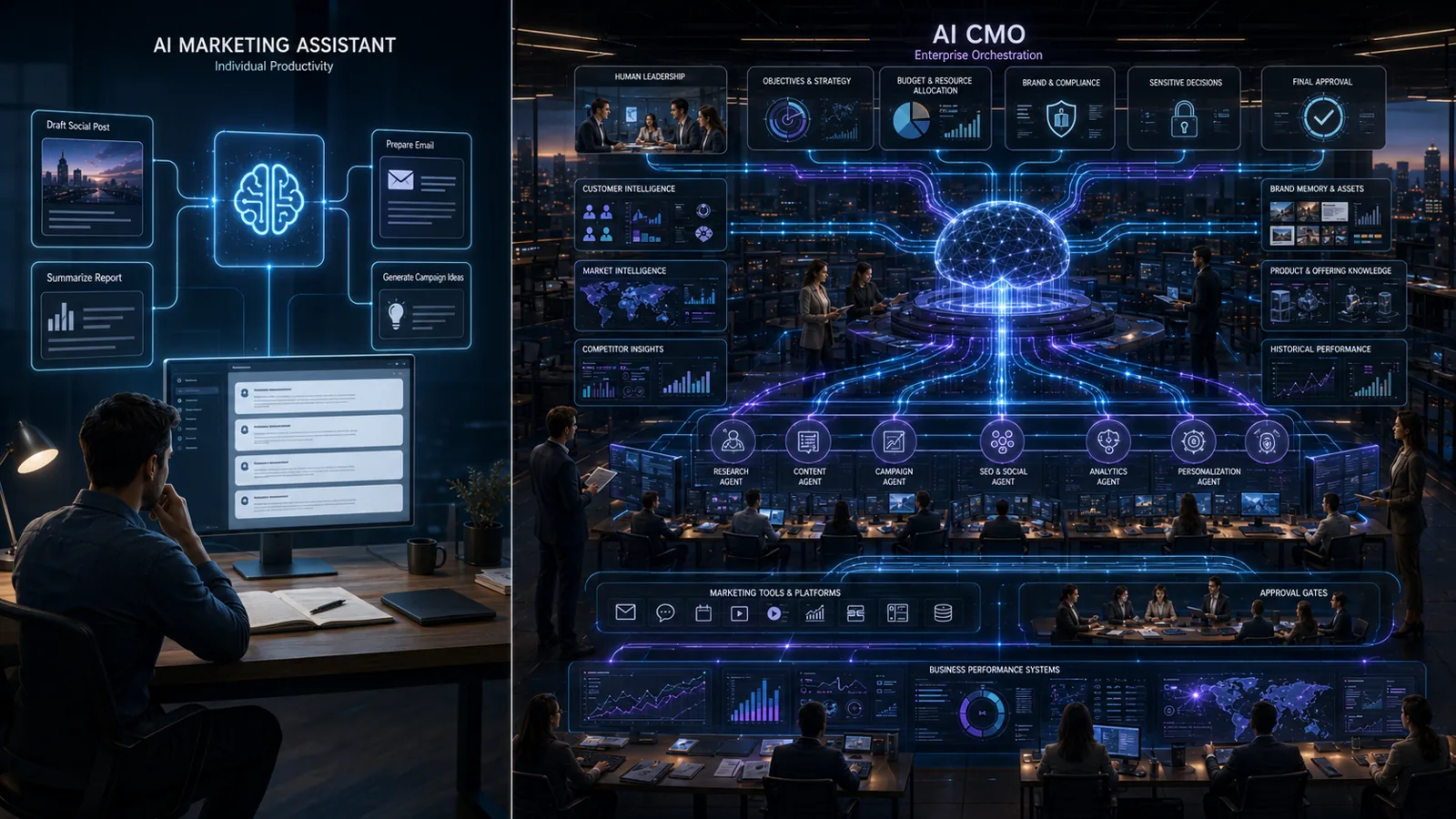
An AI assistant helps complete marketing tasks. An AI CMO decides how those tasks should connect to customers, strategy, workflows and business outcomes.
The distinction is not primarily about which model is more intelligent.
It is about the system surrounding the model:
- What context it receives
- What it remembers
- Which tools it can use
- What authority it has
- Which workflows it coordinates
- How it is evaluated
- Who remains accountable
Understanding this difference is essential as organisations move from experimenting with generative AI towards rebuilding how marketing operates.
What Is an AI Marketing Assistant?
An AI marketing assistant is a system that helps a user complete a specific marketing task.
Common uses include:
- Drafting content
- Summarising documents
- Generating ideas
- Rewriting emails
- Analysing a spreadsheet
- Preparing a meeting brief
- Suggesting campaign themes
- Creating variations of approved copy
The interaction is usually user-led.
A person decides:
- What task should be completed
- Which information should be supplied
- When the task should begin
- What should happen after the output is produced
The assistant is reactive.
It waits for an instruction.
A capable assistant may use files, search or connected tools, but its primary role remains helping an individual perform work more efficiently.
Example
A content manager asks:
Turn this webinar transcript into an article, three social posts and an email.
The assistant performs the transformation.
It does not necessarily determine:
- Whether the webinar contains a strong original argument
- Which audience requires the content
- Whether the company already has competing assets
- Which channels deserve priority
- How the content connects to revenue
The assistant improves production.
It does not automatically own the wider marketing decision.
What Is an AI CMO?
An AI CMO is not simply a chatbot given a senior title.
It is a marketing intelligence and orchestration system designed to coordinate work across the marketing function.
It should combine:
- Business objectives
- Customer and market data
- Organisational memory
- Brand and product knowledge
- Specialised AI agents
- Marketing tools
- Approval systems
- Performance measurement
- Human leadership
The AI CMO receives an objective rather than only an isolated task.
For example:
Improve adoption of the analytics module among existing mid-market customers.
The system may then:
- Analyse product-usage patterns.
- Review customer-support questions.
- Examine previous campaigns.
- Identify adoption barriers.
- Recommend an audience and message.
- Prepare a campaign plan.
- Coordinate content and customer journeys.
- Route claims and budgets for approval.
- Monitor adoption.
- Return learning to organisational memory.
OpenAI describes agents as systems that combine models, tools and structured instructions to complete workflows rather than merely generate one response. More advanced agent systems can coordinate specialised roles through a central manager.
An AI CMO applies that architecture to marketing leadership and operations.
It does not replace the human CMO.
It gives the CMO an intelligent system through which strategy can be translated into coordinated execution.
The Core Difference: Task Completion vs Outcome Ownership
An AI assistant is usually evaluated on the quality of an output.
Did it produce a good article?
Did it summarise the document correctly?
Did it create useful campaign ideas?
An AI CMO should be evaluated on whether marketing moved towards an approved business outcome.
Did product adoption improve?
Did qualified pipeline increase?
Did campaign response improve among priority accounts?
Did the system reduce time from customer insight to action?
This is the most important distinction.
Difference 1: The Starting Point
AI Assistant: Starts With the User’s Request
The assistant assumes the requested task is appropriate.
If the user asks for ten social posts, it creates ten social posts.
AI CMO: Starts With the Business Objective
The AI CMO asks:
- Why is this activity needed?
- Which customer decision should it influence?
- Does it support the current strategy?
- Is new production necessary?
- How will it be distributed?
- What outcome will justify the work?
The AI CMO may still approve the ten posts.
It may also recommend a different action.
This makes the AI CMO a prioritisation system rather than merely a production system.
Difference 2: Temporary Context vs Organisational Memory
An assistant often knows only what appears in the current conversation, uploaded files or connected sources used for that task.
An AI CMO needs persistent knowledge of:
- Brand positioning
- Priority customers
- Product capabilities
- Approved claims
- Campaign history
- Customer language
- Previous decisions
- Strategic exclusions
- Governance rules
This memory allows the system to maintain continuity.
It should know that leadership rejected discount-led positioning last quarter.
It should know which customer segment currently has priority.
It should know that a planned product capability is not yet commercially available.
Without organisational memory, every interaction begins again.
The system may produce individually competent outputs that conflict with previous decisions.
Difference 3: One Task vs an End-to-End Workflow
An assistant may complete one step within a campaign.
An AI CMO should connect the entire workflow.
AI Assistant Workflow
- User provides topic.
- Assistant creates article.
- User copies article into another system.
- User requests social posts.
- User manually coordinates approval and distribution.
AI CMO Workflow
- Detect customer-information gap.
- Connect the gap to a business objective.
- Retrieve customer and market evidence.
- Audit existing content.
- Prepare the strategic brief.
- Generate channel assets.
- Run brand and factual checks.
- Route the work for approval.
- Coordinate distribution.
- Measure the customer and commercial result.
- Store reviewed learning.
OpenAI’s business guidance describes agents as capable of automating entire workflows when they are equipped with well-defined tools, instructions and orchestration.
This workflow ownership is what elevates the system beyond an assistant.
Difference 4: Generic Knowledge vs Company Context
A general assistant can explain widely understood marketing principles.
It may recommend:
- Personalisation
- Multichannel campaigns
- Customer segmentation
- Thought leadership
- Data-driven optimisation
These recommendations are broadly plausible.
An AI CMO should know what those ideas mean for one specific company.
It should understand:
- Which customer has the highest strategic importance
- Which channel has historically produced quality demand
- Which product advantage customers actually value
- Which constraints affect execution
- Which promises the brand can support with evidence
Salesforce’s 2026 marketing research argues that access to unified context separates basic AI use from agentic systems capable of supporting more relevant customer engagement. Its research also found that marketers using agents reported stronger satisfaction with cross-functional data access.
The AI CMO becomes valuable when it connects general intelligence with company-specific truth.
Difference 5: Content Generation vs Marketing Orchestration
AI assistants are often introduced through content creation because the value is immediately visible.
They can create:
- Articles
- Posts
- Advertisements
- Emails
- Scripts
An AI CMO must coordinate more than content.
It may orchestrate:
- Market research
- Customer intelligence
- Campaign planning
- Creative production
- Media operations
- Sales enablement
- Customer journeys
- Performance analysis
Salesforce introduced agentic marketing capabilities in June 2026 designed around teams of agents that help build pipeline, create content and run campaigns across connected customer and business workflows.
This illustrates the wider shift.
The strategic opportunity is not simply faster copywriting.
It is coordination across the marketing operation.
Difference 6: User Supervision vs Governed Authority
An assistant normally acts under direct user supervision.
The person requests the work, reviews the answer and decides what happens next.
An AI CMO may operate continuously.
It could:
- Monitor campaign performance
- Detect a customer trend
- Route a task
- Prepare a recommendation
- Execute a low-risk action
This requires formal authority design.
The organisation must define:
What the System Can Read
- CRM records
- Campaign data
- Brand documents
- Product information
What the System Can Prepare
- Drafts
- Reports
- Recommendations
- Campaign structures
What the System Can Change
- Project tasks
- Approved journey rules
- Low-risk experiments
What Requires Human Approval
- Major budgets
- Public claims
- Sensitive customer communication
- Pricing
- Brand-positioning changes
OpenAI’s current workspace-agent materials emphasise approved tools, defined jobs, activity logs and the ability to review how workflows were executed.
An AI CMO must operate through explicit permissions.
It should never gain broad authority simply because its outputs appear intelligent.
Difference 7: Personal Productivity vs Organisational Capacity
An AI assistant makes one person faster.
That is valuable.
A content manager may draft more quickly.
An analyst may summarise reports in less time.
A campaign manager may generate ideas faster.
An AI CMO should make the complete marketing organisation more coordinated.
It creates shared capacity by:
- Preserving decisions
- Standardising workflows
- Connecting teams
- Routing approvals
- Reusing learning
- Aligning agents with the same priorities
This prevents every employee from building a separate personal AI workflow with different prompts, files and assumptions.
The AI CMO becomes shared infrastructure.
Difference 8: Output Quality vs System Performance
An assistant can be evaluated with questions such as:
- Was the answer accurate?
- Was the writing clear?
- Did it follow the requested format?
An AI CMO needs a broader scorecard.
Business Performance
- Pipeline
- Revenue
- Retention
- Product adoption
- Acquisition efficiency
Customer Performance
- Relevance
- Satisfaction
- Journey progression
- Reduced customer effort
Operational Performance
- Cycle time
- Manual coordination reduced
- Approval delays
- Cost per completed workflow
Agent Performance
- Accuracy
- Escalation quality
- Tool success
- Human correction
- Decision consistency
Governance Performance
- Unsupported claims
- Permission violations
- Budget exceptions
- Data incidents
An AI CMO that generates excellent content but does not improve marketing outcomes is not performing its intended role.
Difference 9: Individual Intelligence vs Agent Portfolio
An AI assistant is often experienced as one general interface.
An AI CMO may coordinate a portfolio of specialised agents.
Market Intelligence Agent
Monitors competitors and category developments.
Customer Intelligence Agent
Analyses conversations, objections and behaviour.
Content Strategy Agent
Develops briefs based on customer and business priorities.
Creative Agent
Produces approved asset variations.
Campaign Agent
Coordinates execution and approvals.
Performance Agent
Monitors outcomes and prepares decisions.
A central orchestration layer ensures these agents do not pursue conflicting goals.
Anthropic distinguishes between structured workflows and more autonomous agents, while recommending the simplest architecture capable of completing the work reliably.
The AI CMO should not deploy multiple agents for visual effect.
Each agent must have a defined role, toolset, owner and measurable contribution.
Difference 10: Assistance vs Leadership Support
An assistant helps an individual perform an action.
An AI CMO helps leadership direct the system.
It should bring forward:
- Emerging customer changes
- Campaign risks
- Strategic inconsistencies
- Budget decisions
- Approval requests
- Growth opportunities
The human CMO should not spend every morning manually interrogating dashboards, searching for files and chasing campaign updates.
The AI CMO should prepare the decision environment.
Microsoft’s 2026 Work Trend Index describes an emerging model in which agents perform more execution while humans retain judgement, direction and ownership of consequential outcomes. The research included 20,000 knowledge workers who use AI at work across ten markets.
This is the appropriate relationship between the human and AI CMO.
The AI system does not become the accountable executive.
It expands the executive’s capacity to understand and direct marketing.
AI Assistant, AI Agent or AI CMO?
These terms are often used interchangeably, but they describe different levels of capability.
AI Assistant
Helps complete an individual request.
Example: Draft a product-launch email.
AI Agent
Owns a defined, repeatable workflow using approved tools and instructions.
Example: Analyse new customer interviews each week and prepare an insight briefing.
AI CMO
Coordinates multiple agents, workflows, knowledge systems and human decisions around the organisation’s marketing objectives.
Example: Improve enterprise product adoption by connecting customer intelligence, content, lifecycle campaigns, sales enablement and performance analysis.
The AI CMO is therefore not necessarily one model.
It is an operating architecture.
A Practical Comparison
When an AI Assistant Is Enough
Not every company needs an AI CMO immediately.
An assistant may be sufficient when:
- The team is small.
- Marketing workflows are simple.
- AI use is primarily individual productivity.
- Data remains limited.
- The company is still learning where AI creates value.
Useful assistant applications include:
- Drafting
- Research support
- Meeting preparation
- Document analysis
- Brainstorming
- Simple reporting
The mistake is expecting an assistant to solve organisational problems it was not designed to manage.
An assistant will not automatically fix:
- Fragmented customer data
- Unclear strategy
- Inconsistent brand knowledge
- Broken approval systems
- Competing departmental priorities
When the Organisation Needs an AI CMO Layer
An AI CMO becomes valuable when the company has:
- Several marketing channels
- Large volumes of customer data
- Multiple teams or agencies
- Recurring campaign workflows
- Complex approvals
- A substantial content library
- Several AI tools operating independently
- Difficulty connecting activity with revenue
These conditions create an orchestration problem.
The organisation no longer needs only faster individual execution.
It needs a shared intelligence layer.
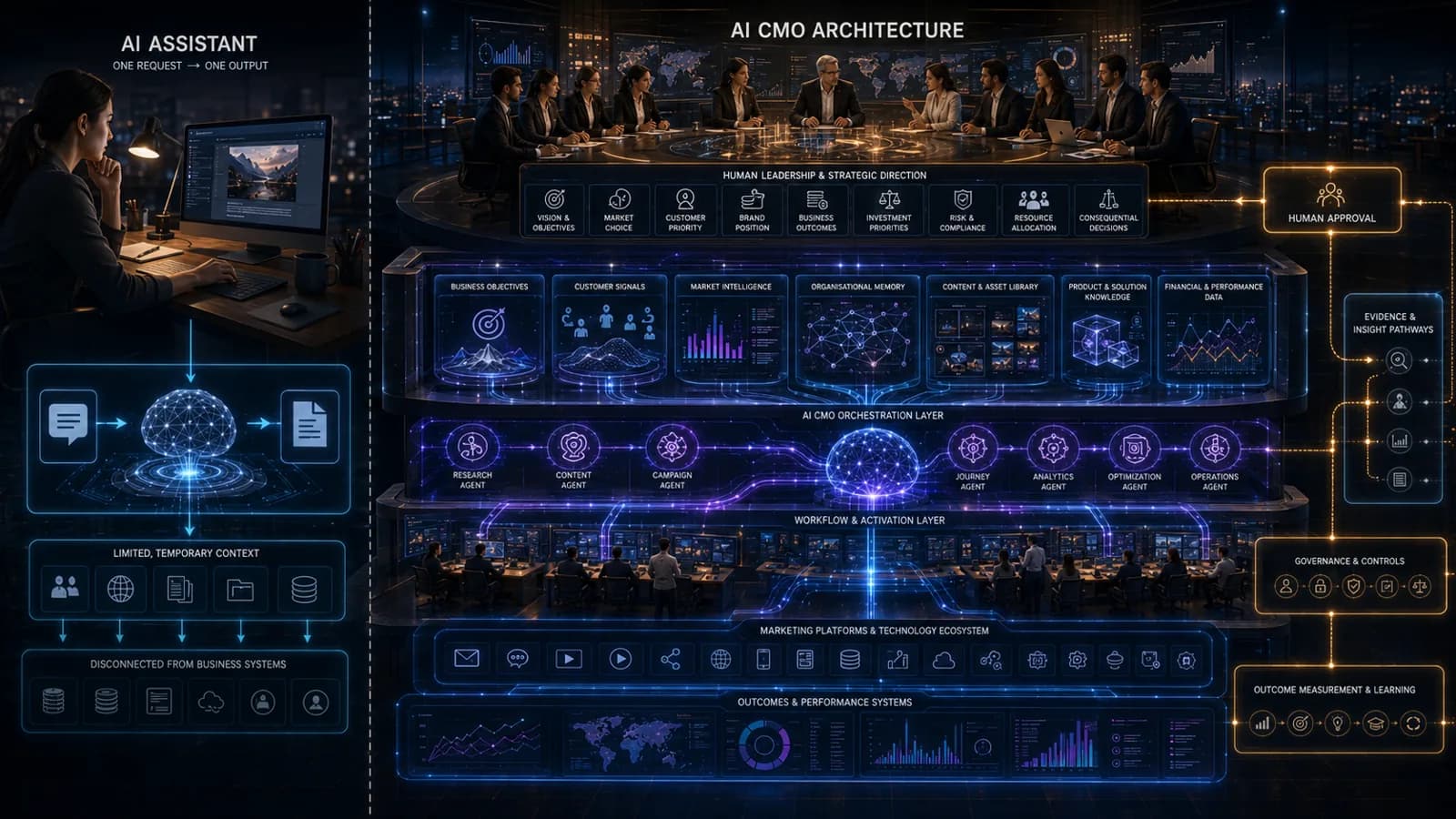
The Five Architectural Components of an AI CMO
1. Marketing Memory
A governed source of:
- Brand
- Product
- Customer
- Strategy
- Campaign learning
- Previous decisions
2. Intelligence Layer
A system for interpreting:
- Customer signals
- Market developments
- Campaign results
- Commercial performance
3. Agent Workforce
Specialised systems assigned to defined workflows.
4. Orchestration
The rules governing how agents, people, data and tools work together.
5. Governance and Evaluation
Permissions, approvals, monitoring and outcome measurement.
Remove any one of these components, and the AI CMO becomes weaker.
Without memory, it becomes inconsistent.
Without intelligence, it becomes an automation layer.
Without agents, it cannot execute.
Without orchestration, agents conflict.
Without governance, the system becomes dangerous.
What the Human CMO Still Owns
The AI CMO should not independently decide:
- Which market the company will enter
- What the brand should stand for
- Which customer receives priority
- Which major investment is justified
- Which ethical trade-off is acceptable
- How a crisis should be handled
- What kind of organisation marketing should build
The AI system can:
- Gather evidence
- Generate options
- Model scenarios
- Challenge assumptions
- Prepare recommendations
The human CMO decides and accepts responsibility.
Salesforce’s 2026 CMO research argues that marketing leaders increasingly need to unite creative judgement, data-led growth and operational intelligence while directing humans, platforms and AI agents as one team.
That is not executive replacement.
It is executive augmentation.
Common Mistakes
Calling a Chatbot an AI CMO
A conversational interface without organisational memory, tools, workflows or measurement remains an assistant.
Giving the AI a Senior Title Without Authority Design
The name does not determine the system’s capability.
Automating Before Clarifying Strategy
An AI CMO cannot compensate for unclear market choices or positioning.
Connecting Every Tool Immediately
Begin with a small number of high-value workflows.
Deploying Too Many Agents
Complexity increases coordination, evaluation and governance costs.
Confusing Content Volume With Marketing Performance
An AI CMO should improve outcomes, not merely produce more assets.
Removing Human Approval
Strategic, financial and reputational decisions must remain human-owned.
Ignoring Adoption
A technically capable system fails when teams do not trust or use it.
A Roadmap From AI Assistant to AI CMO
Stage 1: Individual Assistance
Employees use AI for:
- Research
- Drafting
- Summaries
- Ideas
Stage 2: Shared Context
The organisation creates approved sources for:
- Brand
- Product
- Customers
- Compliance
Stage 3: Reusable Agents
Teams deploy agents for workflows such as:
- Customer analysis
- Content operations
- Performance reporting
Stage 4: Connected Orchestration
The agents exchange information and operate through shared approval systems.
Stage 5: AI CMO Layer
The system connects:
- Strategy
- Customer intelligence
- Agent workflows
- Marketing execution
- Business measurement
Human leadership remains above the system, defining direction and approving consequential decisions.
A 30-Day Diagnostic
Before investing in an AI CMO, ask:
Strategy
Can we clearly define our priority customer, positioning and business objective?
Data
Can the system access reliable customer and performance data?
Memory
Do we have authoritative brand and product knowledge?
Workflow
Which recurring marketing process should AI own first?
Ownership
Which human leader is accountable?
Governance
What can the system read, prepare, recommend and change?
Evaluation
How will we know whether it improved marketing?
A company that cannot answer these questions should begin by improving its operating foundations.
Key Takeaways
- An AI assistant helps complete individual marketing tasks.
- An AI CMO coordinates marketing workflows around business and customer outcomes.
- The main difference is architecture, context, memory, authority and orchestration—not simply model intelligence.
- AI assistants are primarily reactive, while an AI CMO can monitor and coordinate continuously.
- An AI CMO may use several specialised agents rather than one general assistant.
- Organisational memory prevents inconsistency and repeated explanation.
- Governance determines what the system can read, recommend and execute.
- AI CMO performance should be measured through business, customer, operational and governance outcomes.
- Small teams may begin effectively with assistants and individual agents.
- Human leaders must retain strategy, creative judgement, major budgets, ethical decisions and accountability.
Conclusion: An Assistant Helps You Work; an AI CMO Changes How Marketing Works
An AI assistant can make a marketer considerably more productive.
It can reduce research time.
It can accelerate drafting.
It can organise information.
It can provide useful suggestions.
That is already valuable.
But it does not automatically create a coordinated marketing organisation.
It does not necessarily know which work deserves priority.
It does not preserve every strategic decision.
It does not connect customer intelligence with content, campaigns, sales and revenue.
It does not manage a portfolio of agents towards one business outcome.
An AI CMO operates at that wider level.
It is not merely another employee interface.
It is the intelligence and orchestration layer of an AI-first marketing function.
The AI assistant waits for the marketer to decide what should happen.
The AI CMO helps determine:
- What is happening
- Why it matters
- Which workflow should begin
- Which agent should act
- Which decision requires a human
- How the result should be measured
This does not make the human CMO obsolete.
It makes the CMO’s strategy more executable.
The future marketing leader will not choose between human leadership and artificial intelligence.
They will build a system in which:
- Humans define strategy.
- Agents perform repeatable workflows.
- The AI CMO coordinates the system.
- The organisation measures outcomes.
- Humans remain accountable.
An AI assistant helps marketers complete work.
An AI CMO helps the entire marketing organisation operate with greater intelligence, consistency and speed.
That is the difference between adding AI to marketing and rebuilding marketing around AI.
Actionable Next Steps
- Audit how your team currently uses AI assistants.
- Identify tasks that belong inside repeatable workflows.
- Create authoritative brand, product and customer memory.
- Select one workflow for a specialised agent.
- Assign a named human owner.
- Define what the agent can read, recommend and execute.
- Connect the workflow to a business outcome.
- Add evaluations and activity logs.
- Introduce orchestration only after individual agents perform reliably.
- Keep strategy and consequential decisions under human leadership.
Frequently Asked Questions
What is the difference between an AI CMO and an AI assistant?
An AI assistant completes individual tasks based on user requests. An AI CMO coordinates data, knowledge, agents, workflows and human decisions around broader marketing outcomes.
Is an AI CMO one AI model?
Not necessarily. An AI CMO may be an architecture containing several models, specialised agents, business tools, organisational memory and governance systems.
Can an AI assistant become an AI CMO?
It can become part of an AI CMO system when connected to persistent company context, specialised workflows, tools, orchestration, evaluations and permissions.
Does an AI CMO replace a human CMO?
No. It supports the human CMO by organising intelligence and coordinating execution. The human remains responsible for strategy, brand, budgets, judgement and accountability.
What can an AI marketing assistant do?
It can support drafting, research, summarisation, analysis, ideation and other clearly requested tasks.
What workflows can an AI CMO coordinate?
It may coordinate customer intelligence, market research, content operations, campaign execution, personalisation, sales enablement and performance analysis.
Which businesses need an AI CMO?
It becomes most useful for companies with multiple channels, teams, data sources, campaigns and AI tools that require shared context and orchestration.
How should an AI CMO be evaluated?
Evaluate its contribution to business results, customer outcomes, workflow efficiency, agent reliability, human review requirements and governance performance.
Frequently asked questions
What is the difference between an AI CMO and an AI assistant?
An AI assistant completes individual tasks based on user requests. An AI CMO coordinates data, knowledge, agents, workflows and human decisions around broader marketing outcomes.
Is an AI CMO one AI model?
Not necessarily. An AI CMO may be an architecture containing several models, specialised agents, business tools, organisational memory and governance systems.
Can an AI assistant become an AI CMO?
It can become part of an AI CMO system when connected to persistent company context, specialised workflows, tools, orchestration, evaluations and permissions.
Does an AI CMO replace a human CMO?
No. It supports the human CMO by organising intelligence and coordinating execution. The human remains responsible for strategy, brand, budgets, judgement and accountability.
What can an AI marketing assistant do?
It can support drafting, research, summarisation, analysis, ideation and other clearly requested tasks.
What workflows can an AI CMO coordinate?
It may coordinate customer intelligence, market research, content operations, campaign execution, personalisation, sales enablement and performance analysis.
Which businesses need an AI CMO?
It becomes most useful for companies with multiple channels, teams, data sources, campaigns and AI tools that require shared context and orchestration.
How should an AI CMO be evaluated?
Evaluate its contribution to business results, customer outcomes, workflow efficiency, agent reliability, human review requirements and governance performance.