AI CMO vs Traditional CMO: What Actually Changes in Marketing Leadership?
Previous technologies mostly gave the CMO new channels, new data or new tools.
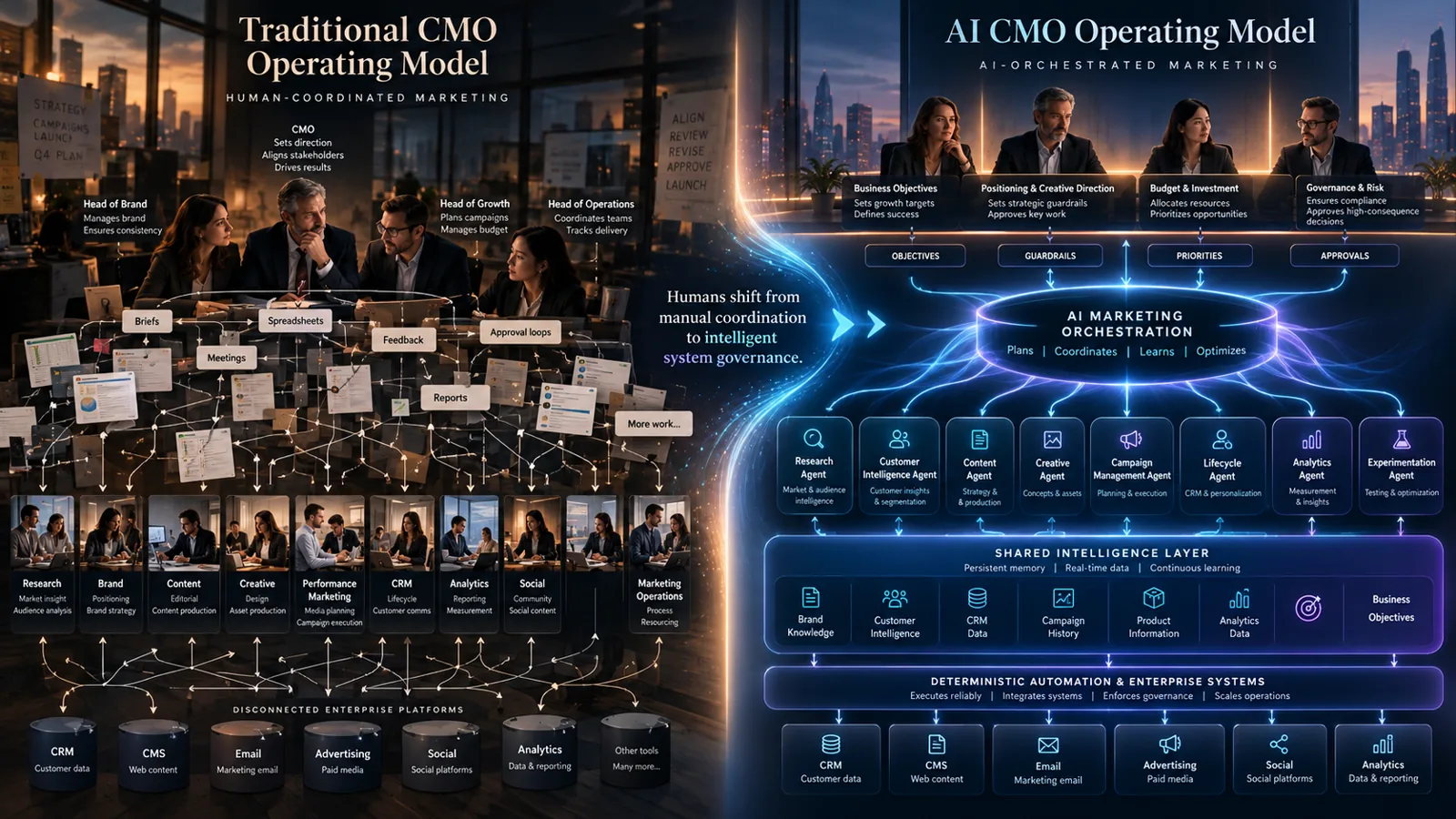
The CMO role has always evolved with technology.
Television changed it.
Digital advertising changed it.
Social media changed it.
Marketing automation changed it.
CRM changed it.
Analytics changed it.
And now artificial intelligence is beginning to change it again.
But this shift is different.
Previous technologies mostly gave the CMO new channels, new data or new tools.
AI increasingly introduces something else:
a new operating layer capable of interpreting information, coordinating workflows, generating work, making recommendations and executing actions.
That raises an important question:
What actually changes between a traditional CMO and an AI CMO?
The simple answer is this:
A traditional CMO leads marketing through people, processes and software. An AI CMO operating model adds shared intelligence, AI agents, orchestration and automation beneath human leadership so that more of marketing can continuously observe, reason, execute and learn.
The human CMO does not necessarily disappear.
What changes is the amount of operational work that must flow directly through humans.
That may ultimately redefine marketing leadership itself.
First: What Is a Traditional CMO?
A Chief Marketing Officer is the senior executive responsible for an organization's marketing strategy, brand, customer acquisition, demand generation, market positioning and often customer experience.
Depending on the company, a traditional CMO may own or influence:
- brand strategy
- market positioning
- advertising
- customer acquisition
- content
- communications
- lifecycle marketing
- product marketing
- customer research
- digital marketing
- marketing operations
- analytics
- agencies
- budgets
- growth targets
The CMO rarely executes all of this personally.
Instead, they lead an organization that does.
Historically, that organization has been built primarily around:
people + teams + agencies + software + processes.
The CMO establishes priorities.
Leaders translate them into plans.
Teams execute those plans.
Platforms enable the execution.
Dashboards measure what happened.
Meetings interpret performance.
Leadership determines what happens next.
This model has worked for decades.
But it carries an important limitation:
humans are still responsible for coordinating most of the system.
What Is an AI CMO?
An AI CMO is not simply an artificial executive sitting in the C-suite.
A more useful definition is:
An AI CMO is an AI-powered marketing operating model that combines shared business intelligence, specialized AI agents, orchestration, automation, enterprise systems and human governance to support marketing strategy, execution, measurement and optimization.
That distinction matters.
The phrase “AI CMO” can sound as though companies will replace their human marketing executive with one large language model.
That is probably the wrong mental model.
A more realistic architecture looks like this:
Human leadership
↓
AI intelligence
↓
Specialized AI agents
↓
Workflow orchestration
↓
Marketing automation + enterprise systems
Humans continue to own important strategic decisions.
But increasingly, the operational system underneath them can become intelligent.
AI CMO vs Traditional CMO: The Core Difference
The most important difference is not:
Human vs AI.
It is:
Human-coordinated marketing vs AI-orchestrated marketing.
In a traditional model, humans are heavily involved in moving work through the organization.
They:
- brief teams
- collect information
- request reports
- coordinate specialists
- chase approvals
- combine insights
- decide task sequences
- monitor execution
- organize meetings
- move information between platforms
In an AI CMO model, more of that coordination can happen through software.
The marketing system can increasingly determine:
- what information is relevant
- what changed
- which agent should investigate
- what task should happen next
- which system needs an update
- whether approval is required
- what performance signal matters
- what action should follow
The CMO therefore spends less time operating the machine and more time governing the machine.
That is the real transition.
1. Strategy Changes Less Than Execution
One of the biggest misconceptions about AI is that strategy will simply become automated.
Some strategic analysis certainly can.
AI can help evaluate:
- market conditions
- competitors
- customer behavior
- performance history
- category trends
- audience segments
- pricing signals
- search demand
- campaign results
But analysis is not the same as strategy.
Strategy involves choosing.
Which market should we prioritize?
Which customer should we serve?
What should the brand stand for?
What should we deliberately not pursue?
What trade-off are we willing to make?
What level of risk is acceptable?
These decisions require organizational context and accountability.
That means human leaders remain central.
The difference is that an AI CMO system can dramatically improve the intelligence available before the decision and the execution after the decision.
Traditional CMO
Receives research and reports from teams, agencies and platforms before making decisions.
AI CMO Model
Receives synthesized intelligence, scenarios, recommendations and likely consequences generated continuously across multiple sources.
Human strategy remains.
The intelligence system supporting strategy becomes much more powerful.
2. Research Moves From Periodic to Continuous
Traditional marketing research frequently happens around projects.
A new campaign begins.
A team studies the market.
A competitor analysis is prepared.
Customer research is gathered.
A strategy is written.
Then execution begins.
Months later, another research cycle happens.
AI can make research continuous.
Specialized agents can monitor:
- competitors
- category changes
- customer reviews
- sales conversations
- social discussions
- campaign results
- search behavior
- product usage
- market developments
Instead of waiting for the next planning cycle, an AI CMO system can continuously update its understanding.
The shift is:
Traditional CMO: research before decisions
AI CMO: persistent intelligence informing decisions
That can dramatically shorten the distance between market change and organizational response.
3. The CMO Stops Being the Human Integration Layer
This may be one of the largest changes.
In many companies, senior marketing leaders function as integration layers.
Different teams know different things.
Sales knows customer objections.
Performance marketing knows acquisition economics.
Content understands audience questions.
Product marketing knows positioning.
Analytics understands behavior.
Brand understands standards.
Agencies understand campaigns.
Someone has to connect all of this.
Often, leadership does.
That is expensive.
Not simply financially.
It consumes attention.
An AI CMO architecture can create a shared intelligence layer containing:
- brand knowledge
- customer research
- CRM information
- product information
- campaign history
- analytics
- competitive intelligence
- content performance
- strategic objectives
Specialized AI agents can retrieve from and contribute to this common context.
The CMO no longer needs to personally transfer as much information between teams.
The system increasingly becomes the context layer.
4. Campaign Management Becomes Orchestration
A traditional campaign often looks something like this:
Objective → Brief → Research → Strategy → Content → Creative → Approval → Channel Setup → Launch → Reporting → Review
Humans coordinate almost every transition.
An AI-native model changes that.
Leadership sets:
- business objective
- customer target
- positioning
- budget
- channel constraints
- brand rules
- approval requirements
Then orchestration begins.
Research agents can investigate the market.
Customer agents can analyze relevant segments.
Strategy agents can assemble recommendations.
Content and creative agents can develop assets.
Brand systems can evaluate outputs.
Humans can approve high-consequence decisions.
Campaign agents can prepare deployment.
Marketing automation handles predictable execution.
Analytics agents monitor results.
Experimentation agents suggest improvements.
The system coordinates more of the workflow.
The CMO governs its direction.
5. Marketing Moves From Campaigns Toward Continuous Loops
Traditional marketing organizations are built heavily around campaign cycles.
Plan.
Launch.
Measure.
Report.
Discuss.
Repeat.
AI allows marketing to move toward a more continuous model.
McKinsey argues that the campaign-era operating model is increasingly giving way to a continuous growth engine in which insights, creation, personalization and orchestration operate much closer to real time. Its 2026 research found that 90% of CMOs were experimenting with AI, but fewer than 10% had scaled AI or captured value across marketing workflows.
An AI CMO model can operate around a loop such as:
OBSERVE → UNDERSTAND → DECIDE → PLAN → EXECUTE → MEASURE → LEARN
The difference is subtle but important.
Traditional campaigns have beginnings and endings.
An intelligent marketing system continuously learns.
6. Reporting Becomes Decision Intelligence
Consider how executives currently interact with marketing analytics.
A dashboard shows:
traffic,
conversion,
CAC,
pipeline,
engagement,
revenue,
CTR,
ROAS,
retention,
email performance,
channel performance.
The CMO still has to ask:
What does this mean?
That creates another human workflow.
Someone collects data.
Someone prepares slides.
Someone explains variance.
People attend a meeting.
Leadership identifies the issue.
Then someone decides what to investigate.
AI can compress that process.
Instead of merely showing metrics, an AI CMO system could produce something like:
Enterprise lead conversion declined 9% this week. The drop is concentrated in paid search traffic from three campaigns. Traffic quality remained stable, but landing-page conversion declined after Tuesday's messaging update. Reverting the headline or testing the previous positioning against variant C are the strongest next actions.
This is decision intelligence.
It changes the interface from:
data → human interpretation
to:
data → interpretation → recommendation → human judgment
Humans still make consequential decisions.
But far less human effort is required to reach the decision.
7. Content Changes From Production to Systems Management
Generative AI has already made content production faster.
But an AI CMO model goes beyond writing.
It can potentially coordinate:
- topic discovery
- customer questions
- SEO opportunities
- content strategy
- briefing
- creation
- brand checks
- creative production
- distribution
- performance monitoring
- repurposing
- optimization
This changes the CMO's problem.
Historically, the challenge might have been:
How do we produce enough content?
Increasingly, the challenge becomes:
How do we decide what deserves to be produced, ensure quality, distribute it intelligently and continuously learn from performance?
Production becomes abundant.
Judgment becomes scarce.
That means brand standards, editorial strategy and creative taste become more important—not less.
8. Personalization Can Move From Segments Toward Decisions
Traditional marketing personalization often relies on predefined segments.
For example:
Enterprise.
SMB.
New customer.
Returning customer.
High-value customer.
Geographic segment.
Lifecycle stage.
Then marketing automation determines which predefined experience the customer receives.
AI allows much richer interpretation.
An intelligent system can potentially consider:
- customer history
- recent behavior
- product interest
- content consumption
- channel preferences
- account information
- buying stage
- campaign response
- contextual signals
It can then determine which communication is most appropriate within policy boundaries.
Salesforce's 2026 research shows both the demand and the constraint. It reported that 75% of marketers had adopted AI, while 81% said they would trust AI to respond to customers at scale—but fragmented or irrelevant data remained a major obstacle.
This highlights a key difference:
An AI CMO is not simply a more intelligent messaging engine.
It requires shared, usable customer intelligence.
9. The Team Structure Changes
A traditional marketing organization may include:
- CMO
- VP Marketing
- Brand
- Performance Marketing
- Content
- Social
- SEO
- CRM
- Lifecycle
- Analytics
- Design
- Marketing Operations
- Agencies
AI does not necessarily eliminate these capabilities.
But it changes how work is distributed.
Some executional work moves toward agents.
Some coordination moves toward orchestration.
Some reporting moves toward intelligent synthesis.
Some repetitive research becomes automated.
Human roles shift toward:
- strategic thinking
- creative judgment
- system design
- agent supervision
- workflow ownership
- quality control
- cross-functional integration
- governance
McKinsey's 2026 research explicitly anticipates this kind of shift, arguing that AI-ready marketing organizations are likely to place relatively greater emphasis on orchestration, judgment, integration and AI management as more executional tasks become partially or fully automated.
So the future marketing organization may not simply be:
smaller.
It may be:
differently shaped.
10. The CMO Becomes an Orchestrator
The traditional CMO manages an organization.
The AI-era CMO increasingly also manages a system of intelligence.
That system includes:
- people
- agents
- models
- data
- workflows
- enterprise software
- automation
- permissions
- governance
The leadership question changes from:
Who should do this?
to:
What combination of human, AI agent and deterministic software should perform this workflow?
That is a fundamentally different management capability.
Adobe's 2026 research captures the broader shift clearly: its guidance to CMOs emphasizes moving from AI experimentation toward customer experience orchestration, while first unifying data and operational workflows and defining measurable business outcomes.
Orchestration may become as important to the future CMO as channel management was to the digital-era CMO.
11. Governance Becomes a Core Marketing Responsibility
Traditional marketing governance already exists.
There are:
- budgets
- approval policies
- legal review
- brand guidelines
- privacy policies
- procurement controls
But AI introduces new questions.
What can an agent publish automatically?
How much budget can it modify?
Can it change targeting?
Can it contact a customer directly?
What customer data may it access?
Which claims require verification?
Which actions require legal review?
When must a human approve?
When should the system escalate uncertainty?
AI therefore turns governance from a policy sitting beside marketing into part of the marketing architecture itself.
An AI CMO operating model needs:
- permissions
- thresholds
- decision rights
- auditability
- approval gates
- escalation logic
- testing standards
The more autonomous the system becomes, the more important those controls become.
12. Speed Changes Dramatically
Traditional marketing speed depends heavily on coordination capacity.
Even talented organizations encounter delays in:
- approvals
- briefing
- revisions
- reporting
- handoffs
- information retrieval
- platform setup
AI can compress many of these processes.
But the opportunity is not merely “doing the same work faster.”
Adobe's 2026 research found that 90% of surveyed organizations said they could support rapid or high-frequency campaign cycles, yet 69% said doing so creates strain, is challenging or cannot be sustained, while 84% had missed at least one marketing opportunity in the previous quarter because their workflow could not respond quickly enough.
The lesson is important:
Speed without workflow redesign simply creates pressure.
An AI CMO operating model tries to change the underlying system so that speed becomes structural rather than dependent on human heroics.
13. The Unit of Management Changes From Tasks to Outcomes
Traditional marketing operations often manage tasks.
Write article.
Design ad.
Launch campaign.
Build report.
Send email.
Post social content.
AI can make individual tasks extremely cheap.
That means task completion becomes a less useful measure of productivity.
An AI CMO needs to optimize around outcomes such as:
- revenue
- pipeline
- conversion
- retention
- customer acquisition cost
- lifetime value
- brand impact
- customer experience
- market share
- learning velocity
This sounds obvious.
But AI makes it more important.
If an organization can generate 500 assets instead of 50, content volume becomes almost meaningless.
The question becomes:
Did the system produce better business outcomes?
This is another shift from managing production toward managing intelligence.
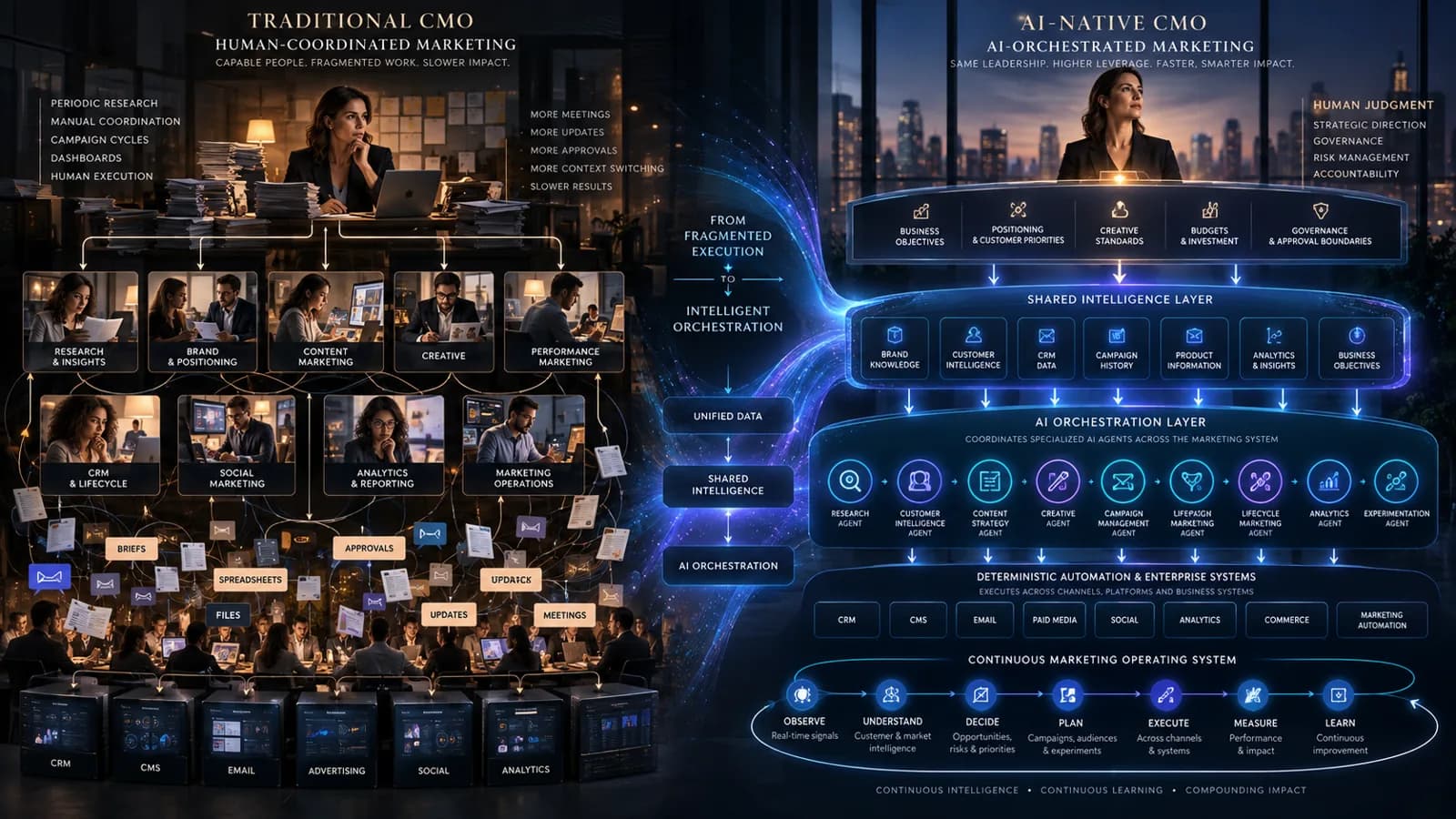
Traditional CMO vs AI CMO: Side-by-Side
The distinction is not absolute.
Most organizations will exist somewhere between these two models for years.
The direction of travel, however, is becoming increasingly clear.
What Does Not Change?
This may be the most important part of the comparison.
Several responsibilities should not disappear simply because AI becomes capable.
The CMO Still Owns Business Alignment
Marketing cannot optimize independently of company strategy.
Someone must connect marketing to:
- growth priorities
- financial objectives
- product strategy
- market strategy
- organizational constraints
That remains leadership work.
The CMO Still Owns Positioning
AI can analyze competitors and customers.
It can propose positioning alternatives.
But deciding what a company should represent requires commitment.
A company cannot outsource its identity to a probability distribution.
The CMO Still Owns Standards
If AI can generate almost unlimited creative possibilities, defining what “good” means becomes increasingly important.
Human leaders need to establish:
- brand standards
- creative quality
- messaging boundaries
- customer principles
- ethical boundaries
The CMO Still Owns Major Trade-Offs
Should we prioritize growth or margin?
Brand or direct response?
Short-term conversion or long-term positioning?
Which customer matters most?
These are leadership decisions.
The CMO Still Owns Accountability
AI systems can recommend.
Agents can execute.
Automation can act.
But companies remain accountable for the result.
There must always be clear human ownership of consequential decisions.
Will AI Replace the Traditional CMO?
The answer is more nuanced than either:
yes
or
no.
AI is unlikely to eliminate the need for marketing leadership.
But it can eliminate or significantly reduce many activities that historically consumed marketing leadership capacity.
Examples include:
- routine reporting
- information synthesis
- certain forms of research
- campaign coordination
- task routing
- content production
- monitoring
- repetitive optimization
That changes the job.
The future CMO could spend proportionally more time on:
- strategy
- business alignment
- customer priorities
- creative direction
- governance
- organization design
- decision quality
- partnerships
- resource allocation
In other words:
AI may not replace the CMO.
It may replace part of the traditional way the CMO operates.
The Competitive Advantage Will Come From Better Operating Models
Simply giving every marketer an AI assistant will not create an AI CMO.
Simply buying agentic software will not create one either.
The advantage comes from redesigning the marketing system.
McKinsey's 2026 research found that only 28% of surveyed organizations were fundamentally rewiring their marketing teams and workflows, despite widespread AI adoption.
That means many organizations are still doing this:
Old Workflow + AI Tool
The bigger opportunity is:
New Workflow + Human Judgment + AI Intelligence + Agents + Automation
That is a much deeper transformation.
How Should CMOs Prepare?
The transition does not require building a fully autonomous marketing organization immediately.
Start with five shifts.
1. Move From Tool Thinking to Workflow Thinking
Do not ask:
“What AI tools should we buy?”
Ask:
“Which marketing workflows should operate differently?”
2. Build Shared Intelligence
Create reliable access to:
- customer data
- brand knowledge
- product information
- campaign history
- content
- analytics
- market intelligence
AI without context remains shallow.
3. Redesign Roles Around Human Strengths
Determine which tasks should belong to:
Humans
for judgment, strategy, creativity and accountability.
AI agents
for reasoning, synthesis, monitoring and flexible execution.
Automation
for predictable and deterministic actions.
4. Build Governance Early
Define:
- permissions
- risk thresholds
- approval requirements
- escalation rules
- data access
- auditability
Do not wait for autonomy before deciding how autonomy should be controlled.
5. Measure End-to-End Outcomes
Do not celebrate how many employees use AI.
Measure whether workflows improve.
Track:
- cycle time
- conversion
- productivity
- revenue
- cost
- customer outcomes
- decision speed
- learning velocity
AI adoption is not the objective.
Marketing performance is.
The CMO Role Is Moving Up the Stack
The most useful way to understand the AI CMO transition is to imagine marketing as a stack.
At the bottom:
enterprise systems
Above them:
deterministic automation
Above that:
AI execution
Then:
AI intelligence
Then:
human standards and governance
And at the top:
human intent and judgment
The traditional marketing organization requires humans to operate at almost every layer.
They retrieve data.
Move information.
Build reports.
Write assets.
Configure systems.
Coordinate tasks.
Interpret results.
Make decisions.
The AI CMO model increasingly shifts humans upward.
Machines handle more of the mechanics.
Humans concentrate on the meaning.
That may be the defining transformation.
The Future Isn't AI CMO vs Human CMO
The phrase AI CMO vs traditional CMO makes the change sound like a competition.
It probably will not work that way.
The more realistic transformation is:
Traditional CMO
becomes
AI-native CMO.
The winning marketing leader will not necessarily be the person who knows how to generate the best prompt.
It will be the leader who understands how to build and govern a marketing system where:
AI can observe.
AI can analyze.
Agents can act.
Automation can execute.
Systems can learn.
And humans remain responsible for deciding:
what should happen, why it matters and what standards must never be compromised.
The next evolution of marketing leadership is therefore not about removing leadership.
It is about giving leadership a far more intelligent operating system.
That is what actually changes.
Frequently asked questions
What is the difference between an AI CMO and a traditional CMO?
A traditional CMO leads marketing primarily through human teams, agencies, processes and software. An AI CMO operating model adds shared intelligence, specialized AI agents, orchestration and automation so more marketing execution and coordination can happen beneath human leadership.
Does an AI CMO replace a human CMO?
Not necessarily. AI is more likely to change how the CMO role operates by automating or augmenting research, execution, coordination, reporting and optimization while humans retain strategy, judgment, governance and accountability.
What responsibilities can AI take over from a CMO?
AI can increasingly assist with research, information synthesis, monitoring, reporting, content generation, campaign coordination, optimization and decision recommendations. High-consequence strategic decisions should remain human-owned.
What should a human CMO still control?
Human CMOs should retain ownership of business objectives, positioning, customer priorities, creative standards, budgets, major trade-offs, risk boundaries, organizational leadership and accountability.
How do AI agents change the CMO role?
AI agents can handle specialized marketing activities and coordinate across workflows. This allows CMOs to spend less time on operational coordination and more time on strategy, governance, system design and decision-making.
Is an AI CMO the same as marketing automation?
No. Traditional marketing automation mainly executes predefined rules. An AI CMO model can also use AI agents that interpret context, reason about information and make bounded decisions before using automation for predictable execution.
What skills will future CMOs need?
Future CMOs will increasingly need skills in business strategy, customer understanding, creative judgment, data, AI governance, workflow design, orchestration, organizational transformation and human–AI collaboration.
Is the traditional CMO becoming obsolete?
The leadership role is not necessarily becoming obsolete. However, the traditional operating model—where humans manually coordinate research, execution, reporting and workflows—is increasingly being challenged by AI-enabled systems.