Five Marketing Workflows AI Should Own—and Five Decisions Humans Must Keep
The work is important, but much of it is repetitive, fragmented and dependent on people moving information manually between systems.

Marketing teams do not usually suffer from a shortage of ideas.
They suffer from operational congestion.
Customer conversations are collected but rarely analysed consistently.
Campaign reports take days to assemble.
Approved content is used once and forgotten.
Competitor research happens irregularly.
Campaign managers spend more time chasing tasks than improving the campaign.
The work is important, but much of it is repetitive, fragmented and dependent on people moving information manually between systems.
This is where AI agents can create meaningful value.
The strongest marketing use cases are not isolated prompts such as:
- Write a social post.
- Summarise this spreadsheet.
- Suggest five campaign ideas.
They are complete workflows with:
- A recurring objective
- Predictable inputs
- Several connected steps
- Clear quality standards
- Defined human checkpoints
- A measurable outcome
OpenAI describes agents as systems that combine models, tools and instructions to gather context, choose actions and complete workflows within defined guardrails. The important shift is from automating individual tasks to automating sequences of work.
Marketing leaders should therefore stop asking:
Which individual tasks can AI perform?
They should ask:
Which recurring workflows should AI own from beginning to end?
Ownership does not mean unrestricted autonomy.
It means the agent is responsible for monitoring, preparing, analysing and coordinating the workflow, while humans retain authority over consequential decisions.
The ideal division is:
AI owns repeatable operational flow. Humans own strategy, judgement, relationships and accountability.
What Makes a Marketing Workflow Suitable for AI Ownership?
Not every process should be delegated.
A strong AI-owned workflow usually has five characteristics.
It Happens Frequently
The workflow is performed daily, weekly or whenever a predictable event occurs.
It Uses Accessible Information
The agent can obtain the required data from approved documents, platforms or tools.
It Has a Clear Output
The organisation can define what a successful result should contain.
Errors Can Be Detected
Human reviewers or automated evaluations can identify weak performance.
High-Risk Decisions Can Be Escalated
The workflow can pause when it encounters sensitive claims, major budgets, unclear evidence or unusual customer situations.
Anthropic recommends using predictable workflows where tasks can be clearly structured, while reserving greater agent autonomy for situations that genuinely require flexible, model-driven decision-making. It also recommends beginning with the simplest architecture that performs reliably.
These principles lead to five high-value marketing workflows that AI should increasingly own.
Workflow 1: Customer Conversation Intelligence
The Problem
Companies collect enormous amounts of customer language through:
- Sales calls
- Support tickets
- Interviews
- Product reviews
- Surveys
- Community discussions
- Churn feedback
Yet most marketing teams review only a small sample.
Important insights remain trapped inside individual conversations.
Marketing continues using outdated personas while customers are describing new objections, expectations and frustrations every day.
What the AI Should Own
A customer-intelligence agent should continuously:
- Collect new conversations from approved sources.
- Remove or protect sensitive information where required.
- Classify the conversation by customer segment and journey stage.
- Identify recurring questions, objections and desired outcomes.
- Compare themes with previous periods.
- Detect meaningful changes.
- Connect themes with product, sales or retention data.
- Prepare a decision-ready briefing.
- Escalate urgent or sensitive findings.
The output should not be another generic summary.
It should explain:
- What customers are saying
- Which segment is saying it
- What has changed
- Why the change may matter
- Which business team should investigate
- How confident the system is
Example
Suppose an AI software company promotes model accuracy as its primary advantage.
The customer-intelligence workflow discovers that enterprise buyers rarely question model quality.
Their recurring concerns are:
- Integration time
- Data access
- Internal approval
- Employee adoption
- Accountability when the AI makes a mistake
This should affect:
- Positioning
- Sales enablement
- Content strategy
- Product onboarding
- Campaign messaging
The AI owns the continuous analysis.
Humans determine whether the finding requires a strategic change.
What Humans Must Keep
Humans should retain responsibility for:
- Interpreting emotional and cultural context
- Conducting important customer interviews
- Determining which pattern is strategically significant
- Making changes to positioning or product strategy
- Handling sensitive customer relationships
Success Metrics
- Percentage of customer conversations analysed
- Time from emerging issue to detection
- Useful insights accepted by teams
- Repeated themes connected to action
- Improvements in conversion, adoption or retention
Workflow 2: Competitive and Market Monitoring
The Problem
Competitive research is often conducted before:
- A strategy meeting
- A campaign
- A product launch
- A board presentation
Between those moments, the market continues to change.
Competitors update:
- Positioning
- Pricing
- Features
- Partnerships
- Customer segments
- Content strategy
New regulations, channels and customer expectations appear.
A periodic slide deck cannot maintain a live understanding of the market.
What the AI Should Own
A market-intelligence agent should:
- Monitor an approved list of competitors and sources.
- Record important changes.
- Compare new information with historical snapshots.
- Group developments by category.
- Distinguish routine updates from potentially strategic signals.
- Verify important findings across multiple sources.
- Prepare regular market briefings.
- Alert leaders when a high-priority threshold is reached.
- Preserve the findings in organisational memory.
The agent should not notify leadership about every new blog post.
Its value comes from filtering noise.
Example
Three competitors begin changing their language from “AI automation” to “governed AI operations.”
One change may be insignificant.
A pattern across several competitors, analyst discussions and customer questions may indicate that the market is moving from experimentation towards control and deployment.
The AI agent can detect the pattern early.
Human leaders decide whether to:
- Update positioning
- Change the product roadmap
- Create content
- Ignore the trend
- Conduct additional customer research
What Humans Must Keep
Humans should own:
- Competitive strategy
- Market-entry decisions
- Brand positioning
- Major pricing decisions
- Judgement about whether a market signal is temporary or structural
Success Metrics
- Relevant changes detected
- Manual research time reduced
- False-positive rate
- Strategic decisions supported
- Speed of response to material developments
Workflow 3: Content Repurposing and Lifecycle Management
The Problem
Most companies do not have a content-production shortage.
They have a content-utilisation problem.
A team may invest heavily in:
- A research report
- A webinar
- A customer interview
- A product launch
- An executive presentation
The asset is published once, shared briefly and then buried.
At the same time, marketers repeatedly create new content from scratch.
Existing assets become:
- Outdated
- Duplicated
- Inconsistent
- Difficult to find
- Disconnected from current campaigns
AI is particularly well suited to owning the operational lifecycle of approved content.
What the AI Should Own
A content-operations agent should:
- Ingest an approved source asset.
- Identify its key ideas, evidence and reusable components.
- Match those components to approved audiences and channels.
- Prepare channel-specific adaptations.
- Apply current brand and product memory.
- Check for unsupported or outdated claims.
- Route sensitive assets for human review.
- Update the content calendar and asset library.
- Monitor performance.
- Flag assets requiring revision, consolidation or retirement.
One webinar might generate:
- A long-form article
- Executive social posts
- Short video scripts
- Sales talking points
- Customer emails
- An FAQ
- A visual framework
The agent should not create every possible format automatically.
It should create the adaptations required by a defined distribution plan.
Content Lifecycle Ownership
The same agent can manage the asset after publication.
It can identify:
- Broken links
- Old statistics
- Changed product capabilities
- Duplicate pages
- Underused high-performing material
- Content no longer aligned with positioning
This prevents the content library from becoming a growing archive of organisational debt.
What Humans Must Keep
Humans should retain:
- The original thesis
- Editorial judgement
- Creative direction
- Expert review
- Approval of high-profile public assets
- Decisions about what the brand should say
AI can extend the life of an idea.
It should not invent the company’s perspective.
Success Metrics
- Reuse per approved source asset
- Time from approval to channel adaptation
- Human editing time
- Cost per approved asset
- Percentage of content kept current
- Distribution and commercial influence
Workflow 4: Campaign Operations and Coordination
The Problem
Campaign managers often spend too much time coordinating work.
They chase:
- Briefs
- Design files
- Approvals
- Audience lists
- Tracking links
- Sales updates
- Launch dates
- Performance reports
This coordination is essential, but it is not where the campaign manager creates the most strategic value.
Important decisions receive less attention because the team is occupied with operational status.
What the AI Should Own
A campaign-operations agent should:
- Read the approved campaign objective and brief.
- Create the work plan and dependencies.
- Assign tasks to the correct teams or agents.
- Track asset and audience readiness.
- Route work through required approval gates.
- Check that approved claims and versions are used.
- Identify blockers and missed dependencies.
- Prepare the campaign for launch.
- Notify sales and customer-facing teams.
- Maintain a live campaign record.
The agent can also coordinate specialised systems for:
- Audience preparation
- Content production
- Creative adaptation
- Email configuration
- Analytics setup
- Post-launch monitoring
McKinsey describes agentic marketing as the redesign of end-to-end workflows rather than the addition of isolated AI tools. Its research estimates that agentic AI could eventually support a substantial share of current marketing activity, including content production, audience testing and media planning.
What the Agent Should Not Approve
The campaign agent should not independently approve:
- The campaign strategy
- Major creative concepts
- Sensitive customer claims
- High-value media investment
- Significant audience exclusions
- Crisis-related communication
It coordinates approved work.
It does not become the campaign executive.
What Humans Must Keep
Humans should own:
- Campaign objectives
- Creative strategy
- Customer promises
- Budget authority
- Cross-functional trade-offs
- Final go/no-go decisions
Success Metrics
- Time from brief to launch
- Approval turnaround
- Missed dependencies
- Manual coordination time
- Campaign error rate
- Percentage of launches delivered on schedule
Workflow 5: Performance Monitoring and Decision Preparation
The Problem
Marketing teams have more dashboards than decisions.
Every platform reports its own activity:
- Advertising spend
- Website traffic
- Email engagement
- Search performance
- Social reach
- Pipeline
- Product activity
Employees manually gather the numbers, create charts and explain what changed.
By the time the review is prepared, the opportunity to respond may have passed.
What the AI Should Own
A performance-intelligence agent should:
- Retrieve approved data from relevant systems.
- Validate completeness and consistency.
- Compare performance with targets and prior periods.
- Detect anomalies and material changes.
- Segment results by audience, product, channel or journey stage.
- Generate possible explanations.
- Retrieve related campaign and customer context.
- Prepare recommended investigations or actions.
- Identify decisions requiring leadership.
- Record what action was taken and what happened next.
The report should not simply say:
- Traffic declined by 12%.
- Cost per lead increased.
- Email clicks improved.
It should say:
Paid acquisition costs increased primarily within two audience segments after a creative rotation ended. Lead volume remained stable, but sales acceptance declined. The immediate decision is whether to refresh the creative, narrow the audience or pause investment while lead quality is investigated.
That is decision preparation.
Limited Autonomous Action
After sufficient testing, the agent may be allowed to perform low-risk actions such as:
- Pause a small experiment that exceeds a defined loss threshold
- Adjust an approved reporting schedule
- Select among pre-approved creative variations
- Notify an owner when an anomaly occurs
Major budget and strategic decisions should remain human-controlled.
McKinsey’s research on continuous AI-enabled marketing reports substantial time and cost improvements in selected implementations, but it also emphasises the need for unified data, end-to-end KPIs, cross-functional ownership and strong governance.
What Humans Must Keep
Humans should own:
- Interpretation of ambiguous causes
- Budget allocation
- Strategic optimisation
- Decisions involving brand and customer trust
- Evaluation of long-term versus short-term effects
Success Metrics
- Reporting time reduced
- Important anomalies detected
- Accuracy of underlying data
- Recommendations accepted
- Decision response time
- Commercial outcomes influenced
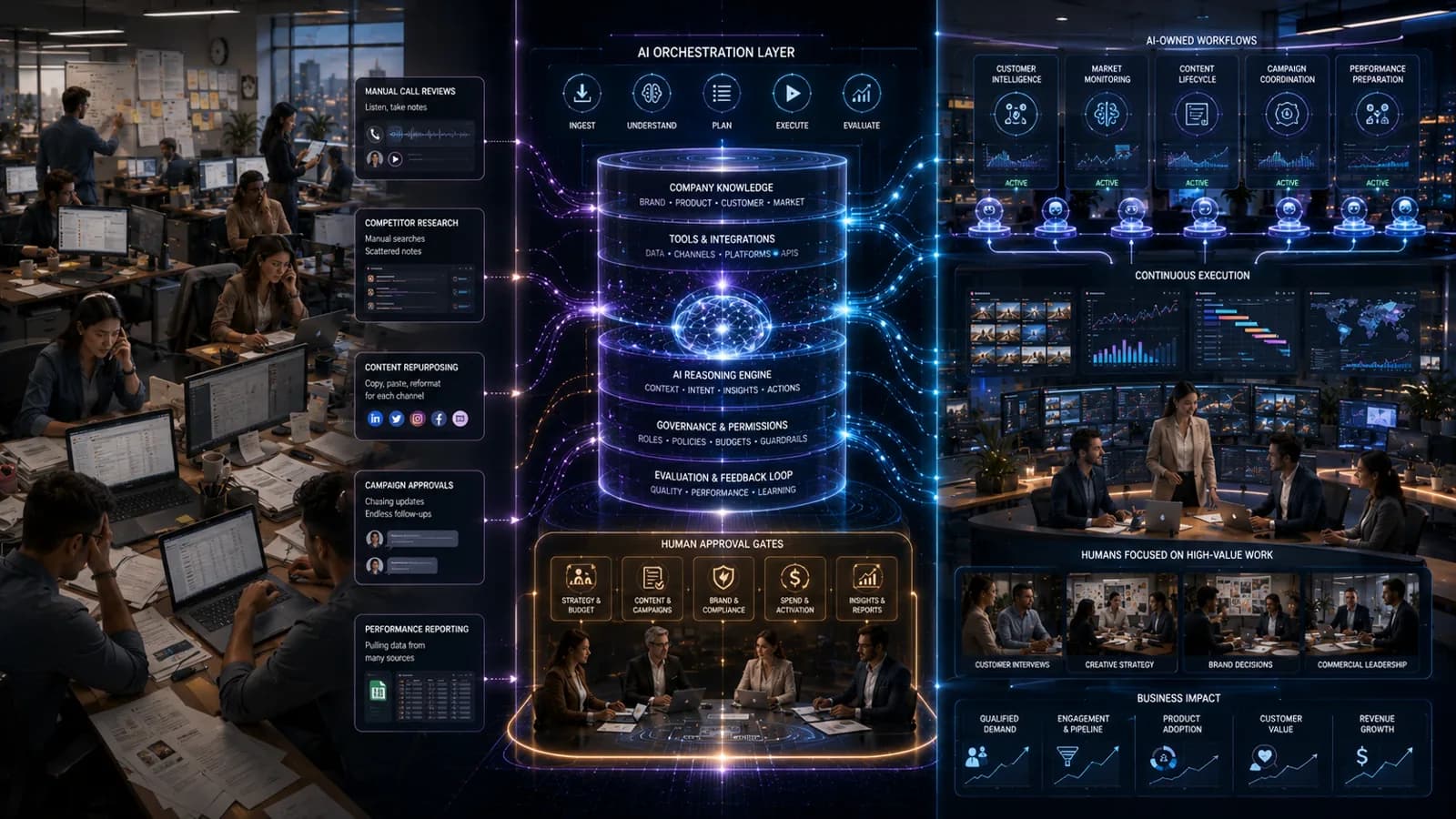
The Five Decisions AI Should Not Own
Delegating workflows does not mean delegating leadership.
Five categories of decision should remain clearly human-owned.
1. Brand Direction
AI can analyse markets and generate positioning alternatives.
Humans must decide:
- What the company stands for
- Which customer promise it will make
- Which values it will protect
- How it should differ from competitors
The brand cannot be reduced to whichever message receives the highest immediate click-through rate.
2. Creative Ambition
AI can produce many concepts and variations.
Humans must decide:
- Which idea deserves development
- Which convention should be challenged
- Which emotional territory is appropriate
- Which creative risk is worth taking
AI is excellent at expanding the possibility space.
Taste remains a human responsibility.
3. Sensitive Customer Communication
AI may prepare drafts and gather context.
Humans should lead communication involving:
- Complaints
- Crisis situations
- Vulnerable customers
- Legal disputes
- Major service failures
- Sensitive personal circumstances
Efficiency should not override empathy.
4. Major Budget and Commercial Trade-Offs
AI can identify patterns and recommend allocations.
Humans must approve decisions that materially affect:
- Media budgets
- Pricing
- Market investment
- Customer acquisition strategy
- Long-term brand building
- Workforce allocation
These decisions involve risk appetite and organisational priorities that are not fully visible in a campaign dataset.
5. Ethical and Reputational Boundaries
AI can check policies.
Humans must determine:
- Whether personalisation has become intrusive
- Whether a claim is technically true but misleading
- Whether targeting is unfair
- Whether an optimisation harms customer trust
- Whether the organisation should take an action merely because it can
Microsoft’s 2026 Work Trend Index characterises the emerging model as human-led and agent-operated, with human judgement remaining central to work that carries consequential responsibility.
The AI Workflow Ownership Matrix
How to Give AI Ownership Safely
Begin With a Workflow Charter
Every AI-owned workflow should document:
Mission
What outcome is the workflow expected to produce?
Trigger
When does the workflow begin?
Inputs
Which data, documents and systems are required?
Outputs
What should the agent deliver?
Permissions
Which tools can it read or change?
Human Owner
Who remains accountable?
Escalation Rules
When must the agent stop and request human input?
Evaluation
How will reliability and value be measured?
OpenAI’s workspace-agent guidance recommends defining a clear job, connecting approved company context and tools, enforcing governance, and reviewing activity logs to understand how workflows were executed.
Start With Read and Recommend
The safest progression is:
- Observe
- Analyse
- Recommend
- Prepare
- Execute after approval
- Execute independently within narrow limits
Do not give an experimental agent broad write access merely because its demonstrations were impressive.
Build Evals Before Expanding
An agent should be tested against realistic scenarios such as:
- Missing data
- Conflicting documents
- Unusual customer requests
- Tool failure
- Sensitive claims
- Ambiguous objectives
Anthropic notes that production agents become difficult to improve and safely upgrade without systematic evaluations. Evals should test whether the system completes the requested work, avoids damaging errors and meets the required quality standard.
Record the Complete Workflow
The organisation should be able to inspect:
- Information retrieved
- Tools used
- Decisions made
- Actions attempted
- Errors encountered
- Human approvals
- Final outcomes
Logs and traces are essential for improving reliability and resolving disputes.
Measure the Outcome, Not Agent Activity
Do not reward the agent for:
- Reports produced
- Calls analysed
- Assets created
- Tasks completed
Measure whether the workflow became:
- Faster
- More accurate
- More consistent
- Less expensive
- More useful
- More commercially effective
A 90-Day Deployment Plan
Days 1–30: Select One Workflow
Choose a workflow that:
- Happens frequently
- Creates clear operational friction
- Has measurable outputs
- Can begin with read access
- Has an accountable human owner
Customer intelligence or performance reporting is often a strong starting point.
Days 31–60: Run the Agent in Parallel
Allow the AI workflow to operate alongside the current human process.
Compare:
- Accuracy
- Time
- Cost
- Missed information
- Human review
- Business usefulness
Do not remove the fallback process yet.
Days 61–90: Transfer Limited Ownership
Give the agent primary responsibility for the repeatable operational stages.
Keep humans responsible for:
- Exceptions
- Sensitive decisions
- Strategic interpretation
- Approval
Review performance weekly and update the agent’s instructions, tools and evaluation cases.
Common Mistakes
Automating Individual Tasks Without Redesigning the Workflow
Generating a report faster does not help when the data still requires three days of manual preparation.
Giving AI Ownership Without Human Accountability
An agent cannot be held responsible for business consequences.
A named person must own the workflow.
Choosing the Most Visible Work
Content drafting is visible, but customer analysis or campaign coordination may be more valuable automation targets.
Allowing Role Overlap
Several agents analysing the same information can create duplication and conflicting recommendations.
Ignoring Human Review Costs
An agent that saves two hours of production but requires three hours of correction has not improved the workflow.
Expanding Autonomy Before Reliability
Execution permissions should follow evidence, not enthusiasm.
Replacing Customer Exposure
Marketers still need direct contact with customers.
AI analysis should increase the value of that contact, not eliminate it.
Key Takeaways
- AI should increasingly own complete, repeatable marketing workflows rather than isolated content-generation tasks.
- Customer conversation intelligence is well suited to continuous AI analysis.
- Market monitoring can become an always-on capability instead of a periodic research project.
- Content repurposing and lifecycle management can dramatically improve the use of existing intellectual property.
- Campaign operations can be coordinated by AI while strategic and creative approvals remain human-owned.
- Performance monitoring should move from dashboard assembly to decision preparation.
- Humans must retain brand direction, creative ambition, sensitive communication, major budgets and ethical responsibility.
- Every AI workflow needs a charter, human owner, limited permissions, escalation rules and evaluations.
- Autonomy should progress gradually from observation to controlled action.
- The objective is not maximum automation—it is better marketing performance with clearer human accountability.
Conclusion: Let AI Own the Flow, Not the Meaning
Marketing is full of work that must happen continuously.
Customer conversations must be reviewed.
Markets must be monitored.
Content must be adapted and maintained.
Campaigns must be coordinated.
Performance must be interpreted.
These workflows depend on large amounts of information moving through repeatable stages.
AI is increasingly capable of owning that flow.
It can monitor, organise, analyse, prepare, route and report with a consistency that is difficult for overloaded teams to maintain manually.
But marketing is not only the movement of information.
It is also the creation of meaning.
It requires choices about:
- Which customer deserves attention
- What the brand should represent
- Which idea is worth expressing
- Which commercial trade-off is acceptable
- Which action respects customer trust
Those responsibilities should remain human.
The future marketing organisation will not divide work according to whether AI is capable of completing a task.
It will divide work according to where different forms of intelligence create the most value.
AI will own workflows requiring:
- Scale
- Repetition
- Monitoring
- Coordination
- Structured analysis
Humans will own decisions requiring:
- Judgement
- Creativity
- Empathy
- Accountability
- Strategic conviction
That is the operating model marketing teams should build.
Not AI replacing the department.
AI carrying the operational load so the department can lead.
Actionable Next Steps
- List the ten most repetitive workflows inside your marketing team.
- Identify which involve large volumes of information or coordination.
- Select one workflow with a measurable business outcome.
- Document its inputs, steps, decisions and exceptions.
- Assign a named human owner.
- Give the agent read-only access initially.
- Build realistic evaluation cases.
- Measure human correction and review time.
- Expand permissions only after reliable performance.
- Reinvest the capacity saved in customer insight, strategy and creative quality.
Frequently Asked Questions
Which marketing workflow should AI own first?
Customer conversation analysis, market monitoring and performance reporting are strong starting points because they are recurring, measurable and can begin without external execution rights.
What does it mean for AI to own a workflow?
It means the AI system takes primary responsibility for monitoring, analysis, preparation and coordination while operating inside defined permissions and escalation rules.
Should AI own content creation?
AI can own drafting, adaptation, repurposing and maintenance. Humans should continue to own the central insight, expert perspective, creative direction and final approval of important content.
Can AI manage marketing campaigns independently?
AI can coordinate campaign operations and perform limited low-risk actions. Strategy, major budgets, sensitive claims and high-impact launches should remain human-controlled.
How should AI marketing workflows be evaluated?
Evaluate accuracy, reliability, human review time, operational cost, workflow speed, error rates and contribution to customer or commercial outcomes.
Does every AI workflow require a human owner?
Yes. A named human must remain accountable for the workflow’s goals, data access, permissions, errors and business consequences.
When should an AI agent receive execution permissions?
Only after it has performed reliably in observation, analysis, recommendation and preparation stages under realistic testing.
Which marketing decisions should never be fully delegated?
Brand direction, sensitive customer communication, major investment, ethical boundaries, crisis decisions and final accountability should remain human-led.