From One Brief to an Entire Campaign: How an AI CMO Orchestrates Marketing End to End
Imagine opening your marketing system on Monday morning and entering one campaign brief.
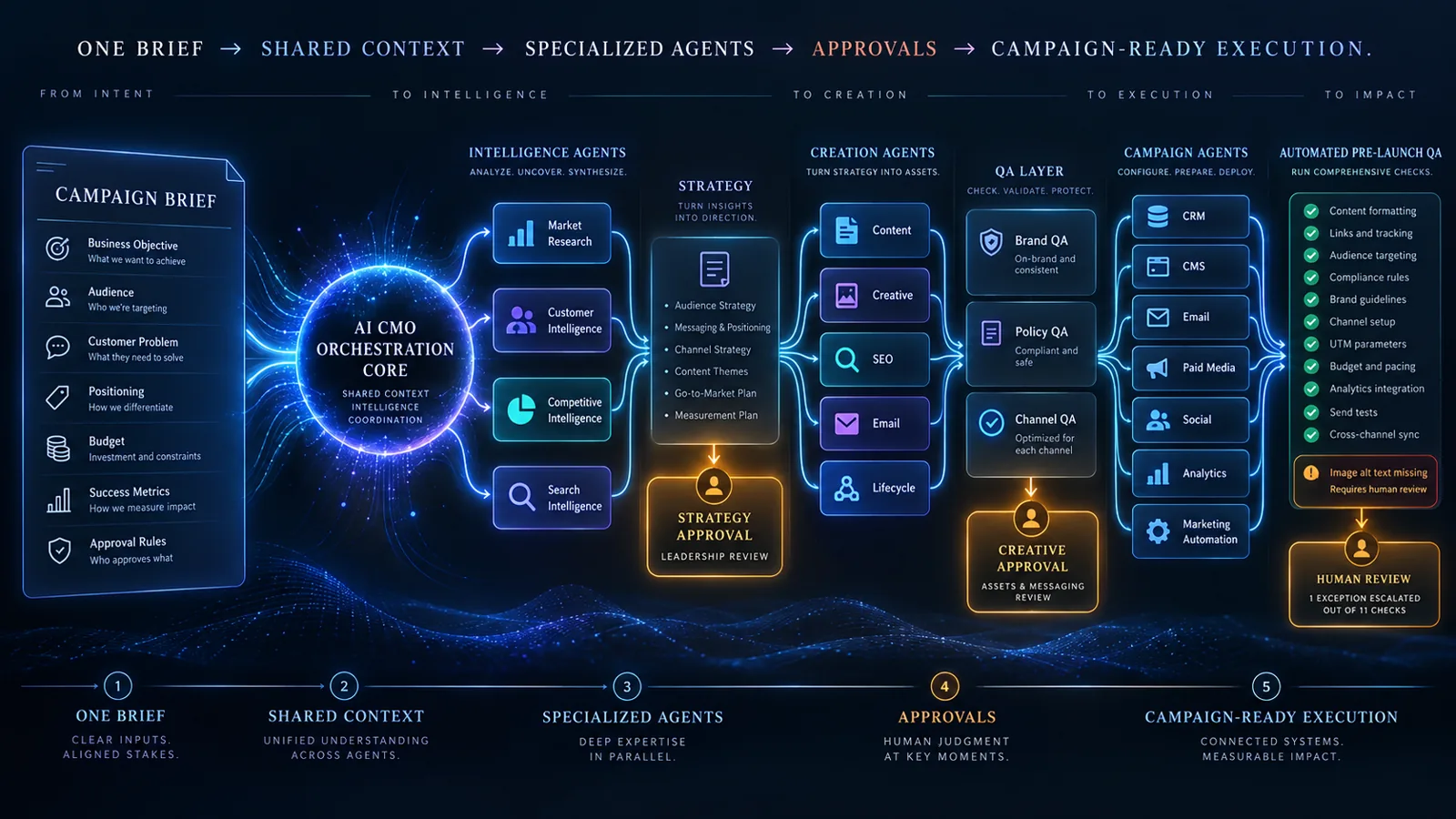
Imagine opening your marketing system on Monday morning and entering one campaign brief.
Not fifty prompts.
Not ten briefs for ten departments.
One structured brief.
It says:
Business objective: Generate qualified enterprise pipeline.
Target audience: CMOs and marketing leaders at companies with 1,000+ employees.
Core problem: Marketing teams have adopted many AI tools but still struggle with fragmented workflows and manual coordination.
Positioning: AI should become the operating layer connecting marketing—not another tool in the stack.
Primary offer: AI CMO platform.
Budget: Existing quarterly allocation.
Risk constraints: No unverified performance claims. Major paid-media budget shifts require approval.
Success metric: Qualified pipeline and enterprise conversion.
Then you submit it.
What happens next?
In a traditional marketing organization, the brief would begin a long chain of human coordination.
Someone sends it to research.
Research comes back.
Strategy develops the campaign.
Content receives a brief.
Creative receives another brief.
Media gets another version.
Marketing operations creates tasks.
Campaign managers configure platforms.
Analytics waits for launch.
Leadership asks for status updates.
The original brief slowly fragments as it moves through the organization.
An AI CMO operating model works differently.
The brief becomes structured operating context.
Research agents activate.
Customer intelligence updates.
Strategy is synthesized.
Content and creative begin.
Campaign structures are prepared.
QA runs.
Human approvals appear only where needed.
Activation flows into existing enterprise systems.
Performance is monitored continuously.
Experiments are generated.
Validated learning returns to the shared intelligence layer.
The brief does not merely create an asset.
It initiates an end-to-end marketing system.
That is the deeper promise of an AI CMO.
The Brief Is No Longer Just a Document
Most marketing briefs are static documents.
They contain:
- objective
- target audience
- message
- deliverables
- timeline
- budget
Humans read them.
Then humans translate them into work.
That translation creates enormous friction.
The strategist interprets the brief one way.
The writer interprets it another.
The designer receives only part of it.
Paid media creates its own version.
Analytics eventually gets the campaign objective in a spreadsheet.
By the time the campaign launches, the original intent can be scattered across:
documents,
messages,
project-management tools,
meetings,
and people's memories.
In an AI CMO system, the brief should become machine-readable campaign intent.
It does not merely describe the work.
It becomes context that downstream agents can retrieve directly.
What an AI-Native Brief Contains
A useful campaign brief for an AI CMO might include several structured dimensions.
Business Objective
What business outcome matters?
For example:
Increase qualified enterprise pipeline by 15%.
Customer Priority
Who should the campaign influence?
Not simply:
“B2B marketers.”
But:
Senior marketing leaders at enterprise organizations struggling with fragmented AI and martech workflows.
Customer Problem
What tension matters?
For example:
Teams have adopted AI, but human coordination still connects the stack.
Positioning
What should the company stand for?
AI as an operating system for marketing rather than another disconnected tool.
Strategic Constraints
What should the system not do?
Examples:
- do not compete primarily on price
- do not use fear-based messaging
- do not position AI as replacing marketing leadership
Business Constraints
Examples:
- fixed campaign budget
- approved markets
- specific product availability
- compliance requirements
Approval Rules
Examples:
- new product claims require human review
- final campaign concept requires creative approval
- budget changes over 5% require CMO approval
Once captured, these become inputs for the entire workflow.
Stage 1 — The AI CMO Expands the Brief With Context
The brief contains intent.
But the system also needs context.
Before creating anything, the AI CMO retrieves relevant information from shared intelligence.
This may include:
- customer research
- CRM data
- previous campaigns
- content performance
- brand guidelines
- competitor intelligence
- sales insights
- product information
- search behavior
- historical experiments
This step matters because AI-generated marketing often becomes generic when creation happens before understanding.
A good AI CMO should not begin by asking:
“What should we write?”
It should first ask:
“What do we already know that should influence this campaign?”
Stage 2 — Multiple Research Agents Work in Parallel
The orchestration layer now activates specialized agents.
Not one giant AI model doing everything sequentially.
Several agents can work simultaneously.
Market Research Agent
Investigates:
- market shifts
- emerging trends
- category dynamics
Customer Intelligence Agent
Analyzes:
- CRM notes
- customer interviews
- sales conversations
- support feedback
- behavioral data
Competitive Intelligence Agent
Maps:
- competitor positioning
- messaging
- offers
- category claims
Search Intelligence Agent
Examines:
- search intent
- related queries
- audience questions
- content gaps
Parallel execution changes the economics of campaign planning.
Instead of waiting for four separate teams to complete work sequentially, several intelligence streams can develop at once.
McKinsey argues that this kind of redesigned human-agent workflow is where agentic AI begins creating significantly more value than isolated productivity tools.
Stage 3 — The System Synthesizes a Strategic Recommendation
Research output is not strategy.
The AI CMO now needs to combine evidence.
A Strategy Agent could synthesize:
Customer tension: Enterprise marketers are not struggling to access AI. They are struggling to coordinate increasingly intelligent but disconnected systems.
Competitive gap: Most competitors emphasize AI generation and productivity rather than orchestration.
Search opportunity: High interest exists around AI agents, AI marketing automation, and marketing operating systems.
Recommended campaign thesis:“Your marketing problem isn't lack of AI. It's lack of orchestration.”
Suggested narrative:
- AI is everywhere.
- Marketing still feels manual.
- More tools increase fragmentation.
- Agents improve tasks.
- Orchestration connects the workflow.
- AI CMO becomes the operating layer.
This is where the AI CMO becomes more than a content engine.
It converts distributed intelligence into a coherent campaign argument.
Stage 4 — Human Strategy Approval
This is an important approval gate.
The system should not quietly decide what the company stands for.
Leadership reviews:
- campaign thesis
- positioning
- audience
- major claims
- creative territory
The human might respond:
Keep the orchestration idea, but make the campaign less technology-centric. Focus more on the operational pain experienced by marketing leaders.
That feedback becomes updated campaign context.
Every downstream agent now works from the revised strategy.
This avoids one of the most common problems in human marketing teams:
different departments working from different versions of the strategy.
Stage 5 — Campaign Architecture Is Generated
Once the strategy is approved, the Campaign Strategy Agent translates it into an execution plan.
It may recommend:
Hero Asset
Long-form thought-leadership article:
The Future of Marketing Isn't More AI Tools
Supporting Content
- AI tool-overload LinkedIn post
- carousel explaining marketing orchestration
- short-form video
- comparison article
- newsletter
Paid Media
Three campaign angles:
- tool overload
- manual coordination
- AI operating system
Landing Page
Dedicated AI CMO campaign page.
Lifecycle
Enterprise nurture sequence.
Sales Enablement
One-page campaign summary and talk track.
Measurement
Track:
- enterprise leads
- qualified pipeline
- campaign-assisted opportunities
- content engagement
- conversion by message angle
Now the campaign is no longer one creative asset.
It is a coordinated system of experiences.
Stage 6 — Content and Creative Agents Work in Parallel
This is where agentic workflows become especially powerful.
Once the strategic foundation is approved, several production agents can activate simultaneously.
Long-Form Content Agent
Writes the campaign's hero article.
Social Content Agent
Builds:
- LinkedIn posts
- short-form posts
- executive commentary
Email Agent
Creates:
- launch email
- nurture messages
- follow-up variants
Creative Agent
Develops:
- campaign visual system
- paid-social concepts
- editorial graphics
- carousel structure
SEO Agent
Optimizes:
- entity coverage
- search intent
- questions
- internal linking
All agents receive the same:
- audience
- positioning
- messaging hierarchy
- claims
- brand context
This matters.
The advantage of a marketing agent system is not simply parallel generation.
It is coordinated generation from shared intent.
Stage 7 — The AI CMO Maintains Message Hierarchy
Without orchestration, AI generation can quickly fragment.
One ad emphasizes automation.
Another emphasizes content.
The landing page talks about cost.
The article talks about AI agents.
The campaign loses coherence.
The AI CMO should maintain a campaign message hierarchy.
For example:
Primary Message
Marketing doesn't need more AI tools. It needs orchestration.
Supporting Message 1
AI tools improve individual tasks but do not connect workflows.
Supporting Message 2
Specialized agents can handle execution across marketing functions.
Supporting Message 3
Human leaders remain responsible for strategy, standards, and judgment.
Product Message
The AI CMO provides the intelligence and orchestration layer connecting the marketing system.
Every agent adapts this hierarchy to its channel.
The message changes format.
It does not change meaning.
Stage 8 — Brand and Policy QA Happens Before Humans Review
Once dozens of assets exist, manual QA becomes a significant bottleneck.
AI can handle first-level validation.
A Brand Agent checks:
- approved terminology
- tone
- product naming
- positioning consistency
- CTA language
A Policy Agent checks:
- prohibited claims
- missing disclaimers
- unsupported statistics
- sensitive messaging
A Channel QA layer checks:
- length
- formatting
- URLs
- metadata
- technical requirements
Human reviewers now receive fewer trivial errors.
Their attention stays focused on:
- quality
- originality
- strategic fit
- creative taste
- high-risk claims
This is the correct use of human attention.
Stage 9 — Human Creative Approval
The Creative Director reviews the campaign system.
Not every comma.
Not every resized asset.
The questions are higher-level:
Does this campaign feel distinctive?
Is the central idea strong?
Does the visual language fit the brand?
Is there enough tension?
Does anything feel generic?
The human rejects one visual territory.
The Creative Agent regenerates within the approved direction.
This is human-AI collaboration at its best.
AI supplies iteration capacity.
Humans supply taste.
Stage 10 — The Brief Becomes an Executable Campaign Plan
At this point, the campaign is strategically and creatively approved.
Traditionally, another operational phase begins.
Tasks must be created.
Deadlines entered.
Owners assigned.
Campaign records configured.
Assets connected.
Adobe is explicitly moving toward this model, where AI can turn campaign briefs into executable project plans and coordinate agents across planning, approvals, and activation.
The AI CMO can translate the approved campaign into:
- deliverables
- dependencies
- channel tasks
- deadlines
- approval states
- campaign records
The brief becomes operational.
Stage 11 — Campaign Agents Configure Execution
Now Campaign Agents interact with the underlying marketing stack.
They may prepare:
CRM
- campaign record
- lead routing
- sales follow-up triggers
CMS
- landing page
- content publication
- launch messages
- nurture sequence
Paid Media
- campaign structure
- approved creative
- audience configuration
Social
- publishing queue
Analytics
- campaign taxonomy
- measurement framework
The AI CMO itself does not need to replace these tools.
It coordinates them.
This is why an AI CMO is better understood as an operating layer above martech than as another martech application.
Stage 12 — Deterministic Systems Handle Predictable Execution
Not every campaign action needs an AI agent.
Once decisions have been made, standard automation can often handle the rest.
Examples:
Campaign approved?
Schedule publication.
Lead reaches qualification threshold?
Create CRM task.
Customer enters nurture segment?
Start sequence.
Consent withdrawn?
Suppress communication.
This is the correct division:
AI handles interpretation.
Agents handle dynamic workflow.
Automation handles predictable execution.
Stage 13 — Pre-Launch QA Runs Automatically
Before activation, the system verifies:
- tracking parameters
- links
- campaign names
- audience configuration
- suppression rules
- creative assignment
- landing pages
- required metadata
- budget configuration
Routine errors are resolved automatically where possible.
Uncertain issues are escalated.
The human receives:
Campaign ready for launch.
42 automated checks passed.
1 decision requires approval: Enterprise audience overlap with the existing ABM campaign.
That is much better than asking a senior marketer to manually check 43 settings.
Stage 14 — Human Launch Approval
This is another high-consequence gate.
Leadership sees:
Objective
Generate enterprise pipeline.
Budget
Within approved allocation.
Primary audience
Enterprise CMOs.
Assets
Approved.
Tracking
Validated.
Outstanding risks
None.
Launch recommendation
Proceed.
The human approves.
The campaign activates.
One approval releases an already validated system.
Stage 15 — The Campaign Does Not Stop at Launch
Traditional campaign thinking often becomes passive after activation.
Launch.
Wait.
Report.
Agentic marketing should operate differently.
The Analytics Agent begins monitoring:
- conversion
- qualified pipeline
- customer segments
- creative performance
- media efficiency
- landing-page behavior
- nurture engagement
The system continuously compares performance against:
- campaign objective
- historical baseline
- expected range
Most normal movement is ignored.
Only meaningful signals surface.
Stage 16 — Anomaly Detection Triggers Investigation
Suppose three days later:
Paid-social engagement remains strong.
But landing-page conversion declines among enterprise traffic.
The Analytics Agent does not simply alert:
Conversion down 11%.
It investigates.
It checks:
- traffic quality
- device
- geography
- campaign source
- audience
- messaging
- landing-page behavior
Diagnosis:
Traffic quality is stable. The largest drop occurs among visitors exposed to the efficiency-led campaign message. Governance-led messaging continues to convert above baseline.
Now the campaign has produced intelligence.
Stage 17 — Analytics Hands Off to Experimentation
The Analytics Agent creates a structured handoff to the Experimentation Agent.
It contains:
Problem: Efficiency-led positioning underperforming.
Evidence: Enterprise conversion -14% vs governance-led variant.
Confidence: High.
Constraint: Existing positioning only. No new product claims.
The Experimentation Agent designs a test.
Variant A:
Scale marketing with AI.
Variant B:
Control how AI operates across marketing.
Because both remain inside the approved message architecture, the test can proceed within predefined limits.
No new strategy meeting required.
Stage 18 — Low-Risk Optimization Happens Automatically
Suppose the organization has predefined:
Approved testing budget: up to 10% of campaign traffic.
The Experimentation Agent launches the controlled test.
The Analytics Agent monitors.
Variant B wins.
The system gradually reallocates traffic within the approved threshold.
Leadership receives:
Governance-led positioning outperformed efficiency messaging by 18% among enterprise visitors. Traffic allocation adjusted within approved experimental limits. No action required.
That is marketing operating continuously.
Stage 19 — High-Consequence Decisions Still Escalate
Now imagine the result is much larger.
Suppose the system concludes:
The entire product should be repositioned from productivity to AI governance.
It does not change the website.
It does not rewrite the brand.
It escalates.
Why?
Because the proposed change crosses from campaign optimization into company strategy.
This illustrates the central rule of an AI CMO:
Autonomy should decline as consequence increases.
Stage 20 — The Campaign Feeds Organizational Learning
After the campaign, validated insights should not disappear into a report.
The AI CMO updates shared intelligence.
For example:
Validated learning: Enterprise CMOs respond more strongly to governance-led AI messaging than efficiency-led messaging.
Audience learning: Companies above 2,500 employees show the largest difference.
Channel learning: Paid search generates lower volume but significantly higher enterprise qualification than paid social.
Creative learning: System-level architecture visuals outperform generic AI imagery.
These insights are now available to future:
- Research Agents
- Strategy Agents
- Content Agents
- Campaign Agents
- Lifecycle Agents
The campaign has made the marketing organization smarter.
The next brief does not begin from zero.
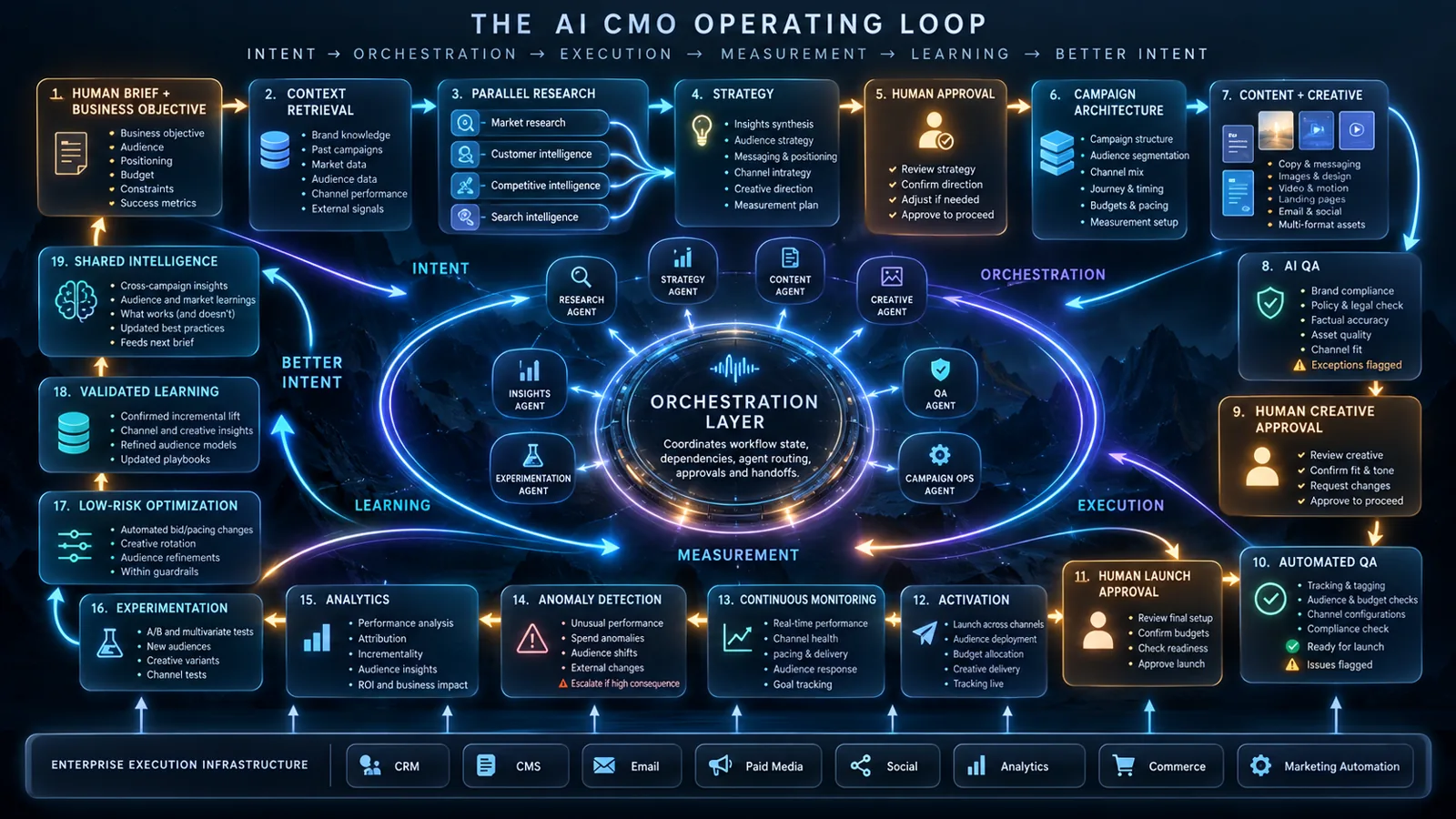
From Brief to Campaign to Learning Loop
The complete workflow looks like this:
BRIEF
↓
CONTEXT RETRIEVAL
↓
PARALLEL RESEARCH
↓
STRATEGY
↓
HUMAN APPROVAL
↓
CAMPAIGN ARCHITECTURE
↓
CONTENT + CREATIVE
↓
AI QA
↓
HUMAN CREATIVE APPROVAL
↓
CAMPAIGN SETUP
↓
AUTOMATED QA
↓
HUMAN LAUNCH APPROVAL
↓
ACTIVATION
↓
MONITORING
↓
ANALYSIS
↓
EXPERIMENTATION
↓
OPTIMIZATION
↓
LEARNING
↓
SHARED INTELLIGENCE
Then the next campaign begins.
This is not a linear content-generation workflow.
It is a continuous operating loop.
What the Human Team Actually Did
Now examine human involvement across this entire campaign.
Humans:
defined the business objective,
approved positioning,
adjusted the strategic direction,
evaluated creative quality,
approved high-risk claims,
approved launch,
reviewed major strategic implications.
They did not manually:
collect every piece of research,
route every task,
write every adaptation,
configure every campaign field,
check every URL,
watch every dashboard,
prepare every report,
assign every optimization.
That is the deeper design principle.
Human involvement becomes concentrated at points of judgment rather than points of routine execution.
What the AI CMO Actually Did
The AI CMO did not simply “create a campaign.”
It coordinated a system.
It:
retrieved context,
activated agents,
maintained workflow state,
preserved campaign intent,
coordinated dependencies,
routed approvals,
connected to enterprise tools,
monitored performance,
triggered experiments,
and updated organizational learning.
This is why calling an AI CMO a “marketing chatbot” dramatically understates the concept.
The intelligence itself is only part of the architecture.
The more important capability is orchestration.
The Brief Becomes the Source of Intent
This is one of the most important architectural shifts.
Traditional organizations have many sources of truth.
A brief.
A project-management ticket.
A media plan.
A content document.
An email.
A Slack message.
An analyst's notes.
An AI-native system needs a clearer source of intent.
The approved brief should define:
What are we trying to achieve?
Then strategy, content, execution, and measurement can all inherit that context.
This reduces one of marketing's biggest invisible costs:
intent degradation across handoffs.
Fewer Handoffs Matter More Than Faster Generation
People often focus on how quickly AI can generate an asset.
That is useful.
But consider a traditional campaign containing 25 handoffs.
Even if AI makes writing 80% faster, the organization may still move slowly.
The bigger opportunity is to remove unnecessary handoffs.
McKinsey's current agentic-marketing research emphasizes precisely this shift: value comes from redesigning complete workflows and the relationship between humans and agents, rather than optimizing isolated tasks.
Adobe makes the operational problem concrete: it reports that 84% of surveyed organizations missed at least one marketing opportunity in the previous quarter because workflows could not respond fast enough, with manual handoffs across planning, production, approvals, and activation contributing to the delay.
Workflow compression can matter more than generation speed.
One Brief Does Not Mean One-Click Autonomous Marketing
This distinction is critical.
The system described here should not be interpreted as:
Human writes one sentence → AI runs the company.
A strong AI CMO requires:
- structured objectives
- reliable data
- shared intelligence
- specialist agents
- orchestration
- permissions
- quality checks
- human approval gates
- enterprise integrations
- evaluation
The simplicity should exist at the human interface.
The architecture underneath is sophisticated.
That is what good infrastructure looks like.
What Should Never Disappear From the Campaign Process
Even as execution becomes more agentic, several human responsibilities remain essential.
Strategy
What are we actually trying to achieve?
Positioning
What do we want customers to believe about us?
Customer Priorities
Which audience matters most?
Creative Taste
What is worth putting into the world?
Risk
What should not happen automatically?
Major Trade-Offs
Growth versus efficiency?
Reach versus relevance?
Brand versus short-term conversion?
Accountability
Who owns the outcome?
The goal is not human-free marketing.
It is marketing where human involvement occurs at the right altitude.
The AI CMO Is Really an Orchestration System
This leads to the deeper insight.
The phrase AI CMO sounds like the goal is to reproduce a human executive using software.
That is probably the wrong mental model.
The more useful architecture is:
human leadership
above
an intelligent orchestration system
that coordinates:
- shared intelligence
- specialized agents
- workflows
- enterprise software
- automation
- measurement
- learning
In that model, AI does not replace the CMO.
It gives the CMO a fundamentally different operating system.
The End State Is Continuous Marketing
One brief becoming one campaign is only the beginning.
The bigger transformation occurs when the system stops thinking in isolated campaigns.
Research is continuously updated.
Customer intelligence continuously evolves.
Content performance continuously informs future strategy.
Campaign results update audience understanding.
Experiments update messaging.
Competitor changes update planning.
Marketing becomes a persistent learning loop.
McKinsey describes this broader transition as the move from traditional campaigns toward a continuous growth engine in which insights, creativity, personalization, commerce, and orchestration operate in much closer to real time.
The campaign is no longer a closed project.
It is one cycle inside an intelligent marketing system.
From One Brief to an Entire Campaign
So what really happens inside an AI CMO?
One human-approved brief defines intent.
Shared intelligence adds context.
Research agents expand understanding.
Strategy agents synthesize the opportunity.
Humans approve the direction.
Content and creative agents develop the campaign.
QA agents enforce standards.
Humans apply taste.
Campaign agents prepare execution.
Automation activates predictable steps.
Analytics agents watch performance.
Experimentation agents improve the system.
High-risk decisions return to humans.
Validated outcomes become organizational memory.
Then the next cycle begins.
That is much more than AI content generation.
It is marketing moving from:
brief → people → tools → handoffs → campaign
to:
brief → orchestration → intelligence → agents → approvals → execution → learning.
And that is what an AI CMO can ultimately change.
Not simply how fast a campaign gets created.
But how the entire marketing organization moves from intent to outcome.
Frequently asked questions
How does an AI CMO turn a brief into a campaign?
An AI CMO can convert a structured campaign brief into shared workflow context, activate research and strategy agents, coordinate content and creative production, route human approvals, configure campaigns through enterprise systems, monitor performance, trigger experiments, and feed validated learning back into organizational intelligence.
Does an AI CMO automatically create and launch campaigns?
It can automate many steps, but important strategic, creative, budgetary, and high-risk decisions should use appropriate human approval gates. The level of autonomy should depend on the consequence of each action.
What information should an AI campaign brief contain?
A strong brief should define the business objective, priority audience, customer problem, positioning, strategic constraints, budget or operational limits, success metrics, and approval requirements.
What agents might participate in an AI CMO campaign workflow?
Agents may include Market Research, Customer Intelligence, Competitive Intelligence, Search, Strategy, Content, Creative, SEO, Campaign, Analytics, and Experimentation agents.
What is campaign orchestration?
Campaign orchestration is the coordination of agents, humans, data, automation, and enterprise systems across the complete campaign workflow, including sequencing, dependencies, handoffs, approvals, execution, and learning.
How does AI maintain consistency across campaign assets?
Agents can work from the same approved positioning, audience, brand context, campaign message hierarchy, claims, and constraints stored in shared marketing intelligence.
What happens after an AI-powered campaign launches?
Analytics agents can continuously monitor performance, detect meaningful anomalies, investigate likely causes, trigger approved experiments, make low-risk optimizations within guardrails, and escalate consequential decisions to humans.
How is this different from traditional marketing automation?
Traditional marketing automation mainly executes predefined rules. An AI CMO adds contextual reasoning, specialized agents, dynamic orchestration, and the ability to adapt workflows based on changing information.
Does an AI CMO replace the human CMO?
No. A more useful model keeps human leadership responsible for objectives, strategy, positioning, creative standards, major trade-offs, governance, and accountability while AI handles more intelligence, coordination, and execution.
What is the biggest advantage of an AI CMO campaign workflow?
The largest advantage may be the reduction of manual coordination and handoffs across the campaign lifecycle—not simply faster content generation.