How AI Marketing Agents Actually Work: From Context and Reasoning to Actions and Orchestration
Sometimes it means a system capable of making decisions and taking actions across multiple tools.
AI marketing agents are everywhere in 2026.
But the phrase is often used so loosely that it can mean almost anything.
Sometimes “AI agent” means a chatbot.
Sometimes it means automation.
Sometimes it means a workflow with an LLM in the middle.
Sometimes it means a system capable of making decisions and taking actions across multiple tools.
These are not the same thing.
So what does an AI marketing agent actually do?
The simplest definition is:
An AI marketing agent is a goal-oriented software system that can interpret context, reason about what should happen, use tools, take actions, and continue working toward an objective within defined boundaries.
That is fundamentally different from a traditional AI assistant.
A traditional assistant waits for:
“Write this email.”
An agent can be given:
“Improve conversion for this campaign without exceeding the approved budget or changing the core positioning.”
Then the agent may need to:
- retrieve campaign data
- compare audience performance
- inspect creative results
- identify the likely problem
- select an appropriate action
- use a connected marketing tool
- measure the outcome
- continue or escalate
That loop is what makes the system agentic.
First: An AI Agent Is Not Just an LLM
Large language models are important.
But an LLM by itself is not a complete marketing agent.
A language model can:
- interpret text
- generate content
- summarize information
- reason over a problem
- suggest possible actions
But a marketing agent needs additional components.
It needs:
- a goal
- context
- access to relevant knowledge
- available actions
- connected tools
- permissions
- workflow state
- guardrails
- stopping or escalation conditions
The LLM is often the reasoning engine.
The agent is the larger system around it.
A useful mental model is:
AI Agent = Goal + Reasoning + Context + Tools + Memory + Actions + Guardrails
Remove the action layer and you often have an assistant.
Add the ability to act and continue working toward an objective, and you begin to have an agent.
The Seven Core Parts of an AI Marketing Agent
Most useful marketing agents can be understood through seven components.
1. Goal
The agent needs to know what it is trying to achieve.
Examples:
Find why enterprise conversion declined.
Create a campaign for dormant customers.
Identify high-intent accounts that need sales follow-up.
Optimize paid media within an approved budget.
The goal matters because it gives the agent a decision criterion.
Without a clear objective, AI can generate work but cannot reliably determine whether its actions are useful.
2. Context
The agent needs to understand the situation.
Context may include:
- business objectives
- customer data
- brand guidelines
- CRM records
- campaign history
- product information
- analytics
- previous actions
- budgets
- approval rules
This is why agents become far more useful when they connect to enterprise data.
Salesforce describes the knowledge layer as one of the core traits of an effective marketing agent: the system needs relevant internal and external data to make useful decisions.
Without context, an agent is intelligent but uninformed.
3. Reasoning
Once the agent understands the goal and context, it needs to determine what to do.
Suppose the goal is:
Investigate why campaign conversion fell.
The agent might reason:
Conversion decreased.
But traffic volume is stable.
Traffic mix is stable.
The decline is isolated to mobile visitors.
The decline began after the landing-page update.
Therefore, the landing-page change is a stronger hypothesis than audience quality.
That reasoning determines the next action.
This is one of the primary differences between an agent and traditional automation.
Traditional automation executes a predefined rule.
Agentic AI can choose among multiple possible paths based on context.
Traditional Automation vs AI Agent
Consider this rule:
IF conversion rate < 2% → notify campaign manager.
That is automation.
Useful.
Reliable.
Predictable.
An AI agent can go further.
It sees conversion below 2%.
Then asks:
Why?
Which audience?
Which device?
Which creative?
What changed?
Has this happened before?
Does this need action?
The difference is:
Automation follows a known path.
An agent can determine the path.
That does not make agents superior for everything.
If the action is predictable, deterministic automation is often better.
Use AI where interpretation is required.
Use automation where predictability is required.
4. Tools
Reasoning is not enough.
An agent needs ways to interact with the world.
These are its tools.
A marketing agent might have access to:
- CRM
- analytics
- CMS
- advertising platforms
- email systems
- marketing automation
- search data
- databases
- APIs
- internal knowledge systems
A tool can be read-only.
For example:
Retrieve campaign performance.
Or it can allow actions.
For example:
Create a CRM task.
Update a campaign.
Build an audience.
Publish approved content.
The agent selects from the tools available to it.
This is critical.
A useful agent is not simply capable of reasoning.
It can connect that reasoning to actual work.
Salesforce highlights this action capability as the major distinction of agentic AI: agents can move from recommendations into actions such as updating records, activating journeys, or triggering workflows.
5. Actions
Tools are what an agent can use.
Actions are what it can actually do.
For example, a Campaign Agent may be allowed to:
- create a draft campaign
- modify an approved audience
- pause an underperforming variant
- create an experiment
- request creative
- update campaign status
But it may not be allowed to:
- increase budget beyond 5%
- create a new customer claim
- publish without approval
- access sensitive customer fields
This is where permissions matter.
Agent design is not simply about intelligence.
It is about defining authority.
6. Guardrails
Guardrails define the agent's boundaries.
Examples:
Never modify total budget by more than 5%.
Never publish a new product claim without approval.
Do not contact customers who have opted out.
Escalate if confidence is below 80%.
Only use approved brand terminology.
Salesforce explicitly identifies guardrails as a core component of effective business agents, including instructions, security boundaries, and escalation paths to humans.
This is one of the most important parts of agentic architecture.
The question is not:
Can the AI do this?
It is:
Should this agent be permitted to do this?
7. State and Memory
Agents also need some understanding of what has already happened.
Imagine an agent managing a campaign workflow.
It needs to know:
Research complete.
Strategy approved.
Content draft ready.
Creative waiting for approval.
Campaign not yet activated.
Without state, the agent could repeat tasks or act out of sequence.
State is the short-term operational memory of the workflow.
Longer-term memory may include:
- campaign results
- prior decisions
- customer patterns
- experiment history
- validated learnings
This allows future decisions to improve.
But memory should not be confused with uncontrolled self-learning.
In enterprise environments, organizations usually need explicit rules about what information persists and what can influence future workflows.
The Agent Loop: How Work Actually Happens
An AI marketing agent usually operates in some variation of a loop.
A useful simplified model is:
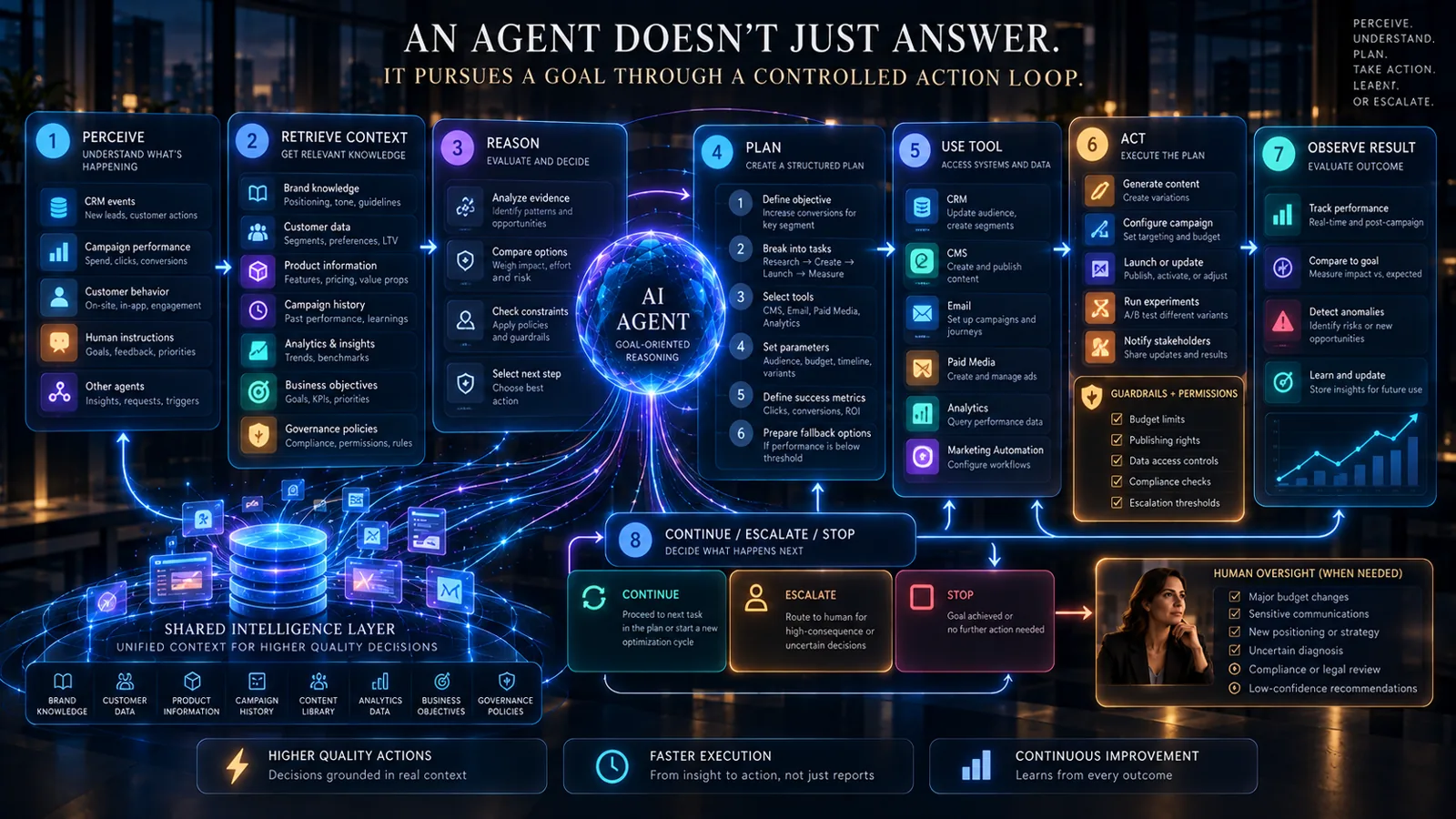
PERCEIVE → UNDERSTAND → PLAN → ACT → OBSERVE RESULT → CONTINUE / ESCALATE / STOP
Let's break that down.
Step 1: Perceive
The agent receives information.
This may come from:
- a human instruction
- CRM event
- campaign performance change
- scheduled trigger
- customer behavior
- another agent
Example:
Paid-search conversion has fallen 15%.
Step 2: Retrieve Context
The agent gathers what it needs.
It might retrieve:
- current campaign configuration
- historical performance
- traffic mix
- landing-page changes
- customer segments
- budget rules
Techniques such as retrieval-augmented generation, or RAG, can provide the underlying model with current company-specific information rather than forcing it to rely solely on its original training data.
Step 3: Reason
The agent compares evidence.
For example:
Traffic stable.
Audience composition stable.
Desktop conversion stable.
Mobile conversion down 28%.
New mobile landing page launched yesterday.
Likely hypothesis:
landing-page change.
Step 4: Plan
The agent determines what needs to happen next.
Possible plan:
- compare previous and current pages
- identify messaging differences
- retrieve previous experiment performance
- prepare controlled rollback test
- request approval
The ability to plan multiple steps rather than simply return one answer is one of the defining properties of agentic systems. Adobe describes its evolution from assistant interfaces toward systems capable of reasoning, planning, executing, and iterating across workflows.
Step 5: Use a Tool
The agent calls the relevant system.
For example:
Retrieve landing-page history.
Then:
Retrieve campaign segmentation data.
Then:
Create test configuration.
Each tool call adds new information or performs work.
Step 6: Evaluate
The agent checks:
Did the action succeed?
Is more work needed?
Is confidence high enough?
Does a human need to approve?
If the test requires approval, it stops and escalates.
If not, it may continue.
Step 7: Repeat
The loop continues until:
- objective is completed
- boundary is reached
- confidence is insufficient
- human intervention is required
- error occurs
This loop is the fundamental operating pattern behind AI agents.
Salesforce describes a closely related cycle of perception, decision-making, action, and learning/adaptation.
A Practical Example: Campaign Optimization Agent
Let's make this concrete.
The agent's goal is:
Maintain campaign efficiency above the approved target without exceeding the existing budget.
The system detects:
ROAS fell 12%.
Perception
The agent receives current campaign metrics.
Context Retrieval
It retrieves:
- audience performance
- creative performance
- budget
- historical results
- frequency
- landing-page conversion
Reasoning
It finds:
Audience quality stable.
Landing page stable.
Creative Variant A has a rapidly declining CTR.
Frequency is significantly above baseline.
Likely diagnosis:
creative fatigue.
Planning
The agent decides to:
- reduce traffic to Variant A
- increase allocation to approved Variant C
- monitor conversion for two hours
Guardrail Check
Allowed optimization:
Maximum allocation shift of 10%.
Proposed:
8%.
Within permissions.
Action
The agent changes allocation.
Measurement
Two hours later:
Conversion improves 6%.
Learning
The campaign state and result are recorded.
No human interaction was required.
Why?
Because:
the objective was clear,
the action was reversible,
the budget stayed fixed,
and the agent remained inside approved boundaries.
That is a good candidate for autonomy.
Compare That With a Strategic Decision
Now suppose the same agent concludes:
We should reposition the entire product around a new customer segment.
Should it execute?
No.
Even if the analysis is excellent, this decision affects:
- company strategy
- brand
- product
- sales
- resource allocation
The agent should escalate.
This demonstrates one of the most important principles in agent design:
Autonomy should be determined by consequence, not simply capability.
How Agents Access Business Knowledge
AI agents are most useful when they have reliable business context.
A marketing agent might retrieve information from:
Structured Systems
- CRM
- CDP
- analytics databases
- campaign systems
Unstructured Knowledge
- brand documents
- research
- product documentation
- customer interviews
- campaign briefs
Real-Time Signals
- performance data
- customer actions
- new leads
- competitor activity
The architecture often looks something like:
User or Event → Agent → Retrieval Layer → Relevant Business Context → Reasoning
This is much more powerful than pasting information into a prompt manually.
Shared Intelligence vs Agent-Specific Knowledge
Not every agent needs access to everything.
A Content Agent may need:
- brand
- products
- customer research
- search data
A Campaign Agent may need:
- audiences
- budgets
- approved content
- campaign history
An Analytics Agent may need:
- performance data
- historical baselines
- business KPIs
Some context should be shared.
Some should be restricted.
This allows organizations to balance:
usefulness
with
least-privilege access.
One Agent Should Not Do Everything
A common mistake is trying to create one giant marketing agent.
Give it all the data.
Give it all the tools.
Ask it to do everything.
That is usually harder to:
- control
- evaluate
- debug
- govern
- improve
A more robust model uses specialized agents.
For example:
Research Agent
Owns market and competitor research.
Customer Intelligence Agent
Owns audience understanding.
Content Agent
Owns content preparation.
Campaign Agent
Owns campaign setup.
Analytics Agent
Owns performance interpretation.
Each agent has a narrower role.
That makes its outputs easier to evaluate.
The larger marketing workflow then emerges through collaboration.
This Is Where Orchestration Enters
Multiple agents create a new problem.
Who decides which one works next?
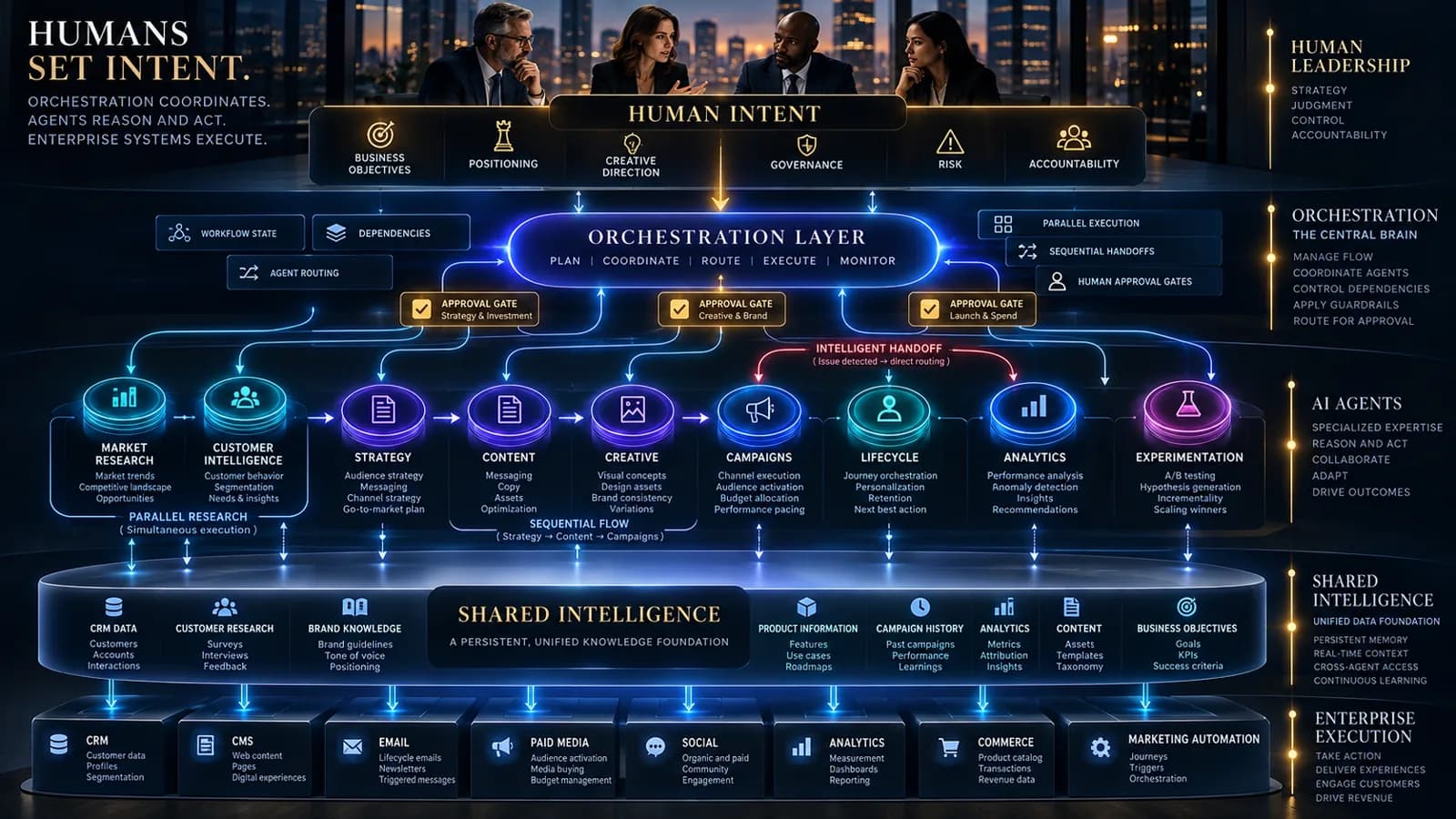
That is the job of the orchestration layer.
Suppose leadership approves a new campaign objective.
The orchestrator may:
- activate Research and Customer Intelligence agents in parallel
- wait for both outputs
- route findings to the Strategy Agent
- send approved strategy to Content and Creative agents
- route completed assets through Brand QA
- request human approval
- send approved work to Campaign Agent
- activate Analytics Agent after launch
The agents do the work.
The orchestration layer manages:
- dependencies
- sequence
- workflow state
- routing
- escalation
This distinction is essential.
Agent = performs specialized work
Orchestrator = coordinates the system
Multi-Agent Systems: How Agents Work Together
Multi-agent marketing can follow several patterns.
Parallel Execution
Several agents work at once.
Example:
Research Agent
Customer Agent
Competitor Agent
all investigate the same opportunity.
Their outputs are combined later.
This increases speed.
Sequential Execution
One agent's result becomes another agent's input.
Example:
Research → Strategy → Content → Campaign
This is useful where stages depend on previous decisions.
Agent-to-Agent Handoff
One agent detects a condition and routes work directly to another.
Example:
Analytics Agent detects creative fatigue.
It activates the Creative Agent.
Supervisor Pattern
A higher-level agent coordinates specialized agents.
For example:
Campaign Supervisor Agent
delegates to:
- Research Agent
- Content Agent
- Creative Agent
- Analytics Agent
This can be useful when the objective requires several capabilities.
Are Agents Really Autonomous?
The word autonomous can be misleading.
Most enterprise agents operate with bounded autonomy.
They are autonomous inside a defined space.
An agent may independently choose:
which analysis to run,
which tool to use,
which approved variant to test.
But it may not be allowed to:
exceed budget,
access restricted data,
publish unapproved claims,
change strategy.
This is the correct model.
The objective is not maximum autonomy.
It is appropriate autonomy.
How Human Approval Actually Fits Into an Agent Workflow
Consider a campaign agent.
It may be able to:
create campaign structure,
prepare audiences,
generate tracking,
validate required fields.
Then it reaches:
Publish campaign.
The architecture checks:
Does publication require approval?
If yes:
workflow pauses.
Human receives:
Campaign ready. One approval required.
Human approves.
Workflow resumes.
This is a human approval gate.
Humans do not need to operate every step.
They simply control specific transitions.
Agentic AI vs Generative AI
These terms are often confused.
Generative AI
Primary purpose:
Create.
Examples:
write copy,
generate images,
produce summaries.
Predictive AI
Primary purpose:
Predict.
Examples:
churn probability,
conversion probability,
customer lifetime value.
Agentic AI
Primary purpose:
Act toward a goal.
An agent may use generative and predictive AI inside its reasoning.
But its defining feature is that it participates in the workflow.
Salesforce makes this distinction explicitly: generative AI creates, predictive AI forecasts, while agentic AI reasons and takes actions toward an outcome.
AI Agent vs Chatbot
A chatbot primarily works through conversation.
You ask.
It answers.
An agent may never have a chat interface at all.
It may be triggered when:
campaign performance changes,
a lead enters CRM,
content receives approval,
a scheduled workflow begins.
It acts in the background of the workflow.
This is a useful distinction:
Chat is an interface.
Agency is a capability.
A chatbot can contain an agent.
An agent does not require a chatbot.
AI Agent vs Automation
Traditional automation:
If X, then Y.
Agent:
Given objective X and situation Y, determine what to do next.
Automation is more predictable.
Agents are more flexible.
The best system uses both.
For example:
Agent decides:
Send customer into recovery journey.
Automation executes:
specific consent checks,
record updates,
scheduled messaging.
AI should not replace deterministic systems where determinism is valuable.
What Makes an Agent Reliable?
Intelligence alone is not enough.
Reliable agents need:
Clear Roles
What exactly is the agent responsible for?
Good Context
Does it have the information needed?
Limited Permissions
Can it access only what it should?
Observable Actions
Are its actions logged?
Evaluation
Can you measure whether it performed correctly?
Escalation
Does it know when to stop?
Human Accountability
Who ultimately owns the result?
These are operational design questions.
They are often more important than choosing the most powerful model.
Agents Need Evaluation, Not Just Prompts
If an agent will repeatedly perform work, organizations need to measure it.
Possible evaluation criteria include:
- accuracy
- task success
- false escalation rate
- missed escalation rate
- cost
- latency
- business outcome
- brand compliance
Prompt quality matters.
But agent performance is a systems problem.
A well-written prompt attached to poor data, excessive permissions, and unreliable tools is still a poor agent.
The Biggest Agentic AI Mistake: Automating a Bad Workflow
A sophisticated agent placed inside a badly designed workflow does not create transformation.
Imagine:
nine unnecessary approval stages.
Then build AI agents to automatically route work through all nine.
Congratulations.
You have automated bureaucracy.
McKinsey's 2026 research emphasizes that the bigger opportunity lies in rewiring end-to-end workflows around human-AI collaboration, rather than simply deploying more agents into existing processes.
The question should be:
What should this workflow look like now that agents exist?
Not:
Where can we insert an agent into the old process?
A Complete AI Marketing Agent Architecture
At a high level, the architecture may look like this:
HUMAN INTENT
Objective
Strategy
Standards
Risk boundaries
↓
ORCHESTRATION
Workflow state
Agent routing
Dependencies
Human approvals
↓
SPECIALIZED AGENT
Goal
Reasoning
Planning
Memory
↓
CONTEXT
CRM
Brand knowledge
Customer intelligence
Campaign history
Analytics
↓
TOOLS
CMS
Paid media
CRM
Marketing automation
Analytics
↓
ACTION
Create
Analyze
Update
Launch
Route
Optimize
↓
OBSERVATION
Did it work?
↓
LOOP / ESCALATE / STOP
This is the basic operating system behind agentic marketing.
How a Full Campaign Could Run With Multiple Agents
Suppose a CMO gives the system:
Increase qualified enterprise pipeline by 15% this quarter without increasing total media spend.
The workflow could operate like this.
Research Agent
Identifies:
market opportunities,
competitive changes,
customer pain points.
Customer Intelligence Agent
Identifies:
high-value segments,
behavior patterns,
objections.
Strategy Agent
Combines findings into a campaign approach.
Human
Approves:
positioning,
customer priority,
creative direction.
Content Agent
Creates messaging and assets.
Brand Agent
Checks standards.
Campaign Agent
Builds programs and audiences.
Human
Approves launch.
Analytics Agent
Monitors performance.
Experimentation Agent
Tests approved alternatives.
Orchestration Layer
Coordinates the entire process.
This is much closer to an AI-powered marketing organization than simply asking a chatbot to:
“Create a campaign.”
What Humans Still Need to Own
Even sophisticated agents should not remove human responsibility.
Humans should retain strong ownership of:
- business strategy
- positioning
- customer priorities
- brand standards
- creative taste
- budgets
- risk thresholds
- high-consequence decisions
- accountability
Agents can execute strategy.
They should not quietly redefine it.
The Future of Marketing Agents Is Not One Giant Autonomous CMO
This is another important misconception.
The future is probably not:
one giant AI system running the marketing department.
The more useful model is modular.
Shared intelligence.
Specialized agents.
Orchestration.
Deterministic automation.
Human governance.
This architecture allows each component to do what it does best.
It also makes the overall system easier to control.
How AI Marketing Agents Actually Work
So, stripped of the hype, what does an AI marketing agent actually do?
It receives an objective.
It retrieves context.
It reasons about the situation.
It creates a plan.
It chooses from approved tools.
It takes an action.
It observes the result.
Then it decides whether to:
continue,
adjust,
escalate,
or stop.
That is the agent loop.
Scale that across:
research,
customer intelligence,
content,
campaigns,
lifecycle,
analytics,
experimentation,
and you begin to get something much more important than an AI assistant.
You get an agentic marketing operating model.
The real shift is not from humans to AI.
It is from:
humans manually coordinating every marketing action
to:
humans defining objectives and boundaries while intelligent systems coordinate more of the work underneath.
That is how AI marketing agents actually work.
Frequently asked questions
What is an AI marketing agent?
An AI marketing agent is a goal-oriented software system that can interpret context, reason about what to do, use connected tools, take actions, and continue working toward a marketing objective within defined permissions and guardrails.
How is an AI agent different from ChatGPT?
A conversational AI assistant primarily responds to prompts. An AI agent can participate in workflows, use enterprise tools, take actions, maintain task state, and pursue an objective across multiple steps.
How do AI marketing agents access data?
Agents can connect to systems such as CRM, analytics, customer-data platforms, knowledge bases, campaign tools, and internal documents. Retrieval systems can provide relevant company-specific context during reasoning.
What tools can marketing agents use?
Depending on their permissions, agents may use CRM, CMS, email systems, paid-media platforms, analytics, marketing automation, databases, APIs, and internal workflow systems.
What is the AI agent loop?
A typical agent loop is: perceive information, retrieve context, reason, plan, act using tools, observe results, and then continue, escalate, or stop.
What is orchestration in AI agents?
Orchestration coordinates multiple agents and workflows. It manages dependencies, sequencing, workflow state, agent routing, and human approval gates.
What is a multi-agent marketing system?
A multi-agent marketing system uses several specialized agents—such as Research, Content, Campaign, and Analytics Agents—that collaborate through sequential, parallel, or supervisor-based workflows.
Are AI marketing agents autonomous?
Usually only within defined boundaries. Enterprise agents typically operate with bounded autonomy based on permissions, risk thresholds, budget limits, and human approval requirements.
What should humans still control?
Humans should retain responsibility for strategy, positioning, major budgets, creative standards, high-risk decisions, governance, and final accountability.
Are AI agents better than marketing automation?
They solve different problems. AI agents are useful when interpretation and flexible reasoning are required. Traditional automation is preferable when actions should follow predictable, deterministic rules.