Introducing the Future of Marketing: Human Strategy, AI Agents and Continuous Growth
For the past several years, the marketing industry has discussed artificial intelligence mainly as a tool.
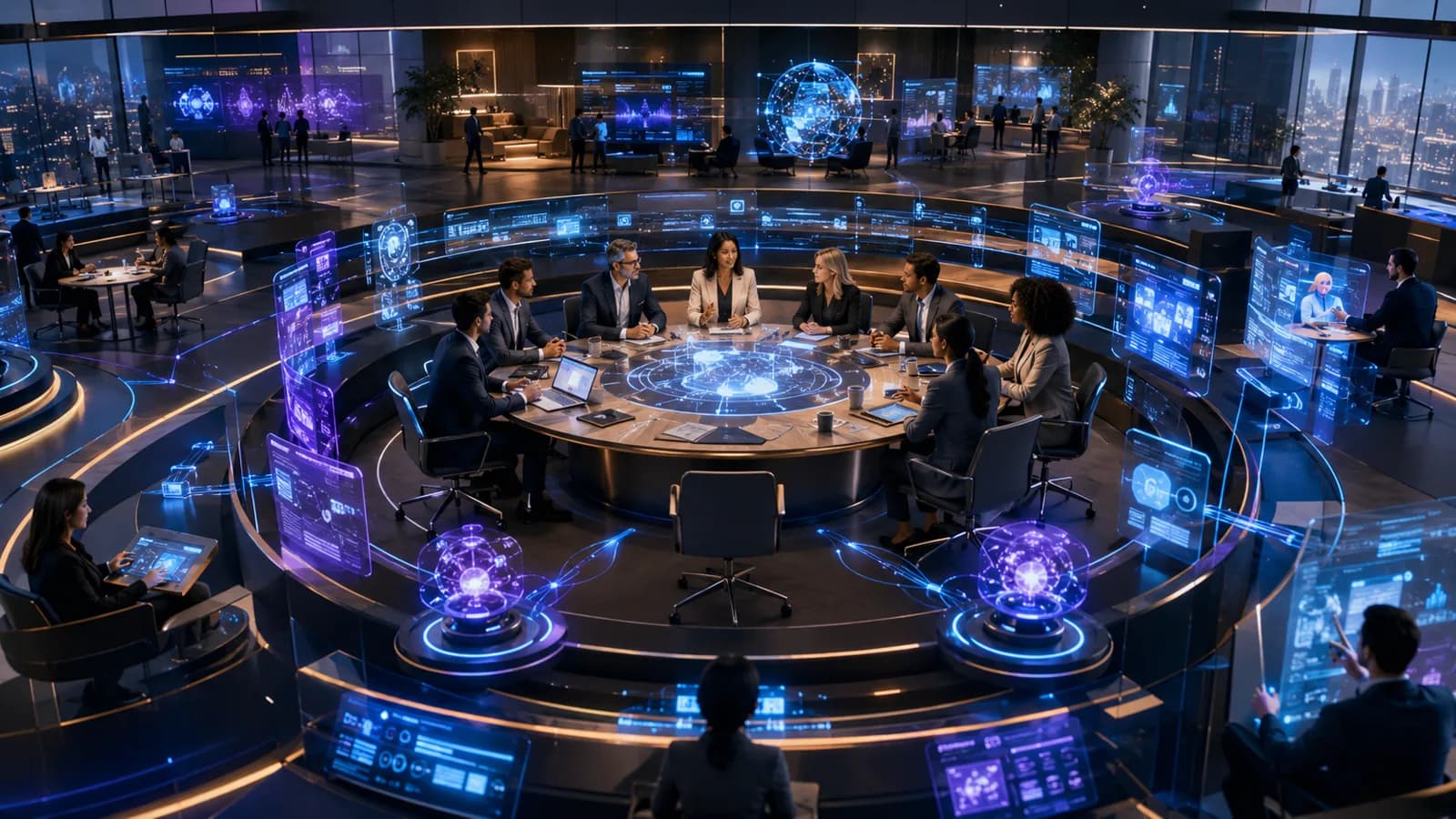
For the past several years, the marketing industry has discussed artificial intelligence mainly as a tool.
A tool for writing content.
A tool for generating images.
A tool for analysing campaigns.
A tool for personalising emails.
A tool for making individual marketers more productive.
That phase was important.
It introduced millions of people to generative AI and proved that machines could support creative and analytical work once considered exclusively human.
But it was only the beginning.
The future of marketing will not be defined by one marketer opening an AI assistant and asking it to complete a task.
It will be defined by intelligent systems that can understand business objectives, retrieve company knowledge, monitor customer signals, coordinate specialised agents, operate connected tools and bring important decisions to human leaders.
Marketing is moving:
- From prompts to persistent context
- From assistants to agents
- From isolated tools to operating systems
- From scheduled campaigns to continuous growth
- From manual reporting to decision intelligence
- From human-only teams to human–agent organisations
- From activity measurement to business outcomes
OpenAI’s enterprise research describes organisations moving beyond individual productivity and embedding AI into end-to-end workflows with human oversight, ownership and quality controls.
This is the future of marketing.
Not marketing without people.
Not creativity without human taste.
Not brands controlled entirely by algorithms.
It is a new division of labour in which machines provide continuous analytical and operational capacity while people provide direction, judgement, imagination, relationships and accountability.
The future of marketing is human-led, agent-operated and outcome-driven.
The First AI Marketing Era Was About Assistance
The first wave of AI adoption focused on helping people complete individual tasks.
A marketer could use AI to:
- Brainstorm campaign ideas
- Draft an article
- Rewrite an advertisement
- Summarise research
- Generate social posts
- Analyse a spreadsheet
- Prepare a meeting brief
The marketer remained responsible for moving the work through the organisation.
They decided what to ask.
They gathered the context.
They copied outputs between systems.
They coordinated approvals.
They launched the campaign.
They reviewed performance.
AI improved the speed of a task, but the surrounding workflow remained mostly unchanged.
This explains why many companies have seen productivity benefits without achieving a complete transformation of marketing performance.
McKinsey reported in 2026 that almost two-thirds of enterprises had experimented with agents, while fewer than 10% had scaled them sufficiently to produce tangible value. It identified data limitations as one of the most common obstacles.
The larger opportunity does not come from distributing more AI tools.
It comes from redesigning the system of work.
The Next AI Marketing Era Is About Delegation
An assistant responds to a request.
An agent can receive an objective and manage a sequence of actions towards it.
It may:
- Retrieve information.
- Interpret the situation.
- Select an approved tool.
- perform an action.
- Evaluate the result.
- Continue or escalate.
OpenAI defines agents as systems built around models, tools and instructions that can complete workflows on behalf of users. Its guidance also stresses that sensitive, irreversible or high-stakes actions require stronger human oversight.
This changes the relationship between marketers and AI.
Instead of asking:
Can AI help me prepare this campaign report?
The organisation can assign an agent the continuing responsibility:
Monitor campaign performance, validate the data, detect meaningful anomalies, prepare evidence-based explanations and escalate decisions requiring human attention.
The task becomes a role.
The prompt becomes a workflow.
The output becomes ongoing operational capacity.
The Future of Marketing Begins With One Connected System
Most marketing departments currently operate through disconnected platforms.
Customer information sits inside CRM and support systems.
Performance information sits inside advertising and analytics tools.
Brand knowledge lives in presentations and documents.
Campaign coordination happens through project-management platforms, spreadsheets, messages and meetings.
AI tools are often added as another disconnected layer.
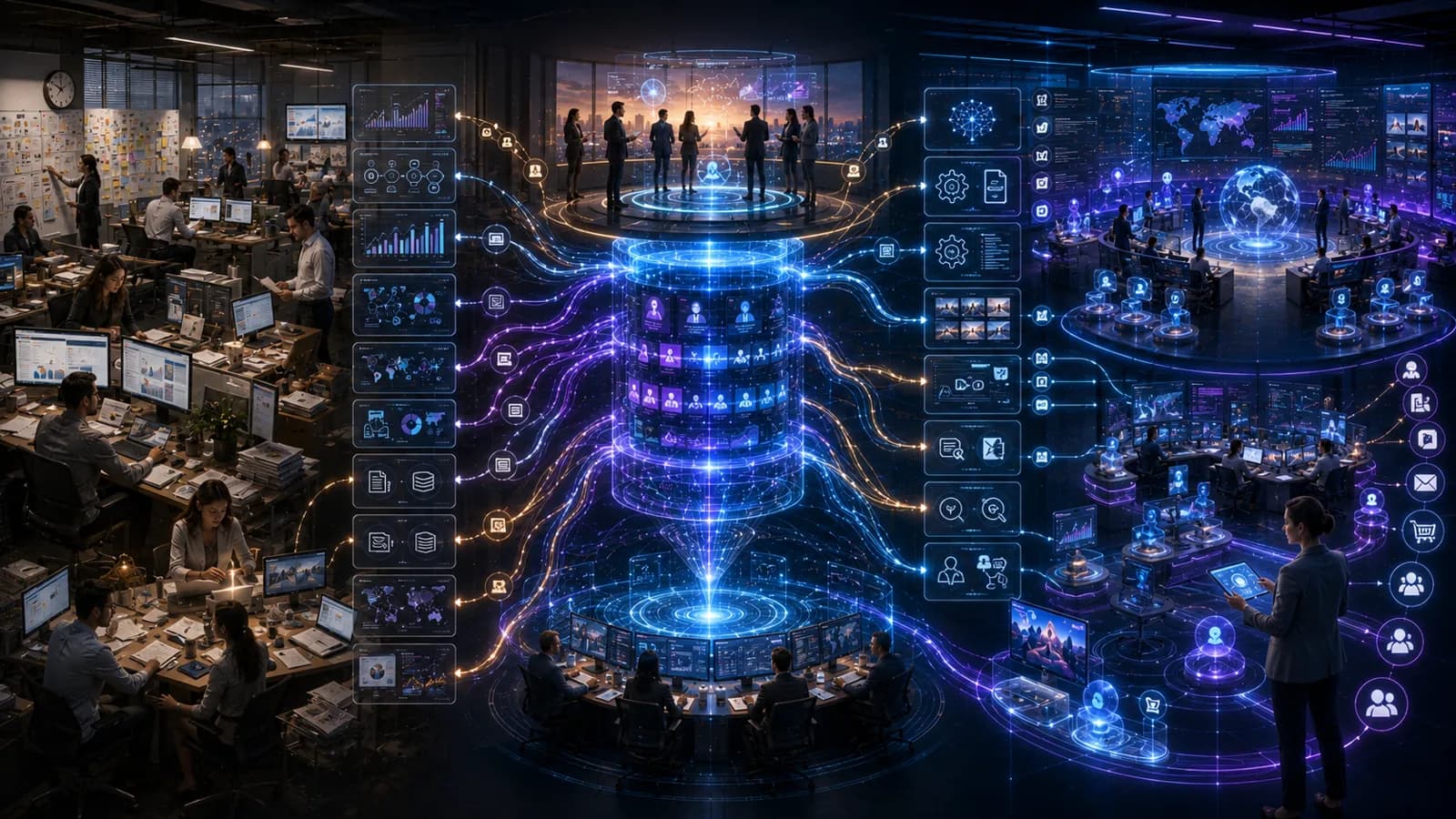
The future marketing organisation will need a shared operating system connecting:
- Business strategy
- Customer intelligence
- Brand and product knowledge
- AI agents
- Human teams
- Marketing platforms
- Governance
- Measurement
- Organisational learning
The system will not necessarily replace the existing technology stack.
It will coordinate the stack.
A human leader should be able to define an objective such as:
Increase adoption of our analytics product among existing mid-market customers without increasing communication fatigue or support demand.
The system can then coordinate the relevant workflow:
- Analyse product usage.
- Review customer questions.
- Identify adoption barriers.
- Retrieve previous campaign learning.
- Recommend an audience and message.
- Prepare approved content and journeys.
- Route decisions for human approval.
- Monitor adoption and customer response.
- Return the results to organisational memory.
This is fundamentally different from generating an email.
It is marketing as an intelligent operating cycle.
The Seven Foundations of Future Marketing
1. Human Strategy
Artificial intelligence can analyse markets, generate options and model possible scenarios.
It should not independently decide:
- Which market the company will enter
- Which customer deserves priority
- What the brand should represent
- Which risk is worth taking
- Which values are non-negotiable
- What the organisation should stop doing
These decisions require commitment and accountability.
AI does not face investors, employees or customers when a strategic choice fails.
Human leaders must define:
- The business objective
- The priority customer
- The customer problem
- The positioning
- The advantage
- The exclusions
- The guardrails
AI can then make those choices executable.
Without strategy, AI increases activity.
With strategy, AI creates leverage.
2. Continuous Customer Intelligence
Traditional customer research happens periodically.
Teams conduct interviews, create personas and present the findings.
Meanwhile, customers continue speaking through:
- Sales calls
- Support tickets
- Reviews
- Search behaviour
- Surveys
- Product usage
- Communities
- Social conversations
Future marketing systems will analyse these signals continuously.
A customer-intelligence agent may identify:
- Emerging objections
- New customer language
- Product-adoption barriers
- Changes in buying criteria
- Increasing customer frustration
The system should not replace direct customer contact.
It should help humans decide where direct contact and interpretation are most valuable.
3. Organisational and Brand Memory
AI systems cannot remain consistent when every interaction begins with a new prompt.
Future marketing organisations will maintain governed memory containing:
- Brand positioning
- Customer definitions
- Product truth
- Approved claims
- Editorial principles
- Previous decisions
- Campaign history
- Customer evidence
- Rejected messages
- Legal restrictions
This memory will be used by both employees and agents.
The model will no longer need a human to paste the complete brand guide into every request.
It will retrieve the relevant context automatically.
Brand memory will turn the company’s accumulated judgement into operational infrastructure.
4. A Specialised Agent Workforce
The future marketing team may include agents responsible for:
Market Intelligence
Monitoring competitors, category developments and commercial signals.
Customer Intelligence
Analysing conversations, behaviour and customer feedback.
Content Strategy
Turning customer and business priorities into content briefs.
Creative Production
Preparing channel-specific adaptations from approved concepts.
Campaign Orchestration
Managing dependencies, tasks, approvals and launches.
Customer Journeys
Selecting appropriate communication within approved customer rules.
Performance Intelligence
Monitoring results, investigating anomalies and preparing decisions.
Salesforce introduced agentic marketing capabilities in June 2026 around teams of agents designed to collaborate with marketers on pipeline development, content creation and campaign execution.
The important idea is not the vendor or platform.
It is the emerging organisational structure: one human team supported by several specialised digital capabilities.
5. Workflow Orchestration
Deploying several agents does not automatically create an intelligent marketing department.
Without orchestration, agents may:
- Duplicate work
- Use conflicting information
- Pursue different metrics
- Generate inconsistent recommendations
- Create more operational noise
The orchestration layer determines:
- Which workflow begins
- Which agent performs each stage
- Which knowledge should be retrieved
- Which action requires approval
- What happens when a tool fails
- How results are evaluated
- Which learning should be stored
McKinsey argues that meaningful value from agentic marketing requires rebuilding complete workflows rather than attaching agents to fragmented legacy processes.
The future of marketing is therefore not agent proliferation.
It is coordinated intelligence.
6. Governance and Human Control
Marketing systems influence:
- Customer communication
- Personal data
- Advertising budgets
- Product claims
- Brand reputation
- Commercial relationships
Autonomy must therefore have boundaries.
Every agent needs:
- A defined mission
- Approved information
- Tool permissions
- Spending limits
- Escalation rules
- Activity logs
- A human owner
- Evaluation standards
An agent may be allowed to adjust the timing of an approved campaign.
It should not independently change the brand position.
It may select among pre-approved content variations.
It should not invent a sensitive product claim.
It may pause a small experiment crossing a defined loss threshold.
It should not reallocate the annual media budget.
Autonomy should increase only after reliability has been demonstrated.
7. Outcome-Based Measurement
Future marketing systems will not be evaluated by the amount of activity they generate.
More content is not automatically better content.
More campaigns are not automatically more growth.
The operating system must connect activity with:
- Qualified demand
- Pipeline
- Revenue
- Product adoption
- Retention
- Customer satisfaction
- Brand demand
- Operating efficiency
McKinsey’s 2026 marketing outlook places insights, creativity, personalisation, agentic commerce and optimisation at the centre of a move from campaign-led activity towards continuous growth.
The ultimate question is not:
How many tasks did the agents complete?
It is:
Did the marketing system create better customer and business outcomes?
From Campaigns to Continuous Growth
Marketing has traditionally worked in cycles.
A campaign is planned, created, launched and reviewed.
The future system will still support major launches and planned brand programmes, but much of marketing will operate continuously.
The system will constantly:
- Sense changes.
- Interpret their importance.
- Recommend a response.
- Coordinate approved action.
- Measure the result.
- Update organisational learning.
Imagine a company discovering that customer objections are changing.
Traditional Model
- Sales notices the issue.
- It is discussed in a meeting.
- Marketing requests call recordings.
- Research is conducted.
- A new content plan is approved.
- Assets are produced.
- The campaign launches several weeks later.
Future Model
- A customer-intelligence agent detects the pattern.
- It validates the pattern across sales, support and product data.
- The AI CMO connects it to a current business objective.
- A strategy agent prepares response options.
- Human leaders select the direction.
- Content and campaign agents prepare the approved workflow.
- The system monitors whether the response changes customer behaviour.
The humans still make the consequential decision.
The system reduces the delay between insight and execution.
The Future Marketing Team
The marketing organisation will not simply replace every employee with an agent.
It will reorganise work according to the type of intelligence required.
Humans Will Own
- Market strategy
- Brand positioning
- Customer relationships
- Original insight
- Creative direction
- Ethical judgement
- Major investment
- Sensitive communication
- Final accountability
Agents Will Own
- Continuous monitoring
- Information retrieval
- Pattern detection
- First-draft production
- Asset adaptation
- Routine coordination
- Low-risk execution
- Performance preparation
- Documentation
Microsoft’s 2026 Work Trend Index describes this transition as an “agency equation”: as agents absorb more execution, humans gain more room to direct work, make decisions and own outcomes.
This means the future marketer will increasingly become:
- A strategist
- An editor
- A customer interpreter
- A creative director
- A workflow architect
- An agent manager
- An evaluator
The human contribution moves upward.
Content Will No Longer Be the Bottleneck
Generative AI has significantly reduced the difficulty of producing a first draft.
By the future of marketing, almost every company will be capable of generating acceptable:
- Articles
- Images
- Videos
- Emails
- Advertisements
- Social posts
This will make several other factors more valuable:
- Original research
- First-hand expertise
- Customer access
- Brand memory
- Editorial judgement
- Distribution
- Trust
AI-generated content will not win because it is abundant.
It will win when it carries knowledge, experience and perspective that competitors cannot reproduce from public information.
The best AI-assisted content workflow will begin before writing.
It will first determine:
- What the business needs
- Which customer decision matters
- What the company genuinely knows
- Which evidence supports the argument
- Where the content will be distributed
- What action should follow
AI can create the sentences.
The organisation must supply the meaning.
Search and Commerce Will Become Agent-Mediated
Future customers will not always discover and evaluate brands directly.
They may ask AI systems to:
- Compare products
- Evaluate vendors
- Summarise reviews
- Check compatibility
- Recommend an option
- Help complete a transaction
This means companies will increasingly market to two interconnected audiences:
Human Decision-Makers
Humans respond to:
- Narrative
- Emotion
- Identity
- Community
- Creative distinction
- Trust
Machine Evaluators
AI systems may depend on:
- Structured product information
- Clear documentation
- Reliable evidence
- Current pricing
- Trusted citations
- Transparent policies
The future brand must be emotionally meaningful to people and factually legible to machines.
The website will not simply persuade visitors.
It will become a knowledge source used by search systems, assistants and customer agents.
Dashboards Will Move Behind the Decision
Marketing leaders currently spend substantial time opening dashboards and searching for important changes.
Future decision systems will monitor performance continuously.
They will surface:
- What changed
- Which customer or business objective is affected
- Why the change may have happened
- How strong the evidence is
- Which action is recommended
- Who should decide
The executive interface may present a small number of decisions rather than dozens of charts.
Dashboards will remain available as evidence and inspection layers.
But they will no longer be the main way leaders discover what matters.
The future CMO will not ask:
Which dashboard should I open?
The system will say:
These three developments require your attention.
The Role of the CMO Will Expand
As AI takes on more execution, the CMO will not become less relevant.
The CMO will become the architect of a more powerful system.
The role will include:
Strategy Design
Defining the market, customer and position.
Objective Design
Translating strategy into measurable outcomes for humans and agents.
Agent Portfolio Design
Determining which workflows should be assigned to specialised agents.
Authority Design
Deciding what the system may execute independently.
Memory Design
Ensuring agents use current and authoritative company knowledge.
Evaluation
Measuring whether the system is reliable and commercially useful.
Human Capability
Developing marketers who can direct, challenge and improve AI systems.
The CMO will manage more than campaigns.
They will manage the flow of intelligence, attention and authority across the organisation.
What Will Remain Human
The future of marketing will change the operating model, but it will not remove the fundamental human qualities that make marketing valuable.
Taste
AI can create possibilities.
Humans decide what is meaningful, original and appropriate.
Empathy
AI can identify customer patterns.
Humans can understand the emotional significance of those patterns.
Conviction
AI can generate several defensible directions.
Humans must commit the organisation to one.
Relationships
Partnerships, communities, executive sales and sensitive customer situations depend on genuine trust.
Responsibility
An agent can perform an action.
A person or organisation must remain accountable for its consequences.
The more capable marketing systems become, the more clearly these human responsibilities must be defined.
The Risks of the Future Marketing Model
The future is not automatically better.
AI-first marketing systems may create:
Automated Mediocrity
More content with less distinction.
Brand Drift
Optimisation gradually changes the company’s intended identity.
Local Optimisation
Agents improve individual metrics while damaging the wider customer or business outcome.
Customer Intrusion
Personalisation becomes surveillance or manipulation.
Error Propagation
One weak insight influences multiple agents and channels.
Weak Accountability
Teams blame the AI for decisions humans should have owned.
Organisational Dependence
The company loses the internal ability to challenge or operate its systems.
These risks require active governance.
The objective should not be maximum autonomy.
It should be maximum responsible value.
A Roadmap for Building the Future Now
Step 1: Clarify the Marketing Strategy
Define:
- Priority customer
- Customer problem
- Positioning
- Advantage
- Exclusions
- Desired business outcome
Step 2: Create Authoritative Memory
Organise:
- Brand knowledge
- Product facts
- Customer evidence
- Campaign learning
- Approval rules
Step 3: Map Marketing Workflows
Identify:
- Strategic decisions
- Repeatable tasks
- Coordination bottlenecks
- Sensitive actions
- Measurement gaps
Step 4: Select One Agent Workflow
Begin with:
- Customer intelligence
- Market monitoring
- Content operations
- Campaign coordination
- Performance analysis
Step 5: Assign Human Ownership
Every workflow needs a person accountable for:
- Objective
- Permissions
- Errors
- Outcomes
Step 6: Build Evaluations
Test:
- Normal cases
- Missing information
- Conflicting context
- Sensitive requests
- Tool failures
- Unsupported claims
Step 7: Expand Autonomy Gradually
Progress from:
- Observe
- Analyse
- Recommend
- Prepare
- Execute with approval
- Execute within limits
Step 8: Measure Business Value
Track:
- Workflow speed
- Human correction
- Reliability
- Customer outcomes
- Commercial results
- Governance performance
Common Mistakes
Buying Tools Before Designing the System
Technology cannot resolve unclear objectives and broken workflows.
Deploying Too Many Agents
Multi-agent complexity should be justified by measurable value.
Treating Brand Context as One Prompt
Brand memory must be structured, updated and governed.
Automating Strategy
AI can support strategy, but humans must choose and own the direction.
Measuring Content Volume
The system should reward useful, approved and effective work.
Removing Customer Contact
AI analysis should guide human research—not eliminate it.
Granting Authority Too Quickly
Impressive demonstrations do not prove production reliability.
Ignoring Organisational Adoption
A technically advanced system fails when people do not trust or understand it.
Key Takeaways
- The future of marketing is a shift from individual AI assistance towards connected, agentic workflows.
- Human leaders will continue to own strategy, creativity, relationships and accountability.
- AI agents will increasingly own continuous monitoring, analysis, coordination and repeatable execution.
- Organisational and brand memory will become essential infrastructure.
- Marketing teams will combine human talent with portfolios of specialised agents.
- Campaigns will increasingly operate inside continuous growth systems.
- AI-generated content will make proprietary insight, distribution and trust more valuable.
- Search and commerce will increasingly be mediated by AI systems acting for customers.
- Dashboards will become inspection layers behind proactive decision intelligence.
- Governance, evaluations and human approval must be built into the operating architecture.
- The goal is not maximum automation. It is stronger customer and business outcomes.
Conclusion: The Future of Marketing Is Already Being Built
The future of marketing will not arrive through one product launch.
It is emerging through a series of connected changes.
AI assistants are becoming agents.
Agents are becoming workflows.
Workflows are becoming operating systems.
Campaigns are becoming continuous growth programmes.
Dashboards are becoming decision engines.
Marketing teams are becoming human–agent organisations.
Each shift changes how intelligence moves through the company.
The future marketing organisation will sense customer and market changes continuously.
It will preserve its brand and strategic knowledge as governed memory.
It will assign repeatable execution to specialised agents.
It will bring consequential decisions to humans.
It will measure whether the complete system improves customer and business outcomes.
This does not make marketing less human.
It allows human contribution to move towards the work that matters most:
- Understanding customers
- Choosing a direction
- Creating meaning
- Exercising taste
- Building trust
- Accepting responsibility
The technology will become widely available.
Models, agents and generation tools will eventually become common infrastructure.
The competitive advantage will come from what the company builds around them:
- Better strategy
- Better customer intelligence
- Better proprietary knowledge
- Better memory
- Better workflows
- Better evaluation
- Better judgement
The future of marketing is not AI replacing the marketer.
It is the marketer gaining an intelligent operating system.
One that can transform human strategy into coordinated, continuous and measurable execution.
That future is no longer theoretical.
It is being introduced now.
Actionable Next Steps
- Write down the marketing strategy your future agents would need to execute.
- Identify the customer and market signals your team is currently missing.
- Create one authoritative source for brand and product knowledge.
- Map one complete workflow from insight to business outcome.
- Identify which stages should remain human-owned.
- Assign one repeatable stage to an AI agent.
- Define permissions, escalation rules and evaluations.
- Measure approval, reliability and business contribution.
- Store validated learning for future workflows.
- Expand only after the system produces measurable value.
Frequently Asked Questions
What is the future of marketing?
The future of marketing combines human strategy and creativity with AI agents that continuously analyse customer signals, coordinate workflows, execute approved actions and measure outcomes.
Will AI replace marketing teams?
AI will replace or transform many repetitive tasks. Human marketers will remain essential for strategy, customer understanding, creativity, relationships, ethics and accountability.
What is agentic marketing?
Agentic marketing uses AI agents that can pursue objectives, use approved tools and complete multi-step marketing workflows with defined levels of human supervision.
What is a marketing operating system?
It is the intelligence and orchestration layer connecting business objectives, customer data, organisational memory, humans, AI agents, marketing tools, governance and measurement.
What role will the CMO play?
The CMO will define strategy, allocate human and agent capacity, establish authority and governance, evaluate performance and remain accountable for marketing outcomes.
Will marketing campaigns disappear?
Major campaigns will continue, but more marketing activity will operate continuously in response to customer, market and performance signals.
How should businesses begin adopting AI agents?
Begin with one recurring, measurable and relatively low-risk workflow. Assign a human owner, restrict permissions, build evaluations and expand autonomy gradually.
What will create competitive advantage when every company has AI?
Advantage will come from proprietary customer knowledge, original insight, strong brand memory, better workflows, effective distribution, rigorous evaluation and human judgement.
Frequently asked questions
What is the future of marketing?
The future of marketing combines human strategy and creativity with AI agents that continuously analyse customer signals, coordinate workflows, execute approved actions and measure outcomes.
Will AI replace marketing teams?
AI will replace or transform many repetitive tasks. Human marketers will remain essential for strategy, customer understanding, creativity, relationships, ethics and accountability.
What is agentic marketing?
Agentic marketing uses AI agents that can pursue objectives, use approved tools and complete multi-step marketing workflows with defined levels of human supervision.
What is a marketing operating system?
It is the intelligence and orchestration layer connecting business objectives, customer data, organisational memory, humans, AI agents, marketing tools, governance and measurement.
What role will the CMO play?
The CMO will define strategy, allocate human and agent capacity, establish authority and governance, evaluate performance and remain accountable for marketing outcomes.
Will marketing campaigns disappear?
Major campaigns will continue, but more marketing activity will operate continuously in response to customer, market and performance signals.
How should businesses begin adopting AI agents?
Begin with one recurring, measurable and relatively low-risk workflow. Assign a human owner, restrict permissions, build evaluations and expand autonomy gradually.
What will create competitive advantage when every company has AI?
Advantage will come from proprietary customer knowledge, original insight, strong brand memory, better workflows, effective distribution, rigorous evaluation and human judgement.