10 Things Your Company Needs Before Deploying an AI CMO: An Enterprise Readiness Checklist
Once AI can act, organizational readiness becomes just as important as model capability.
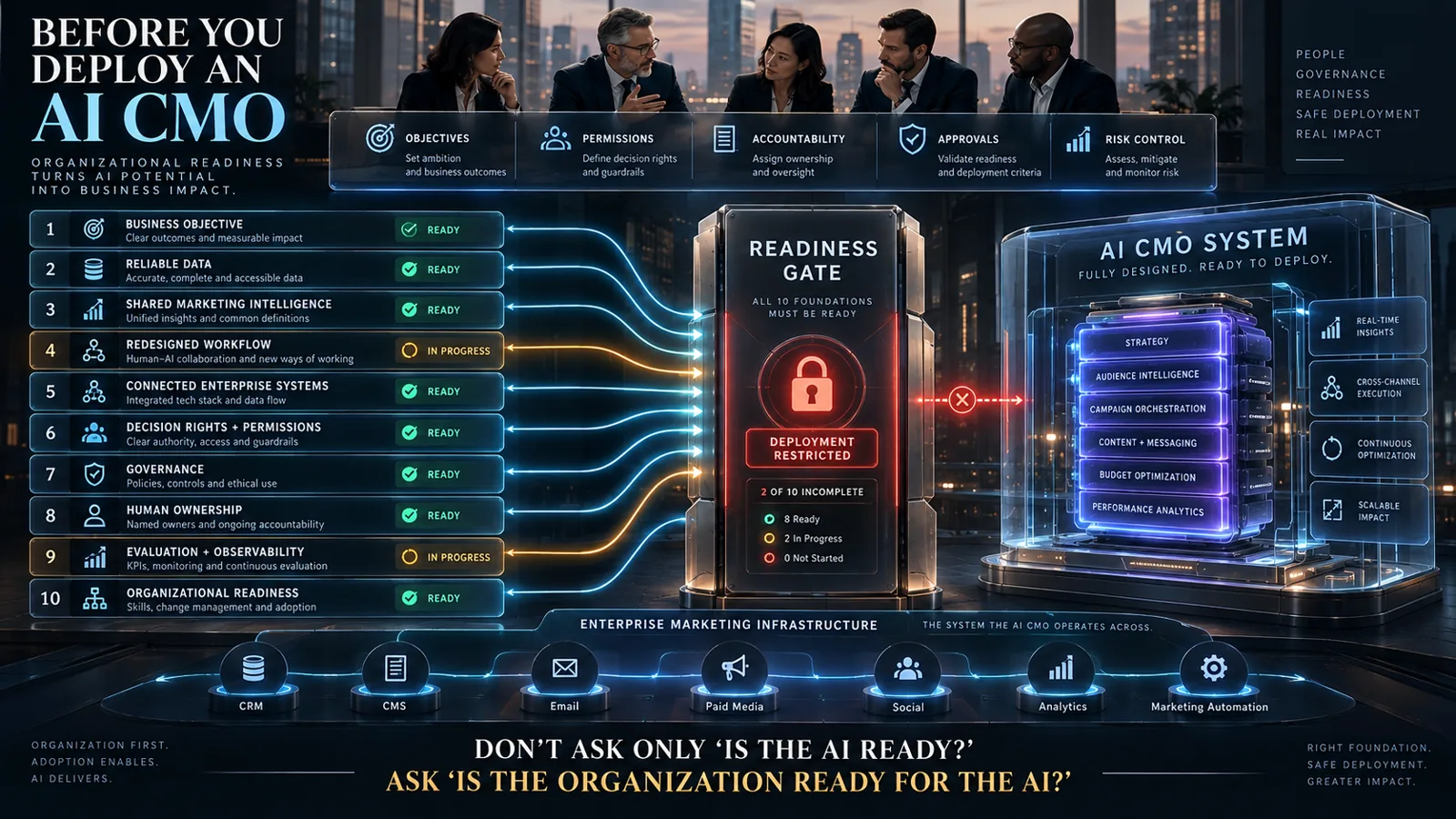
Deploying an AI CMO sounds increasingly plausible.
AI can already:
research markets,
analyze customers,
generate campaign strategies,
produce content,
monitor performance,
coordinate workflows,
prepare experiments,
and increasingly take actions across marketing systems.
So the temptation is obvious.
Connect the models.
Add a few agents.
Give them access to the marketing stack.
Let them start operating.
But that is the wrong starting point.
The question is not:
Is AI capable enough?
Increasingly, it is.
The better question is:
Is your company ready for AI to participate directly in marketing work?
Because an AI CMO is very different from an AI writing assistant.
A writing assistant produces an output.
An AI CMO may eventually:
retrieve customer information,
coordinate multiple agents,
modify campaigns,
publish content,
move budget,
trigger customer journeys,
and recommend strategic changes.
Once AI can act, organizational readiness becomes just as important as model capability.
Before deploying an AI CMO into real marketing workflows, a company needs at least ten foundations.
Not all of them need to be perfect.
But if several are missing, the problem is unlikely to be solved by a better model.
It is likely to be a readiness problem.
1. A Clear Business Objective
Do not deploy an AI CMO because:
“We need AI in marketing.”
That is not an objective.
Start with a measurable business problem.
For example:
Reduce campaign launch time from ten days to three.
Or:
Increase the number of experiments we can run without increasing team size.
Or:
Reduce the time analysts spend on recurring reporting by 60%.
Or:
Improve enterprise lead quality while maintaining paid-media spend.
The AI CMO needs a clearly defined outcome.
Otherwise, the organization risks optimizing AI activity rather than business performance.
Salesforce's current agentic-marketing implementation guidance begins with exactly this principle: identify a clear business case before choosing the AI use case, focusing on repetitive work, performance gaps, and areas where greater speed, scale, or personalization would create value.
Your First AI CMO Objective Should Be Narrow
“Run marketing better” is too broad.
A strong first objective looks more like:
Improve campaign creation.
Improve performance monitoring.
Improve customer intelligence.
Improve content supply chain efficiency.
Once the company proves value in one workflow, it can expand.
The objective should provide:
scope,
measurement,
and boundaries.
2. Reliable, Accessible Data
An AI CMO without reliable data is an intelligent system operating from an unreliable version of reality.
It may need access to:
- CRM information
- customer behavior
- campaign performance
- revenue
- website analytics
- content performance
- product usage
- lifecycle data
If those sources are:
fragmented,
contradictory,
poorly labeled,
or inaccessible,
the AI CMO will struggle.
Salesforce’s 2026 India marketing research found that 81% of marketers report adopting AI, but disjointed or irrelevant data remains a major constraint on scaling AI-powered customer engagement.
Adobe’s 2026 CMO research reaches a similar conclusion: 78% of CMOs cited data integration and quality as the leading obstacle to broader agentic-AI adoption.
Your Data Does Not Need to Be Perfect
This is important.
Waiting for perfect enterprise data can delay AI initiatives indefinitely.
Instead ask:
Is the data required for this workflow trustworthy enough?
For a campaign-monitoring workflow, that might mean:
spend,
conversion,
pipeline,
revenue.
For a content workflow:
brand,
product,
customer research,
content performance.
Solve the minimum data problem required for the first workflow.
Then improve the foundation as you expand.
3. Shared Marketing Intelligence
Data tells the AI CMO what happened.
It does not necessarily tell it what the company believes.
An AI CMO also needs persistent business context.
This might include:
- brand strategy
- positioning
- ICP definition
- customer research
- product information
- pricing
- approved claims
- campaign history
- content knowledge
- competitor intelligence
- previous experiment results
- current business priorities
This becomes the organization's shared marketing intelligence.
Adobe describes an agent deployed without organizational context as essentially a “brilliant stranger”: capable, but unable to reliably understand how the company operates, what has worked before, or who needs to approve what.
That is exactly what shared intelligence prevents.
Organizational Memory Needs to Become Explicit
Human teams often rely on informal context.
Everyone knows:
“That presentation is outdated.”
“We do not use that claim anymore.”
“Enterprise is the priority this quarter.”
An agent does not automatically know those unwritten rules.
AI forces companies to make organizational knowledge more explicit.
That is difficult.
It is also valuable.
4. At Least One Redesigned End-to-End Workflow
Do not deploy an AI CMO into a workflow you have never examined.
Suppose the existing campaign process is:
Brief
↓
Research
↓
Strategy
↓
Content
↓
Creative
↓
Three approvals
↓
Campaign setup
↓
QA
↓
Launch
↓
Reporting
If the AI CMO simply performs some of those steps faster, the organization may still retain:
the same delays,
the same handoffs,
the same approvals,
the same coordination burden.
Before deploying AI, redesign the workflow.
Ask:
Which steps can disappear?
Which can happen in parallel?
Which approvals can become exception-based?
Which handoffs should become automatic?
This is one of the strongest themes in McKinsey's current marketing research: the largest value does not come from inserting AI into isolated tasks, but from redesigning end-to-end marketing workflows around human and machine capabilities.
Do Not Automate Bureaucracy
If your workflow is bad, AI can make bad workflow move faster.
That is not transformation.
The objective should be:
redesign first, automate second.
5. Connected Enterprise Systems
An AI CMO eventually needs to operate somewhere.
It may need to interact with:
- CRM
- CMS
- paid media
- social
- analytics
- marketing automation
- project systems
- customer data systems
Without reliable integrations, humans remain the connective tissue.
The AI recommends.
A human copies.
A human updates another system.
A human creates the task.
The workflow is still manual.
Adobe’s enterprise-agent framework emphasizes the importance of connecting agent workflows to real enterprise systems so agents can execute multistep processes while remaining governed and auditable.
Start With Read Access
Do not immediately give every agent permission to act.
A safer progression is:
Read
↓
Recommend
↓
Prepare
↓
Execute within limits
This allows the company to learn how the system behaves before increasing authority.
6. Explicit Decision Rights and Permissions
This is one of the most important readiness requirements.
Before deploying an AI CMO, the company should know:
What can the AI observe?
What can it recommend?
What can it prepare?
What can it execute?
What requires approval?
For example:
Reporting
AI can execute automatically.
Content Adaptation
AI can act within approved messaging.
Campaign Setup
AI prepares; human approves.
Small Media Optimization
AI can execute within a defined threshold.
Major Budget Reallocation
Human approval.
Positioning Change
Human decision.
If the organization cannot answer these questions, it is not ready for meaningful AI autonomy.
Capability Does Not Equal Authority
An AI model may technically be capable of changing a campaign budget.
That does not mean it should have permission.
The important question is:
Should this agent have authority to make this decision?
That distinction becomes central once AI begins acting.
7. Governance That Can Actually Be Enforced
Policies are not enough.
“Do not overspend.”
“Do not publish sensitive claims.”
“Protect customer information.”
Those are useful principles.
But high-risk rules should ideally become technical constraints.
Examples:
Budget ceiling: Agent cannot move more than 5% without approval.
Publishing rule: Unapproved claims cannot be published.
Data access rule: Content Agent cannot access customer PII.
Escalation rule: Low-confidence conclusions must route to a human.
Adobe emphasizes permissions, auditability, traceability, and enterprise-grade controls as core requirements for scaling agentic execution safely.
McKinsey’s 2026 AI-trust research similarly finds that governance and agentic-AI controls remain less mature than other AI capabilities across many organizations.
Governance Enables Autonomy
Governance is sometimes seen as something that slows AI down.
In reality, good governance makes greater autonomy possible.
If an agent has:
clear permissions,
budget limits,
approved data,
escalation rules,
you can safely allow it to do more.
Without them, humans need to supervise everything.
8. A Defined Human Operating Model
Who owns the AI CMO?
Marketing?
Marketing Operations?
Technology?
Who owns each agent?
Who handles escalations?
Who approves strategic changes?
Who is accountable when something goes wrong?
These questions should be answered before production deployment.
A sophisticated agent architecture does not remove human responsibility.
It changes where responsibility sits.
Every Important Agent Needs a Human Owner
For example:
Analytics Agent → Analytics Lead.
Content Agent → Editorial Lead.
Campaign Agent → Marketing Operations.
Customer Intelligence Agent → Customer Strategy.
Owners should define:
- scope
- quality
- permissions
- evaluation
- escalation
Agents execute.
Humans remain accountable.
Humans Need to Know What They Are Supposed to Do
A common failure mode is:
AI is introduced.
But human roles remain unchanged.
Now people do:
the new AI workflow
and
the old workflow.
That increases work.
The company needs to define:
Which human tasks disappear?
Which tasks become supervision?
Which responsibilities become more strategic?
An AI CMO should redesign work—not simply sit on top of it.
9. Evaluation + Observability
An AI CMO should not be trusted because its output sounds intelligent.
The company needs a way to measure:
Is it correct?
Does it follow instructions?
Does it escalate appropriately?
Does it improve the workflow?
Does it improve the business?
This requires evaluation.
Evaluate at Three Levels
Agent Level
Measure:
- task completion
- accuracy
- quality
- hallucination/error rate
- escalation behavior
Workflow Level
Measure:
- cycle time
- human handoffs
- failure rate
- cost
- completion rate
Business Level
Measure:
- conversion
- pipeline
- revenue
- CAC
- retention
- customer experience
An agent can be performing correctly while the workflow is creating no meaningful business value.
Observability Is Different From Evaluation
Evaluation tells you:
Did the system perform well?
Observability tells you:
What actually happened?
You should be able to reconstruct:
Which agent acted?
What context did it use?
Which system did it access?
What action did it take?
What was changed?
Was approval required?
Did the tool call succeed?
What did the workflow do next?
Without this visibility, debugging agentic systems becomes extremely difficult.
10. A Team Ready to Change How It Works
The final requirement is organizational.
Your people need to be ready for a different operating model.
That means understanding that AI is not simply another tool.
It may change:
roles,
workflows,
decision rights,
management,
hiring,
measurement.
Salesforce’s current implementation guidance explicitly includes team upskilling and organizational readiness as a core step in agentic-marketing deployment.
Adobe likewise recommends that CMOs align leadership and teams around high-value use cases and success metrics before scaling agentic systems.
Adoption Requires More Than Training
Training people to use AI tools is useful.
But the bigger questions are:
Do they trust the system?
Do they know when to intervene?
Do they understand what the agents can do?
Do they know which tasks they should stop doing?
Do managers know how to supervise agent workflows?
Do employees understand what success now looks like?
That is operating-model change.
The 10-Point AI CMO Readiness Checklist
Before deploying an AI CMO into production, ask whether your company has:
1. Clear Business Objective
Can we name the specific outcome the AI CMO should improve?
2. Reliable Data
Can the system access trustworthy information required for the workflow?
3. Shared Marketing Intelligence
Does the AI know our brand, customers, products, strategy, history, and current priorities?
4. Redesigned Workflow
Have we redesigned the workflow rather than simply automating the existing one?
5. Connected Systems
Can the AI safely retrieve information and eventually act across the required enterprise tools?
6. Decision Rights
Do we know what AI may observe, recommend, prepare, or execute?
7. Governance
Are important boundaries technically enforceable?
8. Human Operating Model
Does every important agent and workflow have clear human ownership?
9. Evaluation + Observability
Can we measure performance and reconstruct what the system did?
10. Organizational Readiness
Are people, roles, incentives, and workflows ready to change?
If several of these answers are:
No
your first project should probably not be:
Deploy the AI CMO.
It should be:
Build the missing foundation.
You Do Not Need Perfect Scores on All Ten
This checklist is not intended to become another reason to delay.
A startup may have:
simple data,
few enterprise systems,
informal governance.
That can still work if the initial scope is narrow.
A large enterprise may require much stronger controls.
Readiness should match:
scope,
risk,
autonomy.
The larger the blast radius, the stronger the foundation needs to be.
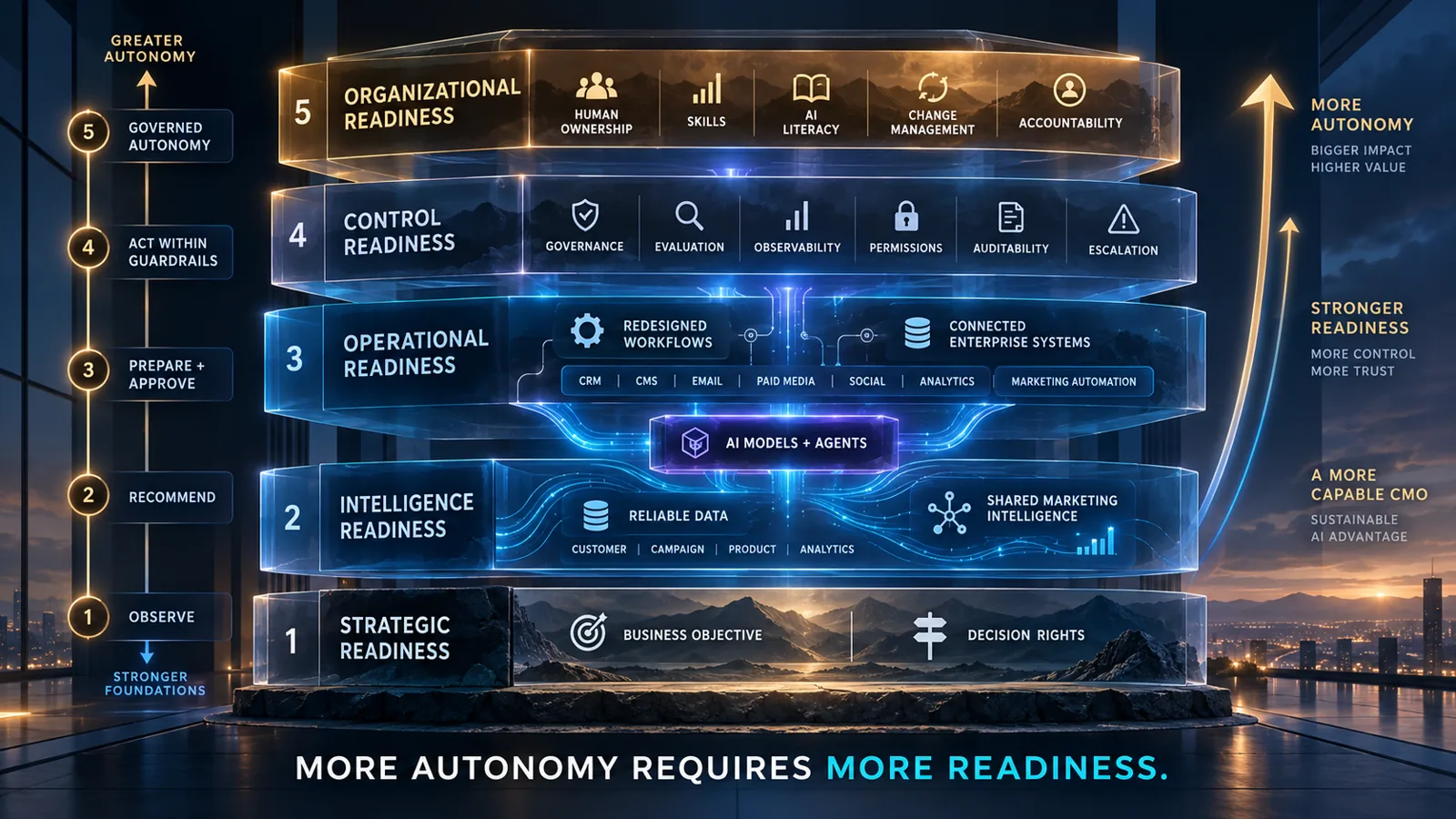
Readiness Changes With Autonomy
Consider three implementations.
AI CMO as Advisor
It reads approved documents and makes recommendations.
Readiness burden:
moderate.
AI CMO as Workflow Participant
It coordinates research, content, analytics, and prepares campaign actions.
Readiness burden:
higher.
AI CMO With Execution Authority
It can publish, change campaigns, communicate with customers, or move budget.
Readiness burden:
much higher.
You do not need the same infrastructure for all three.
The more the system can act, the more serious the readiness requirements become.
Start With Shadow Mode
A company that scores poorly on several readiness areas can still begin safely.
Let the AI CMO:
observe,
analyze,
recommend.
Do not allow action yet.
Compare its recommendations with experienced humans.
Measure:
accuracy,
consistency,
usefulness.
This creates a path to deployment without rushing into autonomy.
Then Move to Prepare-and-Approve
Once performance improves:
allow the AI CMO to prepare complete actions.
For example:
build the campaign,
prepare the audience,
generate the assets,
create the experiment.
Then pause.
Human approves.
This provides substantial productivity without requiring full autonomy.
Only Then Add Bounded Execution
After the system has proven reliable, allow low-risk execution.
For example:
- routine campaign QA
- content adaptation
- small experiment allocations
- approved workflow routing
Keep hard limits.
Measure constantly.
Autonomy should be earned.
Red Flags That Suggest You Are Not Ready
Certain conditions should trigger caution.
Nobody Knows Which Data Is Correct
Fix context first.
The Same Workflow Exists Differently Across Every Team
Standardize before automating.
Nobody Owns AI Governance
Assign responsibility.
Every Decision Currently Requires Senior Approval
Redesign decision rights.
Your Team Cannot Explain the Current Workflow
Map it before introducing agents.
No One Knows How Success Will Be Measured
Define business metrics first.
AI Outputs Will Still Be Copied Manually Between Systems
Integration or workflow architecture is incomplete.
Leadership Thinks AI CMO Means “One Giant Chatbot”
The operating model needs clarification.
The Largest Readiness Gap Is Often Not Technology
Many companies assume the blocking issue will be:
model capability,
GPU infrastructure,
agent frameworks.
Those matter.
But current research suggests foundational organizational issues remain just as important.
McKinsey notes that scaling marketing AI requires an agentic platform architecture integrating existing systems, workflows, data repositories, outside services, and custom capabilities—alongside modular data architecture and clear governance and decision rights.
This is why organizations can have access to the same advanced models and achieve very different results.
The model is only one part of the system.
Better AI Does Not Fix Missing Foundations
Imagine next month's model is significantly more intelligent.
Does it automatically fix:
poor CRM data?
No.
Outdated positioning?
No.
Broken approvals?
No.
Missing permissions?
No.
Unclear accountability?
No.
That is why companies should avoid postponing foundational work while waiting for smarter models.
The foundations will still matter.
Readiness Is a Competitive Advantage
This creates an interesting possibility.
As foundation models become broadly available, competitive differentiation may increasingly come from:
- proprietary context
- better data
- better workflows
- stronger integrations
- better evaluations
- clearer governance
- better organizational adoption
Two companies may use the same model.
One produces marginal productivity improvement.
The other changes how marketing operates.
The difference is readiness.
AI Readiness Is Really Organizational Readiness
At the deepest level, an AI CMO forces the company to answer questions it should probably answer anyway.
What is our current strategy?
Which data is trustworthy?
Who owns which decision?
How does work actually move?
Which approvals matter?
What should be automated?
What does success look like?
Who is accountable?
AI makes the weakness of unclear organizations more visible.
That can be uncomfortable.
It can also be useful.
The AI CMO Readiness Stack
A useful way to think about these ten requirements is as five broader layers.
Layer 1 — Strategic Readiness
Clear business objective.
Decision rights.
Layer 2 — Intelligence Readiness
Reliable data.
Shared marketing intelligence.
Layer 3 — Operational Readiness
Redesigned workflows.
Connected systems.
Layer 4 — Control Readiness
Governance.
Evaluation.
Observability.
Layer 5 — Organizational Readiness
Human ownership.
Skills.
Change management.
The AI model sits inside these foundations.
Not above them.
What If Your Company Only Has Five of the Ten?
Then begin there.
Suppose you have:
clear objectives,
good data,
good context,
but poor orchestration.
Your first project is not full autonomy.
Build orchestration.
Suppose:
workflows are excellent,
but governance is weak.
Begin with recommendation mode.
Suppose:
technology is strong,
but team adoption is weak.
Work on roles and change management.
Readiness gaps should determine the deployment model.
A Simple Readiness Scoring Model
Score each of the ten areas:
0 — Missing
No meaningful capability.
1 — Early
Exists inconsistently.
2 — Operational
Good enough for a controlled workflow.
3 — Scalable
Reliable enough for broader agentic execution.
Maximum score:
30
A company scoring:
0–10
Focus on foundations.
11–20
Begin controlled pilots and recommendation workflows.
21–25
Expand orchestrated agent workflows with human approvals.
26–30
Explore broader governed autonomy where business risk supports it.
This is not a universal scientific benchmark.
It is a practical internal readiness framework.
The purpose is to make gaps visible before agents begin acting.
The Goal Is Not Maximum Readiness
You do not need to spend two years preparing.
The goal is:
minimum sufficient readiness for the next level of autonomy.
For observation:
less infrastructure.
For recommendation:
more context.
For preparation:
more integration.
For autonomous action:
strong governance,
evaluation,
permissions,
observability.
That creates a progressive adoption path.
A Company Ready for an AI CMO Looks Different
The strongest signal is not:
“We have the best AI model.”
It looks more like:
We know what outcomes we want.
Our agents use reliable context.
Workflows are clearly designed.
Systems connect.
Permissions are explicit.
Human approvals happen by risk.
Every important agent has an owner.
We can see what the system did.
We can measure whether it created value.
Our people understand the operating model.
That company is ready.
10 Things Your Company Needs Before Deploying an AI CMO
Before giving AI greater control over marketing, build the environment it needs to succeed.
You need:
1. A clear business objective
2. Reliable data
3. Shared marketing intelligence
4. A redesigned end-to-end workflow
5. Connected enterprise systems
6. Clear decision rights and permissions
7. Enforceable governance
8. A defined human operating model
9. Evaluation and observability
10. Organizational readiness
None of these sounds as exciting as:
“Autonomous AI CMO.”
But they are what make autonomy useful.
The model supplies intelligence.
The agents supply execution capacity.
But the company supplies:
context
structure
authority
standards
accountability
And without those things, even an extremely capable AI CMO is simply intelligence operating inside an organization that is not ready to use it.
The future of AI marketing will not be determined only by which companies gain access to the most capable models.
It will be determined by which companies build the operating environment where those models can reliably create value.
Frequently asked questions
What does a company need before deploying an AI CMO?
At minimum, it needs a clear business objective, reliable data, shared marketing context, redesigned workflows, connected systems, defined permissions, governance, human ownership, evaluation and observability, and organizational readiness.
Does a company need perfect data before deploying an AI CMO?
No. It needs sufficiently reliable and accessible data for the specific workflow being deployed. Data quality can be improved progressively as more use cases are added.
Why is shared intelligence important for an AI CMO?
Shared intelligence gives AI agents consistent access to current brand, customer, product, campaign, performance, and strategic context so they do not repeatedly operate without organizational memory.
What governance should exist before AI agents can act?
Companies should define data access, publishing rights, budget limits, tool permissions, human approval thresholds, escalation rules, and audit requirements.
Should an AI CMO have access to every marketing system?
No. Agents should generally follow least-privilege access, receiving only the data and permissions necessary to perform their defined roles.
What is the safest way to deploy an AI CMO initially?
Start in observation or recommendation mode, evaluate performance against experienced humans, progress to prepare-and-approve workflows, and grant bounded autonomy only after reliability has been demonstrated.
What is AI CMO observability?
Observability is the ability to trace what agents did, which information they used, which tools they accessed, what changed, where failures occurred, and how the workflow progressed.
How do I know whether my company is ready?
Assess strategic clarity, data, context, workflows, integrations, permissions, governance, human ownership, evaluation, and organizational adoption. The required maturity increases with the autonomy and risk of the planned use case.
Does deploying an AI CMO require replacing the existing martech stack?
No. A well-designed AI CMO can operate above and across existing systems such as CRM, CMS, email, paid media, analytics, and marketing automation.
What is the biggest mistake companies make before deploying agentic marketing?
One of the biggest mistakes is focusing on model or agent capability before establishing the data, workflows, governance, integration, evaluation, and human operating model needed for reliable execution.