AI CMO Readiness: Is Your Marketing Team Actually Ready for Agentic Marketing?
“Can our marketing organization safely and reliably delegate meaningful work to AI?”
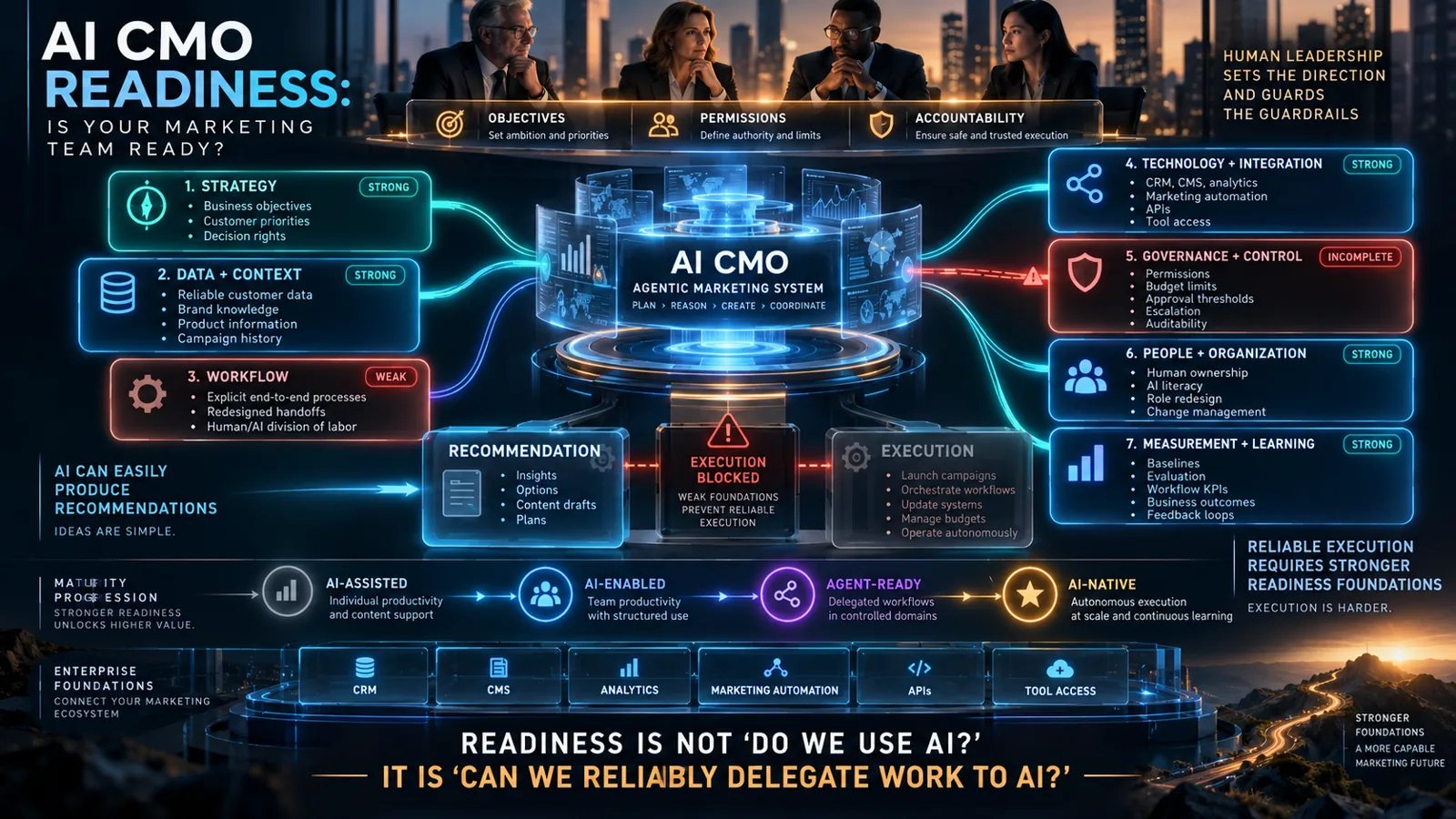
Your marketing team already uses AI.
Someone uses it for copy.
Someone uses it for research.
Someone uses it for presentations.
Someone has connected an AI assistant to analytics.
Maybe you are experimenting with AI agents.
Does that mean your company is ready for an AI CMO?
Not necessarily.
There is a large difference between:
using AI
and
being ready for AI to participate in how marketing operates.
An AI writing tool can fail and produce a bad paragraph.
An AI CMO operating across real workflows could potentially:
recommend strategy,
access customer data,
coordinate agents,
prepare campaigns,
monitor performance,
trigger actions,
or eventually modify spend.
That requires a much higher level of organizational maturity.
The real readiness question is therefore not:
“Does our team know how to use AI?”
It is:
“Can our marketing organization safely and reliably delegate meaningful work to AI?”
That is a much harder standard.
And it is the standard that matters.
AI Adoption Is Not AI Readiness
A team can have:
ChatGPT accounts,
AI writing tools,
automated reporting,
several pilots,
and still be poorly prepared for agentic marketing.
Why?
Because usage does not automatically mean the surrounding operating model is ready.
McKinsey's 2026 research captures this gap clearly.
Nearly 90% of CMOs are experimenting with AI across marketing, yet fewer than 10% have captured value across end-to-end workflows.
Only 28% of surveyed marketers say their organizations are fundamentally rewiring marketing teams and workflows.
Most are layering AI onto existing processes rather than redesigning how work gets done.
That distinction is the heart of readiness.
A Useful Definition of AI CMO Readiness
AI CMO readiness is the degree to which a marketing organization has the strategic clarity, data, context, workflows, technology, governance, measurement, and human operating model required for AI to participate reliably in marketing decisions and execution.
There are three broad dimensions:
Technical Readiness
Can the system access reliable data and tools?
Operational Readiness
Are workflows clear enough to delegate?
Organizational Readiness
Are people, governance, responsibilities, and decision rights prepared for AI participation?
A team needs all three.
You Can Be Technically Ready but Organizationally Unready
Imagine your company has:
clean customer data,
modern APIs,
AI models,
agent infrastructure.
Technically, you look strong.
But:
nobody knows which decisions AI should make,
every campaign requires executive approval,
marketing and IT disagree about ownership,
employees do not trust the system.
That company is not ready.
Technology is necessary.
It is not sufficient.
You Can Also Be Organizationally Excited but Technically Unready
The opposite happens too.
Leadership wants agents everywhere.
Employees are enthusiastic.
But:
CRM fields are unreliable,
customer identities are fragmented,
product knowledge is outdated,
there are no clean integrations.
Now AI has organizational support but poor foundations.
Again:
not ready.
The Seven Dimensions of AI CMO Readiness
A useful readiness assessment should evaluate seven areas:
1. Strategic Readiness
2. Data + Context Readiness
3. Workflow Readiness
4. Technology + Integration Readiness
5. Governance + Control Readiness
6. People + Organizational Readiness
7. Measurement + Learning Readiness
Together, they provide a clearer picture than simply asking:
“Do we have AI?”
1. Strategic Readiness
Start here.
Can your leadership clearly explain:
What should the AI CMO improve?
Who is the priority customer?
What are the business objectives?
What trade-offs matter?
What should never be optimized away?
If the strategy is vague, AI will not solve that.
It may simply automate ambiguity.
Readiness Question #1
Ask:
Can we name the business outcome the AI CMO is supposed to improve?
Strong answer:
“Reduce enterprise campaign cycle time by 40% while maintaining quality and compliance.”
Weak answer:
“Use AI to make marketing more efficient.”
The first can guide a system.
The second cannot.
Readiness Question #2
Ask:
Do we know which decisions remain human-owned?
Examples:
Positioning.
Major budgets.
Creative standards.
Customer priorities.
High-risk claims.
If those boundaries are unclear, autonomy is premature.
Strategic Readiness Score
Level 1 — Experimental
AI use cases are disconnected from business strategy.
Level 2 — Defined
Priority use cases and business outcomes are identified.
Level 3 — Integrated
AI objectives connect directly to marketing and business KPIs.
Level 4 — AI-Native
Human and AI capabilities are explicitly designed around strategic outcomes and decision rights.
2. Data + Context Readiness
An AI CMO needs two things:
data
and
context.
They are not the same.
Data includes:
CRM,
campaign performance,
web analytics,
revenue,
engagement.
Context includes:
positioning,
brand strategy,
customer research,
product knowledge,
approved claims,
business priorities.
The system needs both.
Can Your AI Find the Truth?
Imagine asking:
Who is our priority customer?
CRM says mid-market.
Current strategy says enterprise.
Old campaign decks say SMB.
Website copy targets everyone.
Which answer should the AI use?
That is a readiness problem.
McKinsey's June 2026 research describes data readiness as a major scaling constraint as organizations move from isolated pilots into systems where agents act on enterprise information.
Salesforce Shows the Same Gap
Salesforce reports that 81% of marketers in India have adopted AI.
But adoption does not eliminate the foundational problem.
Siloed systems and poor data quality remain major barriers, and although 86% of marketers surveyed said they would trust AI to respond to customers at scale, many are constrained by disconnected or irrelevant customer data.
The lesson:
AI readiness depends on usable data, not simply available data.
Data + Context Readiness Questions
Can agents retrieve current customer information?
Can they identify which source is authoritative?
Is current positioning documented?
Are approved claims explicit?
Can campaign history be retrieved?
Are business priorities updated?
If not, the organization may have information.
But not machine-usable organizational memory.
3. Workflow Readiness
This may be the most important dimension.
Can your organization clearly describe how marketing work actually moves?
Not how the process diagram says it moves.
How it really moves.
If nobody can explain the workflow, an AI agent cannot reliably operate inside it.
Take One Campaign
Can you identify:
who creates the brief?
who researches?
who approves strategy?
who produces content?
who reviews brand?
who configures campaigns?
who approves launch?
who monitors results?
where work waits?
where errors occur?
where context is duplicated?
That is workflow readiness.
A Messy Workflow Is Not Ready for Autonomy
Suppose campaign approval depends on:
“Usually Sarah looks at it unless David is available, except for enterprise campaigns where Finance sometimes checks first.”
Humans can work around that informally.
Agents cannot reliably operate on implied organizational knowledge.
The workflow needs to become explicit.
The Real Test
Ask:
If an experienced marketer left tomorrow, could another person follow the documented workflow without relying on tribal knowledge?
If not:
your workflow is probably not ready for agents either.
Workflow Readiness Is More Than Documentation
A documented bad process is still bad.
You also need to ask:
Which steps should disappear?
Which can happen simultaneously?
Which approvals can become exception-based?
McKinsey's 2026 marketing research emphasizes that real value comes from rewiring end-to-end workflows around human-AI collaboration, not simply inserting AI into existing tasks.
4. Technology + Integration Readiness
An AI CMO that cannot connect to your systems is still largely an advisor.
That may be a good starting point.
But meaningful agentic execution eventually requires connections to systems such as:
CRM.
CMS.
Analytics.
Email.
Paid media.
Social.
Marketing automation.
Commerce.
Project management.
The important question is not:
Do these tools have APIs?
It is:
Can AI access them securely and predictably inside a governed workflow?
Start With Retrieval Before Action
Technical readiness should progress gradually.
Stage 1 — Read
Agent retrieves information.
Stage 2 — Recommend
Agent proposes action.
Stage 3 — Prepare
Agent creates the complete action but does not execute.
Stage 4 — Constrained Write
Agent can take limited actions.
Stage 5 — Governed Execution
Agent executes broader workflows inside defined controls.
You do not need Stage 5 to start.
You need enough infrastructure for the level of autonomy you intend to grant.
Integration Readiness Question
Ask:
How much manual copy-pasting is required between our AI and our marketing systems?
If the answer is:
“Almost everything,”
you are still in assistant mode.
Not operating-system mode.
5. Governance + Control Readiness
This dimension becomes more important as AI moves from:
saying
to
doing.
McKinsey's 2026 AI Trust Maturity Survey highlights exactly this change: organizations now have to worry not only about AI generating the wrong answer, but about AI taking the wrong action or using tools outside intended boundaries. Only about one-third of surveyed organizations had reached higher maturity levels in strategy, governance, and agentic-AI controls.
Governance Questions
Do you know:
Which agent can access which data?
Which can publish?
Which can spend?
Which customer interactions require review?
Which changes require human approval?
What happens when confidence is low?
Who can stop the workflow?
If those answers are unclear:
your company is not ready for high autonomy.
Good Governance Should Be Executable
Do not rely only on:
“Tell the AI not to exceed the budget.”
Use:
hard budget limits.
Do not rely only on:
“Don't use customer PII.”
Use:
permission boundaries.
Do not rely only on:
“Escalate risky claims.”
Use:
policy rules and approval gates.
Prompts are instructions.
Governance should become architecture.
6. People + Organizational Readiness
This is often underestimated.
Does your team understand how its own work will change?
If AI handles:
reporting,
research,
content adaptation,
monitoring,
routing,
what should the people do instead?
Without an answer, AI deployment creates confusion.
Human Roles Must Be Redesigned
An analyst may move from:
reporting
toward:
experimentation and decision intelligence.
Marketing Operations may move from:
manual workflow administration
toward:
orchestration and AI governance.
Creative may move from:
asset production
toward:
concept and taste.
Managers may move from:
checking routine work
toward:
governing exceptions and outcomes.
That role transition needs to be explicit.
AI Anxiety Is a Readiness Issue
McKinsey's 2026 research found that 76% of surveyed marketing individual contributors reported AI-related anxiety, even though many CMOs underestimated the level of concern inside their teams.
That matters.
A team that does not understand:
why AI is being introduced,
how roles will change,
where humans remain accountable,
is less ready to transform.
Readiness includes trust.
People Readiness Question
Ask each role:
What work should you stop doing if the AI system succeeds?
If nobody can answer:
you may be adding AI without redesigning work.
7. Measurement + Learning Readiness
This final dimension separates experimentation from transformation.
Before deployment, can you establish:
current performance,
the target,
the measurement method?
Adobe's October 2026 State of AI Readiness guidance explicitly recommends building measurement before the model goes live, including defining the outcome metric, establishing a predeployment baseline, and agreeing on attribution before production.
This matters because once the new system changes the workflow, the original baseline may be difficult to reconstruct.
Measure More Than the Agent
Suppose an agent produces excellent outputs.
That is useful.
But what happened to the business?
Measure three levels.
Agent Performance
Accuracy.
Quality.
Errors.
Escalations.
Workflow Performance
Cycle time.
Cost.
Human intervention.
Failures.
Business Performance
Revenue.
Pipeline.
Conversion.
Retention.
Customer experience.
Readiness includes knowing what success means.
Learning Is Part of Readiness Too
An AI-native marketing system should not start from zero every time.
If an experiment succeeds:
capture the learning.
If customers reject a message:
update the context.
If an agent repeatedly fails:
adjust the system.
Readiness therefore requires a feedback loop.
Observe.
Understand.
Decide.
Execute.
Measure.
Learn.
That loop is what turns AI usage into a compounding system.
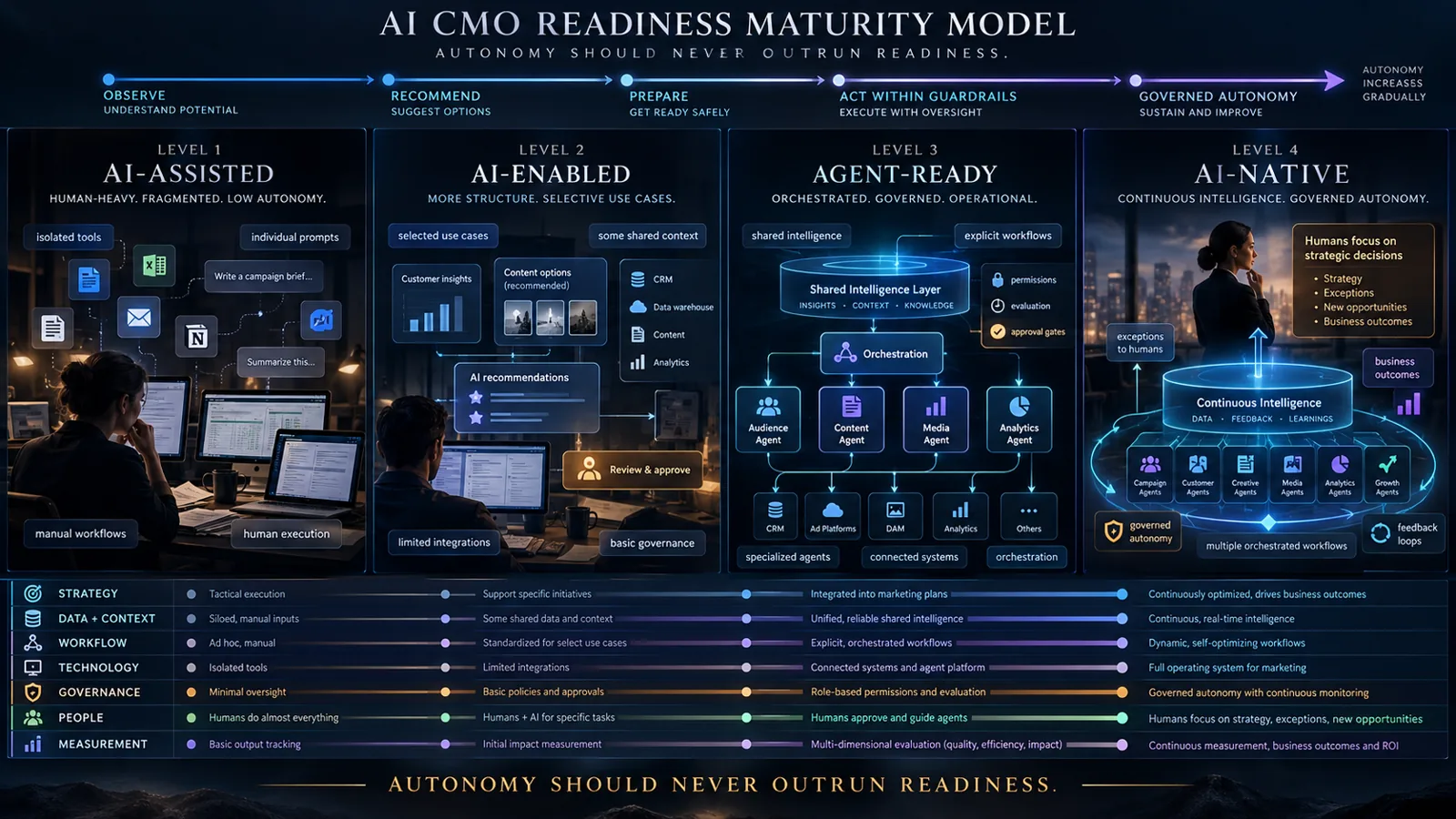
The AI CMO Readiness Maturity Model
Now combine the seven dimensions.
A practical model has four levels.
Level 1 — AI-Assisted
Your team uses AI tools.
Typical characteristics:
- individual AI usage
- isolated prompts
- disconnected experiments
- mostly manual workflows
- human execution remains dominant
AI is useful.
But the operating model is unchanged.
Level 2 — AI-Enabled
AI begins participating in defined processes.
Typical characteristics:
- some shared context
- selected integrations
- task automation
- AI recommendations
- basic governance
- clear priority use cases
The team is ready for controlled AI participation.
Level 3 — Agent-Ready
The organization can safely deploy specialized agents across important workflows.
Typical characteristics:
- reliable data
- persistent shared intelligence
- explicit workflows
- connected systems
- role-based permissions
- evaluation
- human approval gates
- agent ownership
This is where meaningful AI CMO deployment becomes realistic.
Level 4 — AI-Native
Humans, agents, automation, and systems operate as one coordinated marketing organization.
Typical characteristics:
- end-to-end workflow orchestration
- continuous intelligence
- governed autonomy
- exception-based human involvement
- reusable agent capabilities
- shared organizational memory
- continuous learning
- outcome-based management
This is the mature state.
It is not defined by the number of AI tools.
It is defined by how differently marketing operates because AI exists.
A Simple AI CMO Readiness Scorecard
Score each dimension from 1 to 4.
Maximum:
28 points.
How to Interpret Your Score
7–12 — AI-Assisted
Your priority should be foundations.
Do not rush toward autonomy.
13–18 — AI-Enabled
You can run focused agent pilots.
Use recommendation and prepare-and-approve modes.
19–23 — Agent-Ready
You can begin orchestrating multiple agents across defined workflows with meaningful permissions.
24–28 — AI-Native Direction
You have stronger foundations for governed autonomy and broader AI CMO implementation.
This score is a practical internal framework, not an industry certification.
Use it to identify bottlenecks.
Not to win a badge.
Your Lowest Score Matters More Than Your Average
This is important.
Suppose:
Technology = 4.
Data = 4.
Governance = 1.
Average looks reasonable.
But governance may be the constraint preventing autonomy.
Or:
Strategy = 4.
People = 1.
Now the technology may be ready while the organization resists adoption.
Readiness often behaves like a bottleneck.
The weakest critical layer can constrain the whole system.
Different Workflows Can Have Different Readiness Levels
Your company does not need to be fully AI-native everywhere.
For example:
Reporting may be Level 4.
Content adaptation may be Level 3.
Campaign execution may be Level 2.
Positioning may intentionally remain highly human-led.
That is fine.
Readiness should be assessed workflow by workflow, not only company-wide.
Autonomy Should Follow Readiness
There is a useful relationship:
Low Readiness
AI observes.
Moderate Readiness
AI recommends.
Higher Readiness
AI prepares.
Strong Readiness
AI acts inside guardrails.
Mature Readiness
AI manages significant workflows with governed autonomy.
Do not give the system more authority than the surrounding organization can safely support.
Readiness Is Not About Maximum Autonomy
A highly mature organization may still keep certain decisions human-owned.
For example:
Positioning.
Crisis communication.
Large budget changes.
Ethical decisions.
Readiness means knowing where AI should operate autonomously.
Not making everything autonomous.
Five Signs You Are Probably Not Ready
1. You Cannot Agree on Which Data Is Correct
Agents will scale inconsistency.
2. Most Workflows Depend on Tribal Knowledge
Agents need explicit operating logic.
3. Nobody Owns AI Governance
Authority without ownership is dangerous.
4. You Cannot Measure the Outcome
Then you cannot prove value.
5. The Plan Is “Give Everyone AI and See What Happens”
That is adoption.
Not transformation.
Five Signs You May Be Ready
1. Your Priority Workflows Are Clear
You understand where work waits and where AI can help.
2. Important Context Is Reliable
Agents can retrieve a current view of customers, brand, product, and priorities.
3. Decision Rights Are Explicit
You know what AI may do.
4. Humans Know Their New Role
People are moving toward judgment rather than duplicate execution.
5. Success Has a Baseline
You can prove whether the workflow actually improves.
Your Team Does Not Need to Be Perfect
Readiness should not become an excuse for endless preparation.
McKinsey's current guidance is to start from the organization's actual maturity, select valuable opportunities, and build the capabilities progressively rather than waiting for a perfect future architecture.
The goal is:
minimum sufficient readiness for the next level of responsibility.
You can start before everything is perfect.
But you should know what is missing.
A Practical Readiness Sequence
A sensible progression looks like this.
Stage 1 — Establish Baseline
Measure current workflow performance.
Stage 2 — Clarify Objective
Define what AI should improve.
Stage 3 — Fix Critical Context
Identify trusted data and knowledge.
Stage 4 — Redesign Workflow
Determine human, agent, and automation responsibilities.
Stage 5 — Connect Systems
Enable safe access.
Stage 6 — Define Governance
Permissions and approval gates.
Stage 7 — Pilot in Recommendation Mode
Compare AI against human performance.
Stage 8 — Prepare + Approve
Let agents do more of the operational work.
Stage 9 — Add Bounded Autonomy
Allow low-risk execution.
Stage 10 — Expand Only After Evidence
Scale what works.
That is a readiness-driven deployment model.
The Biggest Readiness Mistake: Starting With the Model
Companies often ask:
Which model?
Which agent platform?
Which vendor?
Those questions matter later.
The first questions should be:
What outcome?
Which workflow?
Which data?
Which decision rights?
Which risks?
Which humans?
Which metrics?
Then choose the technology.
This prevents the architecture from driving the strategy.
The Second Biggest Mistake: Mistaking Enthusiasm for Readiness
A team can be excited about AI and still have:
bad data,
unclear roles,
weak workflows.
Conversely, a team can have strong infrastructure but deep organizational resistance.
Neither is enough.
True readiness combines:
capability
and
willingness to change the operating model.
The Third Biggest Mistake: Measuring Readiness Once
Readiness is dynamic.
Models improve.
Workflows change.
Teams learn.
Regulation changes.
New risks emerge.
So readiness should be reassessed periodically.
Especially before increasing autonomy.
Going from:
recommend
to
execute
should trigger a new readiness review.
Readiness Should Increase Before the Blast Radius Does
This is a useful rule.
One agent reading analytics data?
Limited blast radius.
An AI CMO changing global campaign budgets?
Large blast radius.
As:
scope,
permissions,
autonomy,
customer impact
increase,
readiness requirements should increase too.
The Most AI-Ready Team May Not Use the Most AI
This sounds counterintuitive.
An immature team may deploy:
50 tools.
A mature team may use:
fewer,
better-integrated capabilities.
Readiness is not about AI volume.
It is about having the operating discipline to use AI where it creates meaningful value.
AI CMO Readiness Is Really Marketing Readiness
There is a deeper point here.
Preparing for an AI CMO forces marketing organizations to become clearer about:
strategy,
data,
workflow,
ownership,
measurement.
Those are not only AI problems.
They are management problems.
Even without AI, improving them would make marketing better.
AI simply makes the weaknesses harder to ignore.
Is Your Marketing Team Ready?
Ask seven questions.
Do we know what business outcome AI should improve?
Can AI access reliable data and current organizational context?
Can we clearly describe and redesign the workflow?
Can our systems support safe AI participation?
Do we have explicit permissions, governance, and escalation?
Do humans understand their roles in the new operating model?
Can we prove whether the system created value?
If most answers are:
No
you are not behind.
You have found the work that needs to happen first.
If most are:
Yes
you may be ready to move beyond AI assistants and toward genuine agentic marketing.
The most important question is not:
How advanced is the AI?
It is:
How mature is the system around it?
Because an AI CMO becomes valuable only when the organization beneath it is capable of supporting:
reliable context,
clear authority,
coordinated execution,
measurable outcomes,
and human accountability.
That is what readiness actually means.
And in the next phase of marketing AI, organizational readiness may matter every bit as much as model intelligence.
Frequently asked questions
What is AI CMO readiness?
AI CMO readiness is the degree to which a marketing organization has the strategy, data, context, workflows, integrations, governance, people, and measurement needed for AI to participate reliably in marketing decisions and execution.
How do I know whether my marketing team is ready for an AI CMO?
Assess strategic clarity, data and context, workflow maturity, system integration, governance, organizational readiness, and measurement. The weakest critical dimension often determines how much autonomy you can safely deploy.
Does using AI tools mean my marketing team is AI-ready?
No. AI tool adoption can happen while workflows, data, governance, and roles remain unchanged. AI readiness requires changes to the operating model.
What is the difference between an AI-enabled and AI-native marketing team?
An AI-enabled team uses AI inside selected tasks and workflows. An AI-native team deliberately designs people, agents, automation, data, governance, and workflows to operate as one coordinated system.
What are the main dimensions of AI marketing readiness?
A practical framework includes strategic readiness, data and context readiness, workflow readiness, technology and integration readiness, governance readiness, people readiness, and measurement readiness.
Can a company deploy AI agents without perfect data?
Yes. The organization needs sufficiently reliable data for the specific workflow being deployed. Data maturity can increase progressively as more workflows are added.
How much autonomy should an AI CMO have?
Autonomy should depend on readiness, risk, reversibility, and consequence. Less mature environments should begin with observation or recommendation modes before moving toward bounded execution.
What is the biggest sign that a team is not ready?
A major warning sign is being unable to clearly explain which workflow the AI will participate in, what information it should trust, what actions it may take, and who remains accountable.
What is an AI-native marketing team?
An AI-native marketing team is deliberately structured so humans, AI agents, automation, shared intelligence, and enterprise systems work together across end-to-end workflows, with humans owning strategy, governance, judgment, and accountability.
Should AI CMO readiness be assessed once?
No. Readiness should be reassessed as workflows, agent capabilities, permissions, organizational roles, and autonomy levels change.