How Much Autonomy Should You Give an AI CMO? A Risk-Based Framework for Human Oversight
That distinction will become central as marketing moves from AI that recommends to AI that actually acts.
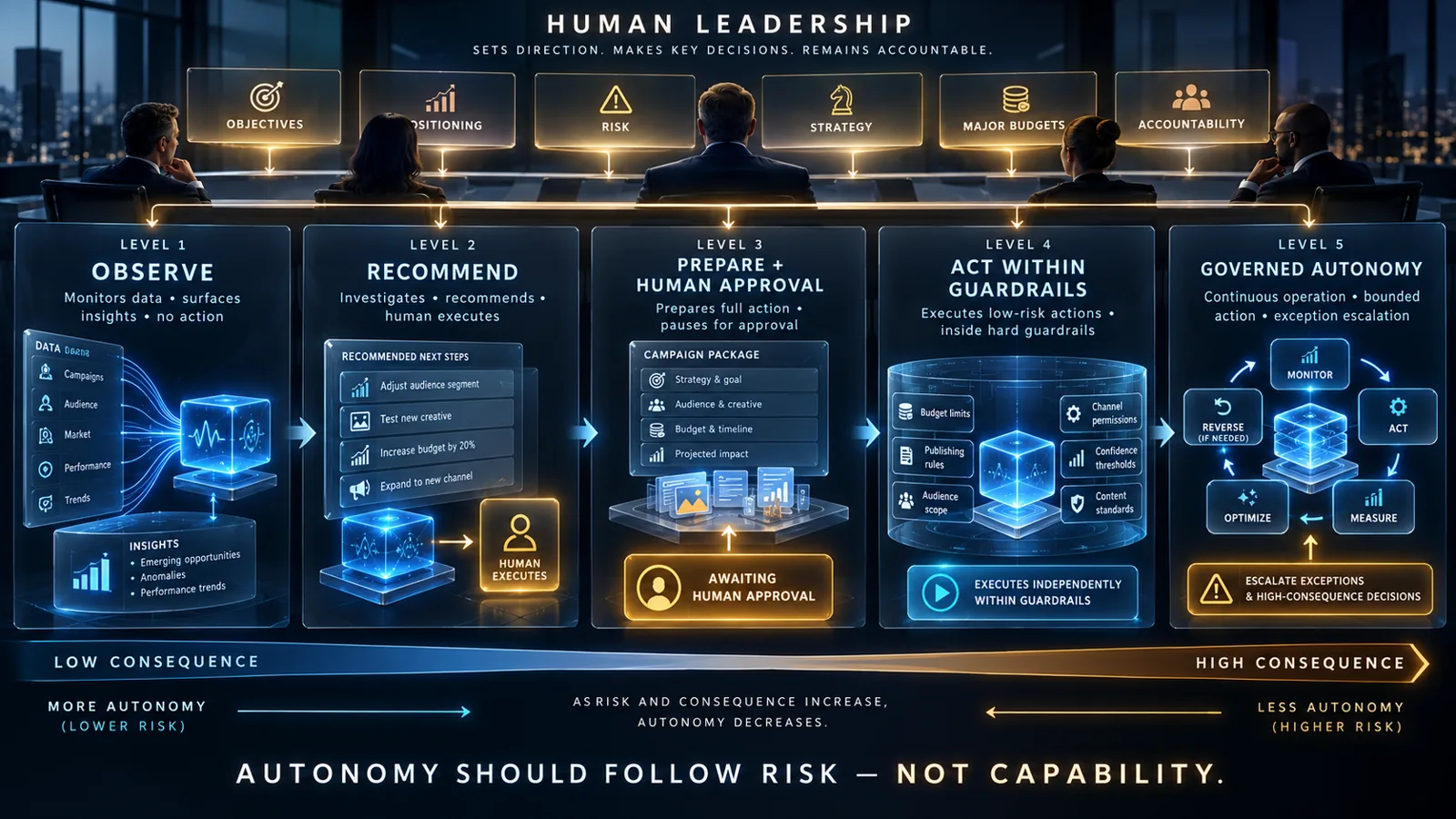
An AI CMO can potentially:
monitor performance,
analyze customer behavior,
prepare campaigns,
generate content,
adjust audiences,
run experiments,
change budgets,
publish assets,
and trigger customer communication.
So the obvious question is:
How much of that should it actually be allowed to do on its own?
The wrong answer is:
Everything.
The other wrong answer is:
Nothing without human approval.
The first creates unnecessary risk.
The second destroys most of the value of agentic AI.
The more useful model is risk-based autonomy.
An AI CMO should receive more autonomy when an action is:
- low-risk
- reversible
- measurable
- constrained
- well-understood
And less autonomy when an action is:
- strategically consequential
- financially significant
- difficult to reverse
- customer-sensitive
- legally or reputationally risky
The goal is not maximum autonomy.
It is appropriate autonomy.
That distinction will become central as marketing moves from AI that recommends to AI that actually acts.
The Governance Problem Changes When AI Can Act
Generative AI introduced one type of risk.
It could say something wrong.
Agentic AI introduces another.
It can do something wrong.
An AI assistant might produce bad copy.
An AI agent might:
publish it,
send it to customers,
change the campaign,
or move budget behind it.
That changes the governance problem completely.
McKinsey's 2026 AI trust research makes this distinction explicit: as AI systems gain more autonomy and tool access, organizations must account not only for incorrect outputs but also unintended actions, inappropriate tool use, and systems operating outside intended guardrails.
This means governance can no longer live only in policy documents.
It needs to become part of the architecture.
The Simplest Rule: Autonomy Should Follow Consequence
A practical starting principle is:
The greater the consequence of a marketing decision, the greater the level of human control.
Consider four actions.
Action A
Generate alt text for an approved image.
Risk:
Low.
Reversibility:
High.
Human approval required every time?
Probably unnecessary.
Action B
Shift 3% of traffic between two already approved creative variants.
Risk:
Limited.
Reversibility:
High.
Potential autonomy:
High.
Action C
Increase campaign spend by 30%.
Risk:
Meaningful.
Financial consequence:
High.
Potential autonomy:
Much lower.
Action D
Change the company's core positioning.
Risk:
Very high.
Strategic consequence:
Very high.
AI should recommend.
Humans should decide.
That is risk-based autonomy.
Five Levels of AI CMO Autonomy
A useful framework is to define five autonomy levels.
Level 1 — AI Observes
At the lowest level, the AI CMO watches but does not act.
It can:
- monitor campaigns
- analyze data
- identify anomalies
- detect customer trends
- summarize performance
It cannot modify the system.
Example:
Enterprise conversion has declined 11% among mobile paid-search visitors.
No action is taken.
This is appropriate when:
- the system is new
- trust is low
- data quality is uncertain
- consequences are high
This level is useful during early deployment.
Level 2 — AI Recommends
The AI CMO can analyze and propose an action.
For example:
Creative fatigue is the most likely cause of the decline. I recommend shifting 10% of traffic toward Variant B.
A human must approve.
This level is appropriate when the organization wants AI reasoning but retains direct control of execution.
Many companies will begin here.
Level 3 — AI Prepares, Human Approves
Now the AI CMO does more than recommend.
It prepares the entire action.
For example:
- builds the experiment
- creates the audience
- prepares campaign settings
- generates the revised assets
Then pauses.
The human receives:
Experiment ready. Approve launch?
This is much more efficient than forcing humans to perform the operational work themselves.
The human controls the transition.
Level 4 — AI Acts Within Guardrails
At this level, the AI CMO can act without asking for approval every time—but only inside predefined boundaries.
Examples:
- reallocate up to 5% of campaign traffic
- pause a clearly broken ad
- adjust send timing
- update campaign metadata
- launch tests using already approved assets
- adapt approved content for channel formats
Everything happens within explicit limits.
This is where agentic systems begin creating substantial operational leverage.
Level 5 — AI Runs the Workflow, Humans Govern Outcomes
At the highest practical level, the AI CMO manages significant parts of an end-to-end workflow.
It may:
monitor,
diagnose,
coordinate agents,
run experiments,
make bounded optimizations,
capture learning.
Humans no longer approve every action.
Instead, they define:
- objectives
- permissions
- risk thresholds
- escalation rules
- strategic constraints
Humans monitor exceptions and outcomes.
This is not human-free marketing.
It is human governance above autonomous execution.
Not Every Marketing Function Should Have the Same Autonomy
Autonomy should vary by task.
A company should not ask:
“How autonomous is our AI CMO?”
It should ask:
“How autonomous is the AI CMO for this type of decision?”
That distinction matters.
High-Autonomy Work
These activities are often good candidates for substantial autonomy.
Monitoring
Examples:
- campaign performance
- website behavior
- customer signals
- spend pacing
Why?
Because observing does not change the environment.
Data Normalization
Examples:
- field mapping
- naming consistency
- classification
- duplicate detection
These activities are structured and usually reversible.
Routine QA
Examples:
- broken links
- naming conventions
- required metadata
- missing tracking parameters
AI and deterministic systems can perform these reliably.
Workflow Routing
Examples:
- assign next task
- trigger approved workflow
- route exception to appropriate owner
This is usually operational rather than strategic.
Standard Reporting
AI can generate recurring performance summaries with minimal risk if underlying data is reliable.
Medium-Autonomy Work
These activities may allow autonomous execution within limits.
Content Adaptation
Taking an approved long-form asset and adapting it for:
LinkedIn,
email,
social,
ad formats.
Allowed if the core message and claims remain unchanged.
Experimentation
AI may launch approved tests inside:
defined audience limits,
budget limits,
approved messaging.
Campaign Optimization
AI may adjust:
traffic allocation,
timing,
frequency,
low-risk bids,
within predefined boundaries.
Low-Autonomy Work
These areas should usually require strong human control.
Positioning
AI can research and recommend.
Humans should decide what the company stands for.
Major Budget Allocation
AI can model scenarios.
Humans should approve major investment decisions.
New Product Claims
AI can identify opportunities.
But new claims can create:
legal,
reputational,
customer risks.
Crisis Communications
The context is usually too sensitive for broad autonomous action.
Strategic Customer Commitments
AI should not independently make commitments with significant commercial or reputational consequences.
Four Variables Should Determine Autonomy
A practical autonomy decision can be based on four dimensions.
1. Consequence
If the AI is wrong, how bad is the outcome?
Low consequence:
minor formatting issue.
High consequence:
major reputation damage.
2. Reversibility
Can the action easily be undone?
Changing a campaign allocation is reversible.
Sending a sensitive message to one million customers is not.
3. Confidence
How certain is the system?
High-confidence routine actions can receive more autonomy.
Ambiguous conclusions should escalate.
4. Scope
How large is the blast radius?
Changing one test variant:
small scope.
Changing brand positioning globally:
large scope.
Together, these variables create a much better autonomy framework than a single company-wide setting.
Add a Fifth Variable: Novelty
There is another important factor.
Has the system done this before?
An AI CMO handling a familiar campaign optimization with hundreds of validated examples may deserve more autonomy.
A completely new situation should receive less.
Novel situations increase uncertainty.
So a stronger model becomes:
Consequence × Reversibility × Confidence × Scope × Novelty
The higher the risk profile, the more human involvement should increase.
What Guardrails Should an AI CMO Have?
Autonomy without constraints is poor architecture.
A production-grade AI CMO should have explicit guardrails.
Budget Guardrails
Examples:
May move up to 5% of campaign spend without approval.
Any increase in total budget requires CMO approval.
Publishing Guardrails
Examples:
Approved channel adaptations may publish automatically.
New strategic claims require Brand approval.
Audience Guardrails
Examples:
May optimize inside approved customer segments.
Creating a new targeting category requires human review.
Data Guardrails
Examples:
Content Agent may access aggregate customer insights.
It may not retrieve sensitive individual customer records.
Brand Guardrails
Examples:
Use approved positioning only.
Do not generate fear-based messaging.
Do not claim the product replaces marketing leadership.
Confidence Guardrails
Example:
If diagnosis confidence falls below the required threshold, escalate to a human analyst.
Escalation Guardrails
Examples:
Escalate if:
- spend exceeds threshold
- customer complaint volume spikes
- model outputs conflict
- compliance rules are triggered
- new strategic territory is proposed
Guardrails convert abstract governance into operational behavior.
Hard Controls Matter More Than Instructions
There is an important difference between telling an agent:
“Please do not exceed the budget.”
and technically preventing it from exceeding the budget.
McKinsey's recent guidance on AI guardrails emphasizes that autonomous systems require controls they cannot simply bypass, alongside clear ownership and records of agent actions.
This suggests an important design principle:
High-risk boundaries should be enforced by the system, not merely described in prompts.
That can mean:
- permission controls
- API limits
- role-based access
- budget ceilings
- approval workflows
- restricted tool access
Governance should be executable.
Human-in-the-Loop Everywhere Is Not the Answer
Many companies react to AI risk by requiring human approval for everything.
This feels safe.
But it creates another problem.
If an agent can perform 100 actions per hour but a human needs to approve all 100, the workflow runs at human speed.
McKinsey argues that organizations need to find a balance between adequate oversight and excessive intervention; otherwise governance itself can become the bottleneck that limits agentic productivity.
That is why risk-based human involvement is better than universal human approval.
Humans should review:
exceptions,
uncertainty,
high-impact decisions.
Not routine actions that are already constrained.
Humans Should Govern Exceptions
This creates an important operating-model shift.
Traditional marketing:
Humans operate every step.
Agentic marketing:
Systems operate routine steps.
Humans govern exceptions.
Example:
Traditional:
Marketer checks every campaign every morning.
Agentic:
AI monitors all campaigns continuously.
Human receives:
2 campaigns require attention.
That is a much more scalable use of human judgment.
Autonomy Should Be Dynamic
Autonomy should not remain fixed forever.
An agent might begin at Level 2:
Recommend only.
After repeated successful performance:
move to Level 3.
Then perhaps Level 4 for specific actions.
Similarly, if:
error rate increases,
data quality falls,
new regulations apply,
the system should lose autonomy.
This creates a dynamic trust model.
Autonomy is earned.
And it can be withdrawn.
How to Earn More Autonomy
An AI CMO should demonstrate reliable performance before gaining authority.
Measure:
- task success
- error rate
- false escalation rate
- missed escalation rate
- brand compliance
- financial impact
- rollback frequency
- human override rate
If the system repeatedly performs correctly in a bounded domain, increase autonomy gradually.
This is closer to how organizations delegate authority to people.
Responsibility grows with evidence.
Auditability Is Non-Negotiable
If an AI CMO makes decisions, the company needs to know:
What happened?
Which agent acted?
What data did it use?
Which rule allowed the action?
What changed?
What was the outcome?
Could it be reversed?
McKinsey's 2026 trust research emphasizes explicit accountability, traceability, and ownership as organizations scale agentic AI.
Autonomy without auditability creates operational risk.
Every Agent Needs an Owner
This is another important governance rule.
If an Analytics Agent incorrectly pauses a campaign, who is accountable?
The AI cannot hold organizational accountability.
A human or team must own:
- agent scope
- performance
- permissions
- escalation design
- evaluation
McKinsey's research finds higher responsible-AI maturity where organizations assign explicit ownership rather than leaving governance fragmented.
This means an agent should have something similar to:
job description + manager + permissions + performance review.
A Practical AI CMO Autonomy Matrix
A useful operating framework might look like this:
The critical point is that autonomy is assigned by decision type, not by system.
A Practical Example: Campaign Optimization
Suppose the AI CMO detects:
ROAS has declined 10%.
The Analytics Agent investigates.
It determines:
Creative A appears fatigued.
Creative B remains above benchmark.
What happens next depends on autonomy.
Level 1
AI reports the issue.
Human investigates.
Level 2
AI recommends moving 8% of traffic.
Human executes.
Level 3
AI prepares the change.
Human clicks approve.
Level 4
AI shifts 8% automatically because the allowed threshold is 10%.
Level 5
AI shifts traffic, monitors results, reverses if performance deteriorates, captures the learning, and only notifies humans if something unusual occurs.
Same AI capability.
Very different operating model.
Now Consider a Positioning Change
The AI CMO notices that governance-focused messaging is outperforming productivity messaging.
It concludes:
We should reposition the entire company around AI governance.
Could it be correct?
Yes.
Should it act autonomously?
No.
Because this decision has:
high strategic consequence,
large scope,
low reversibility,
cross-functional impact.
The AI should:
analyze,
model,
recommend.
Leadership should decide.
This is the point of the autonomy framework.
Capability does not equal authority.
The Most Autonomous AI CMO May Not Be the Best One
This is worth emphasizing.
Companies may eventually compete over:
“Our AI is more autonomous.”
That is not necessarily a sign of maturity.
The better question is:
Does the system have the correct level of autonomy for each decision?
A mature AI CMO may be:
highly autonomous in reporting,
moderately autonomous in optimization,
low-autonomy in strategy.
That is not a weakness.
It is good system design.
Human Accountability Should Never Disappear
Even in highly agentic organizations, human accountability remains essential.
McKinsey's work on agentic operating models argues that humans will increasingly shift from executing line-by-line activities toward defining policies, monitoring exceptions, adjusting human involvement, and owning outcomes.
This may be the most important shift.
Humans do less operating.
They do more governing.
AI CMO Governance Should Work Like a Control Plane
A useful architectural metaphor is a control plane.
The AI CMO execution layer may contain many agents:
Research.
Content.
Campaign.
Analytics.
Experimentation.
Above them sits governance.
The governance plane defines:
- objectives
- permissions
- risk levels
- budget thresholds
- escalation rules
- human decision rights
The agents can move quickly underneath.
But they cannot leave the boundaries set above.
That is how autonomy and control coexist.

The Five Questions to Ask Before Granting Autonomy
Before allowing an AI CMO to act independently, ask:
1. What Is the Maximum Downside?
What is the worst realistic outcome?
2. Can the Action Be Reversed?
If it fails, can we restore the previous state?
3. Can the Outcome Be Measured Quickly?
Can the system determine whether the action worked?
4. Are the Boundaries Enforceable?
Can permissions technically prevent overreach?
5. Who Owns the Result?
Which human remains accountable?
If the organization cannot answer these questions clearly, autonomy should remain limited.
When to Increase Autonomy
Increase autonomy when:
- the task is repeated often
- success is measurable
- the system has proven reliable
- actions are reversible
- risk is limited
- permissions are technically enforced
- logging is complete
- escalation works
When to Reduce Autonomy
Reduce autonomy when:
- the situation is novel
- evidence conflicts
- data quality declines
- customer sensitivity rises
- financial exposure increases
- regulation becomes relevant
- actions become difficult to reverse
A good system should recognize some of these conditions automatically.
AI Autonomy Is an Operating-Model Decision
This topic is often treated as a technical question.
It is not only technical.
It determines:
who makes decisions,
who owns outcomes,
where managers intervene,
how teams work,
how risk is controlled.
That makes autonomy an organizational design question.
McKinsey's October 2026 research makes the broader point that agentic AI alters long-standing constraints around human capacity, expertise, and coordination, requiring organizations to rethink how work and decision rights are structured—not simply deploy more tools.
Start Narrow. Expand Deliberately.
An organization deploying an AI CMO should not begin with:
“Run marketing autonomously.”
Start with narrow authority.
For example:
Monitor everything.
Recommend broadly.
Prepare many actions.
Automatically execute only:
low-risk,
reversible,
well-defined activities.
Then measure.
Expand autonomy only where evidence supports it.
This creates trust through demonstrated performance rather than hype.
The Goal Is Governed Autonomy
The future AI CMO should not be either:
a passive assistant
or
an uncontrolled autonomous executive.
It should operate through governed autonomy.
That means:
AI observes continuously.
AI reasons broadly.
AI prepares aggressively.
AI acts selectively.
Humans define objectives.
Humans control consequential decisions.
Governance defines the boundary between them.
The result is an organization that gains the speed of agents without surrendering human accountability.
How Much Autonomy Should You Give an AI CMO?
The answer is:
as much as the decision deserves.
Not as much as the technology allows.
Give high autonomy to work that is:
routine,
measurable,
reversible,
bounded.
Give moderate autonomy where:
AI can prepare and optimize,
but consequences justify oversight.
Give low autonomy where decisions affect:
strategy,
brand,
major budgets,
customers,
legal exposure,
or reputation.
The mature AI CMO is not the one that acts without humans.
It is the one that knows when it should act—and when it should stop.
And the mature organization is the one that has designed those boundaries before the agent reaches them.
Frequently asked questions
How much autonomy should an AI CMO have?
An AI CMO should have high autonomy for low-risk, reversible, measurable activities and lower autonomy for strategic, financial, legal, customer-sensitive, or reputationally significant decisions.
What is risk-based AI autonomy?
Risk-based autonomy assigns different levels of AI authority according to the potential consequence, reversibility, confidence, scope, and novelty of a decision.
What marketing tasks can an AI CMO perform autonomously?
Potential examples include monitoring, routine reporting, data normalization, standard QA, workflow routing, approved content adaptation, and small optimizations inside predefined guardrails.
What decisions should always involve humans?
Humans should strongly control major positioning changes, significant budget reallocations, sensitive customer communications, new strategic claims, crisis communications, and other high-consequence decisions.
What are AI guardrails?
Guardrails are technical and operational constraints defining what an AI system can access, change, publish, spend, or communicate and when it must escalate to a human.
What is human-in-the-loop marketing?
Human-in-the-loop marketing uses human review at specified stages of AI workflows. More mature systems apply human review selectively according to risk rather than requiring approval for every action.
Should an AI CMO be allowed to change campaign budgets?
Potentially within small predefined limits. Large or strategically meaningful budget changes should generally require human approval.
How can an AI CMO earn more autonomy?
Organizations can progressively increase autonomy after agents demonstrate reliable task success, low error and override rates, strong compliance, complete auditability, and effective escalation.
Who is accountable for an AI CMO's actions?
Human leaders and designated agent or workflow owners remain accountable for the system's scope, governance, permissions, and business outcomes.
What is governed autonomy?
Governed autonomy means AI agents can act independently inside clearly defined technical, financial, strategic, and risk boundaries while humans retain final accountability and control over consequential decisions.