How to Start Building an AI Marketing Operating System: A Practical Step-by-Step Framework
It is easy to look at the final architecture and assume the only sensible starting point is a massive transformation program.
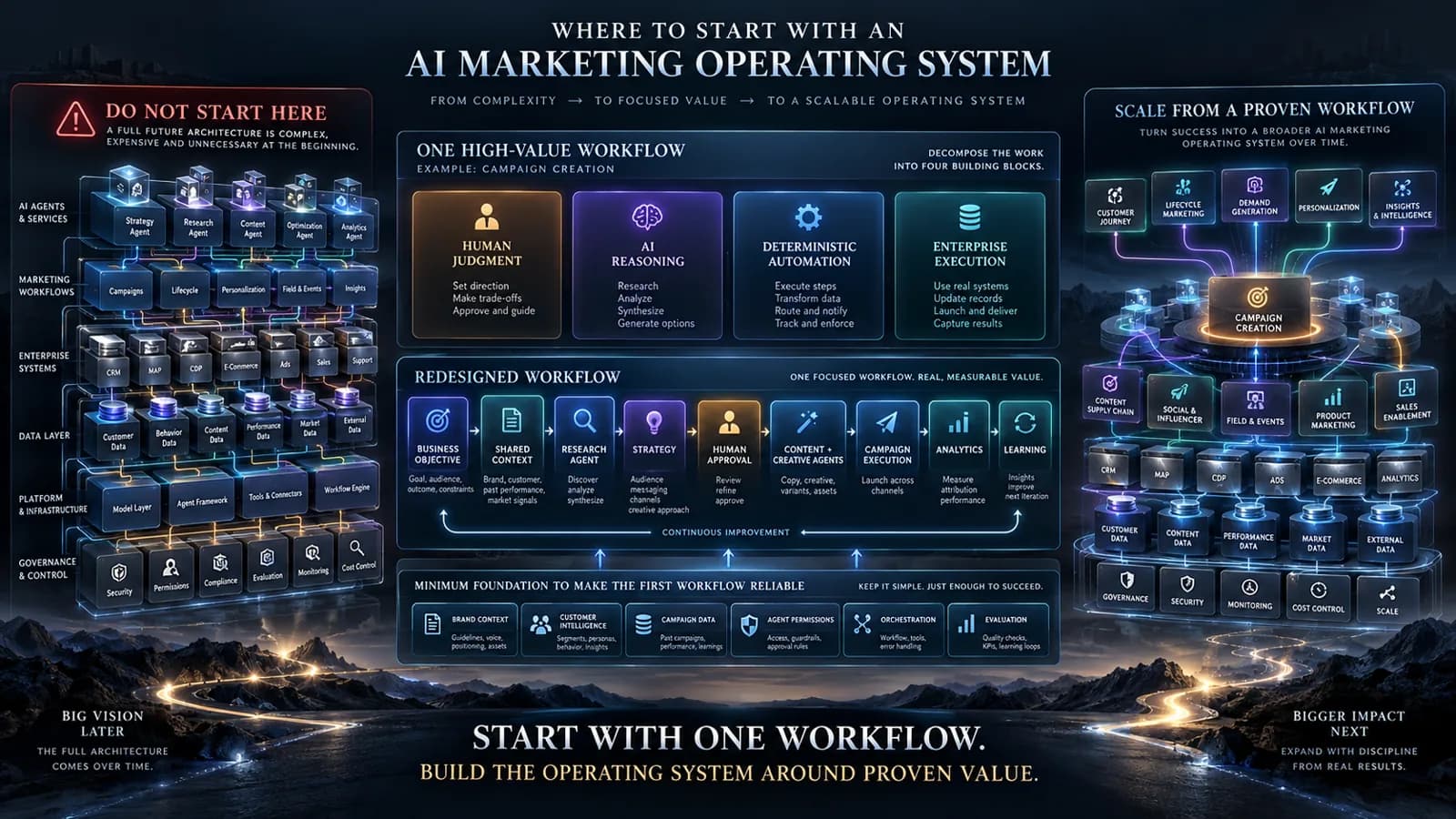
The idea of an AI marketing operating system sounds large.
And intimidating.
Shared intelligence.
AI agents.
Orchestration.
Data architecture.
Governance.
Enterprise integrations.
Human approval layers.
Continuous optimization.
It is easy to look at the final architecture and assume the only sensible starting point is a massive transformation program.
That is usually a mistake.
The best way to build an AI marketing operating system is not to build the whole operating system first.
It is to build one valuable workflow correctly.
Then another.
Then connect them.
The architecture grows around proven business value.
That means the first question should not be:
Which AI agents should we build?
Or:
Which platform should we buy?
The better question is:
Which marketing workflow would create meaningful business value if it operated fundamentally better?
That is where an AI marketing operating system should begin.
Start With the Business Problem, Not the AI
The easiest way to waste money on AI is to start with the technology.
A team buys:
AI writing tools.
Agent platforms.
Automation tools.
Model subscriptions.
Then looks for places to use them.
That reverses the problem.
The starting point should be a business outcome.
For example:
Reduce campaign launch time from ten days to three.
Or:
Reduce analyst time spent on recurring reporting by 70%.
Or:
Increase the number of meaningful experiments the team can run each month.
Or:
Improve enterprise lead quality without increasing media spend.
These are better starting points because they can be measured.
Salesforce's current agentic-marketing implementation guidance recommends beginning with a specific business case and identifying where repetitive work, performance gaps, or lack of capacity are creating the biggest constraints.
The operating system should emerge from the problems worth solving.
Not from the novelty of AI.
Step 1 — Choose One High-Value Workflow
Do not begin with:
Transform marketing with AI.
Too broad.
Choose one complete workflow.
Strong candidates might include:
- campaign creation
- content production
- performance monitoring
- campaign reporting
- customer intelligence
- lifecycle optimization
- lead qualification
- experimentation
The key is choosing something that is:
important,
frequent,
measurable,
and constrained enough to redesign.
What Makes a Good First Workflow?
A strong first workflow usually has several characteristics.
It Happens Often
You want enough repetitions to learn quickly.
A workflow that runs once per year is a poor first experiment.
It Contains Manual Coordination
Look for:
copying data,
routing tasks,
status chasing,
repeated brief creation,
manual QA,
report preparation.
These often create large gains.
It Has a Measurable Outcome
For example:
campaign cycle time,
cost per campaign,
conversion,
human hours,
error rate.
It Is Important but Not Existential
Do not begin with:
global brand repositioning.
Crisis response.
The most sensitive customer communication.
Start where experimentation is safe enough to learn.
Step 2 — Map the Current Workflow Exactly
Before introducing AI, understand how work happens today.
Suppose the workflow is:
Launch a campaign.
Do not write:
Strategy → Creative → Launch.
That hides the important work.
Map the real process.
For example:
Business request arrives.
↓
Marketing lead writes brief.
↓
Research team collects data.
↓
Strategy creates recommendation.
↓
Leadership reviews.
↓
Content receives brief.
↓
Creative receives another brief.
↓
Edits happen.
↓
Marketing Ops builds campaign.
↓
Tracking is configured.
↓
Campaign gets QA.
↓
Leadership approves launch.
↓
Campaign launches.
↓
Analytics builds report.
Now ask:
How long does each step take?
Where does work wait?
Where is context re-entered?
Where do errors happen?
Where are humans doing predictable work?
You cannot intelligently redesign a workflow you do not understand.
Step 3 — Separate the Work Into Four Categories
For every step, classify the activity.
Human-Owned
Requires substantial:
judgment,
accountability,
taste,
relationships,
strategic trade-offs.
Example:
Approve positioning.
AI-Reasoning Work
Requires:
research,
interpretation,
synthesis,
generation,
diagnosis.
Example:
Analyze customer interviews.
Deterministic Automation
Predictable logic.
Example:
After final approval, schedule approved assets.
System Execution
Where actions actually occur.
CRM.
CMS.
Email.
Paid Media.
Analytics.
This distinction is critical.
Do not build an AI agent for work a simple automation can perform more reliably.
And do not automate decisions that require genuine human judgment.
Step 4 — Redesign the Workflow Before Automating It
This may be the most important step.
Suppose the current workflow contains:
12 steps.
Do not assume your goal is to automate all 12.
Some of those steps may exist only because humans historically had limited capacity or systems did not communicate.
Ask:
Can this step disappear?
Can two stages happen simultaneously?
Can an approval become exception-based?
Can the same context flow automatically downstream?
This is workflow redesign.
McKinsey's 2026 research emphasizes that the biggest near-term financial gains come from rewiring high-value workflows around human–AI collaboration, rather than automating isolated tasks.
Example: Traditional Campaign Workflow
A traditional campaign might look like:
Research
↓
Strategy
↓
Content
↓
Creative
↓
QA
↓
Campaign Setup
↓
Launch
↓
Reporting
Everything happens sequentially.
AI-Native Campaign Workflow
A redesigned workflow might be:
Research + Customer Intelligence + Competitive Intelligence
run simultaneously.
↓
Strategy synthesizes them.
↓
Human approves direction.
↓
Content + Creative + SEO + Lifecycle
run simultaneously.
↓
AI QA handles routine checks.
↓
Human evaluates creative quality.
↓
Campaign Agent prepares execution.
↓
Automated QA validates configuration.
↓
Human approves major launch.
↓
Analytics monitors continuously.
That is not simply automation.
The workflow itself changed.
Step 5 — Define the Source of Truth
Once agents participate in work, context becomes critical.
The system needs authoritative answers to questions such as:
What is our current positioning?
Who is our priority customer?
Which claims are approved?
Which product information is current?
What are the campaign objectives?
What did we learn previously?
If those answers live across ten disconnected documents, the agents will eventually disagree.
So define the source of truth.
This becomes the beginning of your shared intelligence layer.
Step 6 — Build Shared Marketing Intelligence
The AI marketing operating system needs persistent context.
A basic shared intelligence foundation might include:
Brand
- positioning
- tone
- messaging
- visual principles
Customer
- ICP
- segments
- research
- pain points
- objections
Product
- features
- use cases
- pricing
- approved claims
Campaign
- historical campaigns
- creative
- performance
- experiments
Business
- objectives
- KPIs
- current priorities
This does not require one enormous database on day one.
The goal is reliable retrieval.
Agents should have access to the right current context when they need it.
Step 7 — Fix the Minimum Necessary Data
This is where many companies overcorrect.
They say:
“We need perfect data before starting AI.”
Then nothing happens.
You do not need perfect enterprise data.
You need sufficiently reliable data for the workflow you selected.
If the first workflow is campaign reporting, focus on:
campaign,
conversion,
spend,
revenue data.
If it is content creation, prioritize:
brand,
customer,
product,
content performance.
McKinsey recommends assessing maturity around data and infrastructure and building the technical foundations required for the workflows being scaled, including common identifiers and interoperable data models.
Build enough foundation for the use case.
Then expand.
Step 8 — Add the Smallest Number of Agents Necessary
This is another common mistake.
Teams immediately imagine:
20 agents.
You probably do not need them.
Suppose the first workflow is campaign creation.
You may initially need only:
Research Agent
Gather and synthesize intelligence.
Content Agent
Create approved campaign assets.
Campaign Agent
Prepare execution.
Analytics Agent
Monitor results.
Four agents may be enough.
The purpose is not agent count.
The purpose is workflow capability.
When Should Something Become Its Own Agent?
Create a specialized agent when there is a meaningful difference in:
- responsibility
- context
- tools
- permissions
- evaluation
For example:
Content and Campaign execution should probably be separate.
Why?
A Content Agent needs:
brand context,
content tools.
A Campaign Agent needs:
ad platform access,
budget permissions.
Different responsibility.
Different risk.
Different agent.
Step 9 — Give Every Agent a Job Description
Define:
Objective
What outcome does this agent own?
Inputs
What information does it receive?
Context
What knowledge can it retrieve?
Tools
What systems can it use?
Permissions
What actions can it perform?
Guardrails
What boundaries apply?
Escalation
When should it stop and involve a human?
Evaluation
How do you know it is working?
This should exist before production deployment.
Step 10 — Connect Agents to Tools Carefully
Agents become operational when they can use tools.
That may include:
CRM,
CMS,
email,
paid media,
analytics,
project systems.
Start cautiously.
Read access first where possible.
Then preparation.
Then constrained write access.
For example:
Stage 1:
Analytics Agent can read campaign data.
Stage 2:
Campaign Agent can prepare changes.
Stage 3:
Campaign Agent can execute changes under a 5% threshold.
Authority should expand gradually.
Step 11 — Add Orchestration
Once multiple agents participate, someone—or something—must coordinate the workflow.
That is orchestration.
The orchestration layer manages:
- sequence
- dependencies
- workflow state
- parallel execution
- handoffs
- approvals
- escalation
- retries
For example:
Research complete?
Trigger Strategy.
Strategy approved?
Trigger Content and Creative.
Brand check failed?
Return to Content.
Campaign ready?
Request launch approval.
This is what turns individual AI capabilities into a system.
Start With Deterministic Orchestration
Do not use an LLM to improvise every workflow decision.
Many rules are already known.
For example:
Campaign may not launch without approval.
Hard rule.
Budget cannot exceed approved allocation.
Hard rule.
If API fails twice, escalate.
Hard rule.
Use deterministic orchestration for predictable requirements.
Use agent reasoning where interpretation is actually useful.
Step 12 — Define Human Approval Gates
Do not add humans everywhere.
Ask where human judgment is actually necessary.
A useful model is:
Low Risk
Execute automatically.
Example:
campaign naming.
Medium Risk
AI prepares.
Human approves.
Example:
new campaign setup.
High Risk
Human leads.
Example:
new positioning.
This creates risk-based human involvement.
The goal is not human-free marketing.
It is avoiding humans becoming routine workflow bottlenecks.
Step 13 — Build Governance Into the Architecture
Governance should answer:
Which agent can access which data?
Which agent can publish?
Which agent can spend?
How much?
Which actions need approval?
When must the system escalate?
Examples:
Budget ceiling: Agent can reallocate up to 5%.
Publishing rule: New product claims require approval.
Data rule: Content Agent cannot access customer PII.
Confidence rule: Low-confidence diagnosis escalates.
Governance should be technically enforced where possible.
Not merely written into a prompt.
Step 14 — Build Evaluation Before Scaling
Do not wait until the system has 30 agents to ask whether they work.
Define metrics early.
At three levels.
Agent-Level
- accuracy
- task success
- quality
- escalation rate
- overrides
Workflow-Level
- cycle time
- errors
- human handoffs
- cost
- completion
Business-Level
- conversion
- pipeline
- revenue
- CAC
- retention
An agent can perform beautifully while the workflow delivers no business value.
Measure the whole system.
Step 15 — Add Observability
You need to understand what the system actually did.
Track:
Which agent acted?
What context did it retrieve?
Which tools did it call?
What decision did it make?
What changed?
What failed?
How much did it cost?
If something goes wrong, you need to reconstruct the chain.
Observability turns AI from a black box into an operable system.
Step 16 — Run in Shadow Mode First
A useful rollout pattern is:
Observe before acting.
Suppose the Analytics Agent is designed to make recommendations.
Initially, let it:
monitor,
diagnose,
recommend.
Compare the recommendation with what experienced humans would do.
Once performance is reliable:
allow preparation.
Then:
bounded action.
This is much safer than beginning with autonomy.
Step 17 — Increase Autonomy Gradually
A sensible progression looks like:
Level 1
Observe.
Level 2
Recommend.
Level 3
Prepare + human approval.
Level 4
Act inside guardrails.
Level 5
Governed workflow autonomy.
Do not grant Level 5 because the model is impressive.
Grant it because the system has demonstrated reliable performance.
Step 18 — Remove the Old Work
This is the step many organizations forget.
Suppose your new Analytics Agent builds the report.
But analysts still build the old report manually.
Nothing was transformed.
Suppose orchestration routes campaign tasks.
But managers still run the same status meetings.
Again:
nothing changed.
Once the new workflow proves reliable, retire unnecessary:
reports,
spreadsheets,
handoffs,
approvals,
meetings.
AI transformation requires subtraction.
Step 19 — Measure Capacity Released
One of the best metrics is:
How much human capacity moved toward higher-value work?
For example:
Before:
Analysts spend 15 hours per week on recurring reporting.
After:
3 hours.
Where did the 12 hours go?
If it became:
experimentation,
customer analysis,
strategic decision support,
great.
If it became:
more status meetings,
less useful.
The operating system should improve how human attention is allocated.
Step 20 — Capture Learning
The system should learn from results.
Suppose an experiment shows:
Governance messaging converts significantly better among enterprise CMOs.
Do not leave that result in a report.
Store it as validated marketing intelligence.
Now:
Content Agent knows.
Strategy knows.
Campaign knows.
The next workflow starts smarter.
McKinsey specifically recommends building AI capabilities with feedback loops from the beginning so each interaction improves the next.
This is how the operating system compounds.
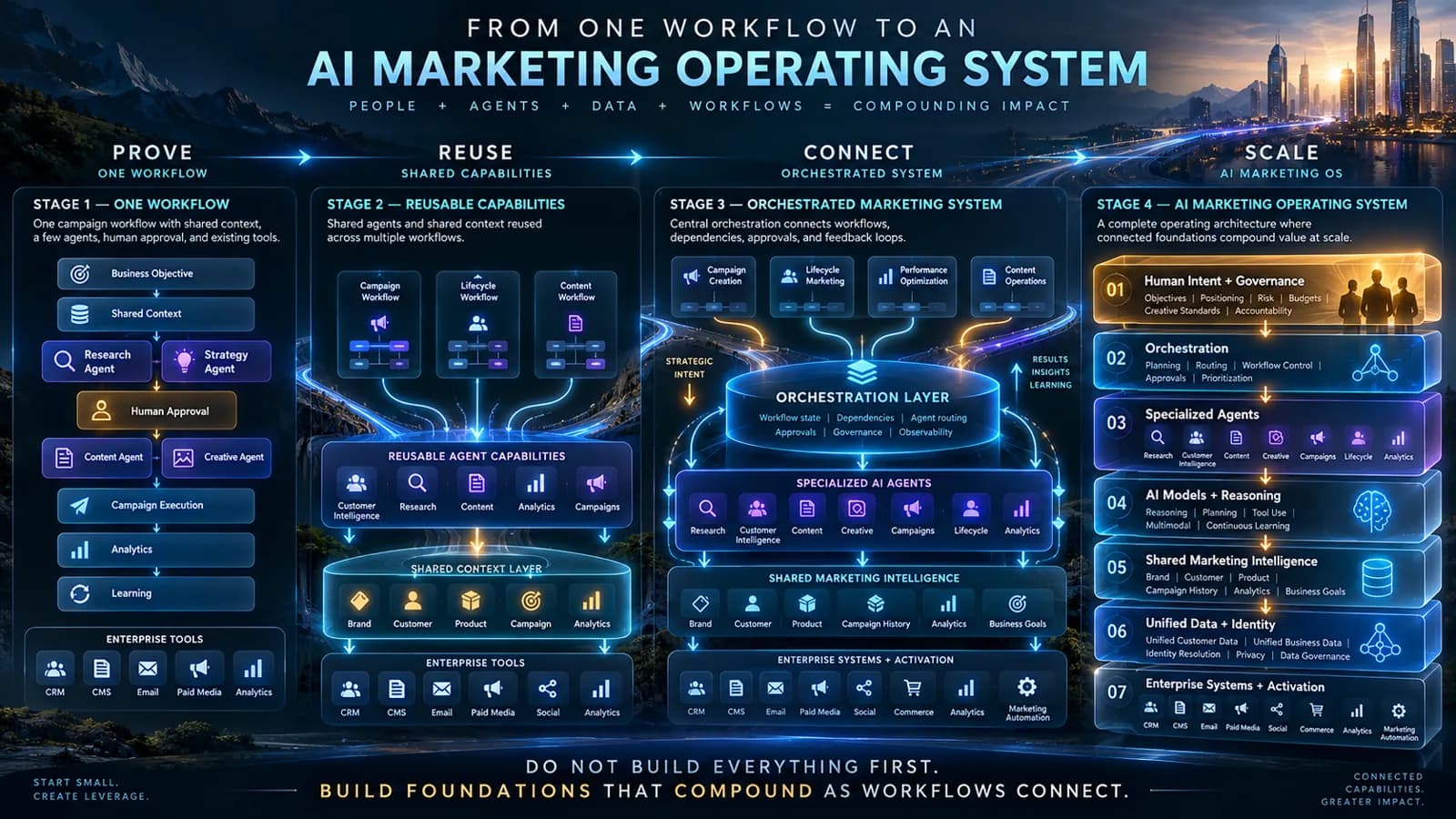
Step 21 — Connect the Second Workflow
Only now expand.
Suppose Workflow 1 was:
Campaign creation.
Workflow 2 might be:
Performance optimization.
But they should not become isolated systems.
The second workflow should reuse:
customer definitions,
campaign context,
Analytics Agent,
business objectives.
This creates shared infrastructure.
Reuse Capabilities Instead of Rebuilding Them
A Customer Intelligence Agent should potentially support:
content strategy,
campaign planning,
lifecycle,
sales enablement.
The same shared intelligence layer should support multiple workflows.
That is how the system becomes more efficient as it expands.
Do not build one stack per use case.
Build reusable capabilities.
Step 22 — Standardize the Architecture
After several successful workflows, patterns will emerge.
Common:
agent templates,
permissions,
evaluation frameworks,
data interfaces,
approval rules.
Standardize them.
This creates a platform rather than a collection of experiments.
Step 23 — Build a Governance Control Plane
As the system grows, centralized governance becomes more valuable.
A control plane can manage:
- agent identities
- permissions
- data access
- budget thresholds
- publishing rights
- escalation
- audit logs
Humans define the authority.
Agents operate within it.
Step 24 — Redesign the Team
Once workflows change, human roles should change too.
Marketing Operations may shift toward:
orchestration,
agent governance,
system architecture.
Analysts toward:
experimentation,
measurement,
decision intelligence.
Creatives toward:
concept,
taste,
art direction.
Campaign managers toward:
exception management,
performance governance.
Do not preserve job design after the underlying work changes.
Step 25 — Move From Workflow Automation to an Operating System
At this point, you begin seeing the larger architecture.
You now have:
Enterprise Systems
where work executes.
Unified Data
where operational signals live.
Shared Intelligence
where business context persists.
Models
providing reasoning.
Agents
performing specialized work.
Orchestration
coordinating workflows.
Human Governance
defining intent and boundaries.
That is the AI marketing operating system.
You did not build it all at once.
You grew it by solving valuable workflows.
A Practical 90-Day Starting Roadmap
The exact timeline will vary, but a useful implementation sequence looks like this.
Days 1–30 — Understand + Design
Choose one workflow.
Map the current state.
Define:
business metric,
human roles,
AI opportunities,
required data,
approval boundaries.
Build the simplest working context layer.
Days 31–60 — Build + Evaluate
Introduce:
one to four specialized agents.
Connect required systems cautiously.
Add orchestration.
Run in:
shadow mode,
recommendation mode,
or prepare-and-approve mode.
Measure performance.
Days 61–90 — Operationalize
Improve reliability.
Add governance.
Remove unnecessary legacy steps.
Increase autonomy where justified.
Measure:
business outcomes,
workflow speed,
human capacity.
Then decide whether to scale.
The objective after 90 days should not be:
We deployed AI.
It should be:
This workflow now operates materially better.
What Should You Build First?
A useful priority framework is:
Business Value × Frequency × Feasibility ÷ Risk
Look for workflows with:
high business value,
high frequency,
reasonable integration complexity,
manageable risk.
A routine reporting workflow may have:
high feasibility,
low risk,
but limited strategic value.
A global positioning workflow has:
high value,
but very high risk.
Campaign creation or performance optimization may sit in the useful middle.
Avoid Starting With Content Generation Alone
Content generation is easy.
That makes it tempting.
But:
“We can generate more content”
does not necessarily justify an operating system.
A stronger first project connects:
context,
workflow,
execution,
measurement.
For example:
Brief
→ Research
→ Content
→ Approval
→ Distribution
→ Measurement.
Now you are learning the architectural capabilities needed for the larger system.
Avoid Building a Giant Agent
Another tempting approach:
Build one massive AI CMO agent with access to everything.
That creates:
permission problems,
evaluation problems,
debugging problems,
unclear responsibility.
A modular architecture is usually stronger.
Specialized agents.
Common intelligence.
Shared orchestration.
Clear governance.
Avoid Agent Sprawl
The opposite mistake is building an agent for every tiny task.
Headline Agent.
Caption Agent.
Email Subject Agent.
Instagram Agent.
LinkedIn Agent.
Now the system becomes difficult to manage.
Create specialized agents only when distinct:
responsibility,
tools,
permissions,
or evaluation
justify it.
Avoid Automating Broken Workflows
If a workflow has:
ten approvals,
duplicate reporting,
unnecessary handoffs,
AI can simply make bad design move faster.
Redesign first.
Automate second.
Avoid Waiting for Perfect Data
You need reliable data.
Not perfect data.
Start with the minimum required for your workflow.
Then improve the foundation as more use cases depend on it.
Salesforce's 2026 India research shows why this matters: 81% of marketers reported AI adoption, yet fragmented or irrelevant data remains a major constraint on scaling customer engagement.
Avoid Measuring AI Activity
Do not report:
12 agents deployed.
4,000 AI outputs.
90% employees using AI.
Those numbers may mean nothing.
Measure:
campaign cycle time down 40%.
reporting hours down 70%.
conversion up 8%.
experimentation velocity doubled.
That is transformation.
The Architecture Should Be Designed for Connection From Day One
Even while starting small, think ahead.
McKinsey specifically recommends defining how capabilities will connect from the beginning—even when only one or two are initially built—to avoid disconnected “dead-end” pilots.
That means establishing early conventions around:
customer IDs,
campaign IDs,
agent interfaces,
context schemas,
evaluation,
governance.
Start small.
Design for scale.
Build the Marketing Operating System Like a Platform
The system should become reusable.
A new workflow should not require rebuilding:
customer context,
brand context,
permissions,
analytics connections.
Those should become shared services.
As reuse increases, marginal implementation becomes easier.
That is when the operating system begins creating compounding value.
The Operating System Is Not a Product You Buy
This is an important distinction.
You may buy many parts of it.
Agent platforms.
CRM.
CDP.
Marketing automation.
Models.
But the operating system itself is the way your company combines:
context,
data,
agents,
workflows,
governance,
human decision-making.
It is partly technology.
And partly operating model.
No vendor can completely install that for you.
Humans Should Remain at the Top of the Architecture
Throughout this process, keep one principle clear.
Humans own:
business objectives,
positioning,
customer priorities,
creative standards,
major trade-offs,
risk,
accountability.
AI increasingly handles:
intelligence,
coordination,
execution.
This prevents the operating system from becoming technology-first.
The system exists to execute human intent more effectively.
How to Start Building an AI Marketing Operating System
You do not need 30 agents.
You do not need to replace your martech stack.
You do not need perfect data.
You do not need a fully autonomous AI CMO.
Start with:
one valuable workflow.
Map it.
Redesign it.
Build reliable context.
Introduce a small number of agents.
Connect them carefully.
Orchestrate them.
Define human approval.
Create guardrails.
Evaluate everything.
Remove old work.
Capture learning.
Then connect the next workflow.
That is how the operating system emerges.
Not from a massive AI transformation announcement.
From one workflow becoming meaningfully better—
and the architecture underneath it being built well enough that the next workflow can reuse what you learned.
The goal is not to build an impressive AI system.
It is to build a marketing organization that can:
observe faster
understand better
decide more intelligently
execute with less friction
measure continuously
and learn from every cycle.
That is an AI marketing operating system.
And the best place to start is much smaller than the final architecture suggests.
Frequently asked questions
What is an AI marketing operating system?
An AI marketing operating system is a coordinated architecture connecting enterprise systems, data, shared marketing intelligence, AI models, specialized agents, orchestration, automation, governance, and human leadership across marketing workflows.
Where should a company start?
Start with one high-value, repeatable, measurable marketing workflow where AI can materially improve speed, cost, quality, or performance.
Should I start by buying an AI agent platform?
Usually not. Start by defining the business outcome and redesigning the workflow. Then select the technology needed to support it.
Do I need perfect data before using AI agents?
No. You need sufficiently reliable data and context for the workflow being automated. Improve the data foundation progressively as more workflows depend on it.
How many AI agents should I build first?
Use the smallest number required for the workflow. One to four specialized agents may be enough for many initial implementations.
What is shared marketing intelligence?
Shared marketing intelligence is persistent context such as brand strategy, customer research, product information, campaign history, analytics, and business objectives that relevant agents can consistently retrieve.
What is AI agent orchestration?
Orchestration coordinates agents, automation, humans, and enterprise systems by managing workflow state, sequencing, dependencies, routing, approval gates, escalation, retries, and completion.
How much autonomy should AI agents have initially?
Start with observation, recommendation, or prepare-and-approve modes. Increase autonomy gradually after the system demonstrates reliable performance inside enforceable guardrails.
How should AI marketing systems be measured?
Measure agent quality, workflow performance, human capacity released, costs, and business outcomes such as conversion, pipeline, revenue, CAC, or retention.
How long does it take to build an AI marketing operating system?
There is no universal timeline because an operating system is built progressively. A better objective is to make one workflow measurably better, establish reusable foundations, and expand from there rather than attempting a full transformation at once.