Imagine Your Marketing Team Starts Monday With 30 AI Agents. What Happens Next?
You have effectively increased the execution capacity of your marketing organization overnight.
Imagine this.
You arrive at work Monday morning.
Your marketing team has not hired anyone over the weekend.
But somehow, you now have 30 additional workers.
They do not need desks.
They do not have calendars.
They do not sleep.
They can research, analyze, write, monitor, coordinate, and operate software.
One tracks competitors.
Another watches campaign performance.
Another analyzes customer feedback.
Several generate content.
One prepares experiments.
Another monitors SEO.
Another handles campaign QA.
Another builds reports.
On paper, this sounds extraordinary.
You have effectively increased the execution capacity of your marketing organization overnight.
But by 10:30 a.m., another possibility becomes obvious.
Three research agents have produced three different conclusions.
Two content agents are using different versions of the positioning.
The Analytics Agent has identified a campaign problem, but nobody knows whether it should send the issue to Creative, Campaign Operations, or a human.
The Campaign Agent wants permission to change budget.
The Content Agent has generated 68 assets nobody asked for.
Five agents have independently sent recommendations to the CMO.
One agent has repeated work another agent finished 20 minutes earlier.
Another is operating from customer data that is six months old.
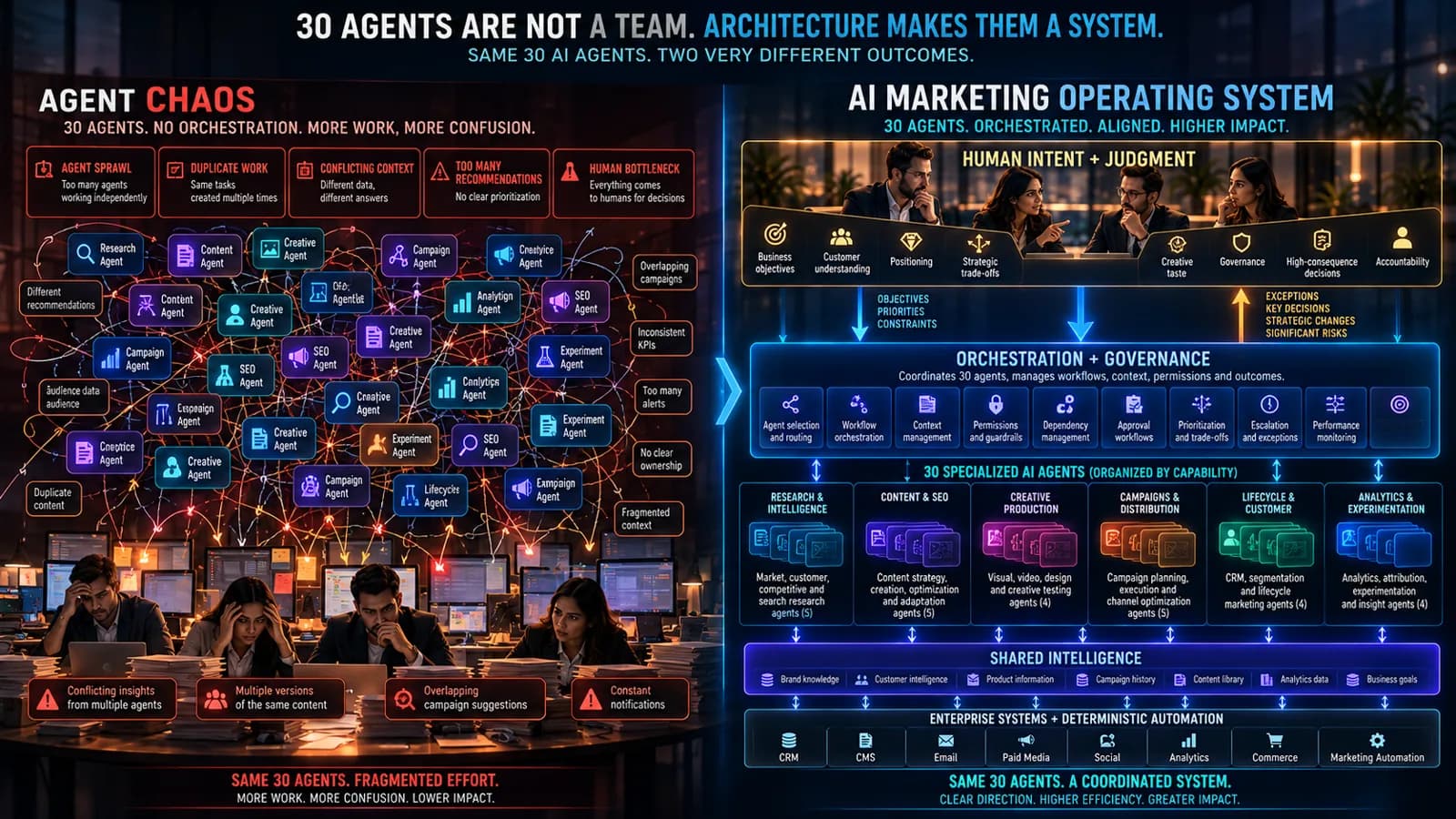
You do not have an AI marketing team.
You have agent chaos.
This is the important lesson behind the next phase of agentic marketing:
More agents do not automatically create more capability.
The value comes from how those agents are organized.
Thirty disconnected agents are 30 more things to manage.
Thirty coordinated agents can become an operating system.
The difference is architecture.
The First Hour: Everyone Is Impressed
At 9:00 a.m., the new capabilities look incredible.
Your team discovers it has:
3 Research Agents
2 Customer Intelligence Agents
2 Competitive Intelligence Agents
3 Content Agents
2 Creative Agents
2 SEO/GEO Agents
3 Campaign Agents
2 Lifecycle Agents
3 Analytics Agents
2 Experimentation Agents
2 QA Agents
1 Brand Agent
1 Workflow Agent
1 Reporting Agent
1 Orchestration Agent
That is 30 AI agents.
Almost every major marketing function has gained additional capacity.
A traditional team might take days to perform work that can now begin simultaneously.
Market research starts.
Customer analysis starts.
Competitor monitoring starts.
Campaign analysis starts.
Content production starts.
The immediate reaction is:
Look how much we can do.
But capacity is only useful when it moves toward the same outcome.
By 10:00 a.m., the First Problem Appears: Nobody Defined the Jobs
What exactly is the difference between:
Research Agent 1
and
Research Agent 2?
Does one own market trends?
Does another own customer research?
Who handles competitor intelligence?
Can they both initiate work?
Should they communicate directly?
Without defined responsibilities, intelligent agents begin duplicating effort.
This is exactly what happens with poorly structured human teams.
If everyone owns everything, nobody truly owns anything.
The first requirement for a multi-agent marketing organization is therefore surprisingly familiar:
job design.
Every AI Agent Needs a Job Description
An agent should have a defined:
Objective
What outcome does it exist to create?
Scope
What type of work does it own?
Context
Which information may it retrieve?
Tools
Which applications can it use?
Permissions
Which actions can it take?
Boundaries
What may it never do?
Escalation Rules
When does a human need to become involved?
Evaluation
How is success measured?
For example:
Customer Intelligence Agent
Objective: Continuously improve understanding of priority customer segments.
May access: CRM, customer interviews, surveys, support feedback, approved behavioral data.
May do: analyze, summarize, identify patterns, create structured insights.
May not: contact customers independently or change targeting definitions.
Escalates: major changes in customer behavior or conflicting evidence.
Now the agent has a role.
30 Agents Need an Org Chart Too
The traditional org chart answers:
Who reports to whom?
An AI-native system also needs to answer:
Which capability connects to which capability?
For example:
Market Research
Customer Intelligence
Competitive Intelligence
↓
Strategy
↓
Human Approval
↓
Content + Creative + SEO
↓
Brand QA
↓
Campaign
↓
Analytics
↓
Experimentation
That is not simply an org chart.
It is a workflow architecture.
Agents need relationships, not just names.
By 11:00 a.m., the Second Problem Appears: Everyone Has Different Context
The Content Agent says:
“Our positioning is AI productivity.”
The Campaign Agent says:
“Our positioning is marketing orchestration.”
The Research Agent says:
“The target customer is mid-market marketing teams.”
The CRM says:
the current priority is enterprise.
Every agent may be individually intelligent.
Together they are inconsistent.
This is one of the biggest risks of agentic systems.
AI can scale action.
But it can also scale context inconsistency.
Thirty Agents Need One Shared Reality
A multi-agent marketing system needs a common intelligence foundation.
That can include:
- brand strategy
- customer definitions
- product information
- pricing
- campaign history
- CRM context
- content knowledge
- approved claims
- analytics
- business objectives
- current priorities
- validated experiments
Every agent does not need access to everything.
But agents performing related work should operate from consistent truth.
This is shared marketing intelligence.
Without it, adding agents makes the organization faster at disagreeing with itself.
Shared Context Is Not the Same as Unlimited Access
Imagine giving all 30 agents unrestricted access to:
customer data,
financial information,
campaign systems,
publishing rights.
That would be unnecessary and risky.
Instead:
Research Agent gets relevant market data.
Content Agent gets brand and customer context.
Campaign Agent gets approved campaign configuration and budgets.
Analytics Agent gets performance data.
This is:
shared intelligence + role-based access.
The organization maintains common reality without giving every agent every permission.
Noon: The Third Problem Appears—30 Agents Are Producing Too Much
By lunchtime:
Research has produced 14 reports.
Content has generated 84 concepts.
Creative has generated 40 visual directions.
Analytics has surfaced 22 anomalies.
SEO has identified 130 opportunities.
Everything is technically useful.
And almost none of it is actionable.
This is a major change AI introduces.
Historically, marketing suffered from production scarcity.
AI creates production abundance.
Now the bottleneck becomes:
attention.
More AI Means Selection Becomes More Important
If AI generates 100 options, the organization needs a mechanism for deciding which three matter.
That means the future marketing team needs:
prioritization,
ranking,
quality thresholds,
confidence thresholds,
business context.
The problem is no longer:
Can we generate enough ideas?
It becomes:
Which ideas deserve organizational attention?
Humans should not receive every agent output.
They should receive the decisions that matter.
Agents Should Communicate With the System Before They Communicate With Humans
A badly designed agentic team works like this:
Research Agent → CMO
Analytics Agent → CMO
Content Agent → CMO
Campaign Agent → CMO
Experimentation Agent → CMO
Now the CMO is managing an inbox containing machine-generated work.
That does not scale.
A stronger system is:
Agents
↓
Orchestration
↓
Prioritization
↓
Only important decisions
↓
Human
The system should absorb complexity.
Humans should receive signal.
1:00 p.m.: The Fourth Problem Appears—Nobody Knows What Happens Next
The Analytics Agent detects:
Enterprise conversion is declining.
Excellent.
What happens?
Should it notify:
Campaign Agent?
Creative Agent?
Customer Intelligence Agent?
Experimentation Agent?
The AI-generated insight has no value unless it moves into execution.
This is where orchestration becomes essential.
Orchestration Is the Manager of Agent Work
The orchestration layer decides:
which agent acts,
when,
using what context,
after which dependency,
under which permission,
and what happens afterward.
For example:
Analytics detects creative fatigue.
↓
Orchestrator checks confidence.
↓
Confidence high.
↓
Routes evidence to Creative Agent.
↓
Creative prepares variants.
↓
Brand Agent validates.
↓
Experimentation Agent prepares test.
↓
Campaign Agent executes within guardrails.
↓
Analytics measures outcome.
Now the system works.
No human manually moved the insight through five departments.
Thirty Agents Without Orchestration Are Thirty More Handoffs
This is one of the most important principles.
Companies may believe that adding agents eliminates coordination.
Not automatically.
If Agent A creates an output and a human must:
read it,
copy it,
brief Agent B,
check Agent B,
send it to Agent C,
the organization still has manual coordination.
It has simply replaced human production with AI production.
True leverage comes when the workflow itself changes.
McKinsey's 2026 marketing research argues that the largest gains from agentic AI come from redesigning end-to-end workflows, rather than simply bolting agents onto isolated tasks.
2:00 p.m.: The Fifth Problem Appears—Two Agents Want to Act
Campaign Agent A says:
Increase spend on Campaign X by 8%.
Campaign Agent B says:
Reduce Campaign X spend by 5%.
Both recommendations can be internally reasonable.
One may be optimizing:
conversion.
The other:
pipeline quality.
Now you have an objective conflict.
The problem is no longer model intelligence.
It is decision architecture.
Agents Need a Hierarchy of Objectives
The marketing system should know:
Business Objective
Increase qualified enterprise pipeline.
Secondary Objective
Maintain CAC within approved range.
Constraint
Do not increase total budget.
Brand Constraint
Do not use unapproved positioning.
Now local optimization happens inside broader organizational intent.
Without this hierarchy, agents optimize whatever metric sits closest to them.
Content Agent maximizes engagement.
Campaign Agent maximizes CTR.
Analytics Agent optimizes conversion.
None may optimize the actual business.
Local Intelligence Can Create Global Stupidity
This is one of the biggest dangers of multi-agent systems.
Every component can behave intelligently in isolation while the system behaves badly overall.
For example:
Content Agent generates more posts because engagement is strong.
Campaign Agent promotes them because CTR is high.
Analytics Agent celebrates because sessions increased.
But qualified pipeline declines.
All three agents optimized their local metrics correctly.
The system failed.
The solution is not smarter individual agents.
It is better system-level objectives and evaluation.
3:00 p.m.: The Sixth Problem Appears—Who Can Actually Do What?
A Campaign Agent wants to change spend.
Content Agent wants to publish.
Lifecycle Agent wants to send 30,000 emails.
Customer Intelligence Agent wants access to more CRM information.
Now permissions matter.
If every agent can do everything, 30 agents create 30 potential risk surfaces.
This is where the AI marketing team needs a governance control plane.
Every Agent Needs Least-Privilege Access
A useful principle is:
Give each agent only the minimum access required to perform its job.
For example:
Content Agent
Can:
read brand guidance,
retrieve approved product facts,
draft content.
Cannot:
access customer PII,
change campaign budgets.
Analytics Agent
Can:
read performance data,
investigate anomalies.
Cannot:
publish or spend.
Campaign Agent
Can:
configure approved campaigns,
perform limited optimization.
Cannot:
change strategic budgets beyond threshold.
Specialization is not only about performance.
It is also about safety.
4:00 p.m.: Another Problem—How Do We Know Which Agent Is Good?
You now have 30 digital workers.
How are they performing?
Which one produces the most errors?
Which one escalates too often?
Which one rarely escalates when it should?
Which one generates lots of output but little business value?
Traditional marketing metrics are not enough.
The organization also needs agent evaluation.
AI Agents Need Performance Management
Useful metrics might include:
Task Success
Did the agent complete its objective?
Accuracy
Were outputs correct?
Quality
Did outputs meet the required standard?
Escalation Accuracy
Did it involve humans appropriately?
Human Override Rate
How often did someone reverse its decision?
Cost
What does the capability cost to operate?
Latency
How quickly does it complete work?
Business Impact
Did the workflow improve outcomes?
Thirty agents should not be celebrated because there are 30.
They should be evaluated because they perform 30 responsibilities.
Agents Need Owners
Every important agent should have a human owner.
For example:
Research Agent → Strategy Lead
Content Agent → Editorial Lead
Creative Agent → Creative Director
Analytics Agent → Analytics Lead
Campaign Agent → Marketing Operations
The owner is responsible for:
scope,
context,
quality,
permissions,
evaluation,
escalation.
The agent executes.
The human remains accountable.
5:00 p.m.: Your Team Finally Understands the Real Opportunity
By the end of Monday, something interesting has happened.
The excitement has shifted.
At 9:00 a.m., the team thought:
We have 30 agents.
At 5:00 p.m., the more useful realization is:
We have 30 new capabilities that need to become one system.
That is a much more mature way to think about agentic marketing.
Tuesday Morning Looks Different
Now imagine Tuesday.
Instead of letting all 30 agents operate independently, the team redesigns the system.
At the top:
Human Intent + Judgment
Leadership defines:
business objectives,
positioning,
customer priorities,
creative standards,
budgets,
risk.
Below that:
Orchestration
The system manages:
workflow state,
agent routing,
dependencies,
approval gates,
exceptions.
Below orchestration:
Specialized Agents
Research.
Customer Intelligence.
Creative.
Content.
Campaigns.
Lifecycle.
Analytics.
Experimentation.
Underneath:
Shared Intelligence
Brand.
Customer.
Product.
CRM.
Campaign history.
Analytics.
Business objectives.
At the bottom:
Enterprise Systems
CRM.
CMS.
Email.
Paid Media.
Social.
Analytics.
Commerce.
Marketing Automation.
Now the 30 agents have an architecture.
The Team Should Not Interact With All 30 Agents Directly
This is another important principle.
Humans should not need to remember:
Which research agent do I call?
Which creative agent?
Which analytics agent?
The system should increasingly route work intelligently.
A marketer provides an objective.
The orchestration layer assembles the appropriate capabilities.
For example:
Launch new enterprise product.
The system activates:
Customer Intelligence.
Market Research.
Competitive Intelligence.
Strategy.
Content.
Creative.
Campaign.
Analytics.
The human should not need to become an agent switchboard.
The Future Interface May Be the Objective
Today's interface is often the tool.
Open CRM.
Open analytics.
Open content platform.
Open AI tool.
Tomorrow's interface may increasingly become:
the outcome.
For example:
Increase enterprise pipeline without increasing media spend.
The system determines which capabilities need to participate.
This is a fundamentally different relationship with software.
Do You Actually Need 30 Agents?
Maybe not.
This is critical.
Thirty agents make a compelling thought experiment.
But a mature organization should not maximize agent count.
It should minimize unnecessary complexity.
If one Research Agent can reliably perform three related research functions, perhaps three agents are unnecessary.
If an ordinary automation can handle campaign naming, do not create a Naming Agent.
If the task is deterministic, do not add reasoning simply because AI exists.
The right number of agents is:
the smallest number required to reliably deliver the workflow.
An Agent Should Exist Because Specialization Matters
Create a separate agent when there is a meaningful difference in:
context,
tools,
permissions,
evaluation,
responsibility.
For example:
Analytics Agent and Campaign Agent should probably be separate.
Why?
They need:
different tool permissions,
different success metrics,
different responsibilities.
But:
LinkedIn Caption Agent
Instagram Caption Agent
X Caption Agent
may simply be one Content Adaptation capability.
Agent architecture should follow real functional boundaries.
Not novelty.
Beware of Agent Sprawl
Martech taught marketing organizations an important lesson.
Every new tool promised productivity.
Eventually many teams accumulated:
too many applications,
duplicate functionality,
fragmented data,
integration problems.
Agentic marketing can repeat the same mistake.
Agent 1.
Agent 2.
Agent 30.
Agent 75.
Suddenly nobody knows:
which agent exists,
which one should be used,
which one owns the task.
That is agent sprawl.
The answer is not more agents.
It is agent architecture.
The Best Multi-Agent System May Feel Like Fewer Tools
This sounds paradoxical.
Behind the interface:
many agents may be working.
But the marketer's experience becomes simpler.
Instead of receiving:
22 alerts,
17 recommendations,
34 dashboards,
the marketer sees:
3 things require your attention.
- Enterprise conversion decline requires strategic review.
- New competitor positioning creates a potential response opportunity.
- Major budget change is recommended.
Meanwhile:
47 routine activities occurred automatically.
That is successful orchestration.
Sophisticated underneath.
Simple above.
The Human Team Becomes More Important as Agent Count Rises
There is another paradox.
The more execution the system can perform, the more important human direction becomes.
Thirty agents can execute quickly.
If the objective is wrong, they scale the wrong work quickly.
If positioning is unclear, they generate inconsistent work quickly.
If the customer strategy is weak, they optimize against weak assumptions quickly.
AI reduces execution friction.
That makes direction quality more important.
Humans Should Not Manage Agent Activity. They Should Govern Agent Outcomes.
There is an important difference.
Weak model:
Human checks everything every agent does.
Strong model:
Humans define:
objective,
quality threshold,
risk,
decision rights.
Then evaluate:
outcomes,
exceptions,
system performance.
This is what humans working above AI actually looks like.
Your Monday Meeting Changes Too
Imagine the traditional Monday marketing meeting.
Each function reports:
Content: what we published.
Paid: campaign performance.
SEO: ranking changes.
Analytics: dashboard update.
CRM: lifecycle results.
A 30-agent team should not produce 30 more updates.
Instead the meeting becomes:
What Changed?
Three important signals.
What Did the System Do?
Twenty-three actions inside existing guardrails.
What Did We Learn?
Four validated insights.
What Requires Human Judgment?
Two decisions.
What Should Change This Week?
Strategic priorities.
The operating rhythm moves from:
activity review
to:
decision review.
Management Also Changes
Managers no longer need to ask:
Has the report been prepared?
Did someone update the campaign?
Did the content get repurposed?
Agents can increasingly handle that.
Managers ask:
Are the objectives correct?
Is agent performance good?
Are the permissions appropriate?
Why are escalations increasing?
Which workflow should we redesign?
Management moves upward.
Your Marketing Org Chart Changes
With 30 agents, the team is no longer represented accurately by human headcount alone.
You need to understand:
Human Capacity
Strategy.
Creativity.
Relationships.
Governance.
Agent Capacity
Research.
Analysis.
Production.
Monitoring.
Coordination.
Automation Capacity
Predictable execution.
Platform Capacity
Systems of record and activation.
Your real organization becomes a capability system.
This Changes the Meaning of “Team Size”
Suppose Company A has:
50 marketers
and limited AI capability.
Company B has:
15 experienced marketers
and a mature network of agents.
Which team is larger?
In headcount:
Company A.
In execution capacity:
possibly Company B.
This is why headcount will become a less complete way to understand organizational capability.
The more relevant question becomes:
What outcomes can this human-agent system reliably deliver?
Thirty Agents Could Produce More Work Than You Need
This is another important problem.
If production becomes near-infinite, should marketing simply produce more?
More blogs?
More ads?
More emails?
More campaigns?
Not necessarily.
More production can create:
more noise,
more customer fatigue,
more review burden,
more brand inconsistency.
The objective should not be:
maximize output.
It should be:
maximize useful outcomes.
Production Is No Longer the Bottleneck
In many AI-native organizations, the bottleneck shifts toward:
selection,
quality,
distribution,
attention,
customer trust,
strategic judgment.
This is why agent count is a poor KPI.
If 30 agents produce ten times more content but customer attention does not increase, the system created volume—not value.
The New Scarce Resource Is Human Attention
As agents become abundant, human attention becomes more valuable.
Human leadership should not be spent on:
routine approvals,
reading every report,
reviewing every low-risk action.
It should be concentrated on:
customer understanding,
strategy,
creative direction,
major trade-offs,
governance,
high-consequence decisions.
The agentic system should protect human attention.
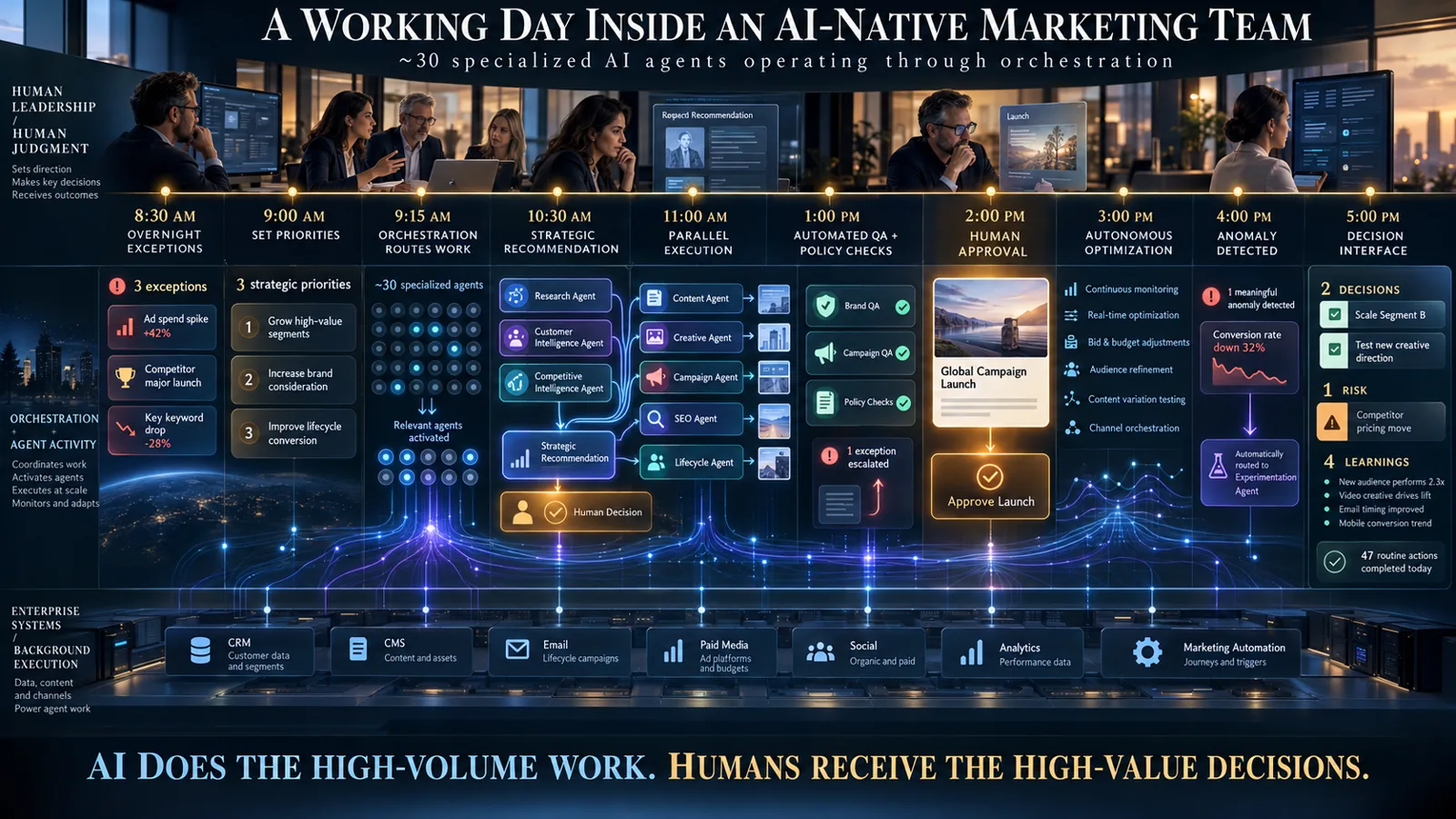
What Monday Should Actually Look Like
A mature version of this scenario might look like:
8:30 a.m.
Agents have already monitored overnight activity.
The system surfaces:
3 exceptions.
9:00 a.m.
Leadership sets priorities.
One new enterprise campaign.
One retention issue.
One competitor response.
9:15 a.m.
Orchestration activates the relevant agents.
Not all 30.
Only the ones needed.
10:30 a.m.
Research and customer intelligence converge into recommendations.
Humans make the strategic choice.
11:00 a.m.
Content, creative, lifecycle, and campaign agents begin execution.
1:00 p.m.
Routine QA happens automatically.
Only uncertain items are escalated.
2:00 p.m.
Campaigns are prepared.
Human approves the high-consequence launch.
3:00 p.m.
Existing campaigns continue being monitored.
Low-risk optimizations execute.
4:00 p.m.
Analytics surfaces one meaningful anomaly.
Experimentation workflow begins automatically.
5:00 p.m.
Leadership receives:
decisions,
risks,
learnings.
Not 30 agent reports.
That is an AI-native marketing team.
What Infrastructure Makes This Possible?
Thirty agents become useful only if several foundations exist.
Shared Intelligence
One reliable organizational context.
Orchestration
One coordination mechanism.
Workflow State
The system knows where work stands.
Governance
Agents understand what they may do.
Observability
Humans can see what happened.
Evaluation
Agent performance is measurable.
Human Ownership
Someone remains accountable.
Without these, 30 agents simply create 30 new failure points.
Current Agentic Marketing Is Already Moving in This Direction
This is no longer purely hypothetical.
Marketing technology vendors are increasingly moving from AI assistants toward systems in which agents can participate directly across workflows, content, campaigns, data, and customer experiences.
The important shift is from:
AI answers questions
to:
AI performs coordinated work.
But as that happens, architecture becomes more important.
The smarter the individual agents become, the more consequential their coordination becomes.
More Intelligence Creates More Need for Governance
This is worth emphasizing.
A simple tool can only do so much damage.
An intelligent agent with:
data access,
tool access,
publishing rights,
budget permissions
has much greater leverage.
Thirty such agents dramatically increase organizational capability.
They also increase the importance of:
permission design,
decision rights,
auditability,
escalation.
AI capability and governance need to scale together.
The Goal Is Not 30 Autonomous Agents
The mature system is not:
30 agents independently doing whatever they believe is best.
It is:
30 specialized capabilities operating inside one governed system.
They share:
objectives,
context,
workflow rules,
permissions.
That is the difference between:
agent autonomy
and
organizational intelligence.
One Agent Is Useful. Thirty Agents Require Architecture.
A single agent can often be managed informally.
You know what it does.
You read its output.
You correct it.
At 30 agents, informal management breaks.
You need:
roles,
ownership,
orchestration,
governance,
evaluation.
This is the same transition companies experience as human teams scale.
The difference is that software agents can multiply much faster.
Organizations may suddenly face scale before they have developed management systems for it.
Your Competitive Advantage Will Not Be Having 30 Agents
Soon, access to agents will be common.
Every marketing platform will offer them.
Every team may have dozens.
So “we use AI agents” will not differentiate a company.
The advantage will come from:
how well the agents understand the business,
how intelligently workflows are designed,
how quickly learning moves through the system,
how effectively humans govern exceptions,
and how reliably the entire architecture converts intent into results.
In other words:
the advantage is not agent count.
It is system quality.
Imagine Your Marketing Team Starts Monday With 30 AI Agents
Would marketing instantly become 10 times better?
No.
You would probably discover that your biggest problem was never simply lack of execution capacity.
You would discover problems in:
context,
workflow,
roles,
prioritization,
decision rights,
measurement,
governance.
And that may be one of the most important lessons of agentic AI.
AI makes execution abundant.
It exposes everything else.
Once agents can:
research,
create,
analyze,
coordinate,
and act,
the bottleneck moves upward.
Toward:
What are we trying to achieve?
Which work matters?
Which agent should own it?
What should happen automatically?
Where should humans intervene?
What does good look like?
Those are organizational questions.
And the marketing team that answers them well will get far more value from ten excellent agents than another team gets from 100 disconnected ones.
Because the future of marketing is not about having the most AI agents.
It is about building the best human-agent operating system.
Frequently asked questions
How many AI agents should a marketing team have?
There is no ideal number. Teams should use the smallest number of specialized agents required to reliably support important workflows. Agent count is less important than clear roles, shared context, orchestration, governance, and measurable outcomes.
What happens if a marketing team has too many AI agents?
Too many poorly coordinated agents can create duplicate work, conflicting recommendations, fragmented context, increased costs, permission risks, and additional management overhead. This is sometimes described as agent sprawl.
What is agent sprawl?
Agent sprawl is the uncontrolled growth of AI agents without sufficient role clarity, orchestration, governance, evaluation, or consolidation.
Do AI agents need job descriptions?
Yes. Production agents should have clearly defined objectives, scope, context access, tools, permissions, boundaries, escalation rules, and evaluation criteria.
Do AI agents need managers?
Important agents should have human owners responsible for their scope, permissions, quality, performance, and escalation design.
How do multiple marketing agents work together?
They can be coordinated through an orchestration layer that manages workflow state, dependencies, agent routing, context, approvals, escalation, retries, and completion.
Should every marketing task have its own AI agent?
No. Separate agents are most useful where specialization in tools, context, permissions, or evaluation matters. Simple predictable work may be better handled through traditional automation.
What should humans do when many agents handle execution?
Humans should increasingly focus on business objectives, customer understanding, positioning, creative direction, strategic trade-offs, governance, exception handling, and accountability.
How should companies evaluate AI marketing agents?
Evaluate task success, accuracy, quality, cost, latency, human overrides, escalation quality, workflow performance, and ultimately business outcomes.
What is the biggest mistake when deploying many marketing agents?
The biggest mistake is treating agent deployment as the goal. The goal should be to improve complete marketing workflows and business outcomes through a coordinated human-agent system.