The AI Marketing Org Chart of 2027: How Human Roles, AI Agents, and Orchestration Fit Together
That structure made sense when nearly all meaningful marketing work had to be performed and coordinated by people.
The marketing org chart has looked surprisingly familiar for years.
CMO.
Brand.
Content.
Performance.
SEO.
CRM.
Social.
Analytics.
Marketing Operations.
Each function owns its own work.
Managers coordinate the functions.
Meetings move information between them.
Project-management systems track the handoffs.
Dashboards help leaders understand what happened.
That structure made sense when nearly all meaningful marketing work had to be performed and coordinated by people.
But that assumption is changing.
AI can already:
research markets,
analyze customers,
generate content,
monitor campaigns,
detect anomalies,
prepare experiments,
coordinate workflows,
and perform bounded actions across software.
That means the marketing organization of 2027 may not simply look like today's org chart with an “AI team” added beside it.
The structure itself may change.
The more useful future model may look less like a traditional hierarchy and more like an orchestration system:
Human leaders define outcomes.
Human specialists provide judgment and expertise.
AI agents provide scalable capabilities.
Orchestration connects them.
Shared intelligence gives them common context.
And teams organize increasingly around outcomes and workflows rather than departments alone.
This is the emerging AI marketing org chart.
First: This Is a Forecast, Not a Universal Blueprint
No single marketing organization will fit every company.
A 30-person SaaS company should not have the same structure as a global consumer enterprise.
Industry matters.
Business model matters.
Regulation matters.
Brand complexity matters.
Customer complexity matters.
So the AI marketing org chart of 2027 should be understood as a design direction rather than a fixed organizational template.
The signals are already visible.
McKinsey's 2026 organizational research argues that AI is beginning to reshape the constraints around human capacity, expertise, and coordination that helped create traditional hierarchies.
It describes an emerging shift:
from org chart
to
orchestration chart.
Instead of starting with departments and moving work between them, organizations can increasingly start with an outcome and assemble the combination of humans and AI capabilities needed to achieve it.
Marketing is especially suited to this transition.
Why the Traditional Marketing Org Chart Exists
Before designing the future, it helps to understand why today's structure exists.
Marketing teams are divided into functions because expertise is specialized.
A performance marketer knows paid acquisition.
An SEO specialist understands search.
A copywriter writes.
A designer designs.
An analyst analyzes.
Then managers exist partly because all those specialists need coordination.
Campaign work typically moves:
Strategy
→ Content
→ Design
→ Media
→ Operations
→ Analytics
with people coordinating each transition.
The organization is therefore designed around two constraints:
specialized human expertise
and
limited human capacity.
AI changes both.
AI Does Not Eliminate Specialization
There is an easy but misleading prediction:
“AI will eliminate specialized marketing roles.”
A more realistic outcome is that specialization remains, but some of it becomes software-defined.
Instead of every capability requiring a full human role, organizations can increasingly maintain capabilities through combinations of:
- humans
- AI agents
- automation
- enterprise platforms
For example, the company still needs:
customer intelligence.
But some continuous research may be handled by a Customer Intelligence Agent.
The company still needs analytics.
But routine reporting and first-level diagnosis may increasingly be automated.
The capability remains.
The organizational structure around the capability changes.
The 2027 Marketing Organization Starts With the CMO
The CMO does not disappear.
But the role moves upward.
The CMO of 2027 increasingly owns:
- business alignment
- customer priorities
- positioning
- growth strategy
- brand direction
- major resource allocation
- AI governance
- organizational design
- accountability
Less of the CMO's time should be consumed by:
- reconstructing reports
- resolving routine workflow bottlenecks
- chasing campaign status
- manually coordinating departments
McKinsey's current marketing work describes the CMO as evolving from steward of brand and demand toward orchestrator of data, technology, and AI-enabled execution.
That is an important change.
The CMO increasingly governs a marketing system, not only a marketing department.
Directly Beneath the CMO: Three Human Leadership Functions
A useful 2027 structure may place three broad human leadership capabilities beneath the CMO.
1. Strategy + Customer Leadership
Owns:
- customer priorities
- market understanding
- positioning
- portfolio strategy
- category strategy
- growth priorities
This team decides where marketing should go.
2. Brand + Creative Leadership
Owns:
- brand
- storytelling
- creative direction
- taste
- standards
- cultural relevance
This team decides what good looks like.
3. Marketing Systems + Growth Operations
Owns:
- AI orchestration
- marketing technology
- data
- workflows
- measurement
- agent governance
- automation
This team determines how the marketing machine operates.
These three human leadership areas then work with an expanding layer of AI capabilities underneath them.
The New Strategic Role: Marketing Systems Architect
One of the most important emerging roles may sit inside Marketing Operations.
Call it:
Marketing Systems Architect
or
AI Marketing Architect.
This person designs the architecture connecting:
- CRM
- analytics
- content
- campaign tools
- customer data
- AI agents
- orchestration
- governance
Historically, companies often designed marketing organizations separately from marketing technology.
That separation becomes harder to maintain when software participates directly in work.
The system architecture increasingly becomes part of organizational architecture.
The New Operational Role: Human-Agent Orchestrator
This may be one of the defining roles of the agentic marketing era.
A Human-Agent Orchestrator determines how work is divided across:
- people
- agents
- automation
They may design questions such as:
Should this step require a human?
Which agent handles it?
What context does the agent need?
What happens if confidence is low?
Where does approval occur?
How does one agent hand off to another?
McKinsey explicitly anticipates new orchestrator roles that manage human-agent workflows as marketing teams become more AI-native.
The orchestrator is not simply an “AI prompt engineer.”
It is closer to an operating-model designer.
The New Governance Role: AI Marketing Governance Lead
As agents gain permissions, governance becomes operational.
Someone must own questions such as:
Which agents can access customer data?
Which agents can publish?
Which can modify campaigns?
How much budget can an agent move?
What actions require approval?
Which actions need audit logs?
This creates room for a new capability:
AI Marketing Governance.
At a smaller company, this may be part of Marketing Operations.
At a larger enterprise, it could become a dedicated role or cross-functional group connecting:
Marketing,
Technology,
Security,
Legal,
Privacy.
The New Quality Role: AI Brand Steward
When AI can generate enormous amounts of content, quality control becomes more important.
The future brand function may include people whose job is not simply creating assets.
They define and protect:
- brand voice
- visual standards
- message hierarchy
- originality
- cultural relevance
- quality thresholds
Think of them as:
standard bearers for AI-generated abundance.
McKinsey uses similar language, anticipating human roles focused increasingly on standards, judgment, creativity, and quality control in hybrid marketing organizations.
Beneath Human Leadership Comes the Agent Layer
This is where the org chart begins to look fundamentally different.
Instead of every capability mapping directly to a person, the marketing organization may maintain a portfolio of agents.
For example:
Market Research Agent
Continuously scans market developments.
Customer Intelligence Agent
Analyzes:
CRM,
feedback,
sales conversations,
behavior,
research.
Competitive Intelligence Agent
Tracks competitive moves and positioning.
Search Intelligence Agent
Monitors:
search behavior,
AI search visibility,
topic demand.
Content Agent
Creates and adapts content from approved strategy.
Creative Agent
Generates visual directions and variants.
Campaign Agent
Prepares campaign structures and execution.
Lifecycle Agent
Monitors and coordinates customer journeys.
Analytics Agent
Continuously detects meaningful performance signals.
Experimentation Agent
Designs and evaluates bounded tests.
None of these agents needs to appear as a box in HR software.
But operationally, they become part of the team's capability map.
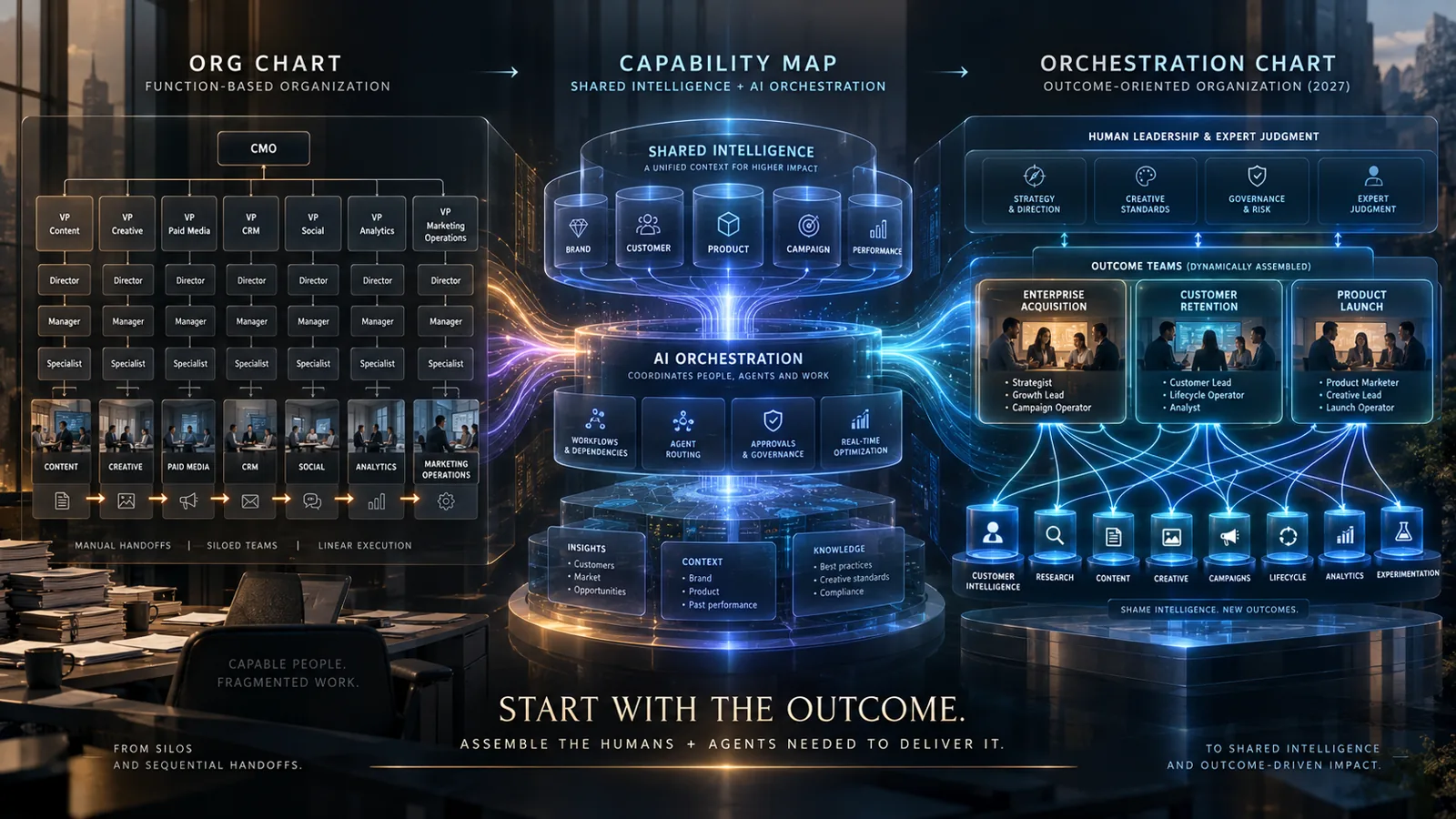
The Org Chart Becomes a Capability Map
This is the deeper change.
The traditional org chart answers:
Who reports to whom?
The AI-native organization also needs to answer:
Which capability performs which work?
A future campaign might involve:
CMO
↓
Growth Strategy Lead
↓
Customer Intelligence Agent
Research Agent
↓
Human strategist
↓
Content Agent
Creative Agent
↓
Human Brand Steward
↓
Campaign Agent
↓
Analytics Agent
↓
Experimentation Agent
This is not a conventional reporting hierarchy.
It is an orchestration graph.
That is why McKinsey's phrase “from org chart to orchestration chart” is so useful.
Teams Organize Around Outcomes
The next shift may be even more important.
Marketing organizations are currently organized largely around functions.
Content team.
Paid team.
CRM team.
Analytics team.
But customer outcomes cut across all of them.
By 2027, more advanced organizations may increasingly create outcome teams.
For example:
Enterprise Acquisition Team
Human members:
Growth Lead
Enterprise Strategist
Creative Director
Sales partner
AI capabilities:
Customer Intelligence Agent
Campaign Agent
Content Agent
Analytics Agent
Experimentation Agent
Shared goal:
qualified enterprise pipeline.
Retention + Expansion Team
Human members:
Lifecycle Lead
Customer Strategist
Product Marketing
Customer Success partner
AI capabilities:
Lifecycle Agent
Customer Intelligence Agent
Content Agent
Analytics Agent
Goal:
retention and expansion.
This is a very different way to think about organizational design.
Functions Don't Disappear. They Become Capability Centers.
Does that mean Brand, Analytics, and Marketing Operations disappear?
Probably not.
A more likely structure is a hybrid.
Central capability groups maintain:
- standards
- expertise
- platforms
- governance
Outcome teams pull from those capabilities.
For example:
The Creative function maintains brand standards and senior creative talent.
But creative agents participate across multiple workflows.
The Analytics function owns measurement methodology.
But Analytics Agents monitor many workflows continuously.
The Marketing Operations function owns orchestration architecture.
But workflow automation runs across every marketing outcome.
This resembles a platform + pods model more than a classic departmental hierarchy.
Shared Intelligence Becomes Organizational Infrastructure
Every agent and team needs access to a consistent view of:
- brand
- customers
- products
- campaigns
- experiments
- business objectives
- performance
This creates another invisible layer in the 2027 org chart:
Shared Marketing Intelligence.
It functions like collective organizational memory.
Without it:
one agent uses old positioning,
another uses current positioning,
one team has the latest customer insight,
another does not.
Adobe describes the problem well: a powerful AI agent without organizational context behaves like a “brilliant stranger.”
The 2027 marketing organization therefore requires not only people and agents.
It needs shared memory.
Orchestration Sits Across the Org Chart
Traditional managers coordinate people.
AI-era orchestration coordinates:
people,
agents,
systems,
workflows,
approvals.
This becomes a horizontal layer across the organization.
It manages:
- workflow state
- dependencies
- routing
- approval gates
- escalation
- agent selection
- retries
- completion
You might not draw this as one department.
But operationally, it is one of the most important capabilities in the organization.
What Happens to Marketing Operations?
Marketing Operations becomes much more important.
But the work changes.
Less:
campaign setup,
manual routing,
dashboard maintenance,
basic platform administration.
More:
- orchestration architecture
- agent lifecycle management
- AI permissions
- integrations
- observability
- evaluation
- shared context
- automation design
Marketing Ops moves from:
keeping marketing tools running
to:
designing how marketing runs.
What Happens to Analytics?
Analytics also moves upward.
Routine activities such as:
data pulls,
weekly dashboards,
basic anomaly detection,
performance summaries
become increasingly automated.
Human analysts focus more on:
- measurement architecture
- causal analysis
- experimentation
- strategic interpretation
- model validation
The Analytics Agent says:
Something changed.
The analyst asks:
What do we actually know?
That is a more valuable division of labor.
What Happens to Content?
Content teams will likely produce far more without proportional headcount increases.
But human roles move toward:
- editorial strategy
- subject-matter expertise
- point of view
- original research
- narrative
- quality
AI handles more:
- first drafts
- adaptation
- repurposing
- variations
- formatting
- metadata
The content function becomes less of a production factory and more of an editorial intelligence function.
What Happens to Creative?
Creative follows a similar pattern.
AI makes production abundant.
Human differentiation increasingly sits in:
- concept
- taste
- storytelling
- cultural relevance
- art direction
- originality
Creative leaders become even more important precisely because mediocre output becomes cheap.
What Happens to Performance Marketing?
Performance marketers increasingly work above campaign mechanics.
AI can monitor continuously and make bounded optimizations.
Humans focus more on:
- channel strategy
- economics
- experimentation
- audience strategy
- investment allocation
- emerging opportunities
The performance marketer becomes less of a platform operator.
More of a portfolio strategist.
What Happens to CRM and Lifecycle?
Lifecycle marketing becomes increasingly continuous.
Agents can monitor individual and segment-level behavior.
But humans still determine:
- lifecycle philosophy
- customer value
- messaging boundaries
- relationship strategy
- escalation rules
The team moves from manually building every journey toward designing the logic and standards governing journeys.
Does the 2027 Marketing Team Get Smaller?
Possibly.
McKinsey explicitly suggests future AI-enabled marketing organizations may become smaller and faster, with fewer people devoted purely to execution and more focused on orchestration, integration, quality, and AI management.
But “smaller” should not automatically be interpreted as:
cut headcount.
There is another possibility.
The same team may dramatically expand what it can accomplish.
More:
research,
experimentation,
personalization,
customer intelligence,
content,
continuous optimization.
The relationship between output and headcount changes.
That is strategically more interesting than simple cost reduction.
The Span of Control Changes
Traditional managers can only supervise so many people effectively.
But managing agents is different.
One human leader may be able to govern significantly more execution capacity when:
- workflows are observable
- guardrails are clear
- exceptions are prioritized
That could increase managerial leverage.
But it also creates a new challenge:
leaders need dashboards for agent performance, not simply employee performance.
Questions may include:
Which agent is failing most often?
Which requires the most human intervention?
Where are escalations increasing?
Which workflow is producing bad outcomes?
This becomes part of modern management.
The Future Org Chart Needs Agent Owners
AI agents should not be ownerless.
Every important agent should have a responsible human or function.
For example:
Content Agent
Owner: Editorial Lead.
Analytics Agent
Owner: Head of Analytics.
Campaign Agent
Owner: Marketing Operations.
Customer Intelligence Agent
Owner: Customer Strategy.
The owner defines:
- objective
- permissions
- standards
- evaluation
- escalation rules
The agent executes.
The human remains accountable.
The Org Chart Needs Decision Rights
Traditional org charts show reporting relationships.
The 2027 org chart also needs to show decision rights.
For example:
AI May Decide
Routine formatting.
Data normalization.
Low-risk traffic adjustments.
AI May Recommend
Channel mix.
Audience opportunity.
New content topics.
Human Must Approve
Major budget changes.
Campaign positioning.
Sensitive claims.
Human Must Own
Business strategy.
Brand identity.
Ethical decisions.
Accountability.
This is as important as reporting lines.
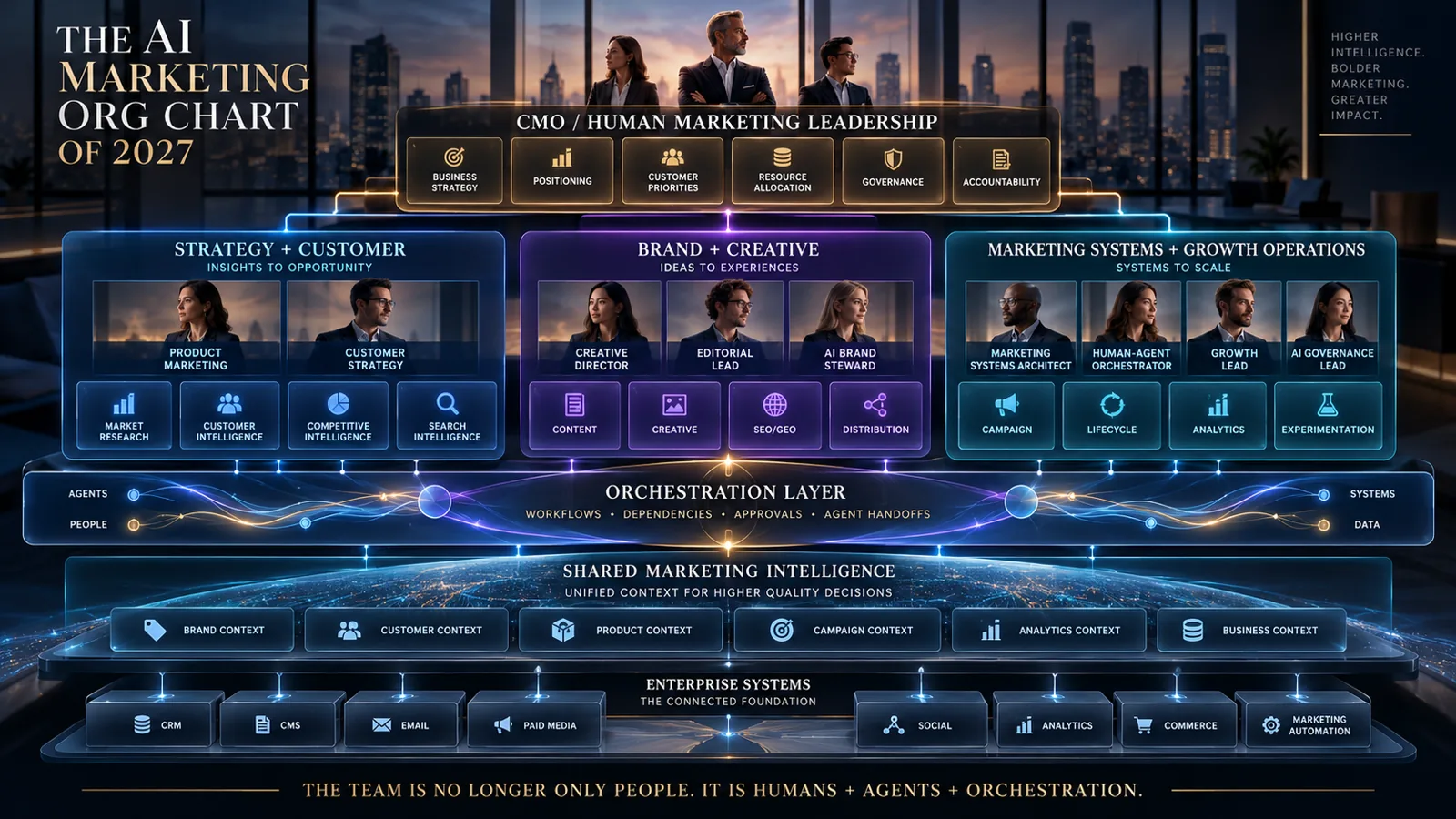
The 2027 Marketing Org Chart
A conceptual structure could look like this:
CMO / Marketing Leadership
Owns:
strategy,
growth priorities,
positioning,
resource allocation,
governance,
accountability.
Strategy + Customer
Human roles:
VP Strategy / Growth Strategy Lead
Customer Strategy Lead
Product Marketing
Supported by:
Market Research Agent
Customer Intelligence Agent
Competitive Intelligence Agent
Search Intelligence Agent
Brand + Creative
Human roles:
Brand Lead
Creative Director
Editorial Lead
AI Brand Steward
Supported by:
Content Agent
Creative Agent
SEO/GEO Agent
Distribution Agent
Growth + Lifecycle
Human roles:
Growth Lead
Performance Strategist
Lifecycle Lead
Supported by:
Campaign Agent
Lifecycle Agent
Experimentation Agent
Decision Intelligence
Human roles:
Analytics Lead
Experimentation Lead
Measurement Strategist
Supported by:
Analytics Agent
Forecasting Agent
Attribution / Incrementality systems
Marketing Systems + AI Operations
Human roles:
Marketing Systems Architect
Human-Agent Orchestrator
AI Governance Lead
Marketing Operations
Supported by:
orchestration infrastructure,
automation,
agent observability,
evaluation systems.
Across all of them:
SHARED MARKETING INTELLIGENCE
and
ENTERPRISE EXECUTION SYSTEMS.
An Org Chart Is No Longer Enough
This structure reveals something important.
You cannot fully understand the future marketing organization through reporting lines alone.
You also need:
Capability Map
What can humans and agents do?
Workflow Map
How does work move?
Decision-Rights Map
Who can decide or execute what?
Data Map
What context is available?
Orchestration Map
How do capabilities coordinate?
Together, these may become more useful than the traditional org chart.
Management Shifts From Activity to Outcomes
A manager should not need to ask:
Did you generate the report?
Did you schedule the email?
Did you upload the asset?
Agents and automation can increasingly handle those activities.
Managers instead ask:
Are we achieving the objective?
What did we learn?
Where is quality weak?
What requires human judgment?
Which agent needs improvement?
Management becomes more outcome-oriented.
Career Progression Changes Too
Traditional marketing careers often advance by becoming responsible for larger teams.
The AI-native organization may add another dimension.
Leaders can increase impact by managing larger systems of capability.
A senior marketer might own:
three humans,
seven agents,
multiple automated workflows,
and a large revenue outcome.
Impact becomes less correlated with direct-report count.
That may change how organizations define seniority.
Hiring Changes
The first question may no longer be:
Which role do we need to hire?
It may become:
Which capability is missing?
Then:
Can AI provide it?
Can automation provide it?
Can an existing employee move into it?
Does it require a new hire?
That changes workforce planning.
The Most Valuable Human Skills Become Clearer
As AI takes on more execution, distinctly human capabilities become more valuable.
These include:
- judgment
- taste
- strategic thinking
- customer empathy
- leadership
- communication
- relationships
- accountability
The future does not eliminate human skill.
It makes the relative value of certain human skills more obvious.
AI Literacy Becomes Baseline
At the same time, almost every marketer needs basic AI literacy.
Not everyone needs to code.
But marketers increasingly need to understand:
- how agents work
- where AI gets context
- when it can fail
- how to evaluate output
- how to delegate to AI
- how autonomy works
- when humans need to intervene
Human-agent collaboration becomes ordinary operating knowledge.
The Biggest Mistake: Adding an AI Department
Many companies may respond to AI by creating:
Head of AI
plus
an AI team.
That can be useful during early capability building.
But if AI remains isolated there, the organization risks missing the deeper transformation.
AI will affect:
content,
growth,
analytics,
operations,
brand,
customer experience.
So the long-term architecture is unlikely to be:
Marketing + separate AI department.
More likely:
every important marketing workflow becomes human + AI.
AI becomes part of the operating model.
The Second Biggest Mistake: Replacing People One-for-One With Agents
Another weak model is:
Writer → Content Agent.
Analyst → Analytics Agent.
Campaign Manager → Campaign Agent.
This recreates today's organization using software.
It does not exploit what AI changes.
The stronger question is:
If human capacity and coordination constraints changed, how should the whole workflow be redesigned?
That may eliminate unnecessary handoffs.
Combine roles.
Create new capabilities.
Move people toward judgment.
The opportunity is organizational redesign—not digital substitution.
From Org Chart to Orchestration Chart
This may be the defining idea of the 2027 marketing organization.
Traditional org chart:
Who reports to whom?
Future orchestration chart:
Which humans and agents come together to produce this outcome?
Imagine a new product launch.
Instead of sending work through six departments, the system assembles:
Product Marketing Lead
Creative Director
Research Agent
Customer Intelligence Agent
Content Agent
Campaign Agent
Analytics Agent
Experimentation Agent
Once the objective changes, another combination may form.
The organization becomes more dynamic.
McKinsey's October 2026 work argues that companies further along in AI reinvention are already more likely to organize cross-functional teams around end-to-end products, customer journeys, and business processes instead of simply passing work between traditional functions.
The Best Org Chart of 2027 May Have Fewer Boxes
This sounds paradoxical.
The underlying marketing system may have:
more intelligence,
more automation,
more agents,
more execution capacity.
But the human organizational chart may become simpler.
Fewer coordination layers.
Fewer roles devoted purely to moving information.
Smaller teams.
Broader spans of capability.
The technical architecture becomes more sophisticated.
The human experience becomes simpler.
That should be the goal.
A Day Inside This Org Chart
Consider one campaign.
The CMO sets:
business objective.
Strategy Lead defines:
market direction.
Customer Intelligence Agent surfaces:
customer problem.
Human strategist approves:
campaign thesis.
Creative Director defines:
creative standard.
Content + Creative Agents produce:
execution.
AI Brand Steward + human creative lead review:
quality.
Campaign Agent prepares:
activation.
Analytics Agent continuously monitors:
performance.
Experimentation Agent manages:
bounded testing.
Human Growth Lead sees:
only significant exceptions and major opportunities.
Marketing Systems owns:
the workflow connecting everything.
That is not a human-less organization.
It is a human organization with dramatically more execution capacity underneath it.
The Marketing Team of 2027 Is a Hybrid System
The deepest change is that the definition of team expands.
A team is no longer only the people on payroll.
Operationally, the team also includes:
agents,
automation,
shared intelligence,
enterprise systems.
Salesforce's 2026 launch of “agentic marketing teams” already reflects this emerging model: agents can work alongside marketers on pipeline, content, campaigns, and customer experiences while marketers remain responsible for strategy and outcomes.
Adobe describes the same transition as human-agent work, where agents become active participants in workflows rather than assistants waiting for prompts.
By 2027, this distinction may increasingly feel normal.
What the AI Marketing Org Chart of 2027 Really Represents
The most important thing about the future org chart is not which new job titles appear.
It is the underlying change in how work is organized.
From:
functions
to:
outcomes.
From:
human execution
to:
human + agent execution.
From:
managers coordinating every handoff
to:
orchestration managing routine flow.
From:
reporting lines
to:
decision rights + capabilities.
From:
AI tools
to:
AI teammates.
From:
headcount as capacity
to:
human judgment + machine execution capacity.
That is the bigger transformation.
The AI Marketing Org Chart of 2027
If you had to summarize the structure in one view, it would look like this:
At the Top
Human leadership
sets:
strategy,
positioning,
priorities,
standards,
governance,
accountability.
In the Middle
Human specialists + AI agents
work together across:
customer intelligence,
creative,
content,
growth,
lifecycle,
analytics,
experimentation.
Across Everything
Orchestration
coordinates:
workflow,
context,
approvals,
handoffs,
exceptions.
Underneath
Shared intelligence
provides organizational memory.
At the Foundation
Enterprise systems + automation
execute the work.
That is not simply a new org chart.
It is a different definition of a marketing organization.
And by 2027, the companies furthest along may stop asking:
“How many people are on the marketing team?”
The more useful question may become:
“What marketing capabilities can this human-agent system reliably deliver?”
That is the organization AI is beginning to create.
Frequently asked questions
What will the marketing team of 2027 look like?
Leading marketing organizations are likely to combine smaller or more focused human teams with specialized AI agents, shared intelligence, orchestration, automation, and existing enterprise software.
What is an AI marketing org chart?
An AI marketing org chart maps not only human roles but also AI capabilities, agent responsibilities, workflow orchestration, and decision rights across the marketing organization.
Will AI replace marketing teams by 2027?
AI is more likely to change the composition and division of labor inside marketing teams than eliminate the need for human marketing organizations. Humans remain essential for strategy, judgment, creativity, relationships, governance, and accountability.
What new marketing roles may emerge?
Likely capabilities include AI Marketing Architect, Human-Agent Orchestrator, AI Governance Lead, Agent Evaluator, AI Brand Steward, and other roles focused on designing, governing, and improving human-agent systems.
What happens to Marketing Operations?
Marketing Operations is likely to become more strategic, with greater responsibility for orchestration architecture, AI permissions, agent governance, integrations, observability, data, and automation.
What happens to marketing analysts?
AI can take on more recurring reporting and first-level analysis, while human analysts increasingly focus on measurement design, causal analysis, experimentation, AI validation, and strategic interpretation.
What is an orchestration chart?
An orchestration chart maps which humans, AI agents, systems, and capabilities work together around an outcome rather than showing only traditional reporting relationships.
Will future marketing teams be smaller?
Some may be. AI can increase execution capacity and reduce coordination-heavy work. However, organizations may also use this capacity to increase experimentation, personalization, research, and growth rather than simply reduce headcount.
Should companies create a separate AI marketing department?
A dedicated AI function can help during early capability building, but the longer-term operating model is likely to integrate AI into marketing workflows rather than isolate it as a separate department.
What should humans still own in the 2027 marketing organization?
Humans should remain responsible for business objectives, customer priorities, positioning, creative standards, major resource decisions, relationships, governance, ethics, and final accountability.