The CMO Role Is Changing Before the Job Title Does: How AI Is Redefining Marketing Leadership
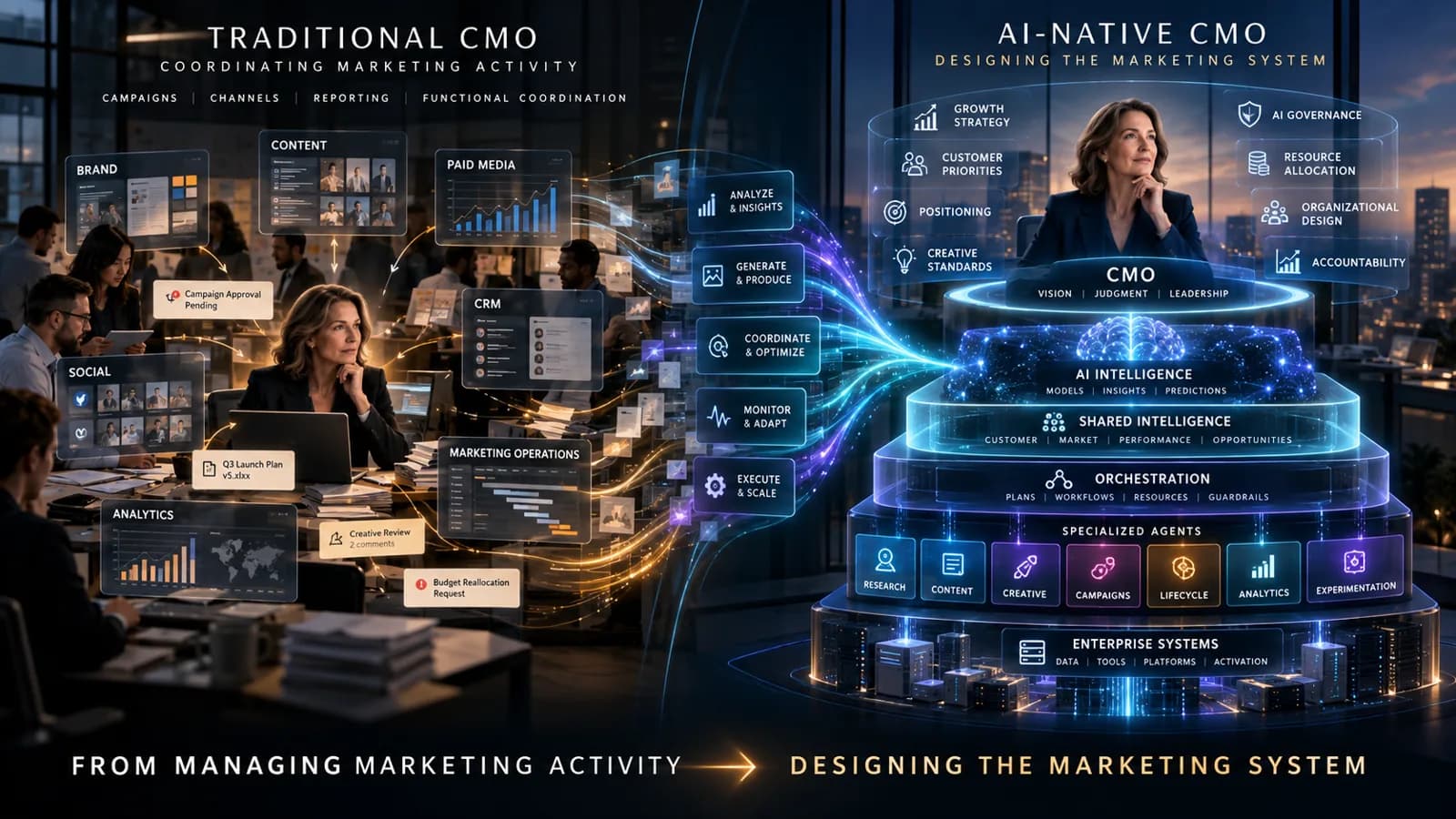
The modern CMO increasingly has to design and govern the system through which marketing operates.
The title still says:
Chief Marketing Officer.
But increasingly, that title hides a very different job.
The traditional CMO was expected to lead:
brand,
advertising,
customer acquisition,
campaigns,
communications,
and marketing performance.
Those responsibilities are not disappearing.
But something else is being added underneath them.
AI is changing how marketing research happens.
Agents are changing how campaigns are executed.
Automation is changing how workflows move.
Customer journeys are becoming more dynamic.
Search is changing.
Content production is becoming abundant.
Marketing technology is becoming more intelligent.
And marketing itself is becoming more tightly connected to:
data,
technology,
sales,
commerce,
product,
and customer experience.
The CMO therefore has a new problem.
It is no longer enough to manage marketing functions.
The modern CMO increasingly has to design and govern the system through which marketing operates.
The job title may still be CMO.
But the actual role is moving toward something broader:
growth leader
customer strategist
brand steward
AI orchestrator
organizational designer
governance owner
all at once.
The title is staying still.
The job underneath it is moving quickly.
The CMO Has Already Been Expanding for Years
AI did not start this transformation.
For years, CMOs have been asked to own more.
Not simply:
advertising.
But:
growth,
customer experience,
digital transformation,
commerce,
data,
technology,
innovation.
McKinsey has described this expanding remit repeatedly, noting that CMOs increasingly operate across functions that historically sat outside traditional marketing.
AI accelerates that expansion.
Because once AI begins participating directly in:
research,
content,
analytics,
campaign management,
experimentation,
customer interaction,
the CMO is no longer simply managing people performing marketing.
The CMO is also managing a marketing operating system.
That is a profound change.
The Old CMO Managed Functions
The traditional marketing organization was often structured around departments.
Brand.
Content.
Performance.
CRM.
SEO.
Social.
Analytics.
Marketing Operations.
Each function had:
people,
budgets,
tools,
processes.
The CMO coordinated the functions.
A major part of leadership involved:
setting priorities,
allocating resources,
reviewing performance,
resolving conflicts,
making sure teams moved in the same direction.
That model was built around human execution.
And human execution requires substantial coordination.
The New CMO Manages Capabilities
AI starts changing the unit of organization.
Instead of asking only:
Which team owns this?
the CMO increasingly needs to ask:
Which capability should perform this work?
For example:
Research may be performed by:
human strategists,
Research Agents,
customer-data systems.
Content may involve:
human editorial leadership,
Content Agents,
brand-validation systems.
Campaign optimization may involve:
Growth Lead,
Analytics Agent,
Campaign Agent,
deterministic automation.
The CMO increasingly manages a portfolio of human and machine capabilities.
That is different from managing departments.
The CMO Becomes an Orchestrator
This may be the most important change.
McKinsey's 2026 agentic-marketing research describes the CMO's expanding role as moving toward orchestration across:
data,
technology,
AI-enabled execution,
and end-to-end workflows.
Why?
Because the marketing system is becoming too complex to think about in isolated channels.
Research affects strategy.
Strategy affects creative.
Creative affects media.
Media generates customer signals.
Analytics changes experimentation.
Experiments change positioning.
Everything is connected.
AI makes those connections faster.
The CMO must increasingly understand the whole system.
Orchestration Does Not Mean Micromanagement
There is an important distinction.
A CMO should not become the human router for every AI agent.
That would create another bottleneck.
Instead, orchestration at the leadership level means defining:
- objectives
- priorities
- decision rights
- governance
- resource boundaries
- human approval points
Then allowing workflows to operate underneath.
The CMO designs the conditions.
The system executes within them.
The CMO Moves From Campaign Leadership to Operating-Model Leadership
Historically, CMOs often thought in campaign cycles.
Plan.
Create.
Launch.
Measure.
Review.
Repeat.
AI pushes marketing toward something more continuous.
Research continuously updates.
Customer signals continuously change.
Agents continuously monitor performance.
Content can continuously adapt.
Experiments can continuously run.
McKinsey describes this transition as moving from campaigns toward a continuous growth engine powered by insight, creativity, personalization, agentic commerce, and orchestration.
The CMO therefore has to design:
how marketing operates continuously.
Not simply:
which campaign launches next.
The First New CMO Responsibility: Designing Human + AI Work
A modern CMO needs to understand:
What should humans own?
What should agents own?
What should automation own?
This is not purely a technology question.
It is organizational design.
For example:
Humans
Own:
strategy,
positioning,
creative taste,
customer priorities,
governance,
accountability.
AI Agents
Handle more:
research,
analysis,
production,
monitoring,
coordination,
bounded optimization.
Deterministic Automation
Handles:
rules-based execution.
The CMO increasingly defines this division of labor.
This Means the CMO Is Becoming an Organizational Designer
Consider what happens when AI absorbs:
routine reporting,
basic research,
campaign QA,
content adaptation,
workflow routing.
Roles change.
Reporting lines may change.
Some teams may shrink.
Other capabilities become more important.
New roles emerge around:
AI orchestration,
agent evaluation,
governance,
system architecture.
McKinsey's 2026 research suggests marketing organizations are likely to become smaller, faster, and more organized around end-to-end workflows, with new roles emerging for AI builders, orchestrators, and human standard-bearers.
That puts organizational redesign directly on the CMO agenda.
The Second New Responsibility: AI Governance
Once AI becomes capable of acting, marketing leadership needs new controls.
An agent may be able to:
publish,
change campaigns,
contact customers,
modify budget,
create offers.
Someone must define the boundaries.
Questions include:
Which agent can access what?
What can publish automatically?
How much budget can change without approval?
Which customer communication requires human review?
What happens if confidence is low?
The CMO may not technically implement all these controls.
But marketing leadership must own the business rules behind them.
Governance Is Becoming a Marketing Leadership Skill
Traditional marketing governance focused on:
brand,
legal claims,
media spend,
privacy,
approval.
AI adds:
agent permissions,
model behavior,
data access,
escalation,
autonomy.
That means governance becomes more operational.
The CMO increasingly needs to understand not just:
what our policies are
but:
how those policies become executable system constraints.
The Third New Responsibility: Deciding How Much Autonomy to Give AI
This may become one of the defining leadership responsibilities.
Should an AI CMO system:
observe?
recommend?
prepare?
execute?
Different actions deserve different autonomy.
Routine monitoring?
High autonomy.
Approved content adaptation?
Potentially high.
Small campaign optimization?
Bounded autonomy.
Major budget reallocation?
Human approval.
Positioning change?
Human decision.
The CMO becomes the owner of marketing decision rights.
The CMO No Longer Needs to Approve Everything
This sounds contradictory.
The CMO gets more responsibility.
But should approve fewer routine actions.
Why?
Because senior leadership time should be concentrated where consequence is highest.
If a CMO has to approve:
every content variation,
every optimization,
every campaign setting,
then the organization has not become AI-native.
It has simply placed AI underneath a human bottleneck.
The modern CMO should design systems where ordinary work continues inside guardrails.
Leadership receives exceptions.
The Fourth New Responsibility: Making Customer Intelligence Continuous
Historically, customer research often happened in periodic projects.
Quarterly study.
Annual segmentation.
Campaign research.
AI can make customer intelligence more continuous.
Agents can analyze:
CRM signals,
reviews,
sales calls,
support conversations,
behavioral data,
search trends.
But more intelligence does not automatically create better strategy.
The CMO must decide:
Which signals matter?
How should they influence strategy?
What counts as meaningful customer truth?
The modern CMO increasingly becomes the person connecting:
continuous customer intelligence
to
business decisions.
The Fifth New Responsibility: Defining What Deserves Human Creativity
AI is making production abundant.
That changes creative leadership.
The CMO's challenge is no longer simply:
Do we have enough content?
The question increasingly becomes:
Is the work distinctive?
Does it strengthen the brand?
Does it deserve attention?
As content proliferates, human judgment and trust become more valuable, a point reinforced in McKinsey's September 2026 discussion with LinkedIn CMO Jessica Jensen.
The CMO increasingly protects quality against abundance.
More Content Means Brand Leadership Matters More
If AI makes content generation cheap, the market fills with more:
posts,
ads,
emails,
videos,
landing pages.
Average execution becomes easier.
Distinctiveness becomes harder.
So the CMO needs stronger control over:
brand meaning,
creative standards,
point of view.
AI does not reduce the importance of brand.
It may increase it.
The Sixth New Responsibility: Managing Decision Intelligence
Traditional marketing leadership depended heavily on dashboards.
Revenue.
Traffic.
CAC.
ROAS.
Conversions.
Engagement.
But dashboards create another problem:
leaders need to determine what matters.
AI can increasingly perform:
monitoring,
anomaly detection,
diagnosis,
forecasting.
The CMO should not need another 40 charts.
The CMO needs:
What changed?
Why?
What matters?
What decision is required?
This is decision intelligence.
The CMO Interface Changes
Imagine Monday morning.
Traditional model:
CMO opens dashboards.
Reads reports.
Attends channel updates.
Asks teams what happened.
Future model:
3 decisions require attention.
- Enterprise conversion decline appears linked to new positioning.
- Competitor launch creates a category-response opportunity.
- Proposed 15% budget shift exceeds AI autonomy limits.
Everything else continues underneath.
That is a very different leadership interface.
The Seventh New Responsibility: Measuring AI by Business Outcomes
CMOs will face enormous pressure to demonstrate AI adoption.
How many agents?
How many employees use AI?
How much content was generated?
Those are weak measures.
The CMO should instead ask:
Did campaign cycle time fall?
Did customer relevance improve?
Did conversion improve?
Did cost fall?
Did human capacity shift toward higher-value work?
McKinsey's 2026 research shows the current adoption-value gap clearly: 90% of CMOs are experimenting with AI, yet fewer than 10% have scaled it or captured value across marketing workflows.
The CMO's responsibility is to bridge that gap.
AI Adoption Is Not the CMO's Goal
The objective is not:
make marketing use AI.
The objective is:
make marketing work better because AI exists.
That may mean:
fewer tools,
fewer manual workflows,
fewer dashboards,
less content,
if those changes create better outcomes.
The mature CMO measures transformation rather than usage.
The Eighth New Responsibility: Reallocating the Marketing Budget
AI also changes where marketing money goes.
Traditional budgets include:
people,
agencies,
media,
software.
Increasingly, they may also include:
AI infrastructure,
agents,
data systems,
orchestration,
evaluation.
Salesforce's June 2026 UK/Ireland CMO survey found that 74% of respondents expected to redirect a significant portion of traditional agency and internal headcount budgets toward AI infrastructure and licensing over the following 24 months.
That means AI is no longer merely a technology budget line.
It becomes a resource-allocation question for the CMO.
Budget Allocation Becomes Capability Allocation
Instead of asking:
Should we hire three more people?
the CMO may ask:
Do we need:
one senior strategist,
a Research Agent,
an Analytics Agent,
workflow automation?
Instead of:
Which agency should we increase?
ask:
Which capability should remain external?
Which should become internal?
Which can become agentic?
This is workforce, technology, and budget planning merging into one conversation.
The Ninth New Responsibility: Aligning With the CIO and CTO
As marketing becomes more AI-native, the CMO cannot treat technology as somebody else's problem.
Marketing increasingly depends on:
data architecture,
AI infrastructure,
identity,
security,
APIs,
enterprise integration.
So the CMO–CIO relationship becomes more important.
The CMO defines:
marketing outcomes,
customer needs,
business rules.
Technology leadership helps define:
architecture,
security,
reliability.
AI transformation requires both.
The CMO Also Needs the CFO
Growth leadership increasingly requires economic credibility.
The CMO must connect marketing decisions to:
revenue,
margin,
cash,
customer lifetime value,
incrementality.
As AI changes investment patterns, the CMO needs to demonstrate:
where value actually comes from.
The modern CMO cannot remain isolated inside marketing metrics.
This Is Why the CMO Is Becoming a C-Suite Integrator
Customer behavior crosses organizational boundaries.
So does AI.
A customer journey touches:
Marketing.
Sales.
Product.
Service.
Commerce.
Technology.
The CMO increasingly sits at the intersection.
That makes cross-functional influence more important than direct organizational control.
The CMO Role Expands While the Team May Get Smaller
This is another paradox.
AI-enabled marketing organizations may require fewer humans devoted entirely to repetitive execution. McKinsey's 2026 work explicitly anticipates smaller and faster marketing organizations in some environments.
But the CMO role may become broader.
The leader manages less manual execution.
But more:
systems,
capabilities,
decision rights,
cross-functional outcomes.
Team size and leadership complexity can move in opposite directions.
The Tenth New Responsibility: Developing AI-Ready Talent
The CMO cannot simply deploy agents and expect the organization to adapt.
People need to learn:
how AI works,
how to delegate,
how to evaluate outputs,
when to trust agents,
when to intervene.
McKinsey reports that skills development is a leading barrier marketers cite in scaling AI.
So capability building becomes a CMO responsibility.
Not simply buying software.
The CMO Needs a New Talent Philosophy
The future team may need fewer people whose primary value is:
manual execution.
More people skilled in:
strategy,
creative judgment,
customer understanding,
experimentation,
systems thinking,
AI orchestration.
Hiring needs change.
Career paths change.
Performance measurement changes.
The CMO is responsible for that transition.
The Eleventh Responsibility: Protecting Trust
As AI increases output and autonomy, trust becomes more fragile.
Customers may increasingly interact with:
AI-generated content,
AI-personalized journeys,
AI-mediated commerce.
A mistake can scale quickly.
The CMO therefore needs to protect:
brand trust,
customer trust,
communication standards.
Recent conversations with CMOs featured by McKinsey emphasize that as AI scales marketing capability, human judgment and trust remain central.
Trust becomes infrastructure.
The CMO Cannot Outsource Accountability to AI
Suppose an agent:
publishes the wrong claim,
targets the wrong customer,
overspends,
or creates a damaging interaction.
The company cannot say:
“The AI chose it.”
The CMO may delegate execution.
But accountability remains human.
This is one reason leadership becomes more important as autonomy increases.
The CMO Becomes the Architect of Attention
There is another subtle responsibility.
AI creates more:
insights,
recommendations,
creative options,
alerts.
The CMO needs to make sure the organization does not drown in them.
That means designing:
prioritization,
decision thresholds,
escalation.
The question becomes:
Which things deserve human attention?
That is increasingly a leadership-design problem.
A Future CMO Should See Fewer Things
Counterintuitively, a more intelligent marketing system should show the CMO less.
Less:
raw data.
routine reporting.
operational status.
More:
decisions.
risks.
opportunities.
trade-offs.
The system absorbs detail.
Leadership receives consequence.
That is what good AI infrastructure should do.
The CMO Role Is Becoming More Strategic—but Only If Execution Actually Moves Down
People have said for decades:
“CMOs should spend more time on strategy.”
But operational reality often prevents it.
Reports need review.
Campaigns need coordination.
Teams need status updates.
AI may finally make some of that shift structurally possible.
But only if organizations genuinely redesign workflows.
If AI produces work and the CMO still has to review everything, nothing changed.
The execution layer needs to become more autonomous.
The Modern CMO Needs to Work Above AI
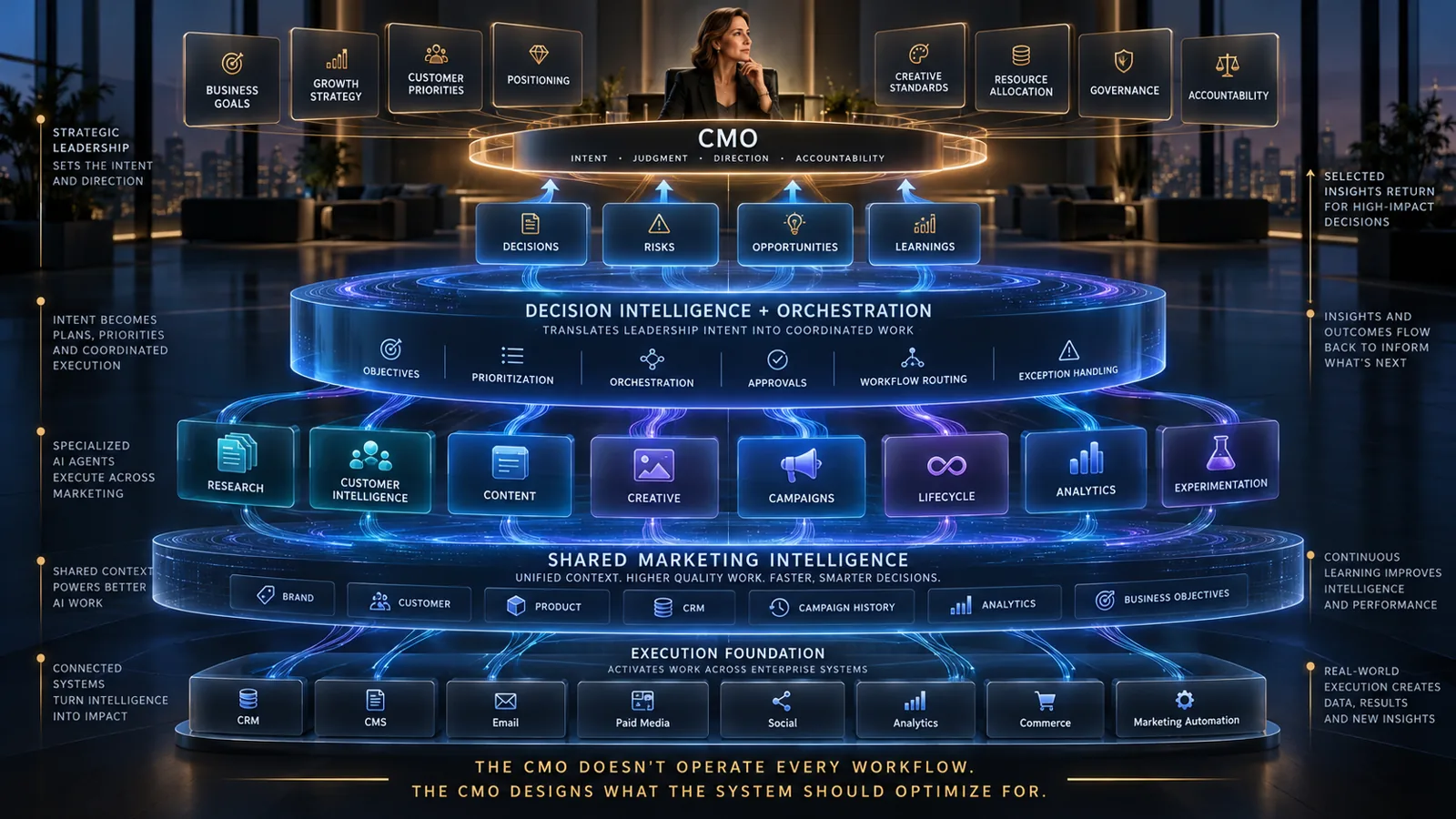
A useful model looks like this.
CMO Owns
Business goals.
Growth strategy.
Customer priorities.
Positioning.
Creative standards.
Resource allocation.
AI governance.
Accountability.
AI Intelligence Layer Handles
Research.
Synthesis.
Forecasting.
Diagnosis.
Recommendations.
Agents Handle
Content.
Campaign operations.
Lifecycle.
Analytics.
Experimentation.
Monitoring.
Automation Handles
Predictable execution.
Enterprise Systems Execute
CRM.
CMS.
Email.
Media.
Commerce.
The CMO works above the system.
Not inside every task.
The Best CMO Will Not Be the Person Who Knows Every AI Tool
There will be too many.
Tool knowledge decays quickly.
The more durable capabilities are:
systems thinking,
customer understanding,
judgment,
organizational design,
economic thinking,
AI literacy.
The future CMO does not need to personally operate every technology.
They need to understand how the capabilities fit together.
AI Literacy Is Different From Technical Expertise
The CMO does not need to become an ML engineer.
But they should understand:
What is an agent?
What is orchestration?
Where does context come from?
How do permissions work?
What can fail?
How is agent performance evaluated?
How much autonomy is appropriate?
These concepts become part of modern marketing leadership.
The CMO Becomes Less of a Channel Expert
Historically, leaders could build careers through deep expertise in:
brand,
media,
digital,
performance.
That expertise still matters.
But modern leadership requires a broader view.
The CMO must understand how:
brand,
performance,
customer experience,
technology,
AI,
data
connect.
The unit of leadership becomes the system.
The CMO Becomes More of a Growth Architect
This is ultimately where the role seems to be heading.
Not simply:
Chief Advertising Officer.
Not:
Chief Content Officer.
But:
the executive responsible for connecting customer understanding to sustainable growth.
AI expands the ways that can happen.
The CMO increasingly designs the engine.
The Job Title May Lag the Reality
Organizations often change more quickly than titles.
The employee called:
“Marketing Manager”
may already spend much of their time managing agents.
The person called:
“Marketing Operations”
may actually be designing orchestration architecture.
And the executive called:
“Chief Marketing Officer”
may increasingly spend their time on:
organizational design,
AI governance,
growth economics,
customer strategy,
technology architecture.
The old title remains.
The actual job changes underneath it.
How Should CMOs Respond Now?
A practical starting agenda:
1. Define the New Marketing Mandate
What outcomes does marketing actually own?
2. Map the Work
Where does human time go today?
3. Identify AI-Native Workflows
Which end-to-end workflows should be redesigned?
4. Define Human Decision Rights
What should people continue owning?
5. Define AI Autonomy
What can agents observe, recommend, prepare, or execute?
6. Build Shared Intelligence
What customer, brand, product, and campaign knowledge should the system use?
7. Create Governance
Permissions.
Budget thresholds.
Publishing rules.
Escalation.
8. Change the Metrics
Measure:
business outcomes,
workflow performance,
human capacity.
Not AI activity.
9. Redesign Talent
What human capabilities become more valuable?
10. Align the C-Suite
AI-enabled marketing cannot be redesigned entirely inside the marketing department.
That is the new leadership agenda.
The CMO Role Is Changing Before the Job Title Does
The CMO of the future may still have exactly the same title.
But the operating reality looks increasingly different.
Less:
campaign supervision.
More:
growth architecture.
Less:
manual coordination.
More:
orchestration.
Less:
dashboard review.
More:
decision intelligence.
Less:
managing only humans.
More:
designing human-agent teams.
Less:
buying point tools.
More:
building a marketing operating system.
Less:
approving every task.
More:
defining guardrails.
Less:
managing channels independently.
More:
connecting the customer journey end to end.
And through all of it, the CMO still owns the responsibilities technology cannot absorb:
what the business should prioritize
who the customer is
what the brand stands for
which trade-offs are worth making
what risks are acceptable
and who remains accountable
The title may still say:
Chief Marketing Officer.
But the role is evolving toward something larger:
the architect of how customer intelligence, human judgment, AI, technology, and creativity come together to produce growth.
The title has not changed yet.
The job already has.
Frequently asked questions
How is the CMO role changing because of AI?
The CMO role is expanding from traditional brand, demand, and campaign leadership toward growth orchestration, AI-enabled workflow design, data and technology alignment, governance, talent redesign, and cross-functional leadership.
Will AI replace the CMO?
AI can automate and augment many marketing activities, but the CMO remains responsible for business priorities, customer strategy, positioning, resource trade-offs, organizational design, governance, and accountability.
What new skills do CMOs need?
Modern CMOs increasingly need AI literacy, systems thinking, customer intelligence, financial fluency, organizational-design capability, governance skills, and an understanding of human-agent workflows.
What is an AI-native CMO?
An AI-native CMO is a marketing leader who designs the function around human-AI collaboration rather than simply adding AI tools to existing processes.
What does orchestration mean for a CMO?
At the leadership level, orchestration means ensuring data, people, agents, technology, and workflows operate toward shared business objectives with clear decision rights and governance.
Should CMOs understand AI agents?
Yes. They do not need to engineer agents themselves, but they should understand agent capabilities, limitations, permissions, orchestration, evaluation, and autonomy well enough to design the operating model around them.
How will AI change the CMO's team?
AI can reduce repetitive execution while increasing demand for roles focused on strategy, creative judgment, customer understanding, orchestration, AI governance, evaluation, and systems design.
Will CMOs manage fewer people?
Some AI-enabled marketing organizations may operate with fewer people devoted exclusively to manual execution. However, the CMO may oversee a broader set of human and AI capabilities, making the role more complex rather than less important.
What should remain uniquely human in the CMO role?
Business priorities, positioning, strategic trade-offs, creative standards, relationships, ethical judgment, governance, resource allocation, and final accountability should remain human-led.
What should a CMO do first to prepare for agentic marketing?
Start by mapping important end-to-end marketing workflows, determining what humans, agents, and automation should each own, establishing clear decision rights and governance, and measuring business outcomes rather than AI adoption alone.