The Future of the Marketing Team Is Human + AI: How Roles, Workflows, and Leadership Are Changing
For the last few years, the debate around AI and marketing has been framed badly.
For the last few years, the debate around AI and marketing has been framed badly.
Will AI replace marketers?
Will human creativity survive?
Will marketing teams become smaller?
Will AI agents eventually run entire departments?
These questions assume there are two competing options:
humans
or
AI.
That is probably the wrong model.
The future marketing organization is much more likely to be:
human + AI.
Humans will remain responsible for the things organizations ultimately need people to own:
- objectives
- positioning
- customer understanding
- creative taste
- relationships
- major trade-offs
- governance
- accountability
AI will increasingly handle work that machines can perform continuously and at scale:
- research
- synthesis
- production
- monitoring
- analysis
- coordination
- workflow routing
- experimentation
- bounded optimization
The result is not simply today's marketing team with a few AI assistants.
It is a different operating model.
And that difference will change:
roles
team structures
management
skills
and
what marketers actually spend their day doing.
The Future Is Not Humans vs AI
The easiest mistake is to imagine AI as another category of employee competing with humans for the same work.
That misses what the technology changes.
Humans and AI have different strengths.
Humans are particularly valuable when work requires:
- judgment
- empathy
- taste
- ambiguity
- accountability
- cultural understanding
- strategic trade-offs
- relationships
AI is increasingly strong at:
- processing large amounts of information
- identifying patterns
- synthesizing evidence
- generating variations
- monitoring continuously
- coordinating structured work
- performing repetitive execution
The strongest marketing system therefore does not ask:
Which one should replace the other?
It asks:
How should work be divided between them?
That is a much more useful organizational question.
Today's Marketing Team Is Built Around Human Capacity
Consider why modern marketing organizations look the way they do.
We create separate roles because people have finite capacity.
Content team.
Performance team.
SEO team.
CRM team.
Analytics team.
Social team.
Creative team.
Marketing Operations.
Then we create managers because those teams need coordination.
We create meetings because information has to move between them.
We create project-management systems because work has to be tracked.
We create dashboards because people cannot monitor everything continuously.
Many characteristics of the traditional marketing organization exist partly because human attention is scarce.
Agentic AI changes that constraint.
McKinsey's October 2026 work on organizational design argues that AI is beginning to change three long-standing constraints underpinning modern organizations: human capacity, expertise, and coordination.
That has significant implications for marketing.
AI Changes the Economics of Marketing Work
Imagine a marketing team needs to analyze 5,000 customer conversations.
Traditionally, that might require substantial analyst time.
AI can process them quickly.
Imagine monitoring 300 campaigns continuously.
No human team can examine every meaningful signal all day.
AI can.
Imagine creating 50 variations of an already approved campaign asset.
That was previously expensive.
Generative AI changes the economics.
Once the cost of certain work drops dramatically, organizations begin redesigning who does what.
The question becomes less:
Who has time to do this?
and more:
What should require human attention?
That is where the organizational transformation begins.
The First Shift: Humans Move From Production Toward Direction
Traditional marketing roles often mix two categories of work.
Direction
Deciding what should happen.
Production
Making it happen.
A content strategist may decide the message and then spend hours drafting variations.
A campaign manager may decide the structure and then spend hours configuring platforms.
An analyst may decide what needs investigation and then spend hours pulling data.
AI can increasingly separate these activities.
Humans spend more time defining:
- objective
- audience
- message
- quality standard
- constraints
AI performs more of the production underneath.
This does not necessarily reduce the importance of marketers.
It changes the altitude at which marketers work.
The Second Shift: Humans Become Editors of Abundance
Marketing historically operated under production scarcity.
Good copy takes time.
Creative takes time.
Research takes time.
Analysis takes time.
Generative AI changes that.
A system can produce:
50 headlines.
20 visual concepts.
10 landing-page versions.
100 content ideas.
Now the scarce resource is no longer generation.
It is:
judgment.
Which idea is distinctive?
Which visual looks generic?
Which argument matters?
Which message should the company stand behind?
Which option should never be published?
The human marketer increasingly becomes an editor of abundance.
AI creates possibility.
Humans create standards.
Creative Taste Becomes More Valuable, Not Less
This is especially important in creative work.
If every company can produce enormous amounts of technically competent content, technical competence itself becomes less differentiated.
The value shifts toward:
- originality
- point of view
- cultural relevance
- storytelling
- emotional intelligence
- brand distinctiveness
A creative leader who can identify one strong idea among 100 average ones becomes extremely valuable.
AI lowers the cost of generating options.
It does not automatically improve taste.
The Third Shift: Marketers Become Managers of AI Capabilities
Today, managers primarily manage people.
Tomorrow, many marketers may manage combinations of:
people,
agents,
automation,
and software.
A Content Lead might manage:
human editors,
Content Agent,
SEO Agent,
Brand QA Agent.
A Growth Lead might oversee:
Campaign Agent,
Analytics Agent,
Experimentation Agent,
paid-media platforms.
This introduces a new management skill:
knowing how to allocate work across humans and machines.
Which task needs judgment?
Which can be delegated?
Which agent should perform it?
What quality threshold applies?
When should the system escalate?
Management increasingly becomes orchestration.
The Fourth Shift: Marketing Operations Becomes AI Operations
Marketing Operations may undergo one of the largest transformations.
Historically, Marketing Ops has often owned:
- campaign setup
- technology administration
- workflow maintenance
- reporting
- integrations
- lead routing
- data hygiene
As more repetitive activity becomes automated, Marketing Ops can move upward.
Its future responsibilities may increasingly include:
- workflow architecture
- AI orchestration
- agent permissions
- context management
- governance
- integration architecture
- observability
- agent evaluation
The function becomes less about operating tools manually.
It becomes more about designing the system through which marketing operates.
That makes Marketing Ops more strategic, not less.
The Fifth Shift: Analysts Move From Reporting to Decision Intelligence
AI can already automate increasing amounts of:
- recurring reporting
- anomaly detection
- data synthesis
- first-level investigation
The analyst's value therefore moves toward harder questions.
Instead of:
What happened?
the analyst spends more time asking:
Why?
Is this causal?
What experiment would prove it?
What should the business do?
Future analysts may spend more time on:
- measurement design
- experiments
- causal analysis
- model validation
- strategic interpretation
The dashboard becomes less important.
Decision quality becomes more important.
The Sixth Shift: Campaign Managers Become Workflow Governors
Campaign managers traditionally perform enormous amounts of coordination.
Brief creative.
Check assets.
Configure platforms.
Update stakeholders.
Monitor results.
Route revisions.
Agentic systems can increasingly handle parts of that operational flow.
The campaign manager then moves toward:
- campaign architecture
- exception handling
- quality assurance
- resource trade-offs
- performance governance
Instead of operating every task, they supervise the system executing the tasks.
The Seventh Shift: The CMO Moves Up the Stack
The CMO changes too.
The traditional CMO already owns:
strategy,
brand,
growth,
customer,
leadership.
But in many organizations, senior marketing leaders also spend large amounts of time managing operational complexity.
Too many tools.
Too many handoffs.
Too many reports.
Too many disconnected teams.
An AI-native operating model can reduce some of that coordination burden.
The CMO increasingly becomes responsible for:
- intent
- priorities
- organizational design
- AI decision rights
- governance
- quality standards
- resource allocation
McKinsey's current marketing research describes the CMO's role as expanding from steward of brand and demand toward orchestrator of data, technology, AI-enabled execution, and end-to-end growth workflows.
What Should AI Own?
The exact boundary will differ by company.
But several categories are natural candidates for greater AI ownership.
Continuous Monitoring
AI should increasingly monitor:
- campaign performance
- customer behavior
- search trends
- competitive activity
- content performance
Humans should not have to stare at dashboards continuously.
First-Level Research
Agents can gather and synthesize:
- market research
- customer signals
- competitive intelligence
- search intent
Humans determine what is strategically meaningful.
Repetitive Production
AI can assist with:
- content variants
- channel adaptations
- formatting
- metadata
- recurring reports
Humans own the standard.
Routine Coordination
AI can route:
- tasks
- approvals
- handoffs
- workflow states
Humans manage unusual conflicts.
First-Level Analysis
AI can detect and investigate anomalies.
Humans validate important conclusions.
Bounded Optimization
Agents can perform low-risk, reversible optimization inside predefined limits.
Humans define those limits.
What Should Humans Own?
This boundary matters even more.
Business Objectives
AI should not decide what the company fundamentally wants to achieve.
Positioning
Models can generate positioning options.
Humans must determine what the company stands for.
Customer Priorities
Data can inform priorities.
Leadership chooses where the business focuses.
Creative Direction
AI can generate execution.
Humans should define the creative bar.
Major Trade-Offs
Growth versus margin.
Brand versus immediate conversion.
Short-term performance versus long-term trust.
These are leadership decisions.
Governance
Humans determine what agents may:
see,
change,
publish,
spend,
or communicate.
Accountability
AI can act.
But an organization still needs humans accountable for outcomes.
The Future Team Needs a New Division of Labor
The old model might look like:
Humans think + humans coordinate + humans execute.
The emerging model becomes:
Humans define intent + AI expands intelligence + agents coordinate and execute + humans govern exceptions.
That is a very different organization.
The Team Will Become More Workflow-Oriented
Traditional marketing organizations are often organized primarily by functions.
Content.
Paid.
SEO.
CRM.
Analytics.
But customers do not experience organizational functions.
They experience journeys.
Agentic AI makes it easier to organize work around outcomes.
For example:
Acquire enterprise customer
might involve:
Research Agent.
Content Agent.
Paid Media.
Lifecycle Agent.
Sales.
Analytics Agent.
Rather than each function operating separately, an orchestrated workflow coordinates them around the same outcome.
McKinsey argues that marketing organizations increasingly need to organize around end-to-end workflows, with humans and agents assigned according to which activities each performs best.
Job Titles May Matter Less Than Capabilities
Traditional organizations ask:
What does this person's job description say?
Agentic organizations may increasingly ask:
Which capability is needed?
Research.
Creative judgment.
Customer intelligence.
Experimentation.
Orchestration.
Then determine the best resource.
Sometimes:
human.
Sometimes:
agent.
Sometimes:
automation.
Teams become more dynamic.
New Marketing Roles Will Emerge
AI will also create roles that barely existed before.
McKinsey's 2026 marketing work specifically anticipates new types of roles for builders, orchestrators, and standard bearers in human–AI marketing organizations.
That could translate into roles such as:
AI Marketing Architect
Designs how agents, data, workflows, and enterprise systems connect.
Agent Orchestrator
Manages how human and AI capabilities work together.
Marketing AI Governance Lead
Defines permissions, risk thresholds, and evaluation standards.
Agent Evaluator
Measures accuracy, quality, workflow success, and failure patterns.
AI Brand Steward
Ensures AI-generated work remains consistent with positioning, identity, and quality.
Customer Intelligence Designer
Structures the context agents use to understand customers.
These may not always become formal job titles.
But the capabilities will become increasingly important.
Human-Agent Teams Need Shared Context
There is one important prerequisite.
Humans and agents need to operate from the same reality.
Adobe describes the problem clearly: a capable agent placed inside an organization without access to how the business operates, what worked previously, or who approves decisions becomes a “brilliant stranger.”
A modern marketing team therefore needs shared intelligence containing:
- brand knowledge
- customer research
- product data
- campaign history
- analytics
- business objectives
- current priorities
Otherwise AI does not become a teammate.
It becomes another disconnected tool.
AI Teammates Need Roles, Just Like Humans
An agent should have something resembling a job description.
What is its objective?
What can it access?
What actions can it take?
When must it escalate?
How is performance measured?
For example:
Analytics Agent
Responsibility: monitor campaign performance and investigate anomalies.
May access: campaign data, historical benchmarks, conversion data.
May perform: analysis and low-risk diagnostic queries.
May not: modify media budgets.
Escalates when: confidence is low or recommended changes exceed thresholds.
That clarity becomes essential as the number of agents grows.
Human Managers Will Need to Learn AI Delegation
Delegation to AI differs from delegation to people.
Humans use intuition and shared context.
AI needs explicit:
- objectives
- inputs
- constraints
- standards
- permissions
The future manager will need to become good at designing those boundaries.
Not simply prompting.
Delegating.
Prompting asks AI for output.
Delegation gives the system responsibility for an outcome within constraints.
That is a more advanced skill.
Teams Need to Stop Double-Doing the Work
A common failure pattern looks like this:
AI creates report.
Analyst recreates report manually.
AI produces campaign brief.
Strategist builds another brief.
Agent routes tasks.
Manager manually verifies every task.
Now the organization has:
AI workflow
plus
human workflow.
Productivity gets worse.
Transformation requires removing work after automation proves reliable.
This can be uncomfortable.
But without subtraction, AI becomes another layer of process.
The Best Human + AI Team Is Not One Where Everyone Uses AI
This is subtle.
AI adoption might mean:
every employee has an assistant.
Human + AI transformation means:
the team itself has been redesigned.
Roles change.
Workflow changes.
Decision rights change.
Management changes.
Some work disappears.
Some becomes automated.
Some becomes more strategic.
This is why high AI adoption does not automatically create an AI-native organization.
AI Fluency Becomes a Core Marketing Skill
Marketers do not all need to become engineers.
But they increasingly need to understand:
- what AI can do
- what it cannot reliably do
- how agents use context
- where errors happen
- how to evaluate outputs
- when to escalate
- how to design workflows
McKinsey identifies skill development as a major barrier for marketing leaders trying to scale AI and stresses that building an AI-ready organization is as much a people challenge as a technology challenge.
AI literacy becomes part of ordinary marketing literacy.
But Domain Expertise Matters More, Not Less
There is a danger in believing AI knowledge replaces marketing knowledge.
It does not.
If AI can generate 100 campaign strategies, someone still needs to know which strategy is good.
If AI can analyze customer behavior, someone needs to know when its interpretation is misleading.
If AI can generate brand content, someone needs to understand the brand.
The stronger AI becomes, the more valuable high-quality human judgment becomes.
Because AI amplifies both:
good direction
and
bad direction.
Smaller Teams May Produce Much More
One likely consequence is that marketing output becomes less tightly tied to headcount.
Salesforce's 2026 marketing announcements explicitly frame AI agents as teams that can help marketers build pipeline, create content, and run campaigns while humans retain strategy and ownership of results.
McKinsey similarly argues that future marketing organizations could become smaller and faster as execution becomes increasingly agent-assisted.
That does not mean every company should immediately reduce headcount.
A more interesting possibility is:
the same team can attempt things that previously required a much larger organization.
More experiments.
More personalization.
More research.
More continuous optimization.
The strategic question becomes:
What new capability does AI create?
not only:
Which cost can AI remove?
Teams Should Measure Outcomes, Not AI Activity
An AI-native team should not celebrate:
number of prompts,
number of agents,
number of AI-generated assets.
Those are activity metrics.
Measure:
- campaign cycle time
- conversion
- customer experience
- pipeline
- revenue
- experimentation velocity
- human time spent on strategic work
- quality
- decision speed
The point of human + AI collaboration is better business performance.
Not maximum AI usage.
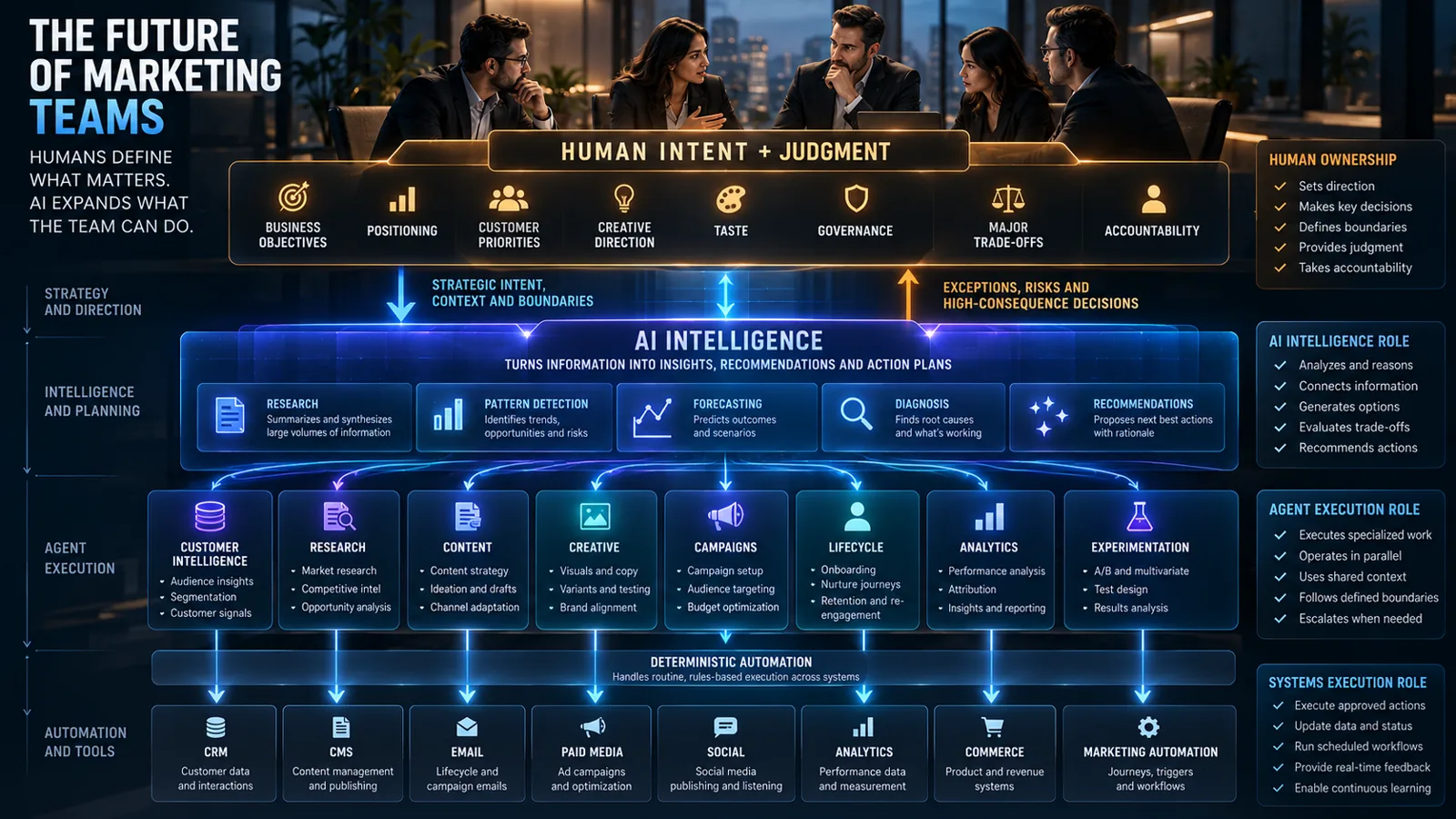
The Human + AI Operating Model
A useful way to visualize the future team is as a hierarchy.
Layer 1 — Human Intent + Judgment
Humans own:
business objectives,
positioning,
strategy,
taste,
governance,
accountability.
Layer 2 — AI Intelligence
AI handles:
research,
synthesis,
forecasting,
diagnosis,
recommendations.
Layer 3 — Agent Execution
Specialized agents handle:
content,
campaigns,
lifecycle,
analytics,
experimentation,
coordination.
Layer 4 — Deterministic Automation
Systems handle:
predictable,
rules-based execution.
Layer 5 — Enterprise Infrastructure
CRM,
CMS,
Email,
Paid Media,
Social,
Analytics,
Commerce.
Humans move upward.
Machines handle more underneath.
The Future Marketing Manager Is a System Manager
This may be one of the largest leadership changes.
Managers historically supervise execution through people.
Future managers increasingly supervise:
people,
agents,
workflows,
standards,
exceptions.
They will ask:
Is the agent performing well?
Are the escalation thresholds correct?
Which work still requires people?
Where is quality declining?
What should become autonomous next?
That is a different managerial skill set.
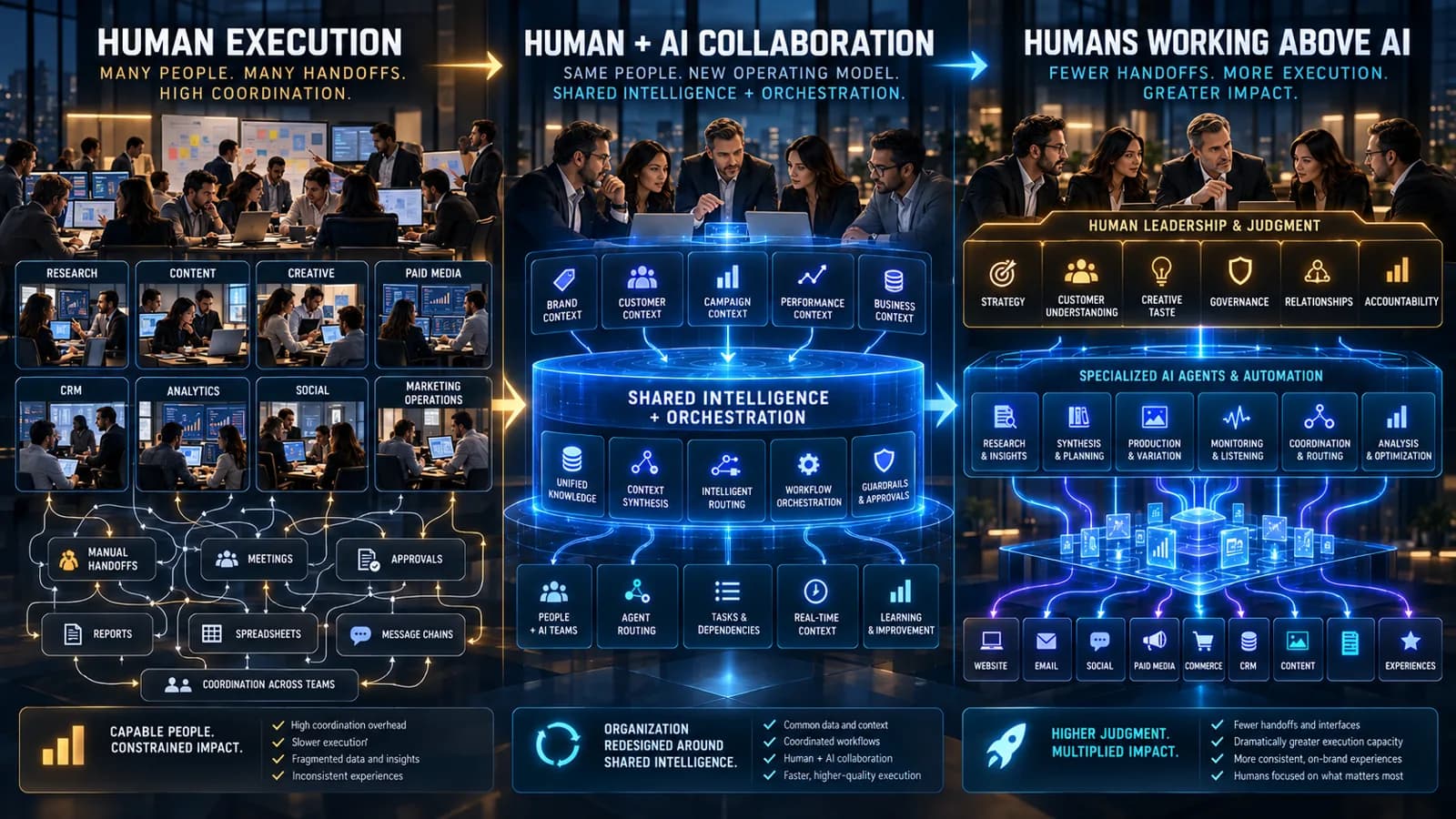
Humans Should Work Above AI
This provides the simplest mental model for the future organization.
Not:
humans racing against AI.
Not:
humans underneath AI approving every action.
But:
humans working above AI.
Humans define the objectives.
AI expands intelligence.
Agents perform execution.
Automation moves predictable work.
Human attention returns when:
strategy changes,
uncertainty rises,
risk increases,
or judgment matters.
That creates leverage without eliminating accountability.
The Biggest Risk Is Designing the Team Around Yesterday's Work
Companies may add AI while preserving every existing:
role,
approval,
meeting,
handoff,
report.
That is the safest organizational response.
It may also leave much of the opportunity untouched.
McKinsey's recent organizational research shows the broader gap: in its 2026 state-of-AI work, 80% of respondents said AI improved individual productivity, but only 37% reported positive EBIT impact, while only 6% qualified as AI high performers.
Individual productivity is not enough.
The organization has to change.
How CMOs Should Redesign the Team
A practical starting approach is:
Step 1 — Map Work, Not Job Titles
List the actual work being performed.
Research.
Reporting.
Creative development.
Campaign setup.
Approvals.
Optimization.
Step 2 — Classify Each Activity
Should it be:
human-led,
AI-led,
agent-executed,
automated?
Step 3 — Redesign the Workflow
Remove unnecessary handoffs.
Run independent work in parallel.
Route exceptions to humans.
Step 4 — Define Decision Rights
Explicitly identify:
what AI may recommend,
what AI may execute,
what humans must approve.
Step 5 — Redesign Roles
Move people toward:
strategy,
judgment,
creativity,
customer understanding,
governance.
Step 6 — Measure the New System
Track whether:
cycle times fall,
quality improves,
decisions accelerate,
business performance improves.
That is organizational transformation.
The Future of Marketing Work Is Not Less Human
It may actually become more human in one important sense.
Much of modern marketing work is highly operational.
Move data.
Prepare report.
Resize asset.
Update campaign.
Route task.
Check dashboard.
Those activities consume human attention without necessarily requiring the qualities that make humans uniquely valuable.
If AI removes enough of this work, marketers gain more time for:
ideas,
customers,
stories,
relationships,
judgment,
strategy.
The future is not necessarily marketing with less humanity.
It could be marketing with less human administration.
The Future Marketing Team Is Human + AI
The next generation of marketing organizations will not be defined by whether they use AI.
Almost everyone will.
The more meaningful distinction will be:
how well humans and AI work together.
The strongest teams will know:
what humans should own,
what agents should own,
what automation should own,
where the boundaries sit,
how context is shared,
how work is orchestrated,
and how learning compounds.
Humans will increasingly provide:
intent.
taste.
judgment.
relationships.
accountability.
AI will increasingly provide:
scale.
speed.
continuous intelligence.
coordination.
execution capacity.
Neither is sufficient alone.
The future marketing organization is not human.
It is not AI.
It is a deliberately designed system where both operate at the layer where they create the most value.
That is the future of the marketing team.
Human + AI.