The Hardest Part of Building an AI CMO Isn’t the AI. It’s Rebuilding How Marketing Works.
The hardest part of building an AI CMO is no longer getting AI to perform marketing tasks.
Ask an advanced AI model to write a campaign brief.
It can do it.
Ask it to analyze customer feedback.
It can do that too.
Ask it to produce:
headlines,
emails,
landing-page copy,
campaign ideas,
competitive research,
performance summaries,
and creative directions.
None of that is particularly surprising anymore.
Which leads to an important realization:
The hardest part of building an AI CMO is no longer getting AI to perform marketing tasks.
The hard part is getting AI to participate reliably in a real marketing organization.
That requires answering questions such as:
Where does the AI get trusted context?
How does it know which version of the positioning is current?
Which customer data can it access?
Which agent owns which responsibility?
What happens when two agents disagree?
How does a campaign move from strategy to content to launch?
Which actions can happen automatically?
Which require human approval?
What happens when an API fails?
How do you know whether an agent did a good job?
Who is accountable when it makes a mistake?
Those are not model questions.
They are questions about:
data
architecture
workflow
governance
organization
And those are increasingly the real bottlenecks in agentic marketing.
The Demo Is the Easy Part
It is surprisingly easy to build an impressive AI marketing demo.
Connect a strong model.
Add a prompt.
Give it a few documents.
Ask:
“Create an enterprise campaign for this product.”
Within seconds, you may receive:
- campaign strategy
- customer segments
- content ideas
- landing-page copy
- social posts
- email sequences
It looks extraordinary.
Then you try to put it into production.
Now the real questions begin.
Where did those customer claims come from?
Which brand guidelines did it use?
Can it access CRM?
Is that data current?
Can it publish?
Can it spend money?
What happens when Legal rejects a claim?
Can the system resume from that point?
How do you prevent the Content Agent from using outdated positioning?
What happens when the campaign API returns an error?
How do you evaluate whether the strategy was actually good?
The prototype demonstrated intelligence.
Production requires a system.
That gap is where most of the difficult work lives.
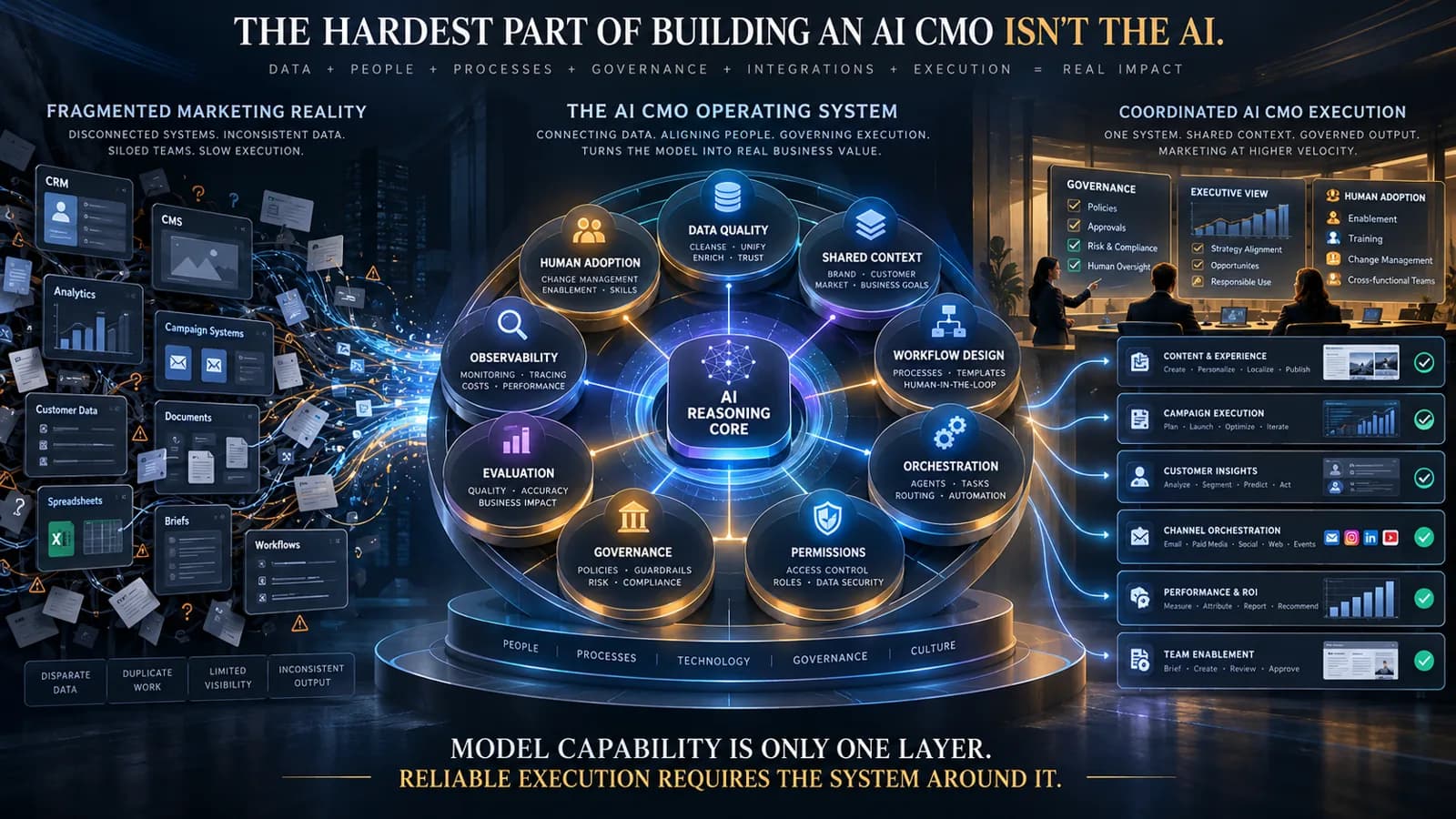
The AI Model Is Only One Layer
An AI CMO is sometimes imagined as:
Powerful LLM + marketing prompt = AI CMO
That is far too simple.
A production-grade AI CMO needs something closer to:
Enterprise Systems
↓
Reliable Data
↓
Shared Marketing Intelligence
↓
Models + Reasoning
↓
Specialized Agents
↓
Orchestration
↓
Governance
↓
Human Leadership
The model is important.
But it sits inside a much larger architecture.
In many cases, improving everything around the model creates more value than switching from one frontier model to another.
Hard Problem #1 — Getting the Data Right
AI needs context.
An AI CMO needs a lot of it.
Potentially:
- CRM data
- customer interviews
- campaign performance
- product information
- brand guidelines
- content history
- pricing
- competitive intelligence
- web analytics
- sales feedback
- business objectives
The problem is that most organizations do not store this information cleanly in one place.
It lives across:
CRM.
Analytics.
CMS.
Documents.
Spreadsheets.
Email.
Slack.
Presentations.
People's heads.
And often, different systems disagree.
The CRM says one thing.
The campaign platform says another.
The strategy deck is six months old.
The website contains newer positioning.
Now imagine an autonomous system trying to make decisions on top of that.
This is why data architecture becomes fundamental.
McKinsey's 2026 research on scaling agentic AI found that eight in ten companies cite data limitations as a barrier, with fragmented data, inconsistent governance, weak lineage, and poor access controls making agentic systems difficult to scale safely.
The problem is not:
Can the model reason?
It is:
Can the model reason from reality?
AI Exposes Data Problems Humans Learned to Work Around
Humans are surprisingly good at compensating for bad systems.
A marketer may know:
“Don't use that CRM field. Nobody updates it.”
“The official brand deck is outdated. Use the latest presentation.”
“That dashboard double-counts partner leads.”
“The customer segment name changed last quarter.”
An AI agent does not automatically know those informal rules.
This is one reason enterprise AI often exposes technical debt that organizations previously tolerated.
Humans carried the missing context.
Agents require that context to become explicit.
Building an AI CMO therefore forces companies to answer:
What is actually true?
That can be harder than building the AI.
Hard Problem #2 — Building Shared Intelligence
Even clean data is not enough.
Customer records tell you what happened.
They do not necessarily explain:
- what the brand stands for
- which customer matters most
- which positioning leadership approved
- what language should never be used
- what the company learned last quarter
An AI CMO needs shared marketing intelligence.
That may include:
- brand strategy
- positioning
- ICP definitions
- customer research
- product knowledge
- campaign history
- approved claims
- competitive intelligence
- experiment results
- current objectives
- strategic priorities
Without this layer, every agent becomes what Adobe recently described as a “brilliant stranger”: capable, but disconnected from how the organization actually works and what it has learned before.
That is why persistent context matters.
The goal is not for each prompt to explain the company again.
The organization itself needs memory.
Hard Problem #3 — Redesigning the Workflow
This may be the hardest problem of all.
Most companies begin AI adoption by inserting AI into an existing process.
Traditional:
Research → Strategy → Brief → Content → Creative → Approval → Campaign → Reporting
Then:
AI Research → Strategy → AI Content → AI Creative → Approval → Campaign → AI Reporting
There is more AI.
But the workflow is basically unchanged.
Humans still:
- move context
- coordinate handoffs
- assign tasks
- chase approvals
- decide what happens next
That creates task automation without true transformation.
McKinsey's 2026 marketing research argues that the largest gains come from rewiring complete workflows around human–AI collaboration, not simply inserting agents into isolated tasks.
That requires asking a harder question:
If we designed this marketing workflow from scratch today, knowing what AI agents can do, would we build it this way?
Often, the answer is no.
The Workflow Is the Real Product
This is an important product-design insight.
A Research Agent is not the product.
A Content Agent is not the product.
Even a sophisticated Campaign Agent is not the product.
The real product is:
the workflow that moves from business intent to business outcome.
For example:
Objective → Research → Strategy → Approval → Content → Campaign → Measurement → Optimization → Learning
The system becomes valuable when that entire flow works.
This is why isolated agents often look impressive while delivering limited organizational value.
They optimize nodes.
The real opportunity is in the connections between them.
Hard Problem #4 — Deciding What Humans Should Still Own
Once agents can perform more work, organizations need to redesign human roles.
This is uncomfortable.
Because every automated workflow raises questions.
Should AI:
recommend positioning?
approve positioning?
generate creative?
publish creative?
adjust budget?
create audiences?
respond to customers?
There is no single answer.
The organization must define decision rights.
A useful principle is:
AI should receive greater autonomy when work is:
- low-risk
- reversible
- measurable
- constrained
Humans should retain stronger control when decisions involve:
- strategy
- brand
- major budgets
- sensitive customers
- legal exposure
- reputation
McKinsey's agentic-marketing work emphasizes that human roles do not simply disappear. They move toward areas such as strategy, taste, cultural understanding, stakeholder relationships, governance, data quality, orchestration rules, and infrastructure oversight.
That is an operating-model problem.
Not an AI-model problem.
Hard Problem #5 — Orchestrating Multiple Agents
One agent is manageable.
Ten agents create a coordination problem.
Suppose an Analytics Agent detects creative fatigue.
What happens next?
Does it:
notify the Campaign Agent?
trigger Creative?
launch an experiment?
ask a human?
What if Creative is already producing a revision?
What if Strategy changed yesterday?
What if the campaign is paused?
Someone—or something—needs to understand:
- workflow state
- dependencies
- priorities
- current context
- permissions
- completion conditions
That is orchestration.
Without it, a collection of AI agents becomes a new version of martech sprawl.
Orchestration Is Mostly About State
People often imagine orchestration as:
agents talking to agents.
That is only part of it.
A production system needs to know:
Research complete.
Strategy approved.
Content revision 3 active.
Creative awaiting review.
Campaign setup blocked.
Budget approval pending.
This is workflow state.
Without state, agents can:
repeat actions,
use the wrong version,
act too early,
contradict one another.
This is much less glamorous than generative AI.
It is also much more important for reliability.
Hard Problem #6 — Making Integrations Reliable
AI agents become useful when they can act.
That means they need tools.
An AI CMO may need to connect to:
- CRM
- CMS
- paid media
- social
- analytics
- project management
- data warehouse
- marketing automation
Every one of those connections creates engineering work.
Authentication.
Permissions.
APIs.
Schemas.
Rate limits.
Errors.
Version changes.
Retries.
Fallbacks.
This is where a beautiful AI demo turns into enterprise software engineering.
Adobe's current agentic-marketing direction reflects this reality: scaling agentic AI requires a unified platform with trusted data, governance, and connected workflows rather than isolated AI point tools.
The model may decide:
Update Campaign A.
The difficult part is making sure the right system receives the right action safely and reliably.
Hard Problem #7 — Permissions
A marketing agent should not automatically have access to everything.
A Content Agent probably needs:
- brand guidelines
- product context
- customer research
It probably does not need:
full customer PII,
payment details,
or permission to change media budgets.
An Analytics Agent may need broad read access.
But limited write access.
A Campaign Agent may be able to:
prepare campaigns
but not launch high-budget ones.
Designing permissions means answering:
What can this agent see?
What can it change?
How much can it change?
When does it need approval?
That is architecture.
Hard Problem #8 — Governance That Actually Executes
AI governance is often discussed through documents.
Policies.
Principles.
Guidelines.
Those matter.
But once agents can act, governance has to become executable.
For example:
Budget ceiling: technically prevent changes above 5%.
Publishing rule: block new product claims without approval.
Data access: prevent Content Agent access to restricted customer fields.
Escalation: automatically pause uncertain high-risk actions.
Governance becomes part of the software.
This is a profound shift.
The policy is no longer simply:
“The agent should not do this.”
The architecture enforces:
“The agent cannot do this.”
Hard Problem #9 — Evaluation
How do you know whether your AI CMO is good?
This is harder than it sounds.
For a content agent:
Did it follow the brand?
Was it original?
Was it factually correct?
Did it perform?
For an Analytics Agent:
Was the diagnosis accurate?
Did it miss an important anomaly?
Did it escalate unnecessarily?
For a Campaign Agent:
Was configuration correct?
Did it violate policy?
Did the campaign achieve the objective?
This means an AI CMO needs evaluation at multiple levels.
Evaluate the Agent
Measure:
- accuracy
- instruction adherence
- task completion
- error rate
Evaluate the Workflow
Measure:
- cycle time
- handoffs
- cost
- human intervention
- failure rate
Evaluate the Business Outcome
Measure:
- conversion
- pipeline
- revenue
- CAC
- retention
- customer experience
An agent can perform perfectly while the workflow fails.
And a workflow can operate efficiently while optimizing the wrong business objective.
Evaluation has to span all three levels.
Hard Problem #10 — Observability
If an AI CMO makes 500 decisions per day, humans cannot manually inspect every one.
But they still need to understand what happened.
A production system should be able to answer:
Which agent acted?
Why?
What data did it use?
Which tool did it call?
What changed?
Was an approval required?
Did the action succeed?
How much did it cost?
This is observability.
Without it, debugging agentic systems becomes extremely difficult.
Hard Problem #11 — Handling Failure
Agents fail differently from deterministic software.
Sometimes they are wrong.
Sometimes uncertain.
Sometimes they choose the wrong tool.
Sometimes they produce valid output that is strategically poor.
A robust system needs:
- retries
- fallback models
- validation
- confidence thresholds
- escalation
- rollback
Imagine:
Campaign Agent attempts to launch.
Advertising API fails.
What happens?
Retry once?
Retry five times?
Notify Marketing Ops?
Switch channels?
Stop the workflow?
These decisions need explicit design.
Hard Problem #12 — Version Control for Marketing Context
Software engineers understand version control.
Marketing organizations often do not think about context this way.
But an AI CMO needs to know:
Which brand guideline version is current?
Which campaign brief is approved?
Which positioning statement superseded the old one?
Which creative is final?
Without clear versioning, agents can retrieve outdated information and act on it.
As AI becomes more autonomous, stale context becomes more dangerous.
A person using an old slide may make one bad decision.
An agent using outdated context could scale that decision across thousands of actions.
Hard Problem #13 — Organizational Adoption
Even a technically excellent AI CMO can fail if people do not trust it.
Teams may ask:
Will this replace my job?
Should I use this agent?
Can I trust its recommendations?
Who owns the output?
What happens if it fails?
If employees do not understand the operating model, they may:
ignore the system,
duplicate its work,
override it constantly,
or revert to old workflows.
Technology adoption therefore requires:
- role clarity
- training
- incentives
- leadership
- change management
McKinsey explicitly identifies operating-model redesign and governance alongside technology and data as requirements for scaling agentic AI.
The AI can work technically and still fail organizationally.
Hard Problem #14 — Killing the Old Workflow
This may be the most underestimated challenge.
Companies add AI.
But they often keep the old process too.
Now they have:
AI workflow
plus
legacy workflow.
That increases complexity.
For example:
AI generates report.
Analyst still manually rebuilds report.
AI creates campaign plan.
Team still creates the same project spreadsheet.
Agent routes work.
Manager still manually checks every task.
Nothing is removed.
AI becomes additional work.
Real transformation requires making decisions such as:
This spreadsheet disappears.
This approval step disappears.
This weekly report disappears.
This manual handoff disappears.
Transformation requires subtraction.
The Coordination Tax Is Often the Real Bottleneck
A useful way to understand this is through the coordination tax.
Organizations spend enormous amounts of time moving work between:
people,
teams,
systems,
and decisions.
McKinsey's September 2026 research found that while 80% of respondents said AI improved individual productivity, only 37% attributed any EBIT impact to AI. One explanation is that productivity improvements inside individual tasks do not automatically remove coordination between them.
This is extremely relevant to AI CMO design.
If every marketer works 30% faster but:
handoffs remain,
approvals remain,
context transfer remains,
system fragmentation remains,
the organization may not become dramatically faster.
The real opportunity is often between the tasks.
Why Better Models Will Not Solve Most of These Problems
Imagine tomorrow's LLM is twice as intelligent.
Does that automatically fix:
fragmented CRM data?
No.
Does it know which campaign brief is current?
No.
Does it understand who can approve budget?
No.
Does it define your API permissions?
No.
Does it redesign your workflow?
No.
Does it decide which legal claims require approval?
No.
Does it automatically create organizational trust?
No.
Better models help.
But many enterprise bottlenecks are not caused by insufficient model intelligence.
They are caused by insufficient system design.
That is why model capability can improve rapidly while enterprise transformation moves much more slowly.
The Moat Is Not the Model
This also has strategic implications for companies building AI marketing products.
Foundation models will continue improving.
And leading model capabilities will become available to many companies.
That means the durable differentiation in an AI CMO may come from:
- proprietary marketing context
- workflow architecture
- agent evaluation
- orchestration
- enterprise integrations
- governance
- domain-specific intelligence
- learning loops
The model matters.
But the system surrounding it may matter more.
What Building an AI CMO Actually Looks Like
A realistic development sequence might look like this.
Step 1 — Choose One High-Value Workflow
Not:
“Build an AI CMO.”
Instead:
Reduce campaign creation time from ten days to three.
Step 2 — Map the Existing Workflow
Document:
- people
- steps
- data
- systems
- decisions
- approvals
- delays
Step 3 — Redesign Before Automating
Ask:
Which steps should disappear?
Which can happen in parallel?
Which require humans?
Which require AI?
Which require deterministic automation?
Step 4 — Build the Context Layer
Connect relevant:
- customer data
- brand context
- product data
- campaign history
- analytics
Step 5 — Add Specialized Agents
Only for capabilities the workflow actually needs.
Step 6 — Add Orchestration
Manage:
- state
- dependencies
- handoffs
- retries
- approvals
Step 7 — Implement Governance
Define:
- permissions
- budget limits
- data access
- escalation
- publishing rights
Step 8 — Build Evaluation
Measure:
agent quality,
workflow quality,
business outcomes.
Step 9 — Deploy With Humans
Let the system begin with:
observe,
recommend,
prepare.
Increase autonomy gradually.
Step 10 — Remove Legacy Work
This is essential.
If the new system works:
retire old processes.
Otherwise AI becomes another layer of complexity.
The Best AI CMO May Look Less Impressive in a Demo
This sounds counterintuitive.
A product that generates an entire campaign in 30 seconds creates an impressive demo.
A production-grade AI CMO may look more restrained.
It may say:
Strategy requires approval.
Customer data unavailable.
Claim cannot be verified.
Budget change exceeds permission.
Confidence too low. Escalating.
Those responses are less dramatic.
But they are signs of maturity.
Reliable enterprise AI knows its boundaries.
Building the AI Is About Intelligence. Building the Product Is About Trust.
This is perhaps the cleanest distinction.
The AI needs to be intelligent enough to:
understand,
reason,
generate,
plan.
The product needs to be trustworthy enough to:
connect,
act,
remember,
recover,
explain,
escalate.
Intelligence gets the demo.
Trust gets deployment.
The AI CMO Is Really an Organizational System
This is why building an AI CMO is not simply a software-engineering project.
It touches:
marketing,
data,
technology,
security,
legal,
operations,
leadership.
Because the system participates in how the organization makes decisions and executes work.
The deeper you integrate it, the more organizational design becomes part of product design.
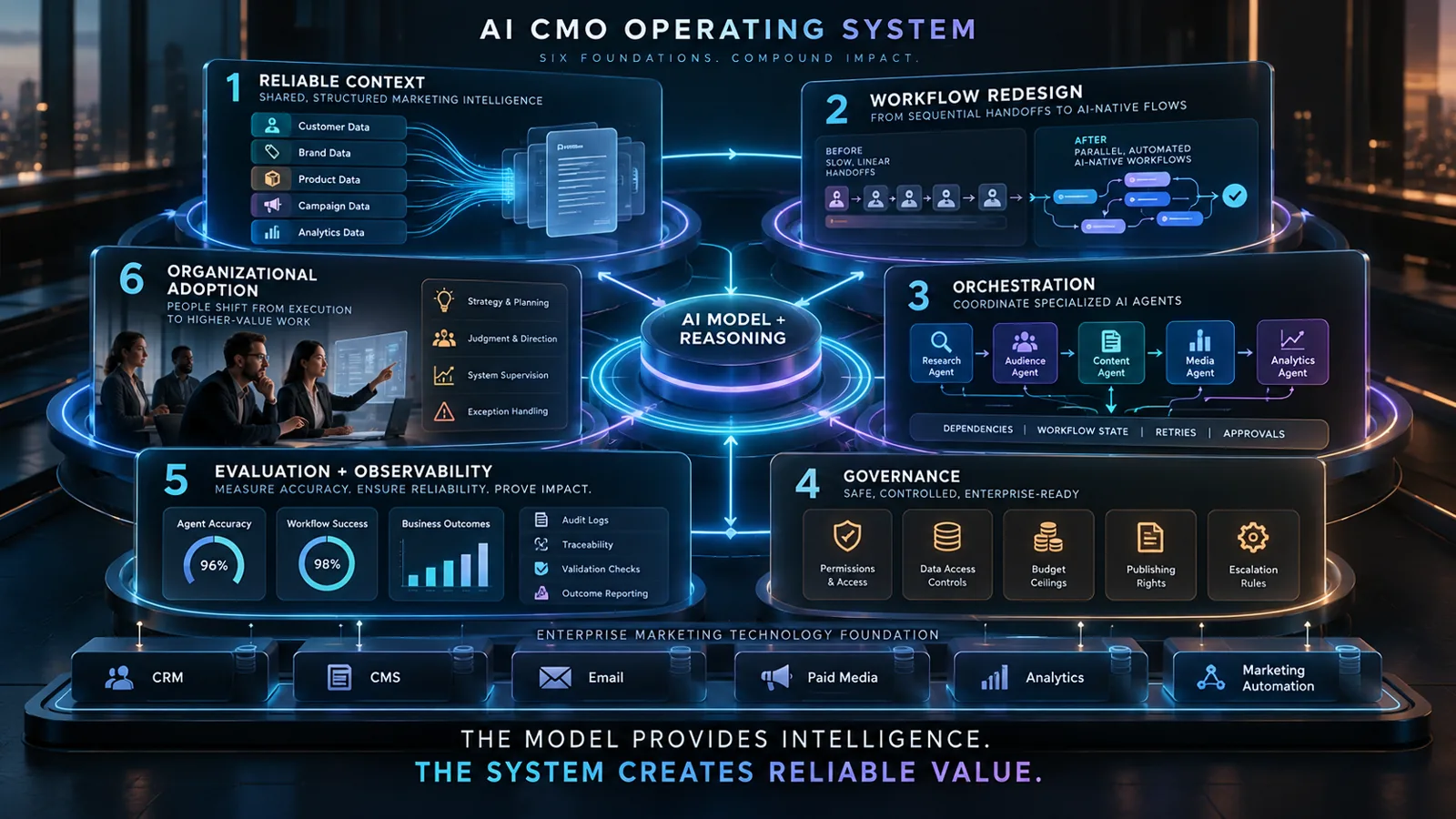
A Mature AI CMO Needs Six Things More Than Another Model Upgrade
If I had to prioritize the difficult parts, they would be:
1. Reliable Context
Can the system access accurate, current business information?
2. Redesigned Workflows
Does the workflow actually use AI-native capabilities?
3. Orchestration
Can multiple agents, humans, and systems coordinate reliably?
4. Governance
Are permissions and decision rights explicit and enforceable?
5. Evaluation
Can you prove the agents and workflows work?
6. Organizational Adoption
Do people understand and trust the new operating model?
Improve these six things and almost any strong modern model becomes dramatically more useful.
Ignore them and even the smartest model becomes an expensive chatbot.
The Hardest Part of Building an AI CMO Isn't the AI
The AI is remarkable.
But increasingly, the AI is not the bottleneck.
The bottleneck is turning intelligence into reliable organizational capability.
That requires:
clean data,
persistent context,
well-designed workflows,
specialized agents,
orchestration,
integrations,
permissions,
evaluation,
observability,
governance,
and humans who know how to work above the system.
The model can write the campaign.
The difficult work is building the environment where that campaign can move safely from:
idea
to:
execution
to:
measurement
to:
learning
without requiring humans to manually reconstruct the workflow every time.
That is why the companies that win with AI marketing may not be the ones with access to the smartest models.
They may be the ones that do the less glamorous work better:
architecture.
data.
workflow design.
governance.
organizational change.
Because building artificial intelligence is only one part of building an AI CMO.
The harder challenge is redesigning marketing so intelligence can actually operate.
Frequently asked questions
What is the hardest part of building an AI CMO?
The hardest part is usually not accessing capable AI models. It is building reliable data, shared organizational context, redesigned workflows, orchestration, enterprise integrations, governance, evaluation, and organizational adoption around those models.
Why isn't a powerful LLM enough to build an AI CMO?
A model can reason and generate, but it does not inherently know your latest business context, workflow state, permissions, approval requirements, data sources, enterprise systems, or organizational decision rights.
Why is data quality important for AI agents?
Agents rely on current, accurate information to make decisions. Fragmented, outdated, poorly governed, or contradictory data can cause unreliable actions at scale.
What is shared intelligence in an AI CMO?
Shared intelligence is persistent organizational context such as brand strategy, customer research, product knowledge, campaign history, approved claims, analytics, and validated learnings that agents can consistently retrieve.
Why is orchestration difficult?
Orchestration must coordinate workflow state, agent sequencing, parallel work, handoffs, human approval gates, retries, permissions, and failure handling across multiple systems.
How should AI CMO agents be evaluated?
Organizations should evaluate individual agent accuracy and task performance, workflow-level metrics such as cycle time and error rates, and business outcomes such as conversion, pipeline, revenue, or customer experience.
Why do AI agent projects fail to scale?
Common reasons include poor data foundations, disconnected pilots, weak workflow redesign, missing governance, unreliable integrations, unclear ownership, inadequate evaluation, and poor organizational adoption.
Should companies build many AI agents?
Not necessarily. Companies should start with important end-to-end workflows and add specialized agents only where they solve a real capability need.
What creates a moat for an AI CMO product?
Potential durable advantages include proprietary context, workflow design, agent evaluation, orchestration, enterprise integrations, governance, domain expertise, and organizational learning—not just access to a foundation model.
How should a company start building an AI CMO?
Start with one high-value marketing workflow, map and redesign it, establish reliable data and context, introduce specialized AI capabilities, add orchestration and governance, measure performance, and expand autonomy gradually.