What Should Humans Do in an AI-Native Marketing Team? The Work That Becomes More Valuable as AI Takes Over Execution
The bigger organizational challenge is deciding where human attention should go once AI performs more of the routine work.
If AI can:
research markets,
analyze customers,
generate content,
build campaign variations,
monitor performance,
detect anomalies,
coordinate workflows,
and optimize campaigns,
what exactly are humans supposed to do?
That question is becoming more important than:
“What can AI do?”
Because the capabilities of AI are expanding quickly.
The bigger organizational challenge is deciding where human attention should go once AI performs more of the routine work.
The wrong answer is:
Humans approve everything.
That simply turns people into bottlenecks.
Another wrong answer is:
AI handles everything.
That removes judgment exactly where it matters most.
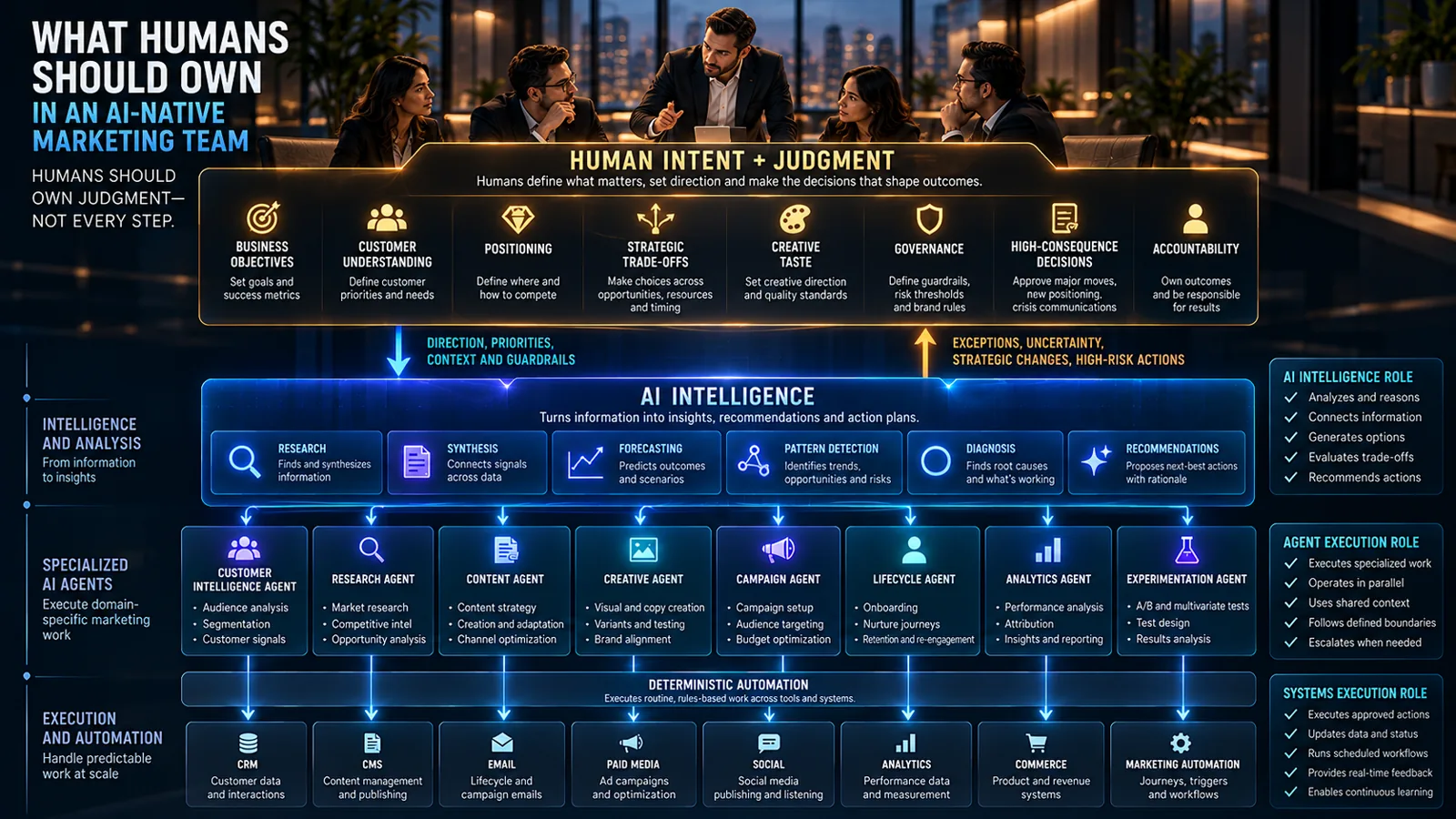
The better model is a deliberate division of labor.
In an AI-native marketing team:
AI provides scale.
Agents provide execution capacity.
Automation provides consistency.
Humans provide intent, judgment, taste, governance, and accountability.
The human role does not disappear.
It moves upward.
The Human Job Is Changing From Doing to Directing
Traditional marketing roles mix several categories of work.
A marketer might:
research,
create,
coordinate,
review,
report,
analyze,
approve.
AI can increasingly absorb portions of all of them.
But it will not affect every part equally.
The biggest change is that humans no longer need to personally perform every step required to produce an outcome.
Adobe describes this transition clearly: as agents begin taking goals, planning steps, acting across systems, and returning completed work, marketers shift from directly producing every output toward directing and supervising the work.
That changes the basic job description.
The future marketer increasingly asks:
What should happen?
rather than:
How do I manually make every step happen?
1. Humans Should Define the Objective
Every intelligent system needs a direction.
AI can optimize.
But someone has to decide:
Optimize what?
More leads?
More revenue?
Higher retention?
Brand preference?
Market share?
Customer lifetime value?
These objectives often conflict.
Increasing conversion might hurt premium positioning.
Increasing lead volume might reduce lead quality.
Reducing acquisition cost might slow expansion into a strategically important market.
AI can model these trade-offs.
Humans must decide which outcomes matter.
That is leadership.
2. Humans Should Decide What the Brand Stands For
AI can generate positioning ideas.
It can analyze competitor language.
It can identify themes customers respond to.
But positioning is not simply an optimization problem.
It is a choice.
What should customers believe about us?
What should we be known for?
Which category do we want to define?
What are we unwilling to become?
These decisions shape the company beyond one campaign.
Humans should remain responsible for them.
A Strategy Agent might say:
“Governance messaging is converting 22% better than productivity messaging.”
Useful.
But it should not independently conclude:
“Reposition the company around governance.”
That is a human decision.
3. Humans Should Understand the Customer Beyond the Data
AI can analyze enormous amounts of customer information.
Support tickets.
CRM notes.
Call transcripts.
Reviews.
Search behavior.
Surveys.
That makes it incredibly powerful for customer intelligence.
But customers are not simply datasets.
People have:
context,
emotion,
identity,
status,
fear,
aspiration,
contradictions.
Human marketers still need to:
talk to customers,
observe them,
understand social context,
interpret what customers do not say explicitly.
The strongest model becomes:
AI expands customer intelligence.
Humans create customer understanding.
Those are related, but not identical.
4. Humans Should Ask Better Questions
As answers become cheap, questions become more valuable.
AI can answer:
Which creative performed best?
A stronger marketer asks:
Why are customers responding differently to this message?
AI can identify:
Enterprise conversion declined.
A better question is:
Which evidence would distinguish a customer-quality problem from a positioning problem?
AI can generate hundreds of answers.
The person who frames the right problem determines whether those answers matter.
This makes problem definition one of the most important human capabilities in AI-native marketing.
5. Humans Should Make Strategic Trade-Offs
Marketing constantly involves choices.
Brand versus conversion.
Reach versus relevance.
Growth versus profitability.
Consistency versus experimentation.
Speed versus quality.
AI can provide models and recommendations.
But trade-offs are often expressions of:
company strategy,
risk tolerance,
values,
time horizon.
There is no universally correct answer.
Humans need to choose.
6. Humans Should Set the Creative Standard
Generative AI dramatically increases creative output.
That does not solve the creative problem.
It changes it.
Instead of asking:
“Can we make something?”
the harder question becomes:
“Which of these things is actually worth making?”
If AI generates:
100 headlines,
50 campaign concepts,
20 visual directions,
someone has to distinguish:
competent
from
memorable.
That is taste.
And as average-quality production becomes abundant, taste becomes more valuable.
AI Makes Taste a Scarce Resource
Historically, production itself was scarce.
A good designer could only create so many assets.
A good copywriter could only draft so many concepts.
AI changes that.
Now organizations risk drowning in:
acceptable content,
acceptable visuals,
acceptable campaigns.
The human role becomes less about producing another variation.
More about saying:
This one.
Not that one.
This feels like us.
That looks like everyone else.
That kind of judgment becomes strategically valuable.
7. Humans Should Create Original Insight
AI is exceptionally good at synthesizing what already exists.
That means truly original information becomes more important.
Examples:
- proprietary research
- customer interviews
- executive experience
- original frameworks
- novel observations
- internal data
- expert interpretation
Future marketers should spend more time creating information worth training the system on, rather than merely asking AI to remix existing information.
That is especially important for thought leadership.
If everybody has the same models, generic knowledge becomes less differentiating.
Original evidence becomes the advantage.
8. Humans Should Govern the Agents
AI-native teams need rules.
What may an agent access?
What may it change?
How much money may it spend?
Which claims may it publish?
When must it stop?
When should it escalate?
These are not questions the agent should answer about itself.
Humans define the boundaries.
McKinsey's research on agentic organizations argues that governance increasingly becomes embedded and continuous, while humans retain final accountability and move toward defining policies, monitoring exceptions, and adjusting the level of human involvement.
That is a major future human role.
9. Humans Should Manage Exceptions
This may become one of the biggest operational changes.
Traditional marketing teams work through every process manually.
Future agentic teams should increasingly let normal work flow automatically.
Humans enter when something unusual happens.
For example:
Analytics Agent detects ordinary variation.
No human action.
Campaign Agent makes a 3% allocation change within approved limits.
No human action.
But:
Performance suddenly collapses across markets.
Human.
A customer-safety issue appears.
Human.
Two agents strongly disagree.
Human.
A recommendation implies changing brand strategy.
Human.
The human becomes an exception manager rather than a routine operator.
Human-in-the-Loop Should Become Human-on-the-Loop
This distinction is useful.
Human in every loop
Every action waits for a person.
Slow.
Human on the loop
The system operates inside approved boundaries.
Humans monitor and intervene when needed.
More scalable.
The goal should not be to eliminate human oversight.
It should be to position oversight where it adds value.
10. Humans Should Decide the Autonomy Level
Not every agent should operate with the same freedom.
Humans determine whether an AI system can:
observe,
recommend,
prepare,
act within guardrails,
or operate a workflow autonomously.
For example:
Reporting Agent:
high autonomy.
Campaign optimization:
bounded autonomy.
Positioning:
recommend only.
Crisis communications:
human-led.
The system may execute.
Humans define its authority.
11. Humans Should Design the Workflow
One of the most valuable future skills will be workflow design.
Instead of asking:
“How do I use AI inside my current process?”
ask:
“If AI agents existed when we originally designed this workflow, would we still organize the work this way?”
Maybe Research and Customer Intelligence can operate simultaneously.
Maybe reporting no longer needs to be a separate activity.
Maybe three approval layers can become one exception-based gate.
Maybe humans no longer need to transfer information between systems.
McKinsey argues that the largest value from AI in marketing comes from rewiring workflows around human–AI collaboration, rather than inserting AI into isolated tasks.
Humans therefore need to become designers of work.
12. Humans Should Orchestrate Capabilities
A future marketer may manage:
Research Agent.
Content Agent.
Analytics Agent.
Campaign Agent.
Automation.
Freelancers.
Internal specialists.
The important skill becomes:
Which capability should handle which task?
That is orchestration.
Not every marketer needs to become a technical orchestration engineer.
But marketing leaders increasingly need to understand how to distribute work intelligently across:
humans,
agents,
automation,
software.
13. Humans Should Evaluate AI Performance
Agents should not be trusted merely because their output looks polished.
Humans need to evaluate:
Did the agent complete the task correctly?
Did it use appropriate evidence?
Did it follow the brand?
Did it escalate the right decisions?
Did it miss anything important?
Did the business outcome improve?
This creates a new human skill:
evaluating intelligent systems.
McKinsey expects future marketing organizations to include “standard bearers” who provide judgment, creativity, and quality control while other human roles focus on building and orchestrating AI capabilities.
14. Humans Should Own Quality
Quality is different from correctness.
An AI-generated article may be:
grammatically correct,
factually accurate,
well structured,
and still boring.
An advertisement can follow every brand rule and still be forgettable.
Quality requires a standard.
Humans should own that standard.
Ask:
Would we be proud to publish this?
Does it deserve customer attention?
Does it strengthen the brand?
That cannot simply become another automated checklist.
15. Humans Should Own Relationships
Marketing is not entirely software interacting with audiences.
Some of the most valuable parts of marketing involve:
customers,
creators,
communities,
partners,
journalists,
executives,
sales teams.
These relationships require:
trust,
empathy,
negotiation,
shared experience.
AI can assist with preparation and information.
But important relationships should remain human.
16. Humans Should Own High-Stakes Communication
Certain communication carries too much consequence for unrestricted autonomy.
Examples:
crisis response,
sensitive customer issues,
public controversy,
major corporate announcements,
regulatory matters.
AI can:
research,
draft,
model scenarios.
Humans should make the final decision.
Because the question is not merely:
“Is the wording correct?”
It is:
“What should the organization say and stand behind?”
17. Humans Should Make Major Resource Decisions
An AI CMO can identify:
underperforming campaigns,
growth opportunities,
potential reallocations.
But major resource allocation reflects strategy.
Should the company:
double enterprise investment?
enter another country?
reduce brand spend?
fund a new category?
AI can provide intelligence.
Humans allocate consequential resources.
18. Humans Should Own Ethics and Values
AI systems can follow policies.
They should not independently establish an organization's values.
For example:
Should we target this vulnerable audience?
Should personalization go this far?
Is this message manipulative?
Just because technology can execute something does not mean the company should do it.
Humans must own that boundary.
19. Humans Should Hold Final Accountability
This is perhaps the most important responsibility.
If:
the campaign causes harm,
the brand makes an inappropriate claim,
the system overspends,
the customer experience fails,
the organization cannot say:
“The agent decided.”
Someone has to own the outcome.
AI may gain authority.
Human accountability remains.
What Should AI Handle Instead?
If humans move upward, machines need to take more of the work below them.
AI is particularly useful for:
Research
Collecting and synthesizing large information sets.
Pattern Detection
Identifying signals humans may miss.
Production
Generating drafts and variants.
Monitoring
Watching systems continuously.
First-Level Analysis
Investigating known problem classes.
Coordination
Routing work and maintaining workflow state.
Routine Optimization
Acting inside predetermined boundaries.
Reporting
Turning raw metrics into structured performance summaries.
These are exactly the categories consuming much of marketers' time today.
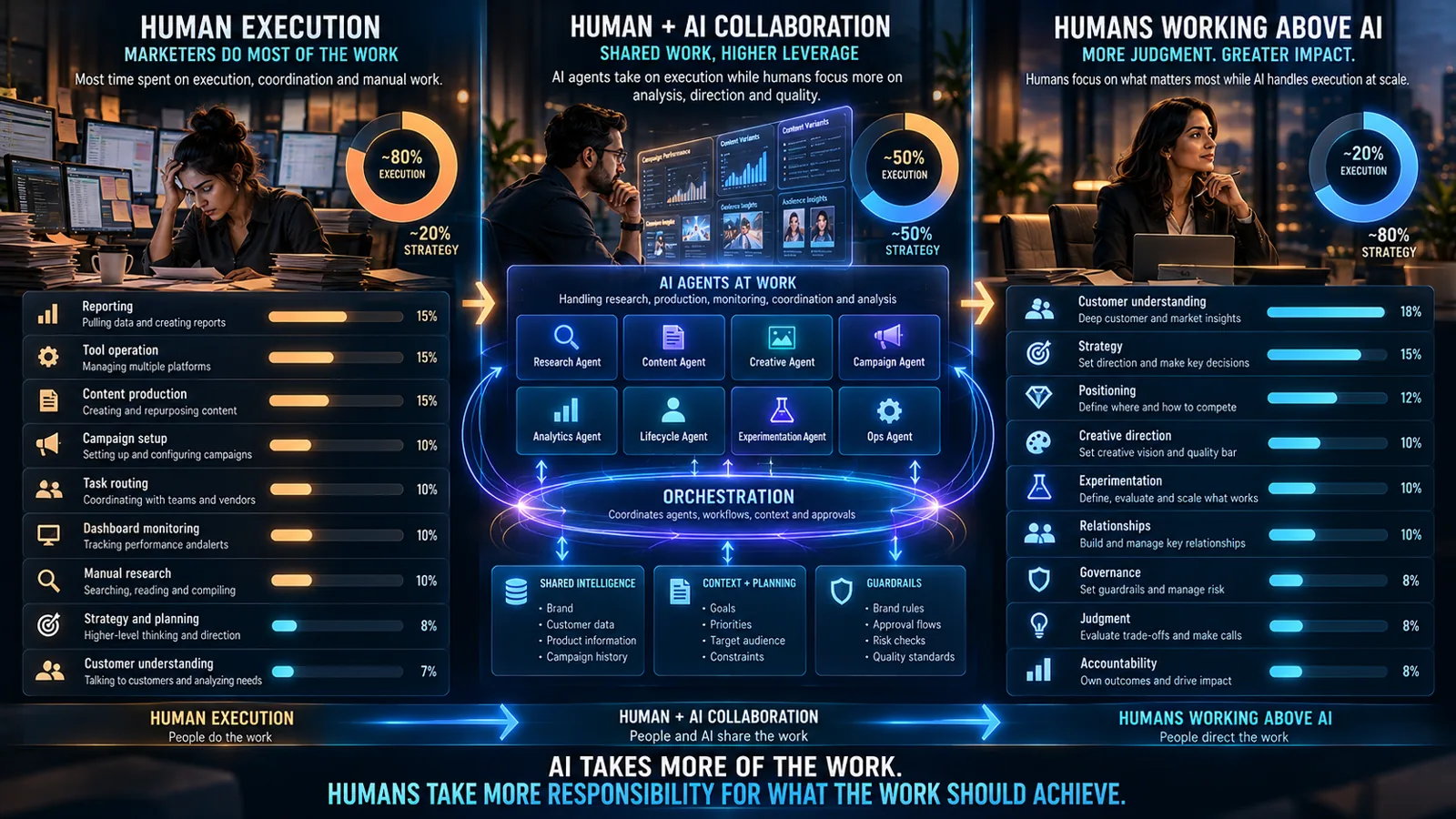
McKinsey estimates that with sufficiently capable always-on orchestration, marketers' execution time could fall from roughly 60–70% to 10–15%, freeing substantial capacity for higher-value work.
Humans Should Not Spend Their New Capacity Making More Busywork
There is an important risk.
AI saves 20 hours.
Then management fills those 20 hours with:
more meetings,
more approvals,
more reporting.
Nothing improves.
The recovered capacity should deliberately move toward:
customers,
strategy,
experimentation,
creative quality,
learning,
relationships.
Otherwise productivity gains disappear into organizational overhead.
The Human Role Is Not “Approver”
This mistake deserves emphasis.
A weak AI operating model looks like this:
AI drafts.
Human approves.
AI configures.
Human approves.
AI changes something.
Human approves.
AI runs analysis.
Human approves.
The human becomes an expensive button.
That is not meaningful human-AI collaboration.
Approval should be based on consequence.
High-risk decision?
Human.
Routine reversible action?
System.
Humans should own judgment, not every checkbox.
The Human Role Is Also Not “Prompt Engineer”
Prompting is useful.
But it is not the long-term definition of a marketer's role.
Interfaces will improve.
Agents will increasingly use persistent context.
Systems will become better at understanding objectives.
The durable skills are deeper:
problem framing,
delegation,
judgment,
taste,
governance,
systems thinking.
Prompting is an interface skill.
Those are operating skills.
A Practical Human + AI Division of Labor
A useful model looks like this:
The line is not human versus AI.
It is judgment versus scalable execution.
Human Roles Will Move Up the Stack
Consider several common marketing roles.
Content Marketer
From:
writing every asset.
To:
editorial strategy,
expertise,
quality,
distribution.
Analyst
From:
building reports.
To:
measurement,
experimentation,
decision intelligence.
Campaign Manager
From:
manually routing campaigns.
To:
exception management,
performance governance,
orchestration.
Marketing Operations
From:
tool administration.
To:
workflow architecture,
agent governance,
systems design.
Creative
From:
production.
To:
concept,
taste,
art direction.
CMO
From:
operational coordination.
To:
intent,
organizational design,
major trade-offs,
accountability.
That is what “humans working above AI” actually means.
Humans Need to Become Better Delegators
Delegating to AI is a new skill.
A weak instruction says:
“Do some customer research.”
A strong delegation defines:
objective,
scope,
sources,
constraints,
output format,
quality threshold,
escalation condition.
This is similar to managing strong people.
The better the delegation, the better the result.
AI-native marketers need to become excellent at turning vague goals into clear responsibilities.
Humans Need Stronger Domain Expertise, Not Less
There is an irony in the AI era.
Because AI makes it easier to produce convincing work, it becomes harder to recognize when something is wrong.
A marketer needs enough expertise to say:
This insight sounds plausible but the methodology is weak.
This copy sounds polished but misunderstands the audience.
This campaign recommendation optimizes the wrong metric.
AI fluency cannot replace domain expertise.
It amplifies it.
AI-Native Teams Need Fewer Human Handoffs
In traditional marketing:
Research hands to Strategy.
Strategy hands to Content.
Content hands to Creative.
Creative hands to Campaign.
Campaign hands to Analytics.
Each handoff costs:
time,
context,
attention.
Agents and orchestration can increasingly maintain continuity.
Humans should not become the messengers transferring context between intelligent systems.
That is exactly the kind of coordination work AI should remove.
Adobe argues that agents only become useful teammates when they operate inside shared context, connected systems, and governed workflows rather than isolated AI sessions that leave humans moving work manually between systems.
Humans Should Spend More Time With Customers
This may be one of the most valuable consequences of AI.
Imagine AI removes:
reporting,
routine research,
formatting,
campaign administration,
status coordination.
What should marketers do with the time?
Talk to customers.
Listen to sales.
Observe behavior.
Attend customer calls.
Visit markets.
Read nuanced feedback.
Marketing can become more human because less time is spent on administration.
Humans Should Spend More Time Creating the Future
Most marketing teams spend enormous time reacting.
Dashboard changed.
Campaign needs update.
Asset needs revision.
Report due Friday.
AI can increasingly absorb this reactive operational layer.
Human attention can move toward:
What is changing in our market?
What should our category become?
Which customer need is emerging?
What can we create that competitors are not thinking about?
Those are higher-value questions.
The Future Manager Manages Humans + Agents
Managers will increasingly supervise a blended workforce.
They need to understand:
Which agent is performing poorly?
Where are humans unnecessarily involved?
Which workflow needs redesign?
Which agent should gain more autonomy?
Where should autonomy be reduced?
McKinsey describes emerging roles including agent orchestrators and hybrid managers who supervise blended human-agent teams.
Management therefore shifts from supervising activity toward designing and improving systems of work.
The Future Team Will Be Smaller at the Execution Layer, Richer at the Judgment Layer
Not necessarily smaller overall.
But the distribution changes.
Less capacity devoted to:
manual execution,
coordination,
routine analysis.
More capacity devoted to:
strategy,
creative direction,
customer insight,
experimentation,
governance,
system design.
That is a healthier use of human talent.
The Human Advantage Is Not Being Slower but More Thoughtful
Humans should not compete with machines on:
speed,
volume,
continuous monitoring,
information processing.
That is the wrong competition.
The human advantage is:
context,
meaning,
judgment,
responsibility.
AI might tell you:
This campaign will probably generate more conversion.
A human still asks:
Is this the campaign we want representing the company?
That distinction matters.
Human Value Moves Toward Consequence
A useful rule is:
The greater the consequence, ambiguity, or irreversibility of a decision, the stronger the human role should become.
Low consequence:
automate.
Moderate consequence:
agent with guardrails.
High consequence:
human judgment.
This principle can guide the whole marketing operating model.
An AI-Native Team Should Make Humans More Human
There is a somewhat ironic possibility in all of this.
Marketing today often asks people to spend their time doing things machines are better suited to:
copying data,
watching dashboards,
formatting files,
routing work,
creating recurring reports.
AI can remove much of that.
What remains are deeply human capabilities:
understanding people,
forming opinions,
telling stories,
building trust,
making choices,
accepting responsibility.
AI-native marketing should not mean less human marketing.
It should mean less human administration.
What Should Humans Do in an AI-Native Marketing Team?
They should:
set the objective
understand the customer
choose the positioning
ask the important questions
make strategic trade-offs
set the creative bar
create original insight
design the workflow
govern the agents
manage exceptions
evaluate quality
build relationships
make high-consequence decisions
hold accountability
Everything below that should increasingly be questioned.
Does a human really need to do it?
If the answer is no, allow the system to take more responsibility.
That is how human talent moves toward its highest-value use.
The future of marketing is not humans trying to keep doing everything while AI watches from the side.
It is humans deliberately moving above the execution layer.
AI monitors.
Agents research.
Agents coordinate.
Automation executes.
Systems remember.
And humans decide:
what matters.
That may become the defining human role in the AI-native marketing organization.