Will AI Replace Marketing Jobs? The More Useful Question Is How Marketing Work Will Change
The first mistake in most AI-and-jobs conversations is treating jobs as indivisible units.
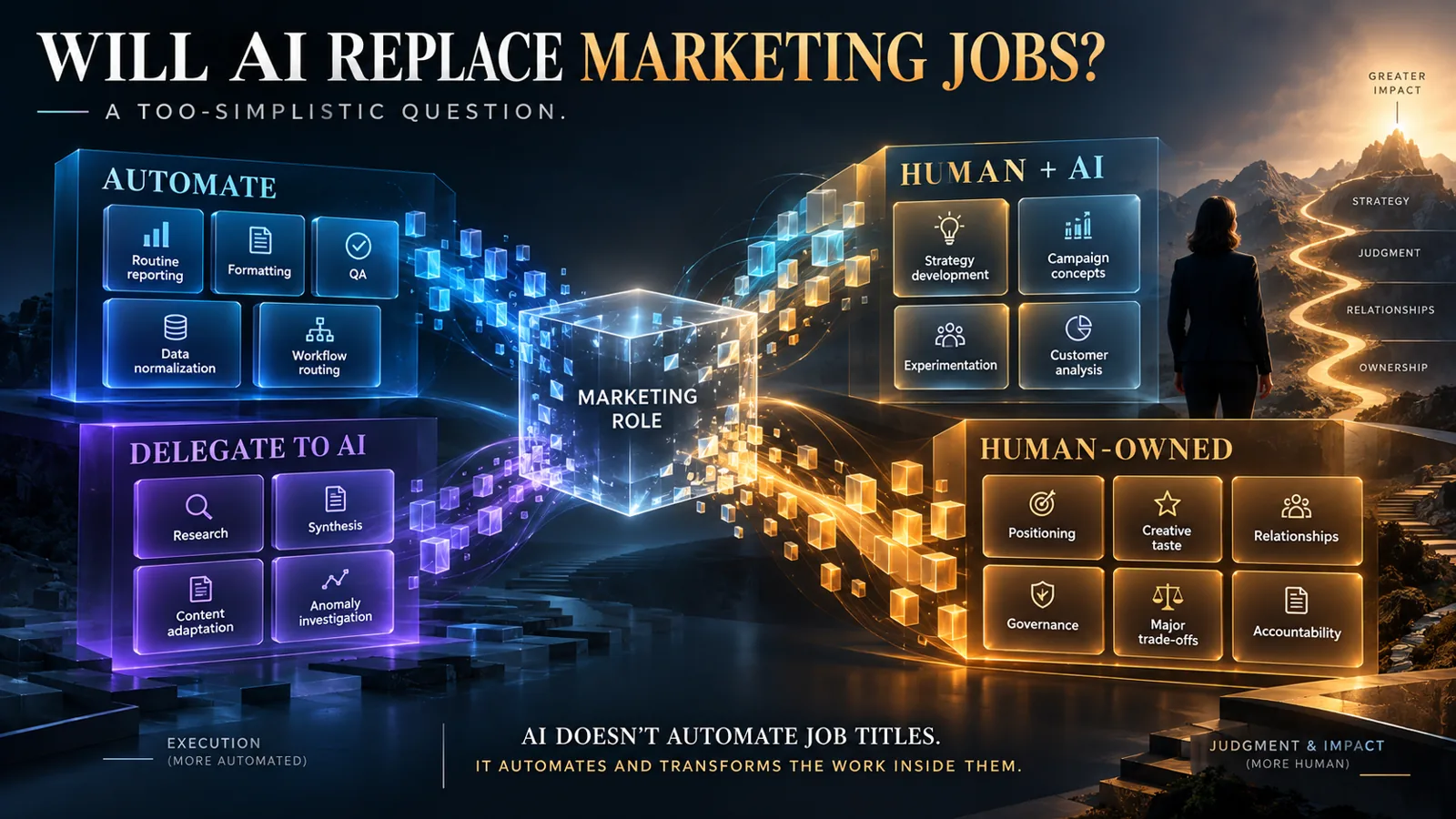
Will AI replace marketing jobs?
It is one of the most common questions surrounding artificial intelligence.
And it is understandable.
AI can already:
write copy,
create images,
analyze campaigns,
research markets,
summarize customers,
build reports,
generate advertising variations,
detect performance problems,
and increasingly take actions through AI agents.
Tasks that once required hours of human work can now happen in minutes.
So the natural conclusion is:
If AI can do the work, does the marketing job disappear?
Sometimes, portions of jobs undoubtedly will.
Some roles may shrink.
Some organizations may require fewer people for the same volume of execution.
Some work that marketers perform today will stop requiring marketers entirely.
But treating the future as a simple contest between:
job survives
and
job disappears
misses the more important transformation.
A marketing job is not one activity.
It is a bundle of activities.
A content marketer may:
research,
interview experts,
develop ideas,
write,
edit,
manage stakeholders,
analyze performance,
protect brand voice.
A performance marketer may:
develop strategy,
configure campaigns,
monitor metrics,
build reports,
allocate budgets,
design experiments,
interpret customer behavior.
AI will not affect every activity equally.
So instead of asking:
Will AI replace marketing jobs?
A much more useful question is:
Which parts of marketing work should AI perform—and what should humans do with the capacity that creates?
That question leads somewhere much more interesting.
Jobs Are Bundles of Tasks
The first mistake in most AI-and-jobs conversations is treating jobs as indivisible units.
Consider a marketing analyst.
Their job may contain:
- extracting data
- cleaning spreadsheets
- maintaining dashboards
- identifying anomalies
- investigating performance
- building forecasts
- explaining implications
- advising leadership
AI can already automate significant portions of the first several activities.
But that does not automatically mean:
Marketing Analyst → eliminated.
It can instead mean:
Marketing Analyst → different job.
Less time pulling data.
More time designing measurement.
Less time describing charts.
More time investigating causality.
Less time preparing recurring reports.
More time advising decisions.
The unit of change is often the task before it is the job.
AI Will Replace Some Marketing Work
This should not be softened unnecessarily.
There is marketing work being performed today that increasingly should not require a human.
Examples include:
- routine reporting
- basic content repurposing
- metadata creation
- first-level research
- campaign naming
- data normalization
- standard QA
- repetitive formatting
- dashboard monitoring
- routine workflow routing
If a person's role consists almost entirely of predictable activities that software can perform reliably, that role is exposed.
But that still does not tell us what happens to the broader marketing profession.
Because technology does not simply remove work.
It also changes:
what becomes possible,
what becomes scarce,
and where companies choose to invest human attention.
The Better Framework: Tasks, Roles, Workflows, Organization
AI affects marketing at four levels.
Level 1 — Tasks
AI performs an individual activity.
Example:
Generate ten headline options.
Level 2 — Roles
Enough tasks change that a person's job changes.
Example:
Content marketer shifts from producing every asset toward:
editorial strategy,
subject-matter depth,
quality,
distribution,
and AI supervision.
Level 3 — Workflows
AI connects multiple activities.
Example:
Research Agent identifies opportunity.
Content Agent creates draft.
Brand Agent reviews.
Distribution Agent adapts it.
Analytics Agent measures it.
Now the workflow changes.
Level 4 — Organization
Once enough workflows change, the entire team structure can change.
You may need:
fewer manual handoffs,
different managers,
new AI-governance roles,
smaller execution teams,
more cross-functional outcome teams.
This is where AI becomes organizational transformation.
Productivity Is Not the Same as Job Elimination
Suppose AI makes one marketer 30% more productive.
Several outcomes are possible.
The company could reduce staff.
But it could also use the additional capacity to:
publish more useful content,
run more experiments,
research customers more deeply,
personalize more experiences,
enter new markets,
support sales more effectively.
Productivity does not dictate what management does with the productivity.
That is a strategic choice.
This is why broad predictions that “AI will eliminate X% of marketing jobs” are usually less useful than they appear.
Technology changes the economics of work.
Organizations decide how those economics translate into employment and growth.
Marketing Jobs With High Repetitive Execution Will Change Fastest
Some work is naturally easier to automate.
Generally, AI can move faster into activities that are:
- repetitive
- digital
- structured
- measurable
- high-volume
- low-risk
- reversible
For example:
A marketer manually resizing approved creative into twelve channel formats is performing work that increasingly belongs to software.
A strategist choosing what the brand should stand for is doing something very different.
This creates an important rule:
The closer a role is to repetitive execution, the more aggressively AI will reshape it. The closer it is to judgment, accountability, relationships, and differentiated expertise, the more likely AI is to change the role rather than simply absorb it.
What Happens to Content Marketing?
Content is often presented as one of the functions most threatened by generative AI.
And parts of content production clearly are.
AI can produce:
- first drafts
- summaries
- descriptions
- variations
- social adaptations
- metadata
- basic SEO content
The cost of producing ordinary content is collapsing.
That creates pressure on roles built primarily around producing ordinary content.
But the scarce skills shift toward:
- original ideas
- editorial judgment
- expert knowledge
- interviews
- proprietary research
- storytelling
- distribution
- point of view
- brand voice
The future content marketer becomes less valuable for the ability to generate words.
More valuable for deciding which words deserve to exist.
What Happens to Copywriters?
Generic copy becomes much cheaper.
AI can generate dozens of reasonable versions instantly.
So value moves toward:
- campaign concepts
- distinctive language
- brand understanding
- persuasion
- cultural nuance
- high-stakes messaging
A person whose advantage is:
“I can produce competent copy quickly”
faces significant pressure.
A person whose advantage is:
“I understand what this brand should say, to whom, why, and in a way competitors cannot easily imitate”
has a much more durable position.
What Happens to Designers and Creatives?
AI dramatically expands visual production capacity.
That reduces the scarcity of execution.
But again, abundance creates another bottleneck:
taste.
Someone still needs to decide:
What fits the brand?
What feels generic?
What is culturally appropriate?
What idea is memorable?
Which visual system should define the campaign?
The creative role shifts upward from:
making every asset
toward:
directing the system that makes the assets.
What Happens to Marketing Analysts?
Reporting is highly exposed.
AI can increasingly:
retrieve metrics,
produce summaries,
detect anomalies,
compare segments,
and perform first-level investigation.
The analyst who primarily builds recurring dashboards will see substantial change.
But analytics does not disappear.
Higher-value work becomes:
- measurement design
- experimentation
- causal inference
- validating AI conclusions
- defining meaningful KPIs
- strategic interpretation
The future analyst produces fewer reports.
They improve more decisions.
What Happens to Performance Marketers?
Platform operation becomes increasingly automated.
Advertising systems already optimize:
bids,
delivery,
audiences,
and creative distribution.
Agentic systems can add another layer of monitoring and reasoning.
Performance marketers therefore move toward:
- investment strategy
- experimentation
- unit economics
- channel portfolio decisions
- customer strategy
- interpreting performance
Less button pushing.
More capital allocation.
What Happens to SEO?
SEO is changing for reasons beyond internal automation.
Search itself is changing.
Traditional work such as:
keyword gathering,
brief generation,
metadata,
basic content optimization
is increasingly automatable.
Higher-value SEO work moves toward:
- audience demand
- information architecture
- topical authority
- original evidence
- technical strategy
- brand/entity visibility
- AI-search discoverability
The job becomes broader than optimizing pages around lists of keywords.
What Happens to Social Media Roles?
Routine social execution is also highly automatable.
AI can:
adapt copy,
create variants,
schedule content,
analyze engagement,
identify patterns.
Human value shifts toward:
- community understanding
- cultural timing
- brand personality
- relationships
- real-time judgment
- creative concepts
Again, execution changes before the need for the capability disappears.
What Happens to Marketing Operations?
Marketing Operations may be one of the roles AI transforms most dramatically—and potentially makes more strategic.
Traditional Marketing Ops often handles:
- campaign setup
- routing
- integrations
- data hygiene
- reporting
- software administration
AI agents and automation can absorb more repetitive execution.
But someone must design:
- agent permissions
- workflow orchestration
- context architecture
- evaluation
- observability
- governance
Marketing Ops can evolve toward something closer to:
Marketing Systems + AI Operations.
That may make the function more important.
What Happens to Marketing Managers?
Management changes too.
A manager traditionally manages:
people,
deadlines,
work allocation,
status,
quality.
Future managers may increasingly manage:
people,
agents,
workflows,
exceptions,
quality standards.
They will ask:
Should this work go to a human or an agent?
Why did this agent fail?
Should this workflow become autonomous?
Where should approval remain?
McKinsey's 2026 work increasingly points toward the rise of agent managers and human–agent operating models where quality control and critical thinking carry a premium.
Management does not disappear.
Its object changes.
What Happens to the CMO?
The CMO becomes less valuable as a human coordination layer.
More valuable as the owner of:
- strategy
- positioning
- customer priorities
- resources
- organizational design
- AI governance
- accountability
As AI handles more analysis and coordination, senior leaders can theoretically spend less time reconstructing what happened and more time deciding what matters next.
The CMO moves upward.
The Jobs Most Exposed Are Not Necessarily Specific Titles
This is an important distinction.
Rather than saying:
“Copywriters are doomed.”
“Analysts are safe.”
look at the composition of the work.
A senior copywriter producing original campaigns may perform highly differentiated human work.
A senior analyst may spend most of the week producing predictable reports.
The title does not tell you enough.
Exposure depends on the activity mix.
Ask:
How much of this role is:
repetitive execution?
pattern recognition?
structured production?
relationship building?
judgment?
accountability?
That is a much better way to evaluate career risk.
A Useful Four-Bucket Framework
Break every marketing role into four categories.
1. Automate
Work software should increasingly perform directly.
Examples:
- formatting
- routine QA
- reporting
- routing
2. Delegate to AI
Work requiring flexible reasoning but not necessarily human execution.
Examples:
- first-level research
- synthesis
- content adaptation
- anomaly investigation
3. Human + AI
Work where AI increases capacity but human judgment remains central.
Examples:
- strategy development
- campaign concepts
- experimentation
- customer analysis
4. Human-Owned
Work where accountability, values, taste, relationships, or high consequence dominate.
Examples:
- positioning
- crisis communication
- major budget trade-offs
- leadership
- final accountability
A future role becomes the combination that remains after this redistribution.
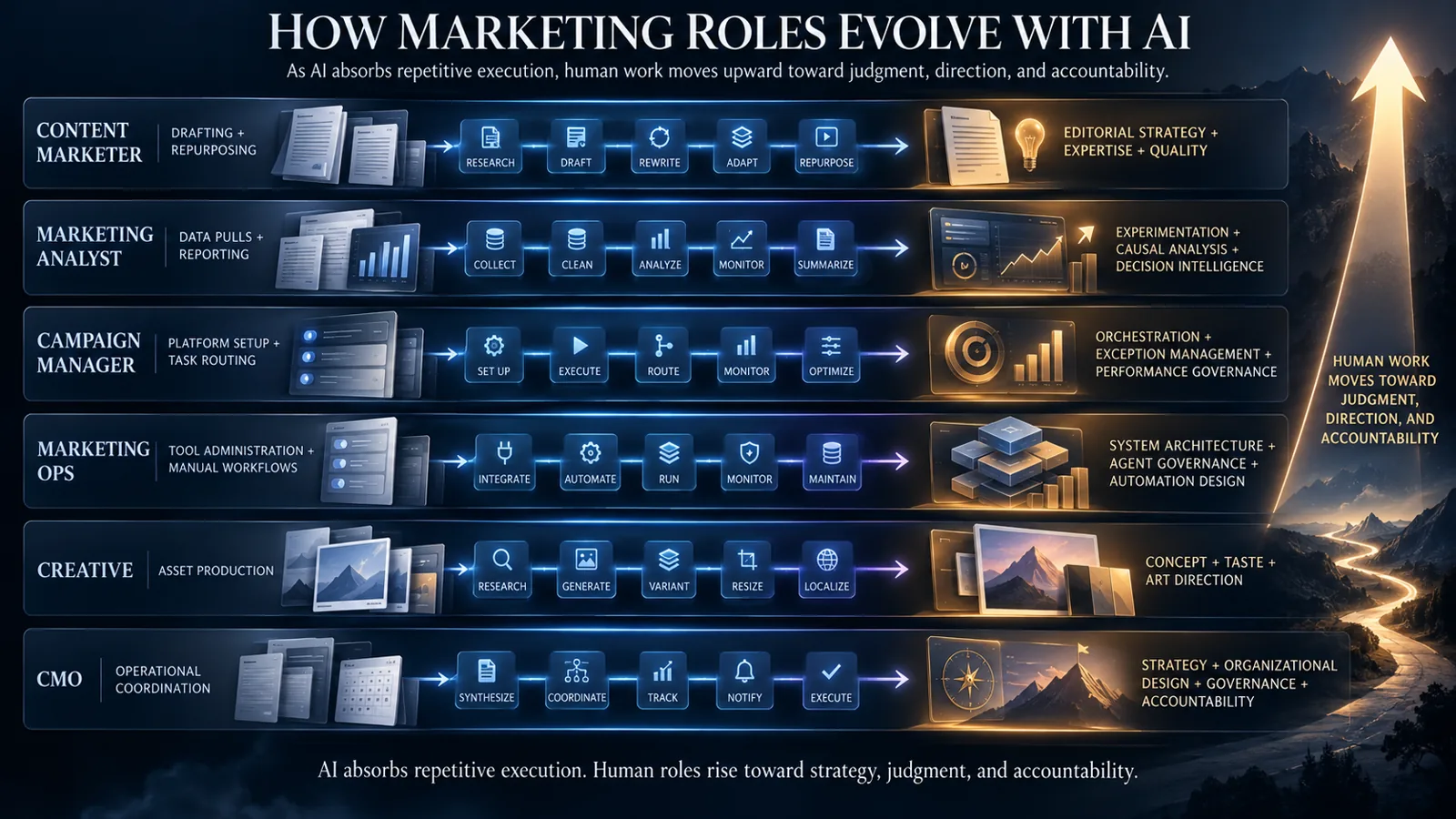
The More Useful Question: What Moves Up?
When AI absorbs low-level work, the important question becomes:
What does the person move toward?
For an analyst:
reporting → experimentation.
For a writer:
drafting → editorial direction.
For a designer:
production → art direction.
For a campaign manager:
configuration → orchestration.
For Marketing Ops:
tool administration → system architecture.
For the CMO:
coordination → organizational judgment.
This is where the opportunity sits.
But Not Everyone Automatically Moves Up
This is an important caveat.
AI does not guarantee every employee receives more strategic work.
Organizations must redesign roles intentionally.
Otherwise one of two things happens.
Outcome 1
AI removes tasks but roles never evolve.
Employees become underutilized.
Outcome 2
AI creates additional outputs but employees still perform all the old work.
Employees become overloaded.
Neither is transformation.
Companies need to deliberately decide what humans should stop doing and what they should start doing instead.
Skills Will Matter More Than Titles
As roles change faster, skills become more important.
Several human capabilities are likely to become more valuable.
Judgment
Knowing when an AI output is wrong, weak, or inappropriate.
Taste
Recognizing quality among abundant AI-generated options.
Strategy
Choosing where to compete and what matters.
Customer Understanding
Interpreting human motivations beyond surface-level data.
Experimentation
Turning uncertainty into structured learning.
Communication
Aligning people around decisions.
Governance
Defining what AI may do.
Systems Thinking
Understanding how workflows, agents, data, and humans connect.
AI Literacy Becomes Table Stakes
This does not mean every marketer needs to become a machine-learning engineer.
But marketers should increasingly understand:
- how models use context
- how agents work
- what orchestration means
- where AI fails
- how to evaluate results
- how to delegate to AI
- how autonomy and permissions work
The marketer who understands both:
marketing
and
how to work with intelligent systems
will have more leverage than someone who understands only one side.
Domain Expertise Becomes More Important
AI can quickly make a novice sound competent.
That makes genuine expertise more valuable.
Why?
Because when everyone can generate:
good-looking strategies,
good-looking reports,
good-looking content,
surface quality becomes less reliable as a signal of competence.
People who actually understand:
the customer,
the economics,
the category,
the brand,
can distinguish plausible output from correct output.
AI raises the premium on judgment.
The Ability to Ask Good Questions Matters
First-generation AI use emphasized prompting.
Long term, the deeper skill is not merely writing prompts.
It is framing problems.
For example:
Weak question:
“Create a marketing campaign.”
Better question:
“Why is enterprise conversion falling despite stable high-intent traffic?”
Better still:
“Which evidence would distinguish a messaging problem from an audience-quality problem?”
As execution becomes easier, problem definition becomes more valuable.
New Marketing Roles Will Appear
Technology does not only automate roles.
It creates new ones.
Possible capabilities include:
AI Marketing Architect
Designs how models, agents, data, and tools connect.
Human-Agent Orchestrator
Designs the division of work across people and agents.
Agent Evaluator
Measures reliability and failure patterns.
AI Governance Lead
Defines permissions and risk thresholds.
AI Brand Steward
Maintains quality and brand consistency across large-scale AI output.
McKinsey's 2026 marketing research explicitly anticipates new roles for builders, orchestrators, and standard bearers as marketing becomes more AI-native.
AI May Reduce Some Teams—and Expand Others
There is no credible reason to assume headcount effects will be identical everywhere.
Some organizations may decide:
We can produce the same output with fewer people.
Others may decide:
With the same team, we can now run three times as many experiments.
Still others may create entirely new capabilities.
The important distinction is:
AI reduces the marginal cost of certain kinds of marketing work.
How companies respond to that change depends on:
strategy,
economics,
growth opportunities,
management choices.
Productivity Gains Can Hide Organizational Failure
This is one of the most important current signals.
McKinsey's October 2026 research reports that 80% of surveyed organizations say AI has improved individual productivity, while only 37% report positive EBIT impact and just 6% qualify as AI high performers.
That gap tells us something.
Making individuals faster is not enough.
If:
roles remain unchanged,
workflows remain unchanged,
coordination remains unchanged,
the company's economics may barely move.
This is why the jobs conversation needs to move from:
“Will my task get automated?”
to:
“How will the organization redesign work?”
Marketing Employees Are Already Anxious
The anxiety around this transition is real.
McKinsey's 2026 marketer research found 57% of marketers reporting anxiety about what AI means for their roles, with anxiety reaching 76% among individual contributors in its sample.
That makes leadership communication important.
Employees need to understand:
Which work is changing?
Which capabilities matter more?
How will success be evaluated?
What is AI allowed to do?
Where should employees develop new skills?
“Use more AI” is not a workforce strategy.
People need a credible picture of the role they are moving toward.
Leaders Should Stop Saying “AI Won't Replace You”
That reassurance is too simplistic.
Some work will disappear.
Some roles may shrink.
Some jobs may change enough that today's title becomes irrelevant.
A more useful message is:
We are redesigning work, and we need to be explicit about where human value moves.
That respects the reality of the transition.
It also creates something employees can prepare for.
Leaders Should Also Stop Saying “AI Will Replace Everyone”
That is equally unhelpful.
AI capability does not map directly to job elimination.
Organizations still need:
- responsibility
- customer understanding
- leadership
- judgment
- collaboration
- strategy
- governance
And even where AI can technically perform an activity, organizations may choose different operating models depending on:
risk,
economics,
quality,
and customer expectations.
The future will be more varied than a single replacement narrative suggests.
The Future Role Has Three Layers
A useful way to redesign a marketing job is to think in three layers.
Human-Owned Layer
What must the employee remain accountable for?
Example:
Content Lead owns editorial quality.
Human + AI Layer
Where should AI dramatically expand the employee's capability?
Example:
AI performs research and creates draft options while the Content Lead sets direction and edits.
Autonomous Layer
What can happen without human involvement?
Example:
Approved content is adapted into standard channel formats.
This creates a much more concrete job design than simply saying:
“Everyone should use AI.”
The Future Marketing Career Is About Leverage
Historically, a marketer's output was closely tied to personal capacity.
One writer could write only so much.
One analyst could investigate only so much.
One campaign manager could operate only so many campaigns.
AI weakens that constraint.
A marketer may increasingly direct:
multiple agents,
automated workflows,
persistent monitoring systems.
The valuable employee becomes someone capable of turning their judgment into system-level leverage.
One Great Marketer Could Direct Much More Work
Imagine a strategist supported by:
Research Agent
Customer Intelligence Agent
Content Agent
Analytics Agent.
That strategist can potentially operate across a much larger information and execution surface than one person could traditionally handle.
This does not make the strategist redundant.
It changes the strategist's leverage.
The same may happen across:
creative,
analytics,
growth,
operations.
The Future Team May Be Smaller—but More Capable
McKinsey's 2026 marketing research expects AI-enabled marketing organizations to become smaller, faster, and increasingly organized around end-to-end workflows, while adding new roles around AI system building, human-agent orchestration, and quality.
That does imply possible headcount pressure in some environments.
But the more strategically useful point is:
capacity becomes less tightly connected to headcount.
A 20-person AI-native marketing team may eventually have execution capacity that previously required far more people.
That changes organizational design.
The Org Chart Itself Starts Changing
Traditional marketing:
Content department.
Performance department.
Analytics department.
CRM department.
Agentic marketing increasingly allows capabilities to assemble around an outcome.
Example:
Enterprise Acquisition
Human:
Growth Strategist
Creative Lead
Product Marketing
Agents:
Customer Intelligence
Research
Content
Campaign
Analytics
Experimentation
The question becomes:
What combination of humans and agents delivers the outcome?
Not merely:
Which department owns the task?
AI Agents Also Need Management
The workforce question increasingly includes digital workers.
If an organization deploys agents, someone needs to manage:
- scope
- permissions
- performance
- quality
- errors
- escalation
McKinsey's 2026 work on human-agent workforces argues that organizations need performance-management approaches for AI agents too, while keeping human critical thinking and quality control central.
The management layer does not vanish.
It expands.
What Should Marketing Leaders Do Now?
CMOs should not begin with:
Which jobs can we eliminate?
That tends to optimize for short-term cost before understanding the new operating model.
A stronger sequence is:
Step 1 — Map Work
What does the team actually do?
Step 2 — Break Roles Into Activities
Separate:
execution,
analysis,
judgment,
coordination,
relationship work.
Step 3 — Determine the Best Performer
For every activity:
Human?
AI?
Automation?
Human + AI?
Step 4 — Redesign the Workflow
Remove steps that no longer make sense.
Step 5 — Redesign Roles
Give humans ownership of higher-value outcomes rather than leaving them with remnants of old job descriptions.
Step 6 — Reskill Deliberately
Train for the role people are moving into.
Not simply for today's tool.
Step 7 — Measure Outcomes
Did:
productivity improve?
quality improve?
decision speed improve?
revenue improve?
employee capacity improve?
That is workforce transformation.
What Should Marketers Do Now?
Individual marketers should perform a similar audit.
Take your current role.
List every repeated activity.
Then classify it:
Likely to Automate
Do not build your career around protecting it.
AI-Assisted
Learn how to perform it with much greater leverage.
Human Differentiator
Become unusually good at it.
This turns an abstract fear into a practical career strategy.
Don't Compete With AI on Volume
This may be one of the most important individual lessons.
Do not build your differentiation around:
how many posts you can produce,
how many slides you can build,
how fast you can summarize a report.
Machines will increasingly win those competitions.
Differentiate through:
- insight
- taste
- trust
- expertise
- judgment
- relationships
- accountability
Those create more durable value.
Learn to Work Above AI
The future marketer should not be:
under AI,
performing whatever remains after automation.
They should increasingly work above AI.
Human defines:
objective.
AI investigates.
Human chooses:
direction.
AI creates options.
Human sets:
standard.
Agents execute.
AI monitors.
Human handles:
exceptions and strategic changes.
That is a powerful operating model.
The Question Is Not Whether Marketing Still Needs Humans
Marketing fundamentally deals with people.
Customers.
Culture.
Trust.
Identity.
Emotion.
Choice.
Machines will increasingly become capable participants in the process.
But organizations will still need people to determine:
what is worth saying,
what is worth building,
which customer matters,
which trade-off is acceptable,
what the company should stand for,
and who takes responsibility for the outcome.
Those questions do not become less important because AI gets better.
They become more visible.
Will AI Replace Marketing Jobs?
Some marketing jobs will likely disappear.
Some will shrink.
Some will be redesigned.
Some entirely new roles will emerge.
And many existing jobs will contain far more AI than they do today.
But that is still not the most useful question.
The better questions are:
Which parts of my work are becoming software?
Which capabilities remain distinctly valuable?
How should my role change?
What can I do now that was impossible before?
How should the team be redesigned?
Where should humans remain accountable?
The companies that answer those questions well will not merely automate marketing.
They will redesign the marketing organization.
And the marketers who answer them personally will have a much clearer strategy than those spending the next several years trying to predict whether their job title will survive.
The future of marketing careers is not about protecting every task humans perform today.
It is about making sure human talent moves toward the work where it continues to create the greatest value.
Frequently asked questions
Will AI replace marketing jobs?
AI is likely to automate significant portions of marketing work and may reduce demand for some execution-heavy roles. But many marketing jobs will also be redesigned as humans move toward strategy, judgment, creativity, relationships, governance, experimentation, and system oversight.
Which marketing tasks are most likely to be automated?
Routine reporting, basic content adaptation, data normalization, recurring research, campaign QA, workflow routing, dashboard monitoring, metadata, and other repetitive digital tasks are strong candidates.
Which marketing skills will become more valuable?
Judgment, creative taste, strategic thinking, customer understanding, domain expertise, experimentation, communication, relationship building, systems thinking, and AI governance are likely to become increasingly valuable.
Will AI replace content marketers?
AI will automate more content production and adaptation, particularly generic or repetitive content. Human content roles are likely to shift toward editorial strategy, expertise, original insight, storytelling, distribution, and quality.
Will AI replace marketing analysts?
AI can automate more reporting, monitoring, and first-level investigation. Human analysts can move toward experimentation, causal analysis, measurement design, validating AI conclusions, and strategic decision support.
Will AI replace performance marketers?
AI will increasingly automate campaign mechanics and bounded optimization. Human performance marketers are likely to focus more on economics, experimentation, investment strategy, audience strategy, and channel portfolio decisions.
What new marketing jobs will AI create?
Emerging capabilities may include AI Marketing Architects, Human-Agent Orchestrators, AI Governance Leads, Agent Evaluators, and AI Brand Stewards.
Should marketers learn AI?
Yes. AI literacy is becoming part of general marketing literacy. Marketers should understand how AI uses context, how agents operate, where systems fail, how to evaluate outputs, and how to delegate work effectively.
Will marketing teams become smaller?
Some may. AI can increase execution capacity and reduce repetitive work, allowing organizations to produce the same output with fewer people. Other companies may use the capacity to expand experimentation, research, personalization, and growth instead.
What is the best way for marketers to prepare?
Audit the activities in your role, identify which are likely to automate, learn to use AI to increase leverage on AI-assisted work, and invest deeply in skills where human judgment, expertise, creativity, relationships, and accountability remain valuable.