Your Next Marketing Hire Might Be an AI Agent: How to Decide Between Hiring a Person, Deploying an Agent, or Redesigning the Workflow
Increase campaign execution capacity without proportionally increasing Campaign Operations headcount.
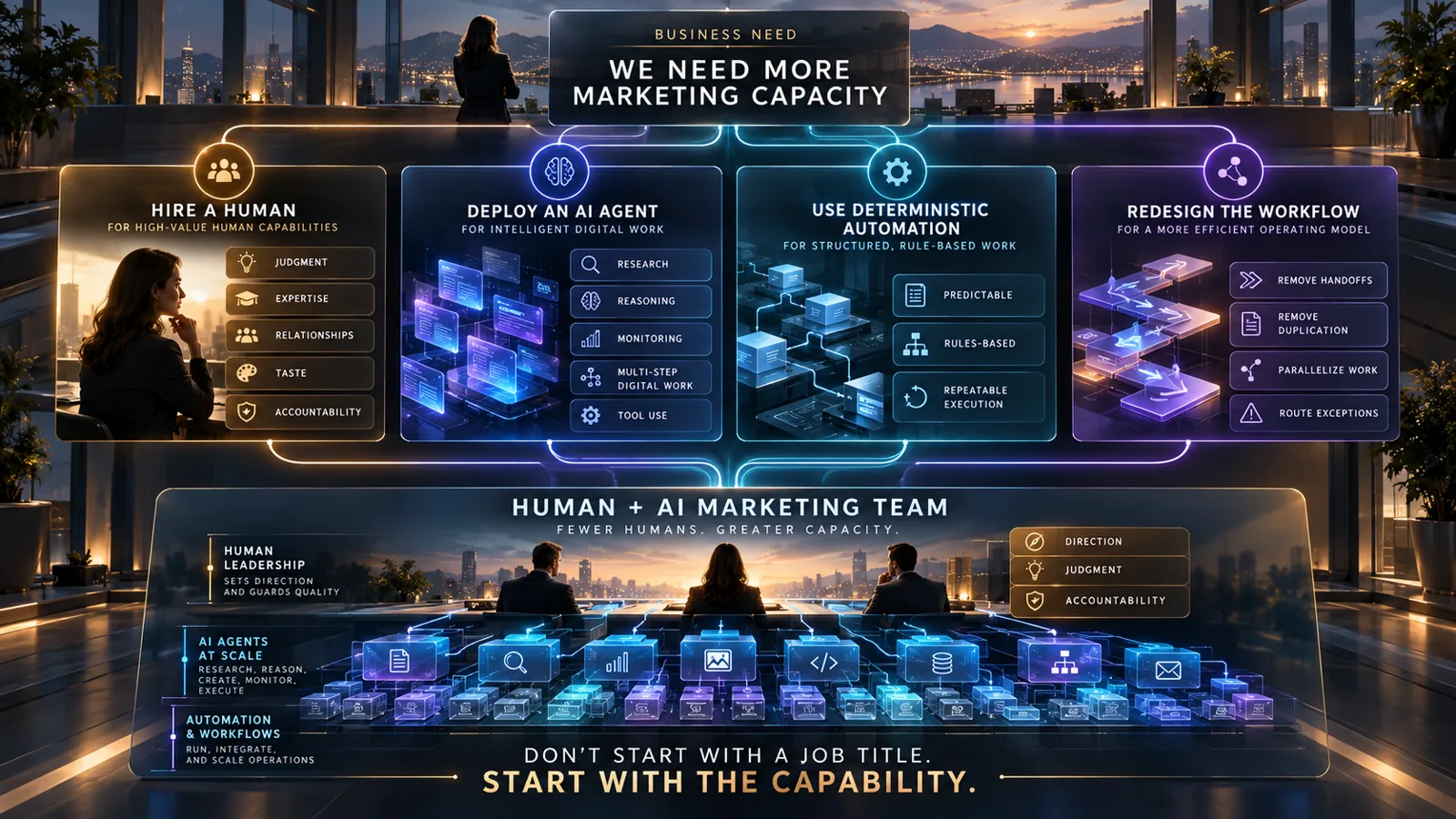
A marketing leader identifies a problem.
Content production is too slow.
Campaign reporting is taking too much analyst time.
Customer research is inconsistent.
Marketing Operations is overloaded.
Campaign managers are drowning in coordination.
The traditional response is predictable:
We need another person.
Open a job description.
Approve headcount.
Recruit.
Interview.
Hire.
Onboard.
But that may no longer be the only reasonable answer.
Increasingly, the question should become:
What capability are we actually missing?
Because the best way to add that capability might be:
a human,
an AI agent,
deterministic automation,
or a redesigned workflow that makes the additional role unnecessary.
That does not mean companies should stop hiring marketers.
Far from it.
It means headcount is no longer the only way to add marketing capacity.
And that changes workforce planning fundamentally.
Your next marketing hire might still be a person.
But increasingly, it might also be an AI agent.
Hiring Has Always Been About Adding Capability
Companies technically hire people.
But what they are really buying is capability.
You hire a researcher because you need:
market understanding.
You hire a content marketer because you need:
content strategy and production.
You hire an analyst because you need:
measurement and interpretation.
You hire a campaign manager because you need:
campaign coordination and execution.
Historically, capability and headcount were tightly connected.
Need more research?
Hire another researcher.
Need more campaigns?
Add another campaign manager.
Need more reporting?
Hire another analyst.
AI begins separating those two things.
A company may now increase research capacity without adding a researcher.
Increase reporting capacity without adding an analyst.
Increase campaign execution capacity without proportionally increasing Campaign Operations headcount.
That changes the hiring equation.
The New Question: What Capability Are We Missing?
Imagine the marketing team says:
“We need another content marketer.”
Why?
Possible answers:
“We need more original thought leadership.”
“We need someone who understands the industry deeply.”
“We need more blog production.”
“We need someone to repurpose approved content across channels.”
Those are four very different needs.
The first two may strongly justify a human hire.
The latter two may increasingly be addressed partly through agents.
So before creating a role, decompose the problem.
Ask:
What work actually needs to happen?
Which parts require:
- human judgment?
- domain expertise?
- relationships?
- creativity?
- accountability?
Which parts require:
- scale?
- monitoring?
- synthesis?
- repetitive production?
- coordination?
That is the beginning of AI-native workforce planning.
Person, Agent, Automation, or Workflow Redesign?
A useful hiring framework has four options.
Option 1 — Hire a Human
Best when the capability requires:
- high judgment
- ambiguity
- deep expertise
- relationships
- creative taste
- accountability
Examples:
Brand leader.
Senior strategist.
Customer research leader.
Creative director.
Option 2 — Deploy an AI Agent
Best when the capability requires:
- flexible reasoning
- repeated information processing
- continuous monitoring
- structured multi-step work
- tool use
Examples:
Research Agent.
Analytics Agent.
Campaign QA Agent.
Customer Intelligence Agent.
Option 3 — Use Deterministic Automation
Best when the work is:
- predictable
- rules-based
- repetitive
Examples:
Lead routing.
Scheduling.
Data syncing.
Suppression rules.
Routine campaign triggers.
Option 4 — Redesign the Workflow
Sometimes the missing “role” exists only because the workflow is inefficient.
If five people spend significant time manually transferring information between systems, the solution may not be a sixth coordinator.
It may be eliminating the handoffs.
This is frequently the most overlooked option.
Do Not Hire an Agent to Preserve a Bad Process
This deserves emphasis.
Suppose the company has a campaign workflow containing:
nine approvals,
seven manual handoffs,
three duplicate reports.
Do not simply create an AI Campaign Coordinator to move work through all of them faster.
You may have automated bureaucracy.
Instead ask:
Which steps should still exist?
Which approvals can disappear?
What can happen in parallel?
What should become exception-based?
McKinsey's 2026 research repeatedly emphasizes that value from agentic AI comes from redesigning end-to-end workflows rather than simply inserting agents into existing process fragments.
The best AI hire may sometimes be no hire at all.
What Makes an AI Agent Different From Software?
Traditional software usually waits.
A marketer logs in.
Clicks.
Configures.
Executes.
An agent can potentially receive an objective and participate in the workflow.
For example:
Monitor our enterprise campaigns and investigate meaningful performance declines.
The Analytics Agent can:
retrieve data,
compare performance,
segment results,
identify likely causes,
prepare recommendations,
and escalate significant findings.
That begins to resemble a role more than a feature.
Salesforce now explicitly describes agents operating as analytical and creative partners that can help marketers qualify leads, create campaigns, and optimize customer experiences.
But an Agent Is Not Literally an Employee
The analogy has limits.
An AI agent does not:
have human judgment,
understand office politics,
build genuine customer relationships,
take moral responsibility,
or possess the broader contextual awareness of an experienced employee.
So the useful idea is not:
agents are employees.
It is:
agents can become persistent participants in work.
That distinction matters.
What Can a Marketing Agent Own?
A well-designed marketing agent can own a defined capability.
For example:
Research Agent
Responsibility:
continuous market research.
Inputs:
business objectives,
category definitions,
approved sources.
Outputs:
structured market insights.
Escalates:
uncertain or strategically important developments.
Analytics Agent
Responsibility:
monitor performance and investigate anomalies.
Inputs:
campaign metrics,
business targets,
historical benchmarks.
Outputs:
diagnosis,
recommended action.
Escalates:
low-confidence or high-impact decisions.
Content Adaptation Agent
Responsibility:
convert approved content into channel-specific formats.
Inputs:
approved core asset,
brand standards,
channel requirements.
Outputs:
adapted content.
Escalates:
new claims or substantial changes in meaning.
These are closer to job descriptions than one-off prompts.
Agents Need Job Descriptions Too
This may become an important organizational discipline.
Every production agent should have something equivalent to:
Role
What capability does it own?
Objective
What outcome should it optimize?
Context
What information may it access?
Tools
Which systems may it use?
Permissions
What may it change?
Limits
What may it never do?
Escalation
When should it involve a human?
Evaluation
How is performance measured?
An agent without this clarity is less like a good employee and more like an intern with every company password.
Your First AI Agent Probably Should Not Be the CMO
There is a temptation to begin at the top.
Build an autonomous CMO.
Give it everything.
That is usually backwards.
Start with narrow, high-frequency, measurable capabilities.
Examples:
Performance monitoring.
Research.
Reporting.
Campaign QA.
Content adaptation.
These provide an opportunity to learn:
how agents behave,
where context fails,
which permissions matter,
how humans respond,
before increasing responsibility.
The same logic applies when hiring people.
You do not give a new employee unlimited authority on day one.
AI Agents Are Particularly Strong at Continuous Work
This is one major difference from human hires.
People need:
working hours,
focus,
rest.
Agents can continuously monitor digital systems.
For example:
An Analytics Agent can watch campaign performance continuously.
A Competitive Intelligence Agent can detect new competitor changes.
A Customer Intelligence Agent can continuously synthesize new feedback.
This makes agents particularly useful for activities where the main constraint was previously human attention.
Agents Are Also Strong at High-Volume Work
Imagine adapting one approved campaign into:
ten audience variants,
eight channels,
five markets.
A human team can do it.
But production scales almost linearly with workload.
AI changes that relationship.
The human can define:
message,
standard,
constraints.
Agents handle more execution.
Human attention shifts toward exceptions and quality.
Where a Human Hire Is Still Clearly Better
Some capabilities remain strongly human.
Strategic Judgment
Which market should we enter?
What should the brand stand for?
AI can provide evidence.
Humans should own the decision.
Creative Taste
AI can generate abundance.
Someone still needs to determine what is distinctive and worth publishing.
Relationships
Customers.
Partners.
Executives.
Employees.
Relationships involve trust and social context that should not be reduced to agent interaction.
Leadership
People still need clarity, motivation, coaching, and accountability.
High-Consequences Accountability
An agent can recommend a crisis response.
A human needs to own it.
The Strongest Hiring Model Is Usually Human + Agent
The most interesting outcome may not be:
hire human
versus
hire agent.
It may be:
hire one excellent human and give them several capable agents.
Imagine a senior Content Strategist supported by:
Research Agent,
SEO Agent,
Content Adaptation Agent,
Analytics Agent.
That person can operate with much greater capacity.
Or a Growth Lead supported by:
Customer Intelligence Agent,
Campaign Agent,
Analytics Agent,
Experimentation Agent.
This is where AI changes span of capability.
One Human Can Direct More Execution Capacity
Historically, execution capacity was strongly tied to team size.
One person can manage only so much.
But if agents perform more:
research,
monitoring,
production,
coordination,
a single skilled marketer can potentially govern a much larger operating surface.
This has major implications for hiring.
Instead of hiring five specialists to increase throughput, a company may sometimes hire one stronger strategic operator and build agent capacity underneath them.
Not always.
But increasingly, it becomes an option.
Your Agent Still Needs Onboarding
A common mistake is assuming an AI agent works immediately because the model is intelligent.
Adobe describes an agent dropped into an organization without shared context as a “brilliant stranger.” It may be capable, but it does not know how your company operates, which work has succeeded, or who must approve what.
A production agent therefore needs onboarding.
It needs:
- brand context
- customer definitions
- business objectives
- workflow rules
- tool access
- permissions
- escalation logic
The analogy to human onboarding is useful.
A brilliant new marketer without context still needs time to understand the company.
Agents do too—except that context must be designed explicitly.
Agents Need Access to the Same Work Environment
If an agent operates only inside an isolated chat window, much of its usefulness disappears.
Humans still need to:
copy its output,
route the task,
update project status,
attach files.
Adobe's Workfront AI Collaborators reflect the opposite model: agents participate directly inside governed workflows as permissioned users, using project context and returning finished work where the team already operates.
That is closer to a real workforce model.
The agent becomes part of the workflow rather than another tool beside it.
Hiring an Agent Creates Management Work
Agents do not eliminate management.
They create a new type of management.
Someone needs to determine:
Is the agent performing correctly?
Does it escalate too much?
Does it escalate too little?
Is context accurate?
Should permissions change?
Should the agent gain more autonomy?
The team needs agent owners.
For example:
Analytics Agent → owned by Head of Analytics.
Content Agent → owned by Editorial Lead.
Campaign Agent → owned by Marketing Operations.
Human accountability remains.
AI Agents Need Performance Reviews
If an agent owns recurring work, its performance should be measured.
Possible metrics include:
- task success rate
- quality score
- error rate
- human override rate
- escalation rate
- cost
- latency
- business impact
An agent that produces huge amounts of work but requires constant correction is not a productive hire.
The same standard should apply as with technology generally:
measure outcomes, not activity.
Agents Can Be Fired Too
Another useful mental model.
If an agent repeatedly fails:
replace the model,
change the workflow,
reduce permissions,
redesign instructions,
or retire the agent.
Agent architectures should be modular enough that one weak capability does not force the entire system to remain unchanged.
This is one reason specialized agents are often preferable to one giant AI employee.
The Hiring Decision Should Begin With Economics
Suppose the team needs more campaign monitoring.
Human option:
salary,
benefits,
management time,
onboarding.
Agent option:
model usage,
software,
integration,
evaluation,
governance,
maintenance.
Do not assume the agent is automatically cheaper.
Complex agent systems can create substantial infrastructure and supervision costs.
The useful comparison is:
total capability cost
not:
salary versus API price.
Consider the Cost of Coordination
Human hires create coordination costs.
So do agents.
A new employee needs:
meetings,
handoffs,
management.
A poorly integrated agent needs:
manual context,
output checking,
copy-pasting,
exception handling.
The best option is the one that improves the whole workflow, not the cheapest isolated performer.
Build vs Buy vs Hire Becomes One Decision
Marketing leaders increasingly need to make three-way choices.
Hire
Add human capability.
Buy
Deploy an existing agentic platform or capability.
Build
Create a proprietary agent or workflow where strategic differentiation justifies it.
McKinsey's 2026 technology-workforce work argues that AI-first organizations increasingly need to make these capability decisions together rather than treating hiring, internal capability building, and vendors as separate questions.
Marketing leaders will face the same logic.
A Practical Decision Framework
Before opening another marketing role, ask seven questions.
1. What Outcome Are We Missing?
Not:
“We need another marketer.”
What exactly needs to improve?
2. Which Activities Create That Outcome?
Break the capability into tasks.
3. Which Activities Require Human Judgment?
Identify:
strategy,
relationships,
taste,
accountability.
4. Which Activities Can an Agent Handle?
Look for:
reasoning,
research,
monitoring,
repetitive digital execution.
5. Which Activities Should Be Automation?
Do not use AI for predictable logic unnecessarily.
6. Can the Workflow Be Simplified?
Maybe the role is compensating for broken systems.
7. Who Will Own the Result?
Whether person or agent performs the work, accountability needs a home.
Example: “We Need Another Marketing Analyst”
Suppose leadership says:
Our analytics team is overloaded. Hire another analyst.
First inspect the workload.
40% recurring reporting.
20% dashboard maintenance.
20% first-level anomaly investigation.
20% experimentation and strategic analysis.
Much of the first 60% may be increasingly automatable.
Instead of immediately adding another analyst, the organization could deploy:
Reporting Agent.
Analytics Agent.
Then let existing analysts spend more time on the final 20–40%:
experimentation,
measurement,
strategy.
The best decision may be:
agent first.
Or it may reveal the company actually needs a more senior measurement strategist instead.
That is better workforce design.
Example: “We Need Another Content Marketer”
Workload:
40% channel adaptation.
20% SEO briefs.
20% original thought leadership.
20% SME interviews and editorial planning.
AI can absorb significant parts of adaptation and initial briefing.
But original insight and interviews remain human-intensive.
The company might deploy:
Content Adaptation Agent
Research Agent
and hire:
one strong Editorial Strategist.
Again, the original role changes.
Example: “We Need Another Campaign Manager”
Why?
Campaign managers spend:
30% configuring campaigns.
25% routing work.
20% QA.
15% reporting.
10% strategy.
That is a warning.
The company may not need another campaign manager.
It may need:
Campaign Agent.
Automated QA.
Workflow orchestration.
Then existing managers can move toward:
campaign strategy,
experimentation,
exception management.
When an Agent Should Definitely Not Be Your Next Hire
Avoid treating an agent as the answer when the real need is:
Leadership
You cannot automate organizational leadership.
Deep Relationship Building
High-value partnerships and customer relationships still depend heavily on humans.
Ambiguous Accountability
If nobody knows who owns the outcome, adding an agent worsens the problem.
Undefined Strategy
AI can execute confusion extremely efficiently.
Do not add an agent before deciding what the business wants.
Broken Data
An agent will not magically fix unreliable context.
It may simply scale bad decisions.
The Best Agent Hire Removes Work, Not Adds AI
This is the procurement test.
A good agent should eliminate:
manual steps,
handoffs,
monitoring,
coordination,
routine execution.
If adding an agent creates:
another interface,
another recommendation queue,
another approval stream,
another silo,
then the “hire” may be creating more management than capacity.
The goal is not to increase agent headcount.
It is to reduce operational friction.
Your Org Chart May Soon Include Digital Capacity
Most companies will probably not literally list AI agents beside employees on official HR org charts.
But operationally, leaders increasingly need to understand both.
Human capacity:
Who provides judgment?
Agent capacity:
Which digital capabilities exist?
Automation capacity:
Which workflows run predictably?
This becomes a capability map.
That may become more useful than headcount alone.
Workforce Planning Becomes Capability Planning
Instead of asking:
How many marketers do we need?
leaders can increasingly ask:
What capabilities do we need to accomplish the plan?
Then map:
Human.
Agent.
Automation.
Platform.
This is a much more flexible organizational design.
McKinsey's 2026 talent research describes this as a new hybrid workforce challenge: companies need to identify where value is created and place the right humans and agents against the highest-value work.
Hiring Humans May Become More Selective
If agents handle more routine execution, the bar for human hires may rise.
Companies may increasingly prioritize people with:
- strong judgment
- deep expertise
- customer understanding
- creative taste
- strategic thinking
- systems thinking
- leadership
Why?
Because routine capacity can increasingly be supplied elsewhere.
Human talent becomes concentrated in areas where human quality matters most.
This Could Make Great Marketers More Valuable
There is a tendency to assume AI commoditizes talent.
It can also amplify it.
Give an average strategist five agents and you may get more average work.
Give an exceptional strategist five well-designed agents and you may get enormous leverage.
AI can scale judgment.
That increases the value of good judgment.
The Hiring Funnel Itself May Change
Imagine a future workforce-planning meeting.
Instead of immediately approving a requisition, leadership asks:
Capability needed: Competitive intelligence.
Human hours required for:
strategic interpretation — 20%.
continuous monitoring — 50%.
data collection — 30%.
Decision:
Deploy Competitive Intelligence Agent for monitoring and collection.
Assign senior strategist as owner.
Reassess human capacity after 90 days.
That is a very different hiring process.
Humans Should Own the Team Design
There is an important boundary.
Agents should not independently decide:
which employees become unnecessary,
which roles to eliminate,
who gets hired,
or how workforce decisions affect people's careers.
AI can provide analysis.
Human leadership should own consequential workforce decisions.
Because these decisions involve:
values,
culture,
responsibility,
human consequences.
The agent can be part of the workforce.
It should not autonomously govern the workforce.
Your Next Hire Might Be an Agent. Your Next Leader Probably Shouldn't Be.
This is a useful distinction.
Agents are well suited to capabilities where success is:
measurable,
bounded,
digital,
repetitive,
or continuously observable.
Leadership requires:
accountability,
relationships,
organizational judgment,
and human trust.
So the shift will likely begin lower in the execution stack.
Agents take on more routine capability.
Humans increasingly concentrate around:
direction,
standards,
governance,
relationships,
leadership.
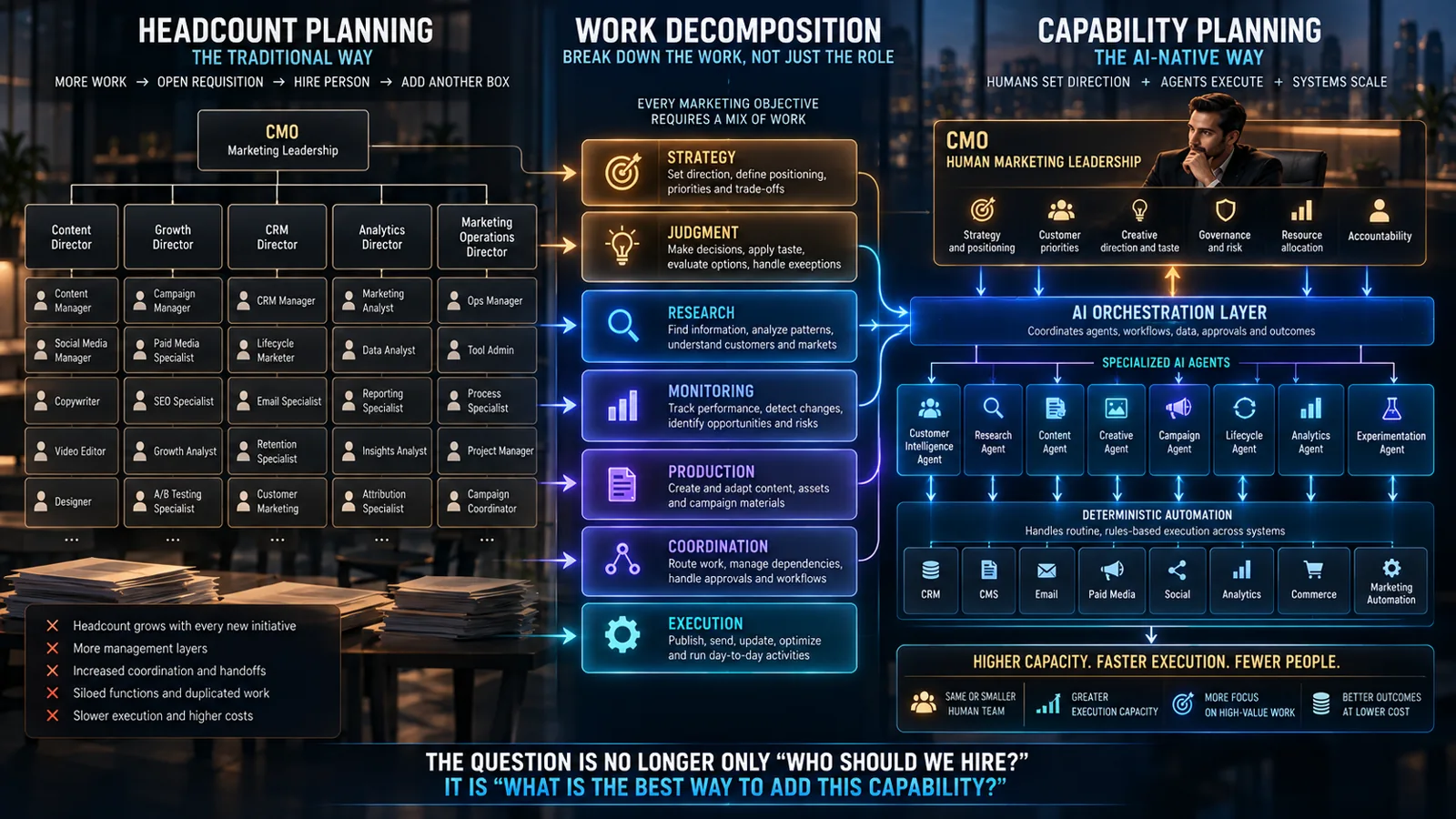
The Future Team Is Not Humans Plus Random Agents
There is one final trap.
Marketing teams could repeat the martech-sprawl problem with agents.
Research Agent from Vendor A.
Content Agent from Vendor B.
Campaign Agent from Vendor C.
No shared context.
No common permissions.
No orchestration.
Now the company has agent sprawl.
The future team needs architecture.
Agents need:
shared intelligence,
clear roles,
common governance,
structured handoffs,
human ownership.
Otherwise more digital workers simply create more coordination.
From Hiring Plan to Human-Agent Operating Model
Ultimately, the transformation goes beyond individual hiring decisions.
The team evolves from:
people performing nearly all work
to:
people + agents + automation operating together.
Humans own:
- intent
- strategy
- taste
- relationships
- governance
- accountability
Agents provide:
- scalable intelligence
- continuous monitoring
- reasoning
- execution
- coordination
Automation provides:
- deterministic reliability
The hiring plan therefore becomes part of the operating-model plan.
Your Next Marketing Hire Might Be an AI Agent
The point is not that companies should replace their next marketer with software.
The point is that leaders now have another option.
Before opening a role, ask:
What capability do we actually need?
Then ask:
Does this require human judgment?
Could an agent perform much of it?
Should predictable parts be automated?
Is the workload actually caused by a broken workflow?
Can one strong human manage greater capacity with agents underneath them?
These questions create a better organization than simply adding another box to the org chart.
Sometimes the answer will still be:
Hire the person.
Sometimes:
Deploy the agent.
Sometimes:
Do both.
And sometimes the most important realization will be:
We never needed another hire. We needed a better system.
That is how AI begins to change marketing workforce planning.
Not by eliminating humans.
By separating capability from headcount—and forcing leaders to design the team more deliberately.
Frequently asked questions
Can an AI agent replace a marketing hire?
For some narrowly defined, repetitive, digital, or continuously monitored capabilities, an AI agent may reduce or delay the need for additional headcount. Roles requiring strong judgment, relationships, leadership, creativity, or accountability remain more human-dependent.
What marketing work is best suited to AI agents?
Strong candidates include market monitoring, first-level research, routine reporting, anomaly investigation, campaign QA, content adaptation, workflow routing, and bounded campaign optimization.
What is the difference between an AI agent and marketing automation?
Automation follows predefined rules. AI agents can interpret context, reason about changing situations, use tools, and pursue goals within defined boundaries.
Should companies hire people or deploy agents first?
It depends on the capability. Leaders should first map the work, identify which activities require human judgment, which require AI reasoning, which can be automated, and whether the workflow itself needs redesign.
Do AI agents need managers?
Yes. Important agents should have human owners responsible for scope, permissions, performance, quality, escalation rules, and business outcomes.
How should an AI agent be evaluated?
Evaluate task success, accuracy, quality, error rates, escalation rates, human overrides, cost, cycle time, and business outcomes.
What is a human-agent workforce?
A human-agent workforce combines people and AI agents in the same operating model, with work assigned according to the strengths of each and humans retaining governance and accountability.
Will AI agents reduce marketing headcount?
They may reduce the amount of human labor needed for certain execution-heavy processes. Some organizations may reduce headcount, while others may use the additional capacity to expand experimentation, personalization, research, and growth.
What roles should remain human-led?
Strategy, positioning, leadership, creative direction, high-value relationships, governance, sensitive decisions, and final accountability should remain strongly human-led.
What should a CMO ask before approving another hire?
Ask what capability is missing, which activities create it, whether those activities require human judgment, whether AI or automation could handle part of the work, whether the workflow can be redesigned, and who will remain accountable for the result.