One AI Agent Is Useful. A Marketing Agent System Changes How Marketing Works.
Give a Campaign Agent the right permissions and it may even configure or optimize parts of a campaign.
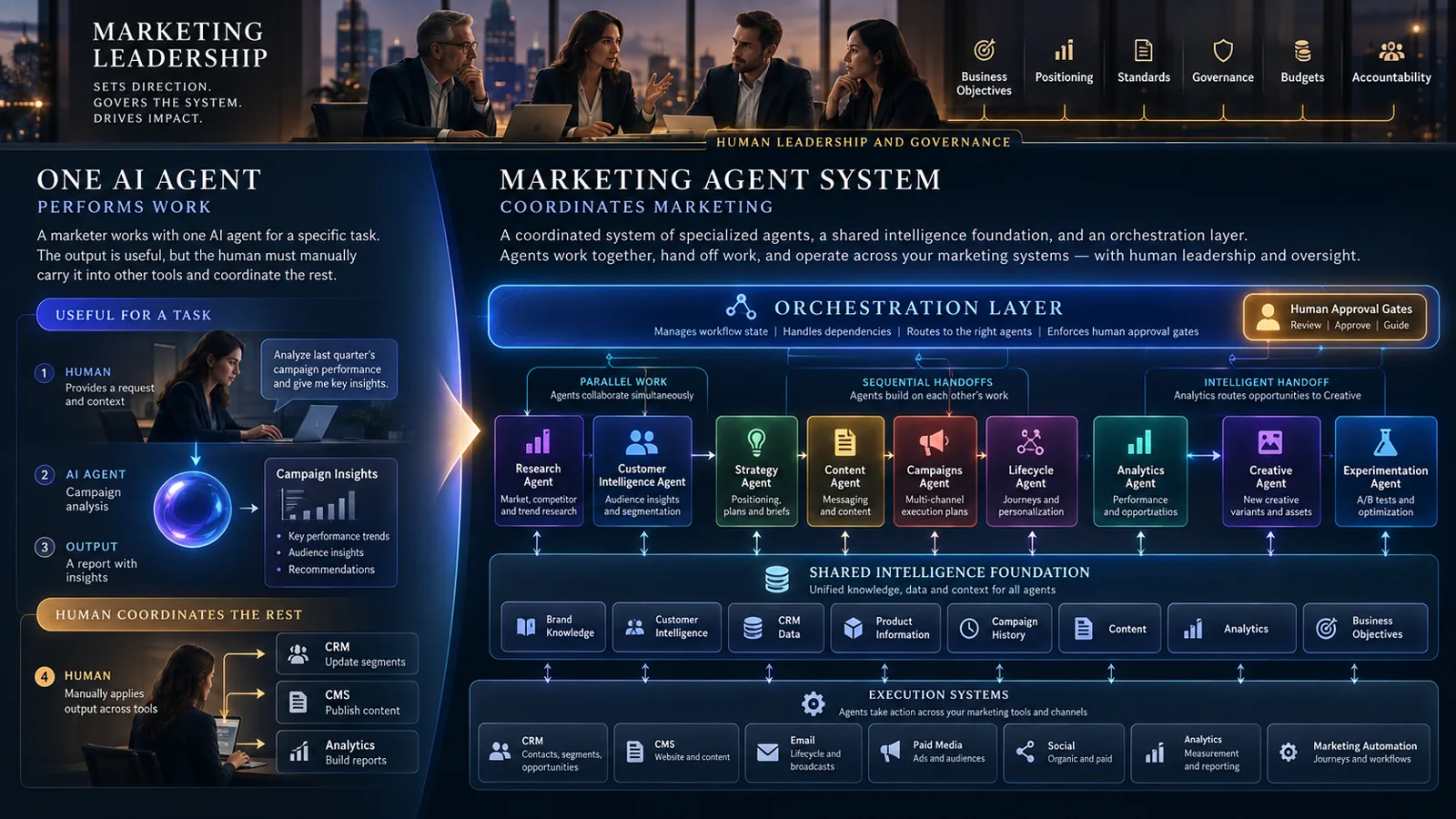
One AI agent can be incredibly useful.
Give a Research Agent a question and it can investigate the market.
Give a Content Agent a brief and it can produce a draft.
Give an Analytics Agent campaign data and it can identify an anomaly.
Give a Campaign Agent the right permissions and it may even configure or optimize parts of a campaign.
That is already a significant change.
But it is not the same thing as building an agentic marketing organization.
Because marketing is not one task.
It is a connected system of:
research,
customer understanding,
strategy,
content,
creative,
campaigns,
lifecycle,
analytics,
experimentation,
distribution,
and optimization.
Improving one of those activities with an AI agent can create productivity.
Connecting all of them can change the operating model.
That is the difference between:
an AI marketing agent
and
a marketing agent system.
A single agent performs work.
A marketing agent system coordinates work.
And that difference is much bigger than it first appears.
First: What Is an AI Marketing Agent?
An AI marketing agent is a goal-oriented software system that can interpret context, reason about a marketing problem, use approved tools, perform actions, and continue working toward an objective within defined boundaries.
For example, an Analytics Agent might receive the objective:
Determine why enterprise conversion declined this week.
It could:
- retrieve campaign performance
- segment conversion by audience
- compare devices
- inspect traffic quality
- identify recent landing-page changes
- rank likely explanations
- recommend an action
That agent is useful because it removes significant analytical work.
But notice something important.
It still owns one part of marketing.
What happens after it identifies the problem?
Someone—or something—must act on the insight.
The Problem Begins at the Handoff
Imagine the Analytics Agent concludes:
The decline appears to be creative fatigue among enterprise paid-social audiences.
Excellent.
Now what?
The organization may need to:
- brief the creative team
- retrieve the approved campaign strategy
- identify which creative elements can change
- develop alternatives
- run brand checks
- prepare an experiment
- update the campaign
- monitor performance
- capture the learning
If a human must manually coordinate all of those steps, the Analytics Agent improved one task.
It did not transform the workflow.
This is exactly why the distinction between agents and agent systems matters.
The biggest bottleneck increasingly moves from:
Can AI perform the task?
to:
Can work move intelligently from one capability to another?
One Agent Optimizes a Step
A single agent is often designed around a relatively clear responsibility.
For example:
Research Agent
Find relevant market intelligence.
Content Agent
Produce content from an approved strategy.
Campaign Agent
Configure campaigns.
Analytics Agent
Analyze performance.
Each can provide significant value.
But optimizing a single step creates limited leverage if the surrounding process remains slow.
McKinsey makes this point explicitly: organizations creating meaningful value from agentic AI are moving beyond deploying individual agents against isolated activities and redesigning end-to-end workflows instead.
That is the fundamental limitation of isolated agents.
They can make individual nodes intelligent while the connections between nodes remain manual.
A Marketing Agent System Optimizes the Flow
A marketing agent system is a coordinated architecture in which multiple specialized AI agents operate using shared business context, common objectives, defined responsibilities, workflow orchestration, enterprise tools, and human governance.
It might include:
- Market Research Agent
- Customer Intelligence Agent
- Competitive Intelligence Agent
- Strategy Agent
- Content Agent
- Creative Agent
- SEO Agent
- Campaign Agent
- Lifecycle Agent
- Analytics Agent
- Experimentation Agent
But simply creating eleven agents does not create a system.
That only creates eleven agents.
The system emerges from what connects them.
Those connections require:
shared intelligence
orchestration
workflow state
handoff logic
governance
common objectives
That connective architecture is where much of the real value lives.
The Difference in One Example
Suppose the business wants to launch a campaign for a new enterprise product.
Single-Agent Model
The marketer opens a Campaign Agent and says:
Create an enterprise launch campaign.
The agent generates:
- campaign structure
- audience ideas
- messaging suggestions
- channel recommendations
Useful.
The marketer then manually:
reviews it,
sends research requests,
briefs content,
coordinates design,
creates campaign tasks,
asks analytics for measurement,
routes approvals.
The agent helped create the campaign.
The human still operates the marketing system.
Marketing Agent System
Leadership enters:
Objective: Generate qualified enterprise pipeline for Product X.
The orchestration layer activates relevant capabilities.
Research and Customer Intelligence agents operate in parallel.
Their findings flow into Strategy.
The approved strategy becomes shared workflow context.
Content and Creative agents prepare assets.
Brand validation happens.
Humans approve high-consequence messaging.
Campaign agents prepare channels.
Analytics agents monitor performance.
Experimentation agents coordinate approved tests.
Validated results return to shared intelligence.
Now the system does not merely help produce a campaign.
It helps operate the campaign lifecycle.
That is fundamentally different.
Shared Intelligence Is the First Requirement
Multiple agents cannot work coherently if each has a different understanding of the company.
Imagine:
The Research Agent uses the new positioning.
The Content Agent uses last quarter's positioning.
The Campaign Agent has a different customer definition.
The Analytics Agent optimizes against an outdated KPI.
You have intelligent agents.
But you do not have an intelligent organization.
A marketing agent system therefore needs shared context.
That can include:
- brand positioning
- customer intelligence
- CRM information
- product knowledge
- campaign history
- previous content
- analytics
- sales insights
- budgets
- business objectives
- governance rules
Each agent receives the relevant subset.
This creates something much more important than memory inside an individual chatbot.
It creates organizational context.
Agents Need Different Views of the Same Business
Shared intelligence does not mean every agent should access everything.
The principle should be:
shared context with role-specific access.
A Content Agent may need:
- brand guidelines
- customer research
- content history
- product knowledge
- search intent
It probably does not need unrestricted access to every customer's personal information.
A Campaign Agent may need:
- approved audiences
- campaign strategy
- budgets
- approved assets
- channel history
An Analytics Agent may need:
- conversion data
- campaign performance
- historical benchmarks
- business KPIs
The system coordinates a common reality while controlling access according to responsibility.
That improves both usefulness and governance.
Orchestration Is What Turns Agents Into a System
This is the central concept.
Orchestration is the coordination layer that determines how agents, humans, data, automation, and enterprise systems work together across a workflow.
An orchestrator may determine:
- which agent should act
- when it should act
- what context it needs
- what previous output it depends on
- which tasks can happen simultaneously
- when a human must approve
- what happens if an agent fails
- which result should trigger another workflow
Without this layer, agents remain intelligent islands.
McKinsey describes orchestration as a foundational capability for the future marketing organization and argues that always-on orchestration can replace disconnected campaign cycles with continuously managed human-agent workflows.
How Multiple Marketing Agents Collaborate
There is no single multi-agent architecture.
Different workflows require different coordination patterns.
Four are especially useful.
Pattern 1: Parallel Agents
Several agents perform work simultaneously.
Suppose a company is considering a new market.
The orchestrator activates:
Market Research Agent
examines market size and trends.
Customer Intelligence Agent
analyzes customer demand.
Competitive Intelligence Agent
maps competitor positioning.
Search Intelligence Agent
examines relevant search behavior.
Instead of running these tasks sequentially, all four work at the same time.
Their findings then converge into a strategy stage.
This is one reason multi-agent systems can dramatically reduce workflow time.
They do not simply work quickly.
They can restructure which tasks need to wait for one another.
Pattern 2: Sequential Agents
Some work genuinely depends on previous work.
For example:
Research → Strategy → Content → Campaign
The Strategy Agent should not finalize positioning before relevant customer research exists.
The Content Agent should not create final messaging before strategy is approved.
The Campaign Agent should not launch before approved assets exist.
Here the orchestrator manages dependencies.
One output becomes the structured input for the next agent.
Pattern 3: Intelligent Handoffs
An agent can identify that another specialist is needed.
Example:
The Analytics Agent detects:
Landing-page conversion is stable, but paid-social CTR is declining after increased frequency. Creative fatigue is likely.
Instead of simply writing this in a report, it creates a structured handoff to the Creative Agent.
The handoff contains:
- problem
- evidence
- affected audience
- approved strategy
- campaign constraints
The Creative Agent prepares alternatives.
The workflow moves forward without a human manually copying the diagnosis into another brief.
This removes the coordination layer between intelligence and execution.
Pattern 4: Supervisor + Specialists
In more complex workflows, a higher-level agent can supervise several specialized agents.
For example:
Campaign Supervisor Agent
coordinates:
Research Agent
Customer Agent
Content Agent
Creative Agent
Campaign Agent
Analytics Agent
The supervisor does not necessarily perform all the work itself.
It determines what work is required and delegates.
This mirrors how human organizations often work.
The distinction is that routine coordination can increasingly become software-defined.
Workflow State Matters More Than It Sounds
Imagine a system preparing a campaign.
At any point, it needs to know:
Research: complete.
Strategy: approved.
Copy: complete.
Creative: revision requested.
Legal: pending.
Campaign configuration: waiting.
Launch: blocked.
This is workflow state.
Without it, agents may:
repeat work,
act too early,
use outdated versions,
or fail to know whether approval already happened.
A multi-agent system therefore needs more than a collection of models.
It needs an operational layer capable of remembering where the work currently is.
This sounds mundane.
But it is one of the things that separates impressive demos from reliable systems.
Handoffs Need Structure
Humans often lose information during handoffs.
Research creates a 30-page presentation.
Strategy extracts six slides.
Content receives a one-page brief.
Creative receives a Slack message.
By launch, important context has disappeared.
Agent systems can reproduce exactly the same problem if handoffs are poorly designed.
A good agent handoff should transfer:
- objective
- relevant findings
- decisions already made
- constraints
- confidence
- unresolved questions
- expected output
The goal is not simply:
Agent A talks to Agent B.
It is:
the right context survives the transition.
Not Every Agent Needs to Talk to Every Other Agent
This is another common misconception.
A marketing agent system should not become an uncontrolled group chat among machines.
That creates:
- unnecessary cost
- duplicate work
- circular reasoning
- difficult debugging
A better architecture defines relationships deliberately.
For example:
Analytics may hand off to Experimentation.
Content may consult SEO.
Campaign may request approved assets from Creative.
Research may feed Strategy.
Communication should follow the workflow.
The system needs architecture, not agent democracy.
Why One Giant Marketing Agent Is Usually the Wrong Design
Why not avoid this complexity and simply create one giant AI Marketing Agent?
Give it every tool.
Every permission.
Every data source.
Every responsibility.
It sounds simpler.
But several problems emerge.
1. Responsibility Becomes Ambiguous
Did the agent fail because of:
bad research,
bad strategy,
poor content,
incorrect analysis?
A modular architecture makes failure easier to identify.
2. Evaluation Becomes Harder
A Customer Intelligence Agent can be evaluated specifically for customer intelligence.
A universal marketing agent performing 100 unrelated functions is much more difficult to benchmark.
3. Permissions Become Too Broad
A Content Agent does not need the same authority as a Campaign Agent.
A modular architecture supports least-privilege access.
4. Improvements Become Easier
If the Research Agent underperforms, improve or replace that component.
The rest of the system can remain intact.
5. Different Work Needs Different Models and Tools
Some problems require strong reasoning.
Others require speed.
Some require retrieval.
Others require image generation.
A modular system can route each task toward the appropriate capability.
One giant agent tends to blur these distinctions.
Reusable Agents Create More Leverage
Another advantage of system thinking is reuse.
Suppose the organization builds a high-quality Customer Intelligence Agent.
It should not need a separate version for every campaign.
The same capability might support:
- campaign strategy
- sales preparation
- lifecycle marketing
- product marketing
- retention
- content planning
McKinsey specifically argues that agents can be reused across functions rather than duplicated, with one customer-data capability potentially serving campaign planning, sales, and post-purchase interactions.
This changes the economics of AI deployment.
Instead of creating hundreds of bespoke agents, companies can build a library of reliable capabilities.
From Agents to an Agentic Marketing Platform
As these reusable capabilities accumulate, the architecture starts to look less like a collection of bots and more like a platform.
That platform includes:
Shared Intelligence
What the company knows.
Specialized Agents
What the system can reason about and do.
Orchestration
How work moves.
Enterprise Tools
Where actions execute.
Governance
What the system is allowed to do.
Human Decision Rights
Where judgment and accountability remain.
This is the foundation of an agentic marketing operating system.
The agent is no longer the product.
The system is.
The Danger: Agent Chaos
More agents do not automatically produce better marketing.
They can create an entirely new form of operational sprawl.
Imagine:
three research agents doing similar work,
two content agents producing contradictory drafts,
separate customer agents using different definitions,
agents independently changing campaign settings,
no common quality standards,
no clear ownership.
That is agent chaos.
McKinsey specifically warns that without effective governance and agentic architecture, scaling agents can produce redundant builds, inconsistent quality, and unmanaged risk.
This is the agentic version of martech sprawl.
The lesson is familiar:
Do not measure maturity by agent count.
Measure whether the system works coherently.
Governance Has to Exist Above the Agents
A marketing agent system requires a governance layer.
That layer defines:
- data access
- publishing rights
- budget authority
- campaign permissions
- customer communication rules
- approval thresholds
- escalation logic
- auditability
Different actions should have different levels of autonomy.
For example:
High Autonomy
Retrieve approved information.
Normalize campaign data.
Monitor metrics.
Medium Autonomy
Adapt approved content.
Build campaign drafts.
Prepare experiments.
Human Approval Required
Launch major campaigns.
Change substantial budgets.
Create new positioning.
Publish sensitive claims.
The more agents cooperate, the more important this architecture becomes.
Because errors can otherwise move across the system extremely quickly.
Humans Should Sit Above the System
A well-designed marketing agent system should not push marketers beneath AI.
It should move them above execution.
Humans define:
objectives
What are we trying to accomplish?
positioning
What should the company stand for?
customer priorities
Who matters?
creative standards
What counts as good?
risk
What can happen automatically?
trade-offs
What are we willing to sacrifice?
accountability
Who ultimately owns the result?
Agents then operate within those boundaries.
This is why the strongest future model is not:
humans vs agents.
It is:
humans governing networks of agents.
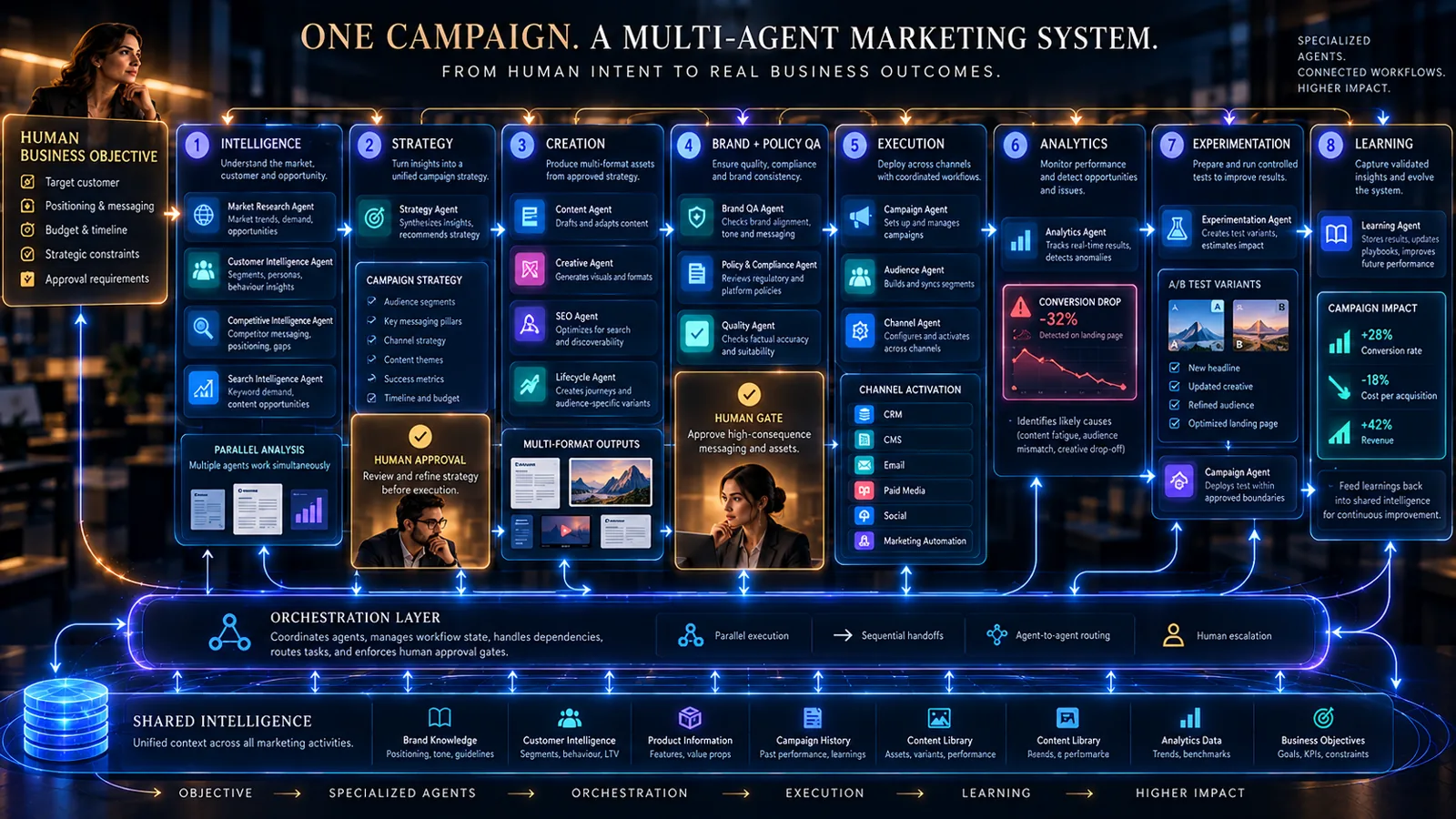
A Complete Multi-Agent Campaign Example
Consider a SaaS company launching a new enterprise offering.
Leadership provides:
Business objective: Generate enterprise pipeline.
Priority audience: CMOs of companies with more than 1,000 employees.
Positioning: AI marketing orchestration without losing human control.
Constraints: Existing media budget. All performance claims require approval.
The system begins.
Stage 1 — Intelligence
Research Agent analyzes market developments.
Customer Agent analyzes CRM, interviews, and sales conversations.
Competitive Agent evaluates category positioning.
Search Agent identifies demand patterns.
They run in parallel.
Stage 2 — Strategy
Strategy Agent synthesizes their outputs.
It recommends:
primary customer problem,
campaign narrative,
channel priorities,
content themes.
Human leadership reviews and modifies the positioning.
Strategy becomes approved workflow context.
Stage 3 — Creation
Content Agent produces core messaging.
Creative Agent develops visual directions.
SEO Agent checks search coverage.
Lifecycle Agent prepares nurture architecture.
All work from the same strategy.
Stage 4 — Quality
Brand Agent checks:
terminology,
tone,
claims,
consistency.
Policy systems identify claims requiring verification.
Humans review the important creative and strategic decisions.
Stage 5 — Execution
Campaign Agent configures programs.
Audience Agent prepares segments.
Automation handles predictable system updates.
Human approves launch.
Stage 6 — Performance
Analytics Agent monitors performance.
It detects:
Enterprise engagement strong.
Landing-page conversion weak.
It investigates.
The issue appears concentrated in one value proposition.
Stage 7 — Experimentation
Analytics hands off to Experimentation.
Experimentation Agent proposes two approved messaging alternatives.
Human approves.
Campaign Agent launches the test.
Stage 8 — Learning
Variant B improves qualified conversion.
The result is validated.
Shared intelligence records:
Enterprise CMOs respond more strongly to governance-led positioning than efficiency-led positioning.
The next campaign begins with that knowledge.
That is a marketing agent system.
No single agent did everything.
The architecture created the outcome.
The System Creates Compound Value
This is where multi-agent architecture becomes strategically interesting.
An isolated Content Agent might save 60 minutes.
Useful.
An isolated Analytics Agent might save another hour.
Also useful.
But when the Analytics Agent detects a problem, routes it to Creative, Creative produces approved alternatives, Experimentation launches a test, Campaign updates allocation, and the result feeds back into shared knowledge—
the system eliminates an entire chain of human coordination.
The gains begin compounding across the workflow.
That is why the real value of agents is often not simply task productivity.
It is workflow compression.
The Unit of AI Strategy Should Become the Workflow
This leads to one of the most important principles in agentic transformation.
Do not start with:
Which agents should we build?
Start with:
Which workflow should operate differently?
For example:
Campaign creation.
Customer research.
Content production.
Lifecycle optimization.
Performance reporting.
Then break the workflow into activities.
Ask:
Which require human judgment?
Which require AI reasoning?
Which require deterministic automation?
Which capabilities already exist?
Which agents can be reused?
How should they coordinate?
This approach creates much more durable systems than building agents because the technology is exciting.
McKinsey's 2026 marketing research reaches the same conclusion: the workflow is the unit of change, and organizations need to determine which tasks humans versus AI should perform across those workflows.
The Architecture Should Get Simpler for Humans
A sophisticated agent system may sound technically complex.
Behind the scenes, it can be.
But the human experience should become simpler.
Today, marketers might interact with:
CRM.
CMS.
Analytics.
SEO.
Social.
Email.
Advertising.
Project management.
Multiple AI tools.
In a mature agentic environment, leadership might instead receive:
2 decisions require approval.
1 performance risk requires judgment.
5 low-risk workflow actions completed automatically.
3 validated learnings were added to shared intelligence.
The system absorbs operational complexity.
Humans receive the exceptions.
That is what good orchestration should produce.
One Agent Is Productivity. A System Is an Operating Model.
This is perhaps the cleanest way to understand the distinction.
One Agent
Makes a person or task more productive.
Multiple Disconnected Agents
Make many tasks faster but may create another coordination problem.
Marketing Agent System
Coordinates intelligence and execution across workflows.
AI-Native Marketing Operating Model
Redesigns how humans, agents, automation, data, and software work together.
Those are different maturity levels.
Companies should not confuse them.
The Future Isn't About Having the Most Agents
Soon, companies may proudly say:
“We have 50 AI agents.”
That number will mean very little.
Fifty disconnected agents could be worse than five well-designed ones.
The important questions are:
Do they share relevant context?
Are responsibilities clear?
Can capabilities be reused?
Are handoffs structured?
Is workflow state maintained?
Is there orchestration?
Are permissions controlled?
Can humans see why actions occurred?
Does the system learn from validated results?
Does it improve business outcomes?
That is what determines whether a collection of agents becomes an actual system.
One AI Agent Is Useful. A Marketing Agent System Is Different.
The first generation of enterprise AI was largely about assistants.
Ask.
Receive an answer.
The next generation introduced agents.
Give them an objective.
Let them reason and act.
But marketing's deeper transformation begins one level higher.
When specialized agents can work from common business context.
When research automatically informs strategy.
When strategy becomes the input for content.
When analytics can initiate experimentation.
When customer intelligence travels across workflows.
When routine execution happens through enterprise systems.
When learning persists.
And when humans remain above the system controlling:
strategy,
judgment,
standards,
risk,
and accountability.
That is no longer simply an AI agent.
It is an agentic marketing system.
And that distinction may ultimately matter more than how intelligent any individual agent becomes.
Because marketing does not win through isolated tasks.
Marketing wins when the entire system works together.
Frequently asked questions
What is a marketing agent system?
A marketing agent system is a coordinated architecture of specialized AI agents, shared business intelligence, orchestration, enterprise tools, automation, governance, and human decision-making working across marketing workflows.
How is a marketing agent system different from one AI agent?
A single AI agent usually owns a specific task or workflow. A marketing agent system coordinates multiple specialized agents and capabilities across interconnected marketing activities and outcomes.
What is a multi-agent marketing system?
A multi-agent marketing system uses multiple specialized AI agents—for example, Research, Content, Campaign, and Analytics Agents—that collaborate through structured parallel execution, sequential workflows, or intelligent handoffs.
Why not build one large AI marketing agent?
A single universal agent can become difficult to evaluate, govern, debug, secure, and improve. Specialized agents allow narrower responsibilities, permissions, evaluation criteria, and reusable capabilities.
What is AI agent orchestration?
Agent orchestration is the coordination layer that determines which agents act, in what order, using what context, with which dependencies, and when human approval or escalation is required.
What is shared intelligence?
Shared intelligence is a common contextual foundation containing relevant customer, brand, product, CRM, campaign, content, analytics, and business knowledge that multiple agents can use consistently.
How do AI agents communicate with each other?
Agents can communicate through structured workflow outputs and handoffs. One agent's result can become another agent's input, or an orchestration layer can route information between agents.
What is agent chaos?
Agent chaos occurs when organizations deploy many agents without sufficient architecture, role clarity, shared context, governance, or orchestration, leading to duplication, conflicting actions, inconsistent quality, and unnecessary complexity.
Should every marketing workflow use multiple agents?
No. A simple workflow may only need one agent or deterministic automation. Multi-agent architectures are useful when a business outcome genuinely requires several distinct capabilities or coordinated decisions.
What should humans control in a marketing agent system?
Humans should retain responsibility for business objectives, strategy, positioning, creative standards, major budget decisions, governance, risk thresholds, high-consequence approvals, and final accountability.