The 7 Layers of an AI Marketing Operating System: A Practical Architecture for Agentic Marketing
But putting AI everywhere does not automatically create an intelligent marketing organization.
Every marketing platform is getting AI.
CRM has AI.
Analytics has AI.
Email has AI.
Advertising platforms have AI.
Content systems have AI.
Creative tools have AI.
Marketing automation has AI.
And increasingly, companies are deploying specialized AI agents on top of them.
But putting AI everywhere does not automatically create an intelligent marketing organization.
It can just as easily create:
more tools,
more agents,
more recommendations,
more integrations,
and more complexity for humans to coordinate.
That is why the next important question is no longer:
Which AI marketing tool should we add?
It is:
What architecture allows all of this intelligence to operate as one system?
That is the purpose of an AI marketing operating system.
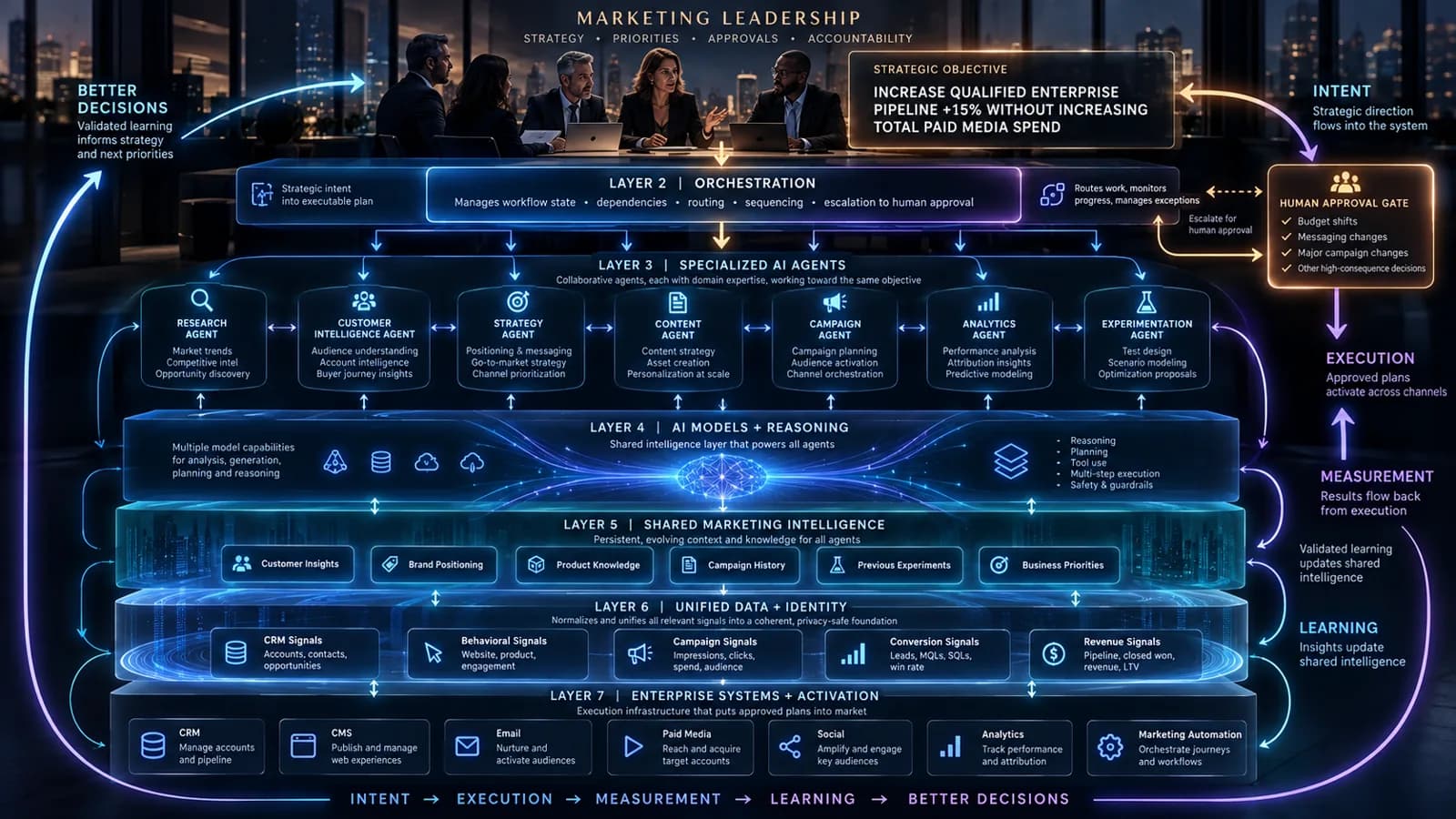
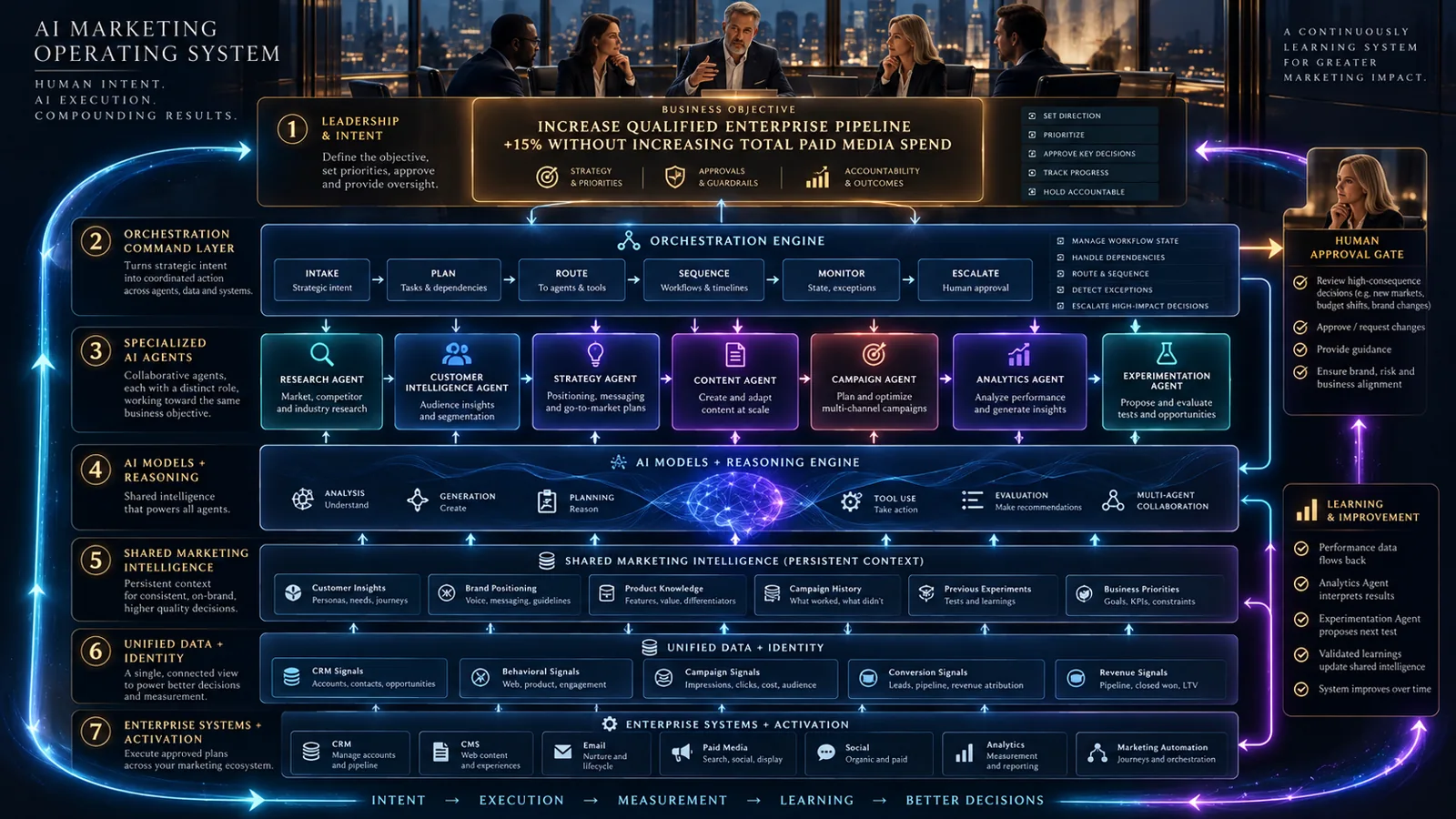
An AI marketing operating system is a layered architecture that connects enterprise applications, customer and business data, persistent marketing intelligence, AI models, specialized agents, workflow orchestration, and human governance so marketing can operate as a coordinated, continuously learning system.
It is not one chatbot.
It is not one giant autonomous CMO.
It is not simply a collection of AI tools.
It is the architecture connecting:
data → intelligence → reasoning → agents → workflows → decisions → outcomes.
A useful way to understand that architecture is through seven layers.
The 7 Layers at a Glance
From foundation to strategic control:
Layer 1 — Enterprise Systems + Activation
Where marketing data originates and actions ultimately execute.
Layer 2 — Unified Data + Identity
How fragmented customer, campaign, product, and behavioral data becomes usable.
Layer 3 — Shared Marketing Intelligence
The persistent business context that allows AI to understand the organization.
Layer 4 — AI Models + Reasoning
The intelligence engines that interpret, generate, predict, classify, and reason.
Layer 5 — Specialized Marketing Agents
Goal-oriented AI systems responsible for individual marketing capabilities.
Layer 6 — Orchestration + Workflow Execution
The coordination layer connecting agents, humans, automation, and enterprise systems.
Layer 7 — Human Intent + Governance
The strategic layer defining objectives, standards, risk, permissions, and accountability.
Every layer solves a different problem.
And skipping one usually creates weaknesses somewhere else.
Layer 1 — Enterprise Systems + Activation
At the bottom of the operating system sits the technology companies already use.
These include:
- CRM
- CMS
- email platforms
- marketing automation
- advertising platforms
- social platforms
- commerce systems
- analytics
- sales systems
- customer service systems
These systems remain important.
AI does not make them disappear.
They perform two critical functions.
First, they generate operational data.
A CRM records customer interactions.
Analytics records behavior.
Advertising platforms record campaign performance.
Commerce records purchases.
Second, they execute actions.
An agent may determine that a campaign should be updated.
But something still has to actually update it.
An AI system may decide that a qualified account needs sales follow-up.
But the CRM still needs to create the task.
This is why enterprise software increasingly becomes the execution infrastructure underneath AI.
The interface shifts upward.
Instead of a marketer manually operating every platform, agents and workflows increasingly interact with those systems on the marketer's behalf.
Deterministic Automation Still Matters
Not every action should involve artificial intelligence.
Some workflows are predictable.
For example:
IF an approved asset reaches its publication timeTHEN publish it.
Or:
IF customer consent is withdrawnTHEN suppress further communication.
AI adds uncertainty where reasoning is useful.
Automation removes uncertainty where predictability is valuable.
A mature marketing operating system uses both.
The architecture should not ask:
“Can AI do this?”
It should ask:
“What is the most reliable mechanism for this action?”
Sometimes that is an AI agent.
Sometimes it is ordinary software logic.
Layer 2 — Unified Data + Identity
The second layer solves one of AI marketing's biggest problems:
fragmented reality.
Customer information may exist in CRM.
Behavior exists in analytics.
Transactions exist in commerce.
Advertising platforms maintain separate audiences.
Email systems contain engagement history.
Support tools contain customer problems.
Without sufficient integration, each system understands only part of the customer.
That creates problems even in traditional marketing.
AI makes the consequences larger.
An intelligent agent making decisions from incomplete context can confidently make the wrong decision.
That is why the AI marketing operating system needs a reliable data foundation.
This layer may include:
- customer identity
- CRM records
- behavioral data
- transaction history
- campaign data
- product usage
- consent
- channel engagement
- performance data
The objective is not necessarily to physically move every data point into one database.
It is to make the relevant information consistently retrievable and interpretable across workflows.
Salesforce's 2026 research illustrates how important this is: despite high AI adoption among marketers in India, disjointed or irrelevant data remains one of the major obstacles to scaling AI-enabled customer engagement.
AI quality increasingly depends on context quality.
Layer 3 — Shared Marketing Intelligence
Data alone does not explain the organization.
An AI system might know that a customer clicked an ad.
But does it know:
Who is the ideal customer?
What does the brand stand for?
Which products matter this quarter?
What positioning has leadership approved?
Which campaign ran previously?
Which claims are prohibited?
What did the organization learn from the last experiment?
That requires a different layer:
shared marketing intelligence.
Shared marketing intelligence is the persistent business context used across AI-powered marketing workflows.
It can contain:
- brand strategy
- positioning
- tone of voice
- products
- pricing
- customer research
- personas or segments
- competitor intelligence
- campaign history
- previous creative
- content libraries
- sales insights
- validated experiments
- business objectives
- current priorities
This layer solves one of the most frustrating problems with first-generation generative AI:
starting from zero every time.
Instead of repeatedly telling AI:
“Here is our company.”
“Here is our audience.”
“Here is our tone.”
the system already knows the relevant context.
Shared Intelligence Is Organizational Memory
This is deeper than giving a chatbot memory.
The goal is to give the marketing organization persistent context.
Suppose an experiment reveals:
Enterprise CMOs convert significantly better when governance is emphasized before productivity.
That learning should not live only in:
a slide deck,
an analyst's head,
or one campaign report.
It should become accessible to:
Content Agent.
Campaign Agent.
Lifecycle Agent.
Customer Intelligence Agent.
Strategy Agent.
The next workflow should start with what the previous workflow learned.
That creates something traditional marketing organizations often struggle to achieve:
institutional learning that compounds.
Layer 4 — AI Models + Reasoning
Now we reach the intelligence engines.
This layer can contain multiple forms of AI.
Large Language Models
Useful for:
- language
- reasoning
- synthesis
- planning
- generation
Predictive Models
Useful for:
- propensity
- churn
- lead scoring
- forecasting
- conversion prediction
Classification Models
Useful for:
- customer categorization
- sentiment
- content labeling
- routing
Multimodal Models
Useful for:
- images
- audio
- video
- documents
The important point is:
the operating system should not necessarily depend on one model.
Different problems require different intelligence.
Some require high reasoning quality.
Some require extremely low latency.
Some require multimodal understanding.
Others can use simple deterministic logic.
The architecture should route work toward the appropriate capability.
Models Are Capabilities, Not the Operating System
This distinction matters enormously.
Companies sometimes treat model selection as the core AI strategy.
Which LLM?
Which vendor?
Which model benchmark?
Those choices matter.
But models will continue changing rapidly.
The durable advantage is more likely to come from:
- proprietary context
- workflow design
- integrations
- evaluation
- governance
- organizational learning
The model is one layer.
It should be replaceable without rebuilding the entire marketing operation.
That is what good architecture allows.
Layer 5 — Specialized Marketing Agents
The next layer converts intelligence into goal-oriented capabilities.
An AI marketing agent is a software system that can understand an objective, retrieve relevant context, reason about what needs to happen, use approved tools, take actions, and continue working within defined boundaries.
A sophisticated marketing operating system might include:
Market Research Agent
Tracks market developments and customer needs.
Customer Intelligence Agent
Analyzes customer behavior, feedback, CRM signals, and research.
Competitive Intelligence Agent
Monitors competitors, positioning, offers, and category shifts.
Content Strategy Agent
Maps topics, formats, audiences, and campaign narratives.
Content Agent
Creates and adapts content.
Creative Agent
Develops creative variations and visual directions.
Campaign Agent
Prepares and coordinates campaigns.
Lifecycle Agent
Manages customer journeys and lifecycle opportunities.
Analytics Agent
Monitors performance and investigates anomalies.
Experimentation Agent
Designs and evaluates tests.
These agents should be specialized.
That makes their:
- responsibilities clearer
- tools narrower
- permissions safer
- performance easier to evaluate
One Giant Marketing Agent Is Usually the Wrong Architecture
It can be tempting to build:
The AI Marketing Agent
One giant system with access to everything.
But that introduces problems.
Who owns the mistake if its research is wrong?
How do you evaluate creative quality separately from analytics quality?
Why should a content agent have permission to modify media budgets?
How do you replace one weak capability?
Specialization creates modularity.
Instead of creating one artificial employee pretending to be an entire marketing department, build reusable capabilities that cooperate.
This is closer to how scalable software systems already work.
Layer 6 — Orchestration + Workflow Execution
This is arguably the layer that turns the architecture into an operating system.
You can have:
excellent data,
excellent models,
excellent agents,
and still have a terrible marketing system.
Why?
Because somebody must coordinate them.
That is orchestration.
An orchestration layer manages:
- workflow state
- sequencing
- dependencies
- agent selection
- parallel execution
- agent handoffs
- retries
- approval gates
- escalation
- completion
Suppose leadership approves a new product campaign.
The orchestrator could:
- activate Research, Customer Intelligence, and Competitive Intelligence agents in parallel
- combine their outputs
- activate Strategy
- wait for human approval
- trigger Content and Creative simultaneously
- route claims through brand and compliance checks
- prepare campaigns
- request launch approval
- activate Analytics after launch
- send performance issues to Experimentation
No individual agent owns the entire workflow.
The orchestration layer ensures they behave like one system.
McKinsey identifies always-on orchestration as one of the foundational capabilities of the future marketing model. Its research argues that the transition requires a unified data and orchestration layer together with explicit governance governing human and machine decision-making.
Orchestration Is Not Just Agent-to-Agent Communication
This deserves emphasis.
An orchestration layer should not merely allow agents to chat with one another.
It needs operational structure.
It must know:
Research complete.
Strategy waiting for approval.
Creative in progress.
Compliance flagged one claim.
Campaign launch blocked.
Experiment scheduled.
This is workflow state.
Without it, sophisticated AI can still produce operational chaos.
The system needs to understand not only:
what the agents know
but:
where the work is.
Orchestration Also Connects Humans
Humans are part of the workflow.
A good operating system knows when work should:
continue automatically,
pause,
request approval,
or escalate.
For example:
Analytics Agent detects a small optimization opportunity.
Within guardrails?
Execute.
Analytics Agent recommends a major budget shift.
Above allowed threshold?
Escalate.
Content Agent changes formatting.
Low risk?
Continue.
Strategy Agent proposes changing brand positioning.
High consequence?
Human decision.
This is how the operating system implements appropriate autonomy rather than maximal autonomy.
Layer 7 — Human Intent + Governance
At the top sits the layer that should never be forgotten.
Humans.
Not because humans need to manually operate every workflow.
Because organizations require intent and accountability.
Human leadership defines:
- business objectives
- customer priorities
- positioning
- strategy
- budgets
- creative standards
- quality thresholds
- risk appetite
- ethical boundaries
- decision rights
These become constraints for the layers underneath.
This reverses the traditional relationship between people and software.
Historically:
Humans operated software.
In the AI-native model:
Humans increasingly govern a system of software and agents.
Governance Must Be Embedded, Not Added Later
As agents gain the ability to act, governance cannot exist only as a policy document.
It needs to become executable architecture.
Examples:
Budget limit: Campaign Agent cannot increase total spend by more than 5%.
Publishing rule: Product claims require human approval.
Data permission: Content Agent cannot retrieve personally identifiable customer data.
Confidence threshold: Analytics Agent must escalate low-confidence causal conclusions.
Consent rule: No communication can bypass customer consent status.
McKinsey's broader research into agentic organizations similarly argues that governance needs to become more real-time and embedded as agents operate continuously, while humans retain final accountability.
Governance therefore is not something limiting AI.
It is what makes greater autonomy possible safely.
Human Intent Should Flow Down. Learning Should Flow Up.
A useful way to visualize the entire operating system is through two flows.
Downward Flow: Intent
Human leadership defines:
business objective
↓
strategy
↓
workflow
↓
agent actions
↓
enterprise execution
Upward Flow: Learning
Enterprise systems generate results.
↓
agents interpret performance
↓
orchestration aggregates insights
↓
shared intelligence updates
↓
humans receive decision intelligence
This creates a continuous loop.
Humans give the system direction.
The system gives humans better understanding.
That is much more powerful than a one-way automation pipeline.
How the Seven Layers Work Together
Consider a simple business objective:
Increase qualified enterprise pipeline by 15% without increasing total paid-media spend.
Here is how the layers interact.
Layer 7 — Human Intent
Leadership defines:
- objective
- target customer
- positioning
- budget constraint
- approval thresholds
Layer 6 — Orchestration
The system identifies the required workflow.
It activates the right agents.
Layer 5 — Agents
Research, Customer Intelligence, Strategy, Content, Campaign, and Analytics agents perform specialized work.
Layer 4 — Models
Language, predictive, classification, and reasoning models power the required capabilities.
Layer 3 — Shared Intelligence
Agents retrieve:
brand,
customer knowledge,
campaign history,
previous experiments,
product information.
Layer 2 — Unified Data
Current customer, campaign, behavioral, and revenue signals are retrieved consistently.
Layer 1 — Enterprise Systems
Campaigns execute through:
CRM,
email,
paid media,
CMS,
marketing automation.
Then results move back upward.
The system measures.
Learns.
Adjusts.
The architecture forms a loop.
Why This Is an Operating System, Not Just a Martech Stack
Traditional martech is primarily a collection of applications.
An AI marketing operating system adds something different:
operating logic.
It knows:
what the objective is,
what context matters,
which capability should act,
which tools it may use,
what has already happened,
what requires approval,
and what should happen next.
That is much closer to an operating system than a toolbox.
McKinsey's work on modern martech makes a similar distinction: extracting value from AI requires moving away from a patchwork of disconnected platforms toward an integrated marketing operating model built for end-to-end orchestration.
Where Most AI Marketing Implementations Break
This seven-layer framework also makes failure easier to diagnose.
Strong AI, Weak Data
Excellent models operating on fragmented information.
Result:
confident but incomplete decisions.
Strong Agents, Weak Shared Intelligence
Agents repeatedly need humans to re-explain context.
Result:
fast execution without consistency.
Many Agents, No Orchestration
Agents produce outputs independently.
Result:
agent sprawl.
Strong Orchestration, Bad Workflow
The system efficiently automates unnecessary bureaucracy.
Result:
faster bad processes.
High Autonomy, Weak Governance
Agents can act broadly without appropriate controls.
Result:
risk.
Great Technology, No Human Operating Model
Nobody knows who owns outcomes.
Result:
organizational confusion.
AI transformation requires the layers to work together.
You Do Not Need All Seven Layers at Maximum Sophistication on Day One
This framework should not imply that every company needs an enormous AI infrastructure project.
A smaller organization can start simply.
Layer 1:
existing CRM, CMS, analytics, and campaign tools.
Layer 2:
reliable access to the most important data.
Layer 3:
a structured brand and customer knowledge base.
Layer 4:
one or two strong AI models.
Layer 5:
a small number of agents.
Layer 6:
one high-value orchestrated workflow.
Layer 7:
clear human approvals and boundaries.
Then expand.
The architecture matters more than the initial scale.
Start With the Workflow, Not the Architecture Diagram
There is also a danger in becoming too architecture-focused.
Do not begin by building every possible layer because the diagram looks impressive.
Start with a business outcome.
For example:
Reduce campaign launch time from ten days to two.
Then map the workflow.
Ask:
Where does data come from?
What context is required?
Where is reasoning needed?
Which tasks need an agent?
What can ordinary automation handle?
Which handoffs can disappear?
Where must a human decide?
Build only what the workflow requires.
McKinsey's research describes the workflow as the unit of change in AI-enabled organizations: break work down end to end, determine which humans or AI capabilities should perform each activity, and redesign the operating model around the outcome.
The Seven Layers Also Change the Marketing Team
Once this architecture exists, jobs shift.
Marketing Leaders
Move toward:
- strategy
- governance
- resource allocation
- system design
Marketing Operations
Moves toward:
- orchestration
- architecture
- agent governance
- workflow engineering
Analysts
Move toward:
- experimentation
- causal analysis
- measurement design
- decision intelligence
Creatives
Move toward:
- creative direction
- taste
- originality
- brand standards
Specialists
Increasingly supervise AI capabilities inside their domain rather than manually completing every activity.
The operating system changes the organization because it changes where human effort is required.
The Architecture Should Make Marketing Feel Simpler
This is the test.
A seven-layer architecture can sound more complicated than the martech stack it replaces.
Technically, it may be.
But good infrastructure should hide complexity from humans.
The marketer should not need to think about:
which model handled the analysis,
which API returned the data,
which agent performed the classification,
which automation updated the record.
The marketer should receive:
One opportunity requires strategic review.
Two low-risk optimizations executed automatically.
One campaign is blocked by a compliance exception.
Three validated learnings were added to customer intelligence.
Sophistication underneath.
Simplicity above.
That is the goal.
The Most Important Layer Is Not AI
This seven-layer framework leads to an important conclusion.
The most important layer is not the model.
It is not even the agents.
It is the combination of:
human intent
and
orchestration.
AI can generate.
AI can reason.
AI can optimize.
But the organization still needs to determine:
What are we optimizing for?
Which customers matter?
What does good look like?
What risks are acceptable?
Where should machines stop?
Those questions define the system.
Technology executes within them.
The 7 Layers of an AI Marketing Operating System
The architecture can therefore be summarized simply:
Layer 1 — Enterprise Systems + Activation
Where marketing executes.
Layer 2 — Unified Data + Identity
What is happening.
Layer 3 — Shared Marketing Intelligence
What the organization knows.
Layer 4 — AI Models + Reasoning
How the system interprets and thinks.
Layer 5 — Specialized Marketing Agents
What intelligent capabilities can do.
Layer 6 — Orchestration + Workflow Execution
How everything works together.
Layer 7 — Human Intent + Governance
Why the system acts and where its boundaries lie.
That is the shift from an AI-powered marketing stack to an AI marketing operating system.
The stack contains tools.
The operating system coordinates outcomes.
And that distinction will become increasingly important as AI moves from assisting marketers to participating directly in how marketing work gets done.
Frequently asked questions
What is an AI marketing operating system?
An AI marketing operating system is an architecture connecting enterprise applications, unified data, shared business intelligence, AI models, specialized agents, workflow orchestration, and human governance across marketing.
What are the seven layers of an AI marketing operating system?
A practical seven-layer model consists of enterprise systems and activation, unified data and identity, shared marketing intelligence, AI models and reasoning, specialized marketing agents, orchestration and workflow execution, and human intent and governance.
Is the seven-layer model an industry standard?
No. It is a practical architectural framework for understanding the capabilities an AI-native marketing organization needs. Different organizations may combine or separate these layers differently.
What is the difference between an AI marketing stack and an AI marketing operating system?
A marketing stack is primarily a collection of technologies. An AI marketing operating system adds shared context, agents, orchestration, workflow state, governance, and decision logic so those technologies can operate as a coordinated system.
Why is shared intelligence important?
Shared intelligence gives multiple agents consistent access to relevant brand, customer, product, campaign, content, and organizational knowledge rather than forcing every AI interaction to begin without context.
What does the orchestration layer do?
The orchestration layer coordinates workflow state, task sequencing, dependencies, agent selection, parallel execution, handoffs, approvals, escalation, and completion.
Why are specialized agents better than one giant marketing agent?
Specialization creates clearer responsibilities, narrower permissions, easier evaluation, greater modularity, and the ability to replace or improve individual capabilities without rebuilding the entire system.
Where does marketing automation fit?
Deterministic automation remains valuable for predictable, rules-based actions. AI agents handle activities requiring more contextual reasoning, while orchestration determines how agents and automation work together.
Where do humans fit in an AI marketing operating system?
Humans should remain responsible for business objectives, positioning, customer priorities, creative standards, budgets, governance, ethical boundaries, high-consequence decisions, and final accountability.
Does a company need all seven layers before using AI agents?
No. Organizations can begin with one high-value workflow and relatively simple implementations of each required layer. The architecture can mature as workflows and agent capabilities expand.