The Future Marketing Team: A Visual Org Chart for Human–AI Collaboration
Researchers gathered information. Writers created every first draft. Analysts assembled reports. Campaign managers moved information between platforms. Designers manually produced variations for…
The traditional marketing organisation was built around functional departments.
A company might have separate teams for:
- Brand
- Content
- Social media
- Advertising
- Communications
- Marketing operations
- Analytics
- Events
- Customer lifecycle marketing
Each function had its own people, processes, tools and reporting lines.
That structure made sense when most marketing work had to be completed manually.
Researchers gathered information. Writers created every first draft. Analysts assembled reports. Campaign managers moved information between platforms. Designers manually produced variations for different channels.
Artificial intelligence changes the economics of this structure.
AI agents can now support research, planning, production, personalisation, analysis, reporting and workflow coordination. This does not mean the future marketing team will contain no humans.
It means the department will be organised differently.
Rather than staffing every repetitive process with additional employees, companies will increasingly build a smaller human leadership and specialist layer supported by a scalable AI execution layer.
The future marketing team may therefore include:
- Human executives who set direction
- Human specialists who provide judgement and expertise
- AI managers who design and supervise intelligent workflows
- Specialised AI agents that perform defined operational roles
- Shared data, governance and orchestration infrastructure
Microsoft’s 2026 Work Trend Index describes a similar organisational transition: AI agents will take on more execution while people focus more heavily on direction, judgement and the responsible use of that capacity.
The future marketing organisation is not simply a smaller version of today’s department.
It is a new operating model.
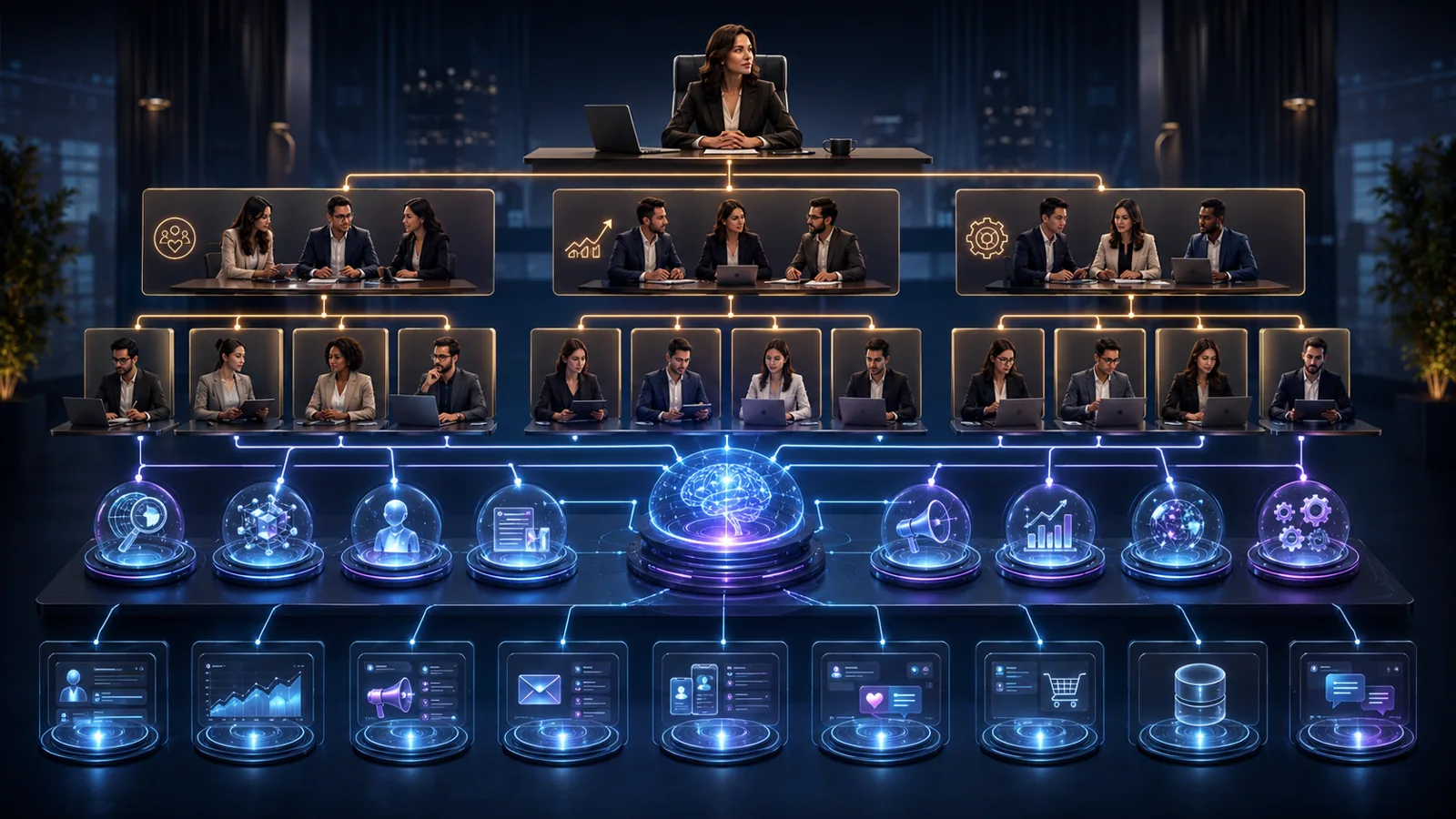
The Future Marketing Team at a Glance
Below is a practical visual org chart for an AI-first marketing organisation.
CEO / BUSINESS LEADERSHIP
│
▼
HUMAN CHIEF MARKETING OFFICER
│
┌─────────────────────┼─────────────────────┐
│ │ │
▼ ▼ ▼
BRAND & CUSTOMER GROWTH & REVENUE AI MARKETING
LEADERSHIP LEADERSHIP OPERATIONS LEAD
│ │ │
┌────────┼────────┐ ┌───────┼────────┐ ┌───────┼─────────┐
│ │ │ │ │ │ │ │ │
▼ ▼ ▼ ▼ ▼ ▼ ▼ ▼ ▼
Brand Customer Creative Demand Product Lifecycle Workflow Data &
Strategist Insight Director Growth Marketing Marketing Architect Governance
Lead Lead Lead Lead Lead Lead
│ │ │ │ │ │ │ │ │
└────────┴────────┴────┴───────┴────────┴────┴───────┴─────────┘
│
▼
AI ORCHESTRATION LAYER
│
┌──────────┬──────────┬──────────┬───────────┬──────────┬──────────┐
│ │ │ │ │ │ │
▼ ▼ ▼ ▼ ▼ ▼ ▼
Research Customer Content Campaign Performance SEO & Marketing
Agent Insight Agent Agent Agent Discovery Operations
Agent Agent Agent
│ │ │ │ │ │ │
└──────────┴──────────┴──────────┴───────────┴──────────┴──────────┘
│
▼
EXECUTION & TOOL LAYER
CRM | Analytics | Advertising | Email | CMS | Social | Sales |
Customer Support | Product Data | Finance
This structure does not suggest that every company needs all these roles.
A start-up might combine several human positions under one leader. A global enterprise may divide each function into multiple regional and specialist teams.
The essential idea is the separation of four distinct layers:
- Human direction
- Human expertise
- AI orchestration
- Automated execution
Why the Traditional Marketing Org Chart Is Changing
Functional Silos Slow Customer Understanding
Traditional marketing structures divide responsibility by channel.
One team manages social media. Another manages email. A third handles search. A fourth creates brand campaigns.
Customers do not experience the business through those organisational boundaries.
A person may:
- Discover the company through an AI-generated answer.
- Read a blog article.
- watch a product video.
- Subscribe to an email.
- Speak with sales.
- Use the product.
- Contact customer support.
The customer experiences one brand.
Internally, however, each interaction may be owned by a different department using different data.
The future marketing team must therefore organise around customer journeys and business outcomes rather than only around channels.
AI Can Coordinate Work Across Functions
A customer-insight agent can analyse information from sales, support, product usage and marketing channels simultaneously.
A campaign agent can coordinate content, email, advertising and social distribution around one objective.
A performance agent can compare activity across channels rather than producing separate reports for each platform.
This allows the organisation to become more connected.
Salesforce reported in 2026 that AI adoption among marketers had become widespread, while many organisations were still using it for relatively basic tasks. Its research positioned agentic marketing as the next step: connected systems that can engage customers and adapt across journeys rather than simply generate isolated outputs.
Workflow Design Becomes More Important Than Headcount
The future marketing leader will not begin by asking:
“How many people do we need?”
They will ask:
- What outcome must the team produce?
- Which decisions require human ownership?
- Which tasks can AI perform reliably?
- Where does specialist expertise matter?
- How should work move between humans and agents?
- What controls are required?
McKinsey’s AI research indicates that organisations generating stronger value from AI tend to redesign workflows and operating models instead of merely placing AI tools inside existing processes.
This means the org chart must be designed around the work of the future—not the job descriptions of the past.
Layer 1: Human Executive Leadership
At the top of the future marketing organisation remains a human Chief Marketing Officer or equivalent business leader.
The human CMO should own:
- Market strategy
- Brand direction
- Customer priorities
- Growth investment
- Organisational design
- Ethical boundaries
- Executive alignment
- Final accountability
The CMO may rely heavily on AI for analysis and execution, but they remain responsible for the company’s relationship with the market.
Why the CMO Remains Human
Marketing decisions involve trade-offs that cannot always be reduced to a clear optimisation target.
A system may recommend aggressive personalisation because it improves conversion.
A human leader must determine whether the experience feels invasive.
An AI agent may recommend reducing brand investment because immediate attribution is weak.
The CMO must consider whether that decision harms long-term demand.
A performance model may recommend prioritising the easiest customers to convert.
Human leadership must decide whether the company should also invest in a strategically important emerging market.
AI can inform these decisions.
It cannot accept accountability for them.
Layer 2: Human Functional Leadership
Below the CMO sit three broad leadership groups.
Brand and Customer Leadership
This group owns how the business understands customers and how it presents itself to the market.
It may include:
- Brand strategist
- Customer insight lead
- Creative director
- Communications leader
- Community leader
Its responsibilities include:
- Positioning
- Brand narrative
- Customer research
- Creative direction
- Reputation
- Cultural interpretation
- Editorial standards
As AI makes average content easier to produce, these capabilities become more valuable.
The challenge will not be generating enough material.
It will be deciding what the company should say, why it matters and whether the market will care.
Growth and Revenue Leadership
This group connects marketing to commercial outcomes.
It may include:
- Demand-generation lead
- Product marketing lead
- Lifecycle marketing lead
- Partner marketing lead
- Revenue operations representative
Its responsibilities include:
- Pipeline creation
- Product launches
- Customer acquisition
- Retention
- Expansion
- Sales enablement
- Commercial experimentation
The group should not operate separately from brand leadership.
Short-term growth without a credible brand becomes expensive.
Brand building without commercial connection becomes difficult to defend.
The future organisation must manage both.
AI Marketing Operations Leadership
This is the most significant addition to the traditional org chart.
The AI marketing operations group is responsible for how human and machine work is designed.
It may include:
- AI marketing operations lead
- Workflow architect
- Data and governance lead
- Agent performance manager
- Marketing systems engineer
- AI quality and evaluation specialist
This function decides:
- Which agents should exist
- Which tools they can access
- What data they can use
- Where human approval is required
- How agent performance is measured
- How failed outputs are handled
- When an agent should be modified or retired
The emerging importance of this role is not limited to marketing. The concept of a “workforce orchestrator”—someone responsible for coordinating human workers, AI agents and automated systems—is already appearing in wider organisational discussions.
Layer 3: Human Specialists
AI will reduce certain production responsibilities, but it will not eliminate specialist expertise.
The future team may employ fewer people whose main responsibility is manually producing routine outputs.
It may employ more people capable of providing context, judgement and quality control.
Brand Strategist
Defines:
- Market position
- Brand promise
- Narrative
- Messaging architecture
- Competitive differentiation
Customer Insight Lead
Interprets:
- Interviews
- Customer behaviour
- Support conversations
- Sales objections
- Product feedback
AI may detect patterns, but the insight lead explains what those patterns mean.
Creative Director
Determines:
- Which concepts deserve development
- Whether the creative work is distinctive
- How the brand should be expressed visually and emotionally
- Where creative risk is justified
Product Marketing Lead
Connects:
- Product value
- Customer problems
- Competitive context
- Sales communication
- Launch strategy
Growth Strategist
Designs:
- Acquisition systems
- Channel experiments
- Conversion strategies
- Audience priorities
- Commercial tests
Lifecycle Marketing Lead
Owns:
- Onboarding
- Activation
- Retention
- Expansion
- Re-engagement
AI Workflow Architect
Maps:
- Inputs
- Decisions
- AI tasks
- Human approvals
- Exceptions
- Outputs
- Feedback loops
AI Quality and Governance Lead
Evaluates:
- Accuracy
- Brand alignment
- Data usage
- Legal and reputational risk
- Agent reliability
- Permission boundaries
Layer 4: The AI Orchestration Layer
The orchestration layer is the operational centre of the future marketing organisation.
It receives objectives from human leaders and coordinates the appropriate agents, tools and approvals.
For example, the CMO may approve an objective:
Increase product adoption among mid-market customers.
The orchestration layer could then:
- Ask the customer-insight agent to identify adoption barriers.
- Ask the performance agent to analyse usage by segment.
- Ask the content agent to prepare educational assets.
- Ask the campaign agent to design the customer journey.
- Route messaging to the brand lead for approval.
- Send approved campaigns to execution platforms.
- Monitor customer response.
- Return findings to human leaders.
The orchestration layer prevents every agent from acting independently.
It applies:
- Task sequencing
- Access controls
- Approval gates
- Cost limits
- Escalation rules
- Logging
- Evaluation
Without orchestration, an organisation may simply replace tool sprawl with agent sprawl.
Layer 5: Specialised AI Marketing Agents
The future team may deploy a portfolio of specialised agents.
These are not employees in the legal or emotional sense.
They are managed systems with defined roles, data access and performance expectations.
Research Agent
The research agent can:
- Monitor competitors
- Summarise market developments
- Collect customer evidence
- Identify emerging topics
- Prepare research briefs
Human ownership remains necessary for source verification and strategic interpretation.
Customer Insight Agent
The customer insight agent can analyse:
- Sales calls
- Customer interviews
- Support tickets
- Reviews
- Survey responses
- Product usage signals
It can group recurring themes and highlight changes in customer language.
Content Agent
The content agent can:
- Develop outlines
- Prepare first drafts
- Adapt material by channel
- Repurpose approved content
- Create variations
- Recommend internal links
The human content strategist remains responsible for originality, accuracy and editorial quality.
Campaign Agent
The campaign agent can:
- Prepare briefs
- Recommend channel mixes
- Coordinate asset requirements
- Build approved workflows
- Track execution
- Suggest experiments
Performance Agent
The performance agent can:
- Monitor metrics
- Detect anomalies
- Compare segments
- Summarise changes
- Recommend further investigation
It should not make high-impact budget changes without defined authority.
SEO and AI Discovery Agent
This agent can support visibility across traditional search and AI-mediated discovery.
It may:
- Analyse search demand
- Identify content gaps
- Review technical issues
- Track brand citations
- Recommend structured content
- Monitor changes in discovery behaviour
Marketing Operations Agent
This agent can coordinate:
- Project updates
- Asset routing
- Calendar changes
- Workflow status
- Documentation
- Routine reporting
It reduces administrative friction across the department.
What Reports to Whom?
The future org chart should not place AI agents directly beneath the CMO without operational ownership.
Every agent requires a human owner.
A human owner should be responsible for:
- Defining the agent’s role
- Approving its knowledge sources
- Evaluating output
- Reviewing errors
- Adjusting permissions
- Monitoring commercial value
No AI agent should operate as an ownerless digital employee.
A Smaller Org Chart for Start-ups and SMEs
A smaller company does not need the full structure shown above.
A practical lean model could look like this:
FOUNDER / CEO
│
▼
HUMAN MARKETING LEAD
│
┌──────────────┼──────────────┐
│ │ │
▼ ▼ ▼
Brand & Content Growth & Sales AI Operations
Strategist Lead Owner
│ │ │
└──────────────┼──────────────┘
▼
AI ORCHESTRATION LAYER
│
┌────────┬───────┼────────┬──────────┐
▼ ▼ ▼ ▼ ▼
Research Content Campaign Analytics Operations
Agent Agent Agent Agent Agent
In this model:
- The founder or marketing lead sets direction.
- A brand and content strategist protects differentiation.
- A growth lead connects activity to revenue.
- An AI operations owner manages workflows and agents.
- AI handles a large share of repeatable execution.
A company might initially combine all three human roles among two or three people.
The architecture can become more specialised as the business grows.
A Future Enterprise Marketing Structure
A global enterprise will require additional layers.
These may include:
- Global CMO
- Regional marketing leaders
- Business-unit marketing heads
- Brand centre of excellence
- Customer intelligence centre
- AI marketing operations centre
- Regional execution teams
- Governance and compliance
- Shared agent platform
The challenge is balancing central control and local relevance.
Central Teams Should Own
- Brand standards
- Data architecture
- Agent governance
- Core platforms
- Global measurement
- Shared knowledge
- Security
Regional Teams Should Own
- Cultural adaptation
- Local customer insight
- Regional channels
- Market-specific campaigns
- Language and regulatory nuance
- Local partnerships
AI can help adapt global campaigns, but local humans must judge whether the resulting communication fits the market.

How Work Moves Through the Future Team
The org chart explains responsibility.
The workflow explains how value is created.
Consider the development of a new B2B campaign.
Step 1: Human Objective
The growth leader defines the commercial objective:
Generate qualified demand among financial-services companies seeking to automate customer operations.
Step 2: AI Research
The research agent collects:
- Customer questions
- Competitor messaging
- Market developments
- Search patterns
- Relevant internal data
Step 3: Human Interpretation
The customer insight lead identifies the most important buyer tension.
Step 4: AI Exploration
The content and campaign agents prepare:
- Message territories
- Campaign concepts
- Channel plans
- Content requirements
- Testing hypotheses
Step 5: Human Selection
The brand strategist and creative director choose and refine the direction.
Step 6: AI Production
Approved systems create:
- Asset variations
- Channel adaptations
- Email sequences
- Sales enablement drafts
- Campaign workflows
Step 7: Human Approval
High-impact claims and major creative assets receive final approval.
Step 8: Automated Execution
The campaign is distributed through connected platforms.
Step 9: AI Monitoring
The performance agent detects significant changes and anomalies.
Step 10: Human Decision
The growth leader decides whether to expand, revise or stop the campaign.
The human team does not disappear from the process.
Its involvement moves towards the decisions where judgement creates the most value.
What Happens to Existing Marketing Roles?
The future team will not appear overnight.
Existing roles will evolve.
This transition creates both opportunity and risk.
A large marketing field experiment involving 2,310 participants found that human–AI teams achieved higher productivity per worker and allowed people to spend less time on direct editing, although performance varied by task and AI configuration.
The evidence supports collaboration rather than a simplistic replacement model.
Companies still need to preserve entry-level development, customer exposure and opportunities for employees to build judgement.
The New Marketing Management Discipline
Managing the future marketing team requires capabilities that are not common in traditional departments.
Leaders will need to understand:
- Agent role design
- Workflow architecture
- Model selection
- Data permissions
- Human approval systems
- Evaluation methods
- AI cost management
- Failure handling
- Organisational learning
The marketing manager of the future may supervise both people and intelligent systems.
They will need to know:
- Which work to assign to humans
- Which work to assign to AI
- Which work requires both
- How to measure each one
- How to redesign the process when performance is weak
This is why the AI operations leader becomes central to the org chart.
The role is not simply technical administration.
It is workforce design.
Governance Must Appear on the Org Chart
Many organisations treat AI governance as a policy owned outside marketing.
That is insufficient when marketing agents can access customer data, create public content or influence advertising expenditure.
Governance must have clear operational ownership.
The future team should define:
Data Rights
Which information can each agent access?
Action Rights
Which systems can each agent change?
Approval Rights
Which decisions require human permission?
Financial Limits
How much can an agent spend or commit?
Communication Boundaries
Which messages can be sent without review?
Auditability
Can the organisation reconstruct what happened and why?
Microsoft’s introduction of enterprise agent-management capabilities reflects the growing need to authorise, monitor, secure and evaluate autonomous systems similarly to other organisational resources.
Agents must be managed as governed infrastructure—not treated as informal browser tools.
Metrics for the Future Marketing Team
The future organisation should not measure success by the number of agents deployed.
It should evaluate the complete human–AI system.
Business Metrics
- Revenue influenced
- Qualified pipeline
- Customer acquisition cost
- Retention
- Expansion
- Lifetime value
Marketing Metrics
- Brand demand
- Conversion
- Engagement quality
- Content influence
- Customer journey performance
Operational Metrics
- Campaign cycle time
- Cost per approved asset
- Human editing time
- Workflow completion
- Agent error rate
Human Metrics
- Employee capacity released
- Strategic work increased
- Skills developed
- Job satisfaction
- Customer exposure
AI Governance Metrics
- Approval escalations
- Unsupported claims detected
- Permission violations
- Data incidents
- Cost per workflow
- Agent reliability
The goal is not maximum automation.
It is better organisational performance.
Common Mistakes When Designing the Future Team
Replacing Roles Before Mapping Work
A job title contains many tasks and responsibilities.
Some may be automated. Others may remain deeply human.
Map the work before changing headcount.
Creating Too Many Agents
Every agent adds complexity, cost and governance requirements.
Begin with a small number of meaningful roles.
Allowing Agents to Operate Without Owners
Each agent needs accountable human supervision.
Preserving Functional Silos
Adding AI to separate channel teams does not create an integrated organisation.
Removing Junior Development
Companies still need future strategists, creative leaders and customer experts.
Measuring Output Volume
More campaigns and content do not automatically create better marketing.
Treating AI Operations as an IT-Only Function
Technology teams should support infrastructure and security.
Marketing leaders must still define objectives, quality and customer impact.
Automating Human Relationships
Customer interviews, community building, partnerships and sensitive conversations should retain meaningful human involvement.
A 90-Day Transition Plan
Days 1–30: Map the Current Organisation
Document:
- Existing roles
- Recurring tasks
- Decision ownership
- Workflow bottlenecks
- Data access
- AI tools already in use
Classify work as:
- Human-owned
- AI-assisted
- Automatable
- Unnecessary
Days 31–60: Build the First Human–AI Pod
Choose one function such as content or campaign reporting.
Create a small pod containing:
- One human owner
- One specialist
- One workflow
- One or two agents
- Clear approval rules
- Defined metrics
Days 61–90: Measure and Redesign
Assess:
- Time saved
- Quality
- Business impact
- Employee experience
- Errors
- Governance
- Work that should stop
Use the results to redesign one role or team—not the entire department.
Key Takeaways
- The future marketing organisation will combine human leaders, specialists, AI managers and specialised agents.
- Human leadership remains responsible for strategy, judgement, ethics, creativity and accountability.
- AI agents will perform more research, production, monitoring and administrative execution.
- An AI orchestration layer will coordinate agents, tools, permissions and approvals.
- Every agent requires a clearly accountable human owner.
- Future teams should be organised around customer outcomes and workflows rather than only around channels.
- Small companies can adopt a simplified structure with a few people and a managed AI execution layer.
- AI operations and workforce orchestration will become important marketing leadership disciplines.
- Governance must be represented through clear roles, permissions and decision rights.
- The objective is not the smallest possible team. It is the most capable, responsive and intelligently designed team.
Conclusion: The Marketing Department Is Becoming a Human–AI Network
The future marketing team will not look like a traditional hierarchy with AI tools added at the bottom.
It will operate as a network.
Human executives will define direction.
Human specialists will contribute customer understanding, creativity, expertise and judgement.
AI managers will design workflows and govern intelligent systems.
Specialised agents will perform repeatable research, production, analysis and coordination.
Shared data and orchestration infrastructure will connect the entire organisation.
This model creates the potential for smaller teams to achieve greater scale.
But scale is not the only objective.
The future team should also become:
- Closer to customers
- Faster at learning
- More consistent
- More creative
- More accountable
- Better connected to revenue
The company that simply replaces people with AI may reduce costs temporarily while weakening judgement, trust and future talent.
The company that ignores AI may preserve familiar roles while becoming slower and less competitive.
The strongest organisation will design a deliberate partnership between people and intelligent systems.
Its org chart will not only show who reports to whom.
It will show:
- Who owns the decision
- Which intelligence supports it
- Which agent executes it
- Where approval happens
- How learning returns to the team
That is the future marketing department: not human-only, not AI-only, but human-led and intelligently orchestrated.
Actionable Next Steps
To create your future marketing org chart:
- Define the outcomes marketing must own.
- List the decisions required to produce those outcomes.
- Separate human responsibilities from repeatable execution.
- Identify the first AI agents the organisation actually needs.
- Assign a human owner to every agent.
- Create an orchestration and approval layer.
- Define data and action permissions.
- Redesign roles around future value.
- Protect customer contact and employee development.
- Measure the performance of the complete human–AI system.
Frequently Asked Questions
What will the future marketing team look like?
It will combine human executives, strategists and creative specialists with AI operations leaders, workflow architects and specialised agents for research, content, campaigns and analytics.
Will future marketing teams have fewer people?
Some teams may become smaller because AI reduces repetitive execution. However, companies may reinvest capacity in customer research, strategy, creativity, community and new growth initiatives.
Who should manage AI marketing agents?
Each agent should have a named human owner, supported by an AI marketing operations or workflow leader responsible for governance and system performance.
Which roles will remain human-led?
Brand strategy, customer interpretation, creative direction, executive communication, ethical decisions, crisis management and final accountability should remain human-led.
What is an AI marketing orchestration layer?
It is the system that coordinates agents, tools, data, workflows, permissions and human approvals so that AI capabilities operate as one controlled marketing system.
Does a small business need a complex AI marketing org chart?
No. A small business can begin with a marketing leader, a brand or content strategist, a growth lead and a small portfolio of supervised AI agents.
How should AI agents appear on an org chart?
They should appear beneath the human or operational function accountable for their work, rather than reporting independently to executive leadership.
How can companies transition to this structure safely?
They should map current work, begin with one human–AI team, set clear approval rules, measure results and redesign the organisation gradually.
11 aug-AI Search is replacing SEO
Frequently asked questions
What will the future marketing team look like?
It will combine human executives, strategists and creative specialists with AI operations leaders, workflow architects and specialised agents for research, content, campaigns and analytics.
Will future marketing teams have fewer people?
Some teams may become smaller because AI reduces repetitive execution. However, companies may reinvest capacity in customer research, strategy, creativity, community and new growth initiatives.
Who should manage AI marketing agents?
Each agent should have a named human owner, supported by an AI marketing operations or workflow leader responsible for governance and system performance.
Which roles will remain human-led?
Brand strategy, customer interpretation, creative direction, executive communication, ethical decisions, crisis management and final accountability should remain human-led.
What is an AI marketing orchestration layer?
It is the system that coordinates agents, tools, data, workflows, permissions and human approvals so that AI capabilities operate as one controlled marketing system.
Does a small business need a complex AI marketing org chart?
No. A small business can begin with a marketing leader, a brand or content strategist, a growth lead and a small portfolio of supervised AI agents.
How should AI agents appear on an org chart?
They should appear beneath the human or operational function accountable for their work, rather than reporting independently to executive leadership.
How can companies transition to this structure safely?
They should map current work, begin with one human–AI team, set clear approval rules, measure results and redesign the organisation gradually. 11 aug-AI Search is replacing SEO