The Future of Marketing Isn’t More AI Tools. It’s an AI Marketing Operating System.
Campaigns still move through documents, messages, spreadsheets, dashboards, and approval chains.
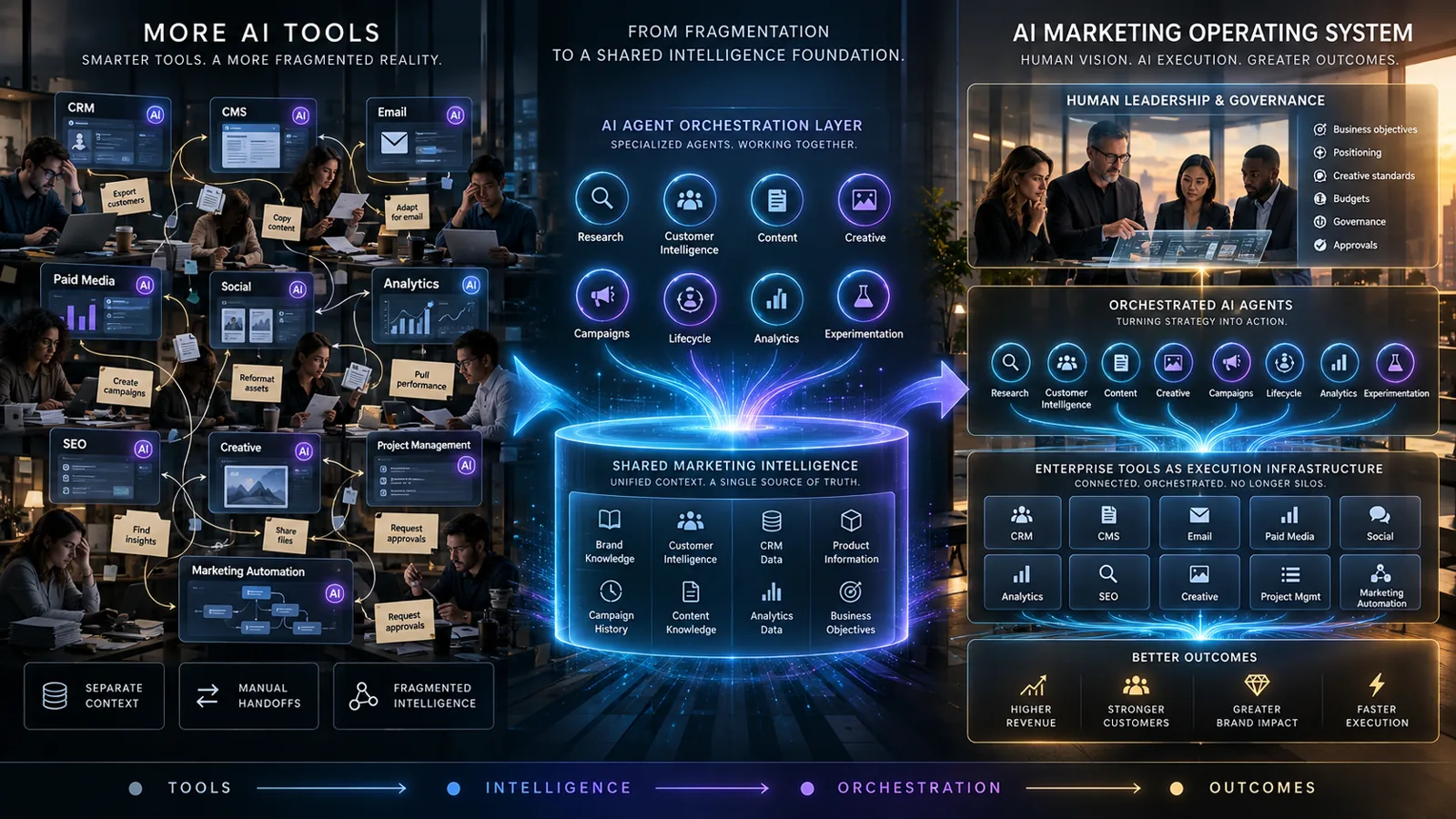
There is an AI tool for almost everything in marketing now.
AI for writing.
AI for SEO.
AI for advertising.
AI for email.
AI for research.
AI for social media.
AI for design.
AI for analytics.
AI for personalization.
AI inside CRM.
AI inside marketing automation.
AI inside project management.
AI inside the platforms marketers were already using.
And every month, another tool arrives promising to transform marketing.
Yet something strange is happening.
Marketing teams have more intelligence available to them than ever before.
But marketing itself often still feels fragmented.
People still copy information between platforms.
Teams still recreate the same context across different AI tools.
Campaigns still move through documents, messages, spreadsheets, dashboards, and approval chains.
Leaders still have to combine outputs from multiple systems before making decisions.
More AI has not automatically created a better marketing operating model.
That is because the industry's next challenge is no longer simply access to intelligence.
It is coordination of intelligence.
The future of marketing is not another AI tool.
It is an AI marketing operating system capable of connecting business context, customer intelligence, specialized agents, workflows, enterprise software, automation, measurement, and human decision-making into one coordinated system.
That is a much bigger change.
We Solved the Tool Problem
Marketing technology has spent more than a decade solving increasingly narrow problems.
Need customer relationship management?
Buy a CRM.
Need email automation?
Buy an email platform.
Need SEO intelligence?
Buy an SEO tool.
Need social scheduling?
Buy a social platform.
Need attribution?
Buy analytics.
Need project management?
Add another tool.
Need content generation?
Add AI.
Need meeting summaries?
Add another AI tool.
Need creative generation?
Add another one.
Individually, many of these tools are excellent.
The problem is not their capability.
The problem is what happens between them.
Every new application creates another place where:
- information lives
- context must be entered
- work must be reviewed
- permissions must be managed
- outputs must be transferred
- decisions must be coordinated
The stack becomes more capable.
But it also becomes more fragmented.
AI does not automatically solve this problem.
In fact, adding intelligence separately to every system can make it worse.
Every Tool Is Becoming Smarter. The Stack Is Becoming More Complicated.
Imagine a company uses eight major marketing platforms.
Its CRM adds an AI assistant.
Its CMS adds AI.
Its social platform adds AI.
Its analytics platform adds AI.
Its email platform adds AI.
Its advertising systems add AI.
Its design platform adds AI.
Its project-management platform adds AI.
The company now has eight intelligent systems.
But those systems may still operate with different:
- data
- memory
- interfaces
- permissions
- workflows
- goals
- context
The marketer remains responsible for connecting them.
The CRM AI might know that an account is highly valuable.
The content AI may not.
The analytics AI may identify a conversion problem.
The campaign tool may not automatically understand why.
The design AI may generate an asset without knowing what performed last month.
The social AI may not understand the strategy being used by paid media.
Each application becomes smarter.
The marketing organization does not necessarily become smarter.
This is the difference between:
tool intelligence
and
organizational intelligence.
The future belongs to the second.
Why More AI Tools Can Actually Increase Marketing Work
AI makes production cheap.
That sounds entirely positive.
And largely, it is.
But removing one bottleneck often reveals another.
Suppose a marketing team once produced:
10 ad concepts.
AI now helps it generate:
Did marketing become ten times more effective?
Not necessarily.
Someone now has to:
- review them
- compare them
- select them
- validate claims
- check brand consistency
- approve them
- distribute them
- measure them
- determine which lessons matter
The bottleneck moved from generation to judgment.
The same happens with content.
AI can produce an enormous number of articles, emails, images, landing pages, scripts, and campaign ideas.
But more output creates more:
- review
- governance
- coordination
- version management
- approval
- measurement
The organization can quickly reach a strange state:
AI produces work faster than humans can manage the work AI produces.
The answer cannot simply be another AI-generation tool.
The surrounding workflow has to change.
AI Adoption Is Not the Same as AI Transformation
This distinction explains much of the current AI market.
Salesforce's 2026 State of Marketing research found that 75% of marketers had adopted AI, yet 84% still reported running generic campaigns. Marketers also cited fragmented or irrelevant data as a major barrier to using AI more effectively.
In India specifically, Salesforce reported AI adoption among marketers at 81%, while emphasizing that siloed systems and poor-quality data continued to constrain AI-powered customer engagement.
This tells us something important.
The industry does not primarily have an AI access problem anymore.
It has an architecture problem.
AI adoption asks:
“Are our marketers using AI?”
AI transformation asks:
“Does marketing now operate differently because AI exists?”
Those are not the same question.
The Bolt-On AI Era
Most companies are currently somewhere in what could be called the bolt-on AI era.
The underlying marketing workflow remains unchanged.
Then AI is added to individual stages.
A traditional content workflow might look like:
Research → Brief → Draft → Design → Review → Approval → Publish → Distribute → Measure
Instead of redesigning it, organizations add:
AI research.
AI writing.
AI design.
AI analytics.
The workflow becomes:
AI Research → Brief → AI Draft → AI Design → Review → Approval → Publish → Distribute → AI Analytics
There is more AI.
But the architecture is nearly identical.
Humans still:
- initiate each step
- transfer information
- determine dependencies
- manage status
- request approvals
- coordinate teams
- combine results
- determine what should happen next
AI improved the components.
It did not redesign the system.
This is why McKinsey's 2026 research is particularly significant: while 90% of CMOs were experimenting with AI, fewer than 10% had scaled it or captured value across marketing workflows. Only 28% of surveyed organizations were fundamentally rewiring teams and workflows.
That gap is where the next transformation will happen.
The Future Is Workflow-First, Not Tool-First
Marketing leaders have spent years asking:
Which tool should we buy?
A more important question is emerging:
How should this workflow operate?
Take campaign creation.
The objective is not to have:
- an AI copywriting tool
- an AI design tool
- an AI research tool
- an AI analytics tool
The objective is to move efficiently from:
business objective
to
customer insight
to
strategy
to
execution
to
measurement
to
learning
The workflow is the product.
Tools are simply capabilities used inside it.
That shift sounds subtle.
It changes almost everything.
What Is an AI Marketing Operating System?
An AI marketing operating system is an integrated architecture that connects business context, customer intelligence, AI agents, workflows, enterprise tools, automation, analytics, and human governance so marketing can operate as one coordinated system.
It is not necessarily one piece of software.
It is an operating model.
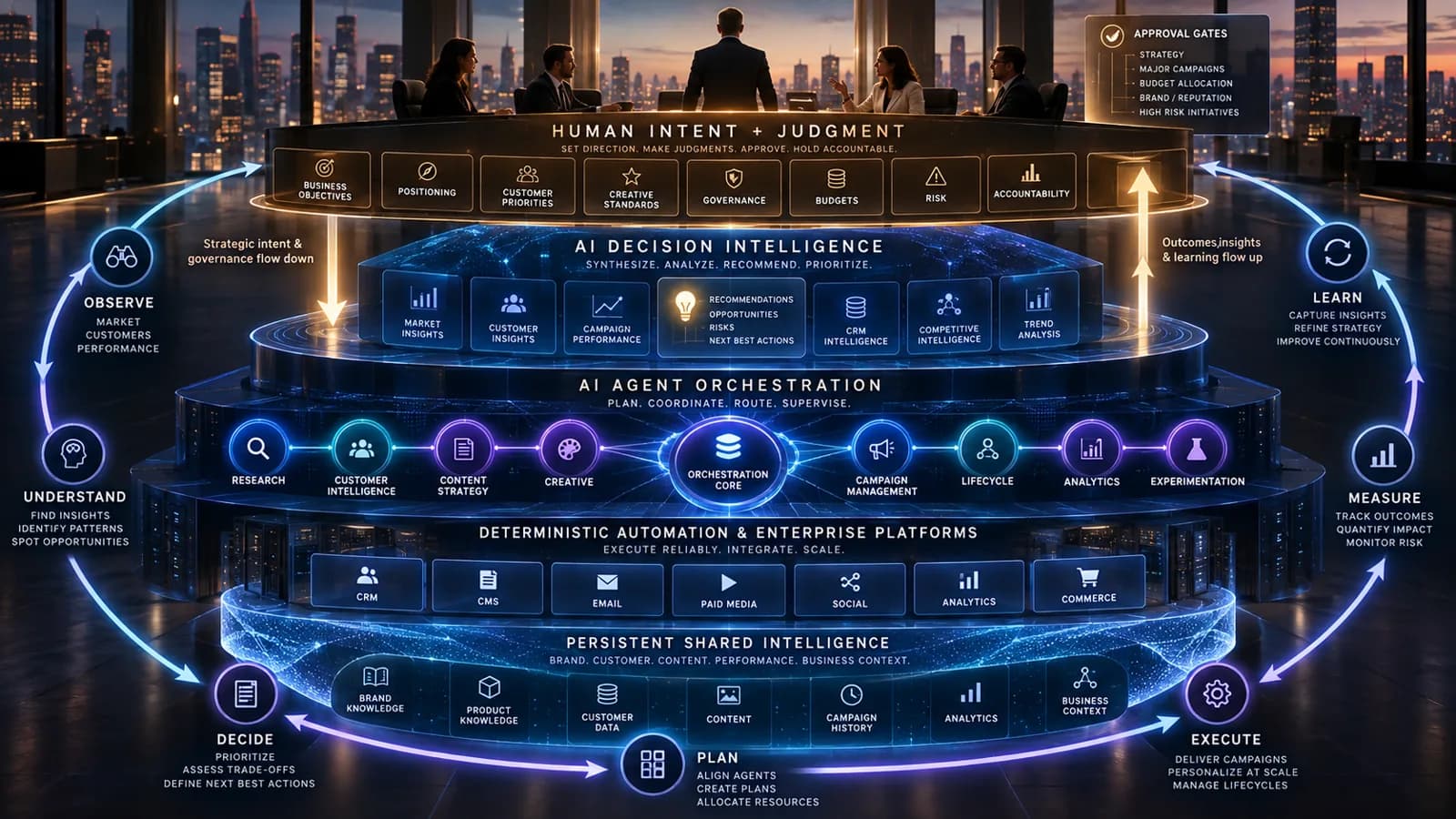
A mature version would contain several layers.
Layer 1: Shared Intelligence
Everything begins with context.
The system needs access to what the organization knows about:
- the brand
- products
- customers
- CRM history
- previous campaigns
- competitors
- content
- performance
- pricing
- sales insights
- business objectives
- strategic priorities
Today, much of this knowledge is scattered.
AI tools therefore repeatedly ask humans to supply context.
“Explain your audience.”
“Upload the brand guide.”
“Tell me about your product.”
“What is the campaign objective?”
“What tone should I use?”
That is manual work.
A shared intelligence layer means multiple agents can access a common understanding of the organization.
Instead of every AI starting from zero, the marketing system develops persistent institutional context.
That becomes the foundation for everything above it.
Layer 2: Specialized AI Agents
One AI assistant should not necessarily do everything.
Marketing consists of specialized problems.
A future marketing operating system might include:
- Market Research Agent
- Customer Intelligence Agent
- Competitive Intelligence Agent
- Content Strategy Agent
- SEO Agent
- Content Production Agent
- Creative Agent
- Campaign Agent
- Lifecycle Agent
- Analytics Agent
- Experimentation Agent
Each agent can have:
- defined responsibilities
- appropriate tools
- specific permissions
- relevant data access
- quality standards
The value comes not from simply having agents.
It comes from how they collaborate.
Layer 3: Orchestration
Orchestration is what turns multiple intelligent capabilities into one operating system.
The orchestration layer determines:
- which agent should act
- when it should act
- what information it receives
- which tasks can run in parallel
- what dependencies exist
- whether human approval is needed
- what happens when something fails
- which tool needs to execute an action
- what should happen after completion
Without orchestration, ten AI agents can become ten new silos.
With orchestration, they become a workflow.
McKinsey identifies orchestration as one of the core capabilities shaping the future marketing model and describes always-on orchestration as a move from isolated campaign cycles toward continuously managed human-agent workflows.
Layer 4: Deterministic Automation
Not everything requires AI.
Some processes should remain predictable.
If a customer completes a form, create the CRM record.
If an approved campaign reaches its scheduled launch date, deploy it.
If consent is withdrawn, stop communication.
If an asset receives final approval, update its status.
Rules-based automation is valuable precisely because it behaves consistently.
The AI marketing operating system should therefore not replace traditional automation.
It should use it.
A useful division is:
AI interprets uncertainty.
Agents coordinate dynamic work.
Automation handles predictable execution.
Each layer does what it is best at.
Layer 5: Enterprise Systems
Existing marketing technology does not disappear.
The CRM remains useful.
The CMS remains useful.
Email platforms remain useful.
Advertising systems remain useful.
Analytics platforms remain useful.
Commerce platforms remain useful.
But they gradually change role.
Instead of every system being another destination a marketer has to manually operate, enterprise platforms become execution infrastructure underneath a more intelligent orchestration layer.
The interface moves upward.
That is an important architectural shift.
Layer 6: Human Governance
The future of AI marketing cannot simply be:
give agents access to everything and hope for the best.
Organizations need explicit rules governing:
- customer-data access
- publishing
- budget changes
- messaging claims
- campaign activation
- experimentation
- customer communication
- escalation
- legal review
- brand safety
Human approval should be designed according to consequence.
A low-risk content-tag update may execute automatically.
A major positioning change should not.
A budget adjustment within approved bounds may be delegated.
Launching an entirely new campaign may require approval.
Governance therefore becomes part of the workflow—not something added afterward.
Layer 7: Human Intent and Judgment
At the top of the operating system sits something AI should not be allowed to obscure:
human responsibility.
Humans need to decide:
- what the business is trying to achieve
- which customers matter
- what the brand should represent
- what trade-offs are acceptable
- what quality looks like
- how much risk is appropriate
- which values are non-negotiable
- when optimization should stop
AI can improve the information available for these decisions.
It can recommend.
It can model scenarios.
It can challenge assumptions.
But organizations still need human ownership.
The most powerful future model is therefore not:
AI above humans.
It is:
Humans above AI.
From Apps to Capabilities
Another major change follows from this architecture.
Marketing teams currently think in applications.
“What SEO tool do we use?”
“What tool creates copy?”
“What platform handles analytics?”
AI-native organizations will increasingly think in capabilities.
“We need competitive intelligence.”
“We need content production.”
“We need experimentation.”
“We need campaign optimization.”
“We need customer intelligence.”
A capability could be delivered by:
- an internal agent
- an external model
- an existing enterprise application
- a specialized API
- a human
- some combination of all five
The marketer should not necessarily care which interface performs every underlying step.
The operating system routes work to the appropriate capability.
This is a more flexible model than building workflows around individual applications.
From Prompts to Persistent Context
The first generation of generative AI taught millions of marketers how to prompt.
Prompt engineering became an important skill because AI had limited context.
Every task began with:
“Here is our company…”
“Here is our audience…”
“Here is our tone…”
“Here is what we did previously…”
That model will increasingly feel primitive.
A mature AI marketing system should already understand:
- the brand
- the audience
- the product
- the campaign
- the customer
- previous performance
- relevant policies
- current objectives
This moves marketing from:
prompt-driven AI
toward
context-driven AI.
Prompt quality does not become irrelevant.
But persistent organizational context becomes far more important.
From Dashboards to Decision Intelligence
AI tools are also changing analytics.
Traditional marketing technology provides dashboards.
Dashboards are useful.
But they still place a heavy cognitive burden on humans.
Someone needs to:
- open the dashboard
- identify what changed
- determine whether it matters
- investigate why
- decide what should happen
- assign the next action
An AI marketing operating system can compress this chain.
Instead of displaying:
Conversion rate: 2.8%
it could surface:
Conversion declined 12% among enterprise visitors after the landing-page messaging change. Paid traffic quality is stable, suggesting the issue is more likely on-page than audience-related. Variant B from last month's experiment is the strongest existing alternative.
Then it can ask:
Would you like to launch a controlled test?
That is a very different interface.
The dashboard does not disappear.
It moves into the background.
The primary interface becomes the decision.
From Campaign Management to Continuous Orchestration
Traditional marketing operates in cycles.
Plan.
Build.
Launch.
Report.
Review.
Repeat.
AI makes a more continuous system possible.
The marketing operating loop becomes:
OBSERVE
Monitor customers, competitors, search, CRM, campaigns, sales, content, and market activity.
UNDERSTAND
Interpret what those signals mean.
DECIDE
Identify opportunities, problems, risks, and priorities.
PLAN
Develop campaigns, content, experiments, audiences, and journeys.
EXECUTE
Coordinate humans, AI agents, automation, and enterprise systems.
MEASURE
Assess outcomes against objectives.
LEARN
Update organizational intelligence based on validated results.
Then begin again.
McKinsey's 2026 view of marketing similarly describes the shift toward a continuous growth engine built around insights, scaled creativity, personalization, agentic commerce, and orchestration.
More Tools vs a Marketing Operating System
The difference becomes clear when compared directly.
This is why the future is not simply about buying better software.
It is about changing the unit of design from the tool to the workflow.
The Martech Stack Will Not Disappear
This argument should not be misunderstood.
CRM systems are not going away.
CMS platforms are not going away.
Marketing automation is not going away.
Creative applications are not going away.
Analytics is not going away.
The change is where intelligence sits.
Today's marketer often sits in the middle of the stack, manually operating many different applications.
In the future, orchestration may sit in the middle.
The marketer increasingly sits above it.
Instead of asking:
“Which tab do I need to open next?”
the marketer asks:
“What outcome are we trying to achieve?”
That is the deeper transformation.
The Marketing Team Changes Too
Once workflows change, roles change.
AI-native marketing teams may need fewer people dedicated primarily to:
- repetitive reporting
- asset resizing
- routine research
- task routing
- status updates
- repetitive content generation
- manual campaign setup
At the same time, they may need more strength in:
- strategy
- creative judgment
- systems thinking
- workflow design
- customer understanding
- agent supervision
- AI governance
- experimentation
- quality assurance
- orchestration
McKinsey's 2026 research anticipates roles increasingly organized around people who build AI systems, orchestrate human-agent workflows, and maintain standards of judgment, creativity, and quality.
This is why the future marketing team should not simply be imagined as today's team using ChatGPT.
The organization itself changes.
Fewer Interfaces, More Intelligence
One of the clearest signs that AI marketing has matured will be when marketers stop spending most of their time interacting with software interfaces.
Today:
Open CRM.
Open analytics.
Open ad manager.
Open CMS.
Open project management.
Open email.
Open AI assistant.
Open spreadsheet.
The human becomes the API connecting everything.
A better system reverses the relationship.
The marketing system surfaces what the marketer needs:
Three decisions require approval.
Two campaign risks were detected.
One new customer segment is outperforming expectations.
The content strategy needs revision based on search demand.
Four low-risk optimizations have already executed within approved limits.
The interface becomes less about software navigation and more about attention allocation.
That is a far more meaningful use of AI.
The Goal Is Not Maximum Autonomy
There is a temptation to imagine the future as completely autonomous marketing.
That is probably the wrong target.
The objective should be appropriate autonomy.
Different activities require different levels of human involvement.
High Autonomy
Good candidates might include:
- data retrieval
- tagging
- monitoring
- reporting
- formatting
- basic optimization within limits
Medium Autonomy
Possible examples:
- campaign recommendations
- content drafts
- audience analysis
- experimentation proposals
- asset adaptation
Low Autonomy
Human ownership should remain especially strong around:
- positioning
- business strategy
- major budget decisions
- sensitive customer communication
- high-risk claims
- brand-defining creative
- ethical decisions
- consequential trade-offs
The best marketing operating system is not the one with the fewest humans involved.
It is the one that uses human attention where human attention creates the most value.
The New Marketing Advantage Is Coordination
For years, companies competed partly on their technology stack.
Who had better analytics?
Better CRM?
Better marketing automation?
Better personalization?
Increasingly, access to powerful AI capabilities will commoditize.
Many organizations will have access to similar models.
Similar content generation.
Similar analytical capability.
Similar automation.
That means differentiation moves somewhere else.
It moves to:
context
workflow design
data quality
integration
orchestration
governance
human judgment
Two companies may use the same underlying AI model.
One may produce generic content faster.
The other may connect AI across customer intelligence, research, campaigns, experimentation, and business outcomes.
The model is the same.
The operating system is different.
That difference can become the competitive advantage.
How Should Marketing Leaders Respond?
The first step should not be buying another AI product.
Start by redesigning one important workflow.
1. Choose a High-Value Workflow
For example:
- content production
- campaign creation
- customer research
- lifecycle marketing
- reporting
- lead nurturing
- experimentation
2. Map Every Step
Identify:
- triggers
- inputs
- people
- platforms
- handoffs
- approvals
- outputs
- metrics
3. Find the Coordination Tax
Look for where humans spend time:
- finding information
- transferring context
- checking status
- routing tasks
- preparing reports
- chasing approvals
4. Decide What Humans Should Own
Protect:
- strategy
- judgment
- creativity
- governance
- accountability
5. Decide What AI Should Own
Consider:
- research
- synthesis
- generation
- monitoring
- recommendations
- dynamic reasoning
6. Decide What Automation Should Own
Use deterministic systems for predictable execution.
7. Connect the Workflow
Do not stop after improving individual tasks.
Ask whether work can move intelligently between stages.
8. Measure Outcomes
Track:
- cycle time
- cost
- conversion
- human effort
- output quality
- revenue
- customer outcomes
- learning speed
The goal is not to prove that AI was used.
The goal is to build a better marketing system.
The Future of Marketing Is an Operating Model
Marketing does not need another wave of disconnected intelligence.
It needs integration.
The last several years have been about giving AI capabilities to individual marketers and individual applications.
The next phase will connect those capabilities.
AI tools become agents.
Agents become workflows.
Workflows become orchestrated.
Data becomes shared intelligence.
Dashboards become decision systems.
Automation becomes an execution layer.
And humans move above the system to provide strategy, standards, governance, creativity, and accountability.
That is why the future of marketing isn't more AI tools.
It is not even primarily about better AI tools.
It is about building an architecture where intelligence can move through the organization.
Where context persists.
Where systems collaborate.
Where workflows learn.
Where human attention is reserved for decisions that genuinely require it.
And where marketing operates as one coordinated system rather than a collection of applications.
The next great marketing platform may therefore not look like another tool in the stack.
It may be the layer that finally makes the entire stack work together.
That is the shift from AI-powered tools to an AI-powered marketing operating system.
And that is where the next era of marketing begins.
Frequently asked questions
Why don't marketing teams need more AI tools?
Many marketing teams already have AI capabilities across multiple platforms. The bigger problem is that those systems often use different data, context, workflows, and interfaces. Adding more tools can increase fragmentation unless the capabilities are connected.
What is an AI marketing operating system?
An AI marketing operating system is an integrated architecture connecting shared business intelligence, AI agents, workflow orchestration, automation, enterprise platforms, analytics, and human governance across marketing.
What is the difference between an AI tool and an AI marketing agent?
An AI tool generally helps a user perform a specific task. An AI agent can pursue an objective, reason over context, use tools, and perform multi-step actions within defined permissions and boundaries.
What is AI orchestration in marketing?
AI orchestration coordinates agents, humans, data, software, and automation across workflows. It determines what happens next, which capability should act, what context is needed, and when human approval is required.
Will an AI marketing operating system replace existing martech?
Not necessarily. CRM, CMS, email, analytics, advertising, and automation platforms can remain important execution systems. The main change is that an intelligent orchestration layer can coordinate work across them.
Why is shared intelligence important for AI marketing?
Shared intelligence prevents every AI system from starting without context. It can provide consistent access to brand knowledge, customer intelligence, products, campaigns, analytics, business objectives, and governance rules.
Will marketing become fully autonomous?
Some low-risk processes may become highly autonomous, but important decisions involving strategy, positioning, budgets, brand standards, sensitive customer interactions, risk, and accountability should remain under appropriate human control.
What should marketing leaders do before buying another AI tool?
Map an important end-to-end workflow and identify where information, coordination, approvals, and manual handoffs create friction. Then decide whether existing capabilities can be connected before adding another application.
What comes after generative AI in marketing?
The next stage is increasingly agentic and orchestrated: specialized AI systems that can reason, collaborate, use tools, execute work within boundaries, and participate in continuous marketing workflows rather than only generating isolated outputs.