What Is AI Agent Orchestration in Marketing? How Multiple AI Agents Work Together Across the Marketing Workflow
AI agent orchestration in marketing is the coordination layer that manages how multiple AI agents, humans, data sources, tools, automation, and enterprise systems work together across a marketing…
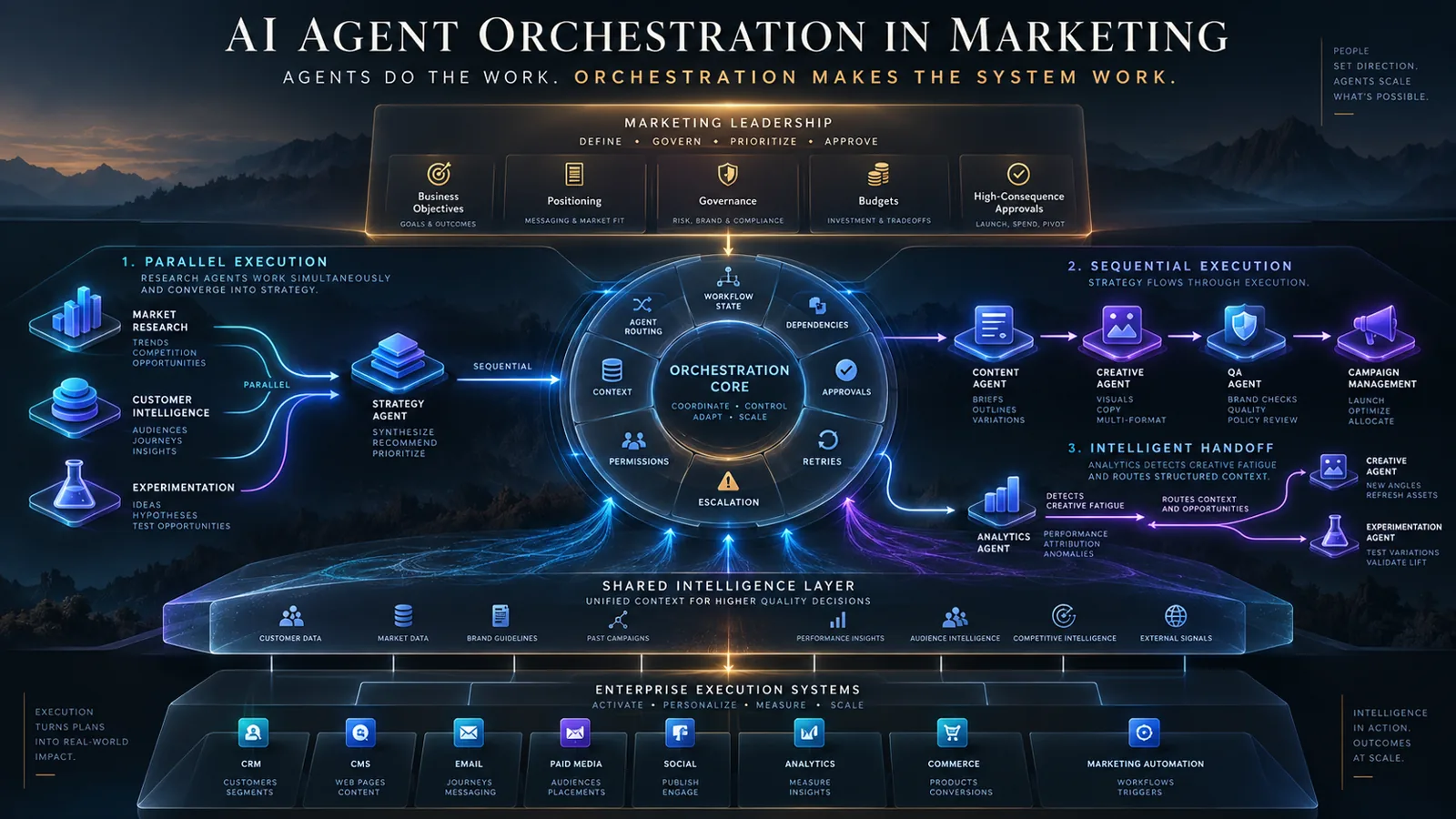
Marketing teams are rapidly adding AI agents.
A Research Agent.
A Content Agent.
A Campaign Agent.
An Analytics Agent.
A Customer Intelligence Agent.
An Experimentation Agent.
Each one can be useful.
But the moment you have several agents, a new problem appears.
Who decides which agent acts first?
Who tells the Content Agent which research to use?
Who knows that Strategy has already been approved?
Who prevents two agents from making conflicting changes?
Who determines whether a campaign can launch?
Who decides when the workflow should stop and ask a human?
That is the problem AI agent orchestration solves.
AI agent orchestration in marketing is the coordination layer that manages how multiple AI agents, humans, data sources, tools, automation, and enterprise systems work together across a marketing workflow.
It determines:
who acts
when they act
what context they receive
what they are allowed to do
what must happen next
when a human needs to intervene
Without orchestration, agents are intelligent islands.
With orchestration, they can become part of a marketing operating system.
Why AI Agents Alone Are Not Enough
An AI marketing agent can perform useful work independently.
For example, an Analytics Agent might detect:
Enterprise conversion fell 14% this week.
It investigates and determines that creative fatigue is likely.
Useful.
But then what?
Someone still needs to:
- notify Creative
- provide campaign context
- specify which assets are approved
- request alternatives
- route them through review
- configure a test
- monitor performance
If a human has to coordinate every one of those steps, the agent improved analysis.
It did not automate the workflow.
This is the core difference.
Agents perform work.
Orchestration coordinates work.
Salesforce describes AI agent orchestration in essentially these terms: it defines how work moves between agents, who has authority to act, and how decisions are reviewed under shared business rules.
A Simple Definition of Marketing Orchestration
A useful mental model is:
Agent
Can do something.
Workflow
Defines what should happen.
Orchestration
Coordinates everything required to make the workflow happen correctly.
Imagine an orchestra.
The violinist may be excellent.
So may the pianist.
The percussionist.
The cellist.
But giving each person sheet music does not automatically produce a coordinated performance.
Someone—or something—must maintain:
- sequence
- timing
- dependencies
- coordination
In agentic marketing, that role belongs to orchestration.
What Does an Orchestration Layer Actually Do?
A useful orchestration layer usually handles several responsibilities.
1. Agent Selection
Which agent should handle the next piece of work?
Example:
A performance anomaly appears.
Should the workflow activate:
Analytics?
Customer Intelligence?
Creative?
Campaign Operations?
The answer depends on the situation.
The orchestrator routes work toward the appropriate capability.
2. Task Sequencing
Some work must occur in a specific order.
For example:
Research → Strategy → Content → Approval → Campaign
You cannot safely launch a campaign before the strategy is approved.
The orchestration layer enforces these dependencies.
3. Parallel Execution
Other tasks can happen at the same time.
For example:
Market Research
Customer Intelligence
Competitive Intelligence
Search Research
may all operate simultaneously.
Once they finish, their outputs converge into Strategy.
This can dramatically shorten workflow time.
4. Context Routing
Not every agent needs every piece of information.
The orchestrator determines what context follows each task.
A Content Agent may receive:
- campaign strategy
- customer problem
- brand guidelines
- product claims
It does not necessarily need:
raw customer PII,
full media budget data,
internal financial records.
Good orchestration moves the right context, not all context.
5. Workflow State
This is one of the least glamorous but most important functions.
The system needs to know:
Research: finished.
Strategy: approved.
Content: in progress.
Creative: revision requested.
Legal: pending.
Campaign setup: blocked.
Launch: not approved.
This is workflow state.
Without state, agents can:
repeat work,
use outdated versions,
act prematurely,
or fail to know whether a decision has already been made.
Reliable agent systems require operational memory, not merely conversational memory.
6. Human Approval Gates
Orchestration determines when automation should pause.
For example:
Content formatting change?
Continue automatically.
Campaign creative adaptation using an approved concept?
Possibly continue.
New product claim?
Pause.
Major budget reallocation?
Pause.
Brand positioning change?
Definitely pause.
This means human-in-the-loop becomes an architectural decision rather than an approval added everywhere.
7. Permissions and Authority
Different agents should have different capabilities.
An Analytics Agent may have permission to:
read campaign data,
run analysis.
But not:
modify a paid-media budget.
A Campaign Agent may be able to:
create campaign drafts,
modify approved configurations.
But not:
launch a high-budget campaign without approval.
Orchestration works together with governance to ensure each capability stays within its authority.
8. Error Handling and Retries
Workflows fail.
APIs time out.
Data is missing.
An agent returns low-confidence output.
A system may reject an update.
What happens then?
A production-grade orchestrator needs logic such as:
retry,
use fallback,
route to another capability,
escalate,
stop.
Without this, agentic workflows can look impressive in demos but behave unpredictably in real environments.
9. Completion Logic
How does the system know the workflow is finished?
A Campaign Agent should not continue optimizing forever.
A Research Agent should not investigate indefinitely.
The orchestrator needs completion conditions.
Examples:
All required assets approved.
Campaign activated successfully.
Experiment reached required confidence.
Human rejected request.
Objective satisfied.
Then the workflow stops or moves into another state.
Orchestration vs Automation
These two concepts are easy to confuse.
Traditional automation usually follows predefined logic.
Example:
IF form submitted → create CRM record.
Or:
IF content approved → publish at scheduled time.
AI agent orchestration manages more dynamic work.
Example:
Campaign performance declined.
The system needs to determine:
what changed,
which specialist should investigate,
what information matters,
whether an experiment is appropriate,
whether a human must approve.
Salesforce describes the distinction clearly: traditional automation generally executes predefined processes, while orchestration coordinates multiple intelligent agents that can evaluate conditions and act across systems under shared governance.
The strongest architecture uses both.
Agents handle reasoning.
Orchestration handles coordination.
Automation handles predictable execution.
Orchestration vs an AI Agent
Another important distinction:
An agent might say:
I can analyze campaign performance.
An orchestrator says:
Analytics should investigate this first. If creative fatigue is detected, route the evidence to Creative. If a new variant stays within approved messaging, send it to Experimentation. If the recommendation changes campaign strategy, escalate to leadership.
The agent performs a capability.
The orchestration layer manages relationships between capabilities.
Orchestration vs a Supervisor Agent
Sometimes orchestration is implemented partly through a supervisor agent.
For example:
A Campaign Supervisor could:
- interpret the overall objective
- delegate work
- decide which specialist is needed
- evaluate whether tasks are complete
But orchestration is broader than one supervisor model.
It may also include deterministic workflow logic for:
- approvals
- permissions
- retries
- state management
- auditing
- system integrations
This is important.
You do not necessarily want an LLM improvising every operational rule.
Some parts of orchestration should remain deterministic.
A Real Marketing Example
Suppose a CMO enters this objective:
Generate 20% more enterprise-qualified pipeline this quarter without increasing paid-media spend.
What happens?
Step 1 — Orchestrator Reads the Objective
The system identifies required capabilities.
The goal likely needs:
- market intelligence
- customer intelligence
- campaign strategy
- content
- paid media
- analytics
- experimentation
It creates the workflow.
Step 2 — Research Agents Run in Parallel
The orchestrator activates:
Market Research Agent
Customer Intelligence Agent
Competitive Intelligence Agent
Search Intelligence Agent
All receive the same high-level objective but different role-specific context.
Their findings are stored in structured outputs.
Step 3 — Strategy Receives the Combined Evidence
Once required research is complete, the orchestrator activates Strategy.
It does not simply dump every research document into the prompt.
It passes the relevant findings.
The Strategy Agent produces:
- audience priority
- campaign thesis
- channel recommendation
- messaging hierarchy
Step 4 — Human Approval
Because positioning is strategically consequential, orchestration pauses.
Leadership receives:
Strategy ready for approval.
A human modifies the primary positioning.
That approved version becomes the next workflow state.
Step 5 — Content and Creative Activate
Now the orchestrator launches several tasks in parallel:
Content Agent
Creative Agent
SEO Agent
Lifecycle Agent
Each receives the approved strategy.
They no longer need separate human briefs.
Step 6 — QA Runs
Assets pass through:
brand validation,
claim validation,
channel formatting,
technical checks.
Simple issues resolve automatically.
One unsupported performance claim is detected.
The workflow routes the claim to a human reviewer.
Step 7 — Campaign Setup
After approval, the Campaign Agent:
creates campaign configuration,
prepares audiences,
attaches approved assets,
configures tracking.
Deterministic systems check technical requirements.
Step 8 — Launch Approval
Because launch carries budget and brand consequences, orchestration pauses.
The CMO receives:
Campaign ready.
48 automated checks passed.
No unresolved issues.
Approve?
The CMO approves.
Step 9 — Analytics Takes Over
After launch, the orchestration layer changes the active workflow.
Analytics now monitors:
- conversion
- pipeline
- CAC
- creative performance
- audience performance
The workflow has moved from:
creation
to:
optimization.
Step 10 — Intelligent Handoff
Analytics detects creative fatigue.
The orchestrator routes the problem to Creative and Experimentation.
No human manually creates a brief.
The structured handoff includes:
- affected campaign
- audience
- supporting evidence
- approved messaging
- budget constraints
Creative produces alternatives.
Experimentation prepares the test.
Step 11 — Low-Risk Action Executes
The test falls within approved experimental limits.
Orchestration allows execution.
The result is measured.
Variant B wins.
Traffic is gradually reallocated within the approved threshold.
No leadership meeting is needed.
Step 12 — Learning Is Captured
The result becomes validated learning.
Shared intelligence updates.
The next relevant campaign can use the lesson.
The workflow does not merely finish.
It improves the system.
That is orchestration.
The Five Main Orchestration Patterns in Marketing
Different workflows require different structures.
Pattern 1 — Sequential Orchestration
Tasks execute in order.
Example:
Research → Strategy → Content → Approval → Launch
Useful when later stages require prior outputs.
Pattern 2 — Parallel Orchestration
Multiple tasks run simultaneously.
Example:
Customer Research + Competitive Research + Search Research
all feed Strategy.
Useful for accelerating workflows.
Pattern 3 — Event-Driven Orchestration
A signal triggers work.
Example:
Conversion falls below an expected range.
This triggers:
Analytics investigation.
Useful for continuous marketing.
Pattern 4 — Conditional Orchestration
The next step depends on the result.
Example:
If performance problem = creative fatigue → Creative Agent.
If performance problem = audience quality → Customer Intelligence Agent.
If uncertain → human analyst.
This is one of the areas where agentic systems become more flexible than rigid automation.
Pattern 5 — Human-Escalation Orchestration
The system proceeds autonomously until consequence crosses a threshold.
Example:
Budget adjustment under 5% → execute.
Budget adjustment over 5% → CMO approval.
Low-risk messaging adaptation → execute.
New positioning → leadership review.
This is the basis of risk-based human involvement.
Always-On Orchestration Changes the Campaign Model
Traditional marketing operates in campaign cycles.
Plan.
Create.
Launch.
Report.
Meet.
Repeat.
Orchestration enables something closer to:
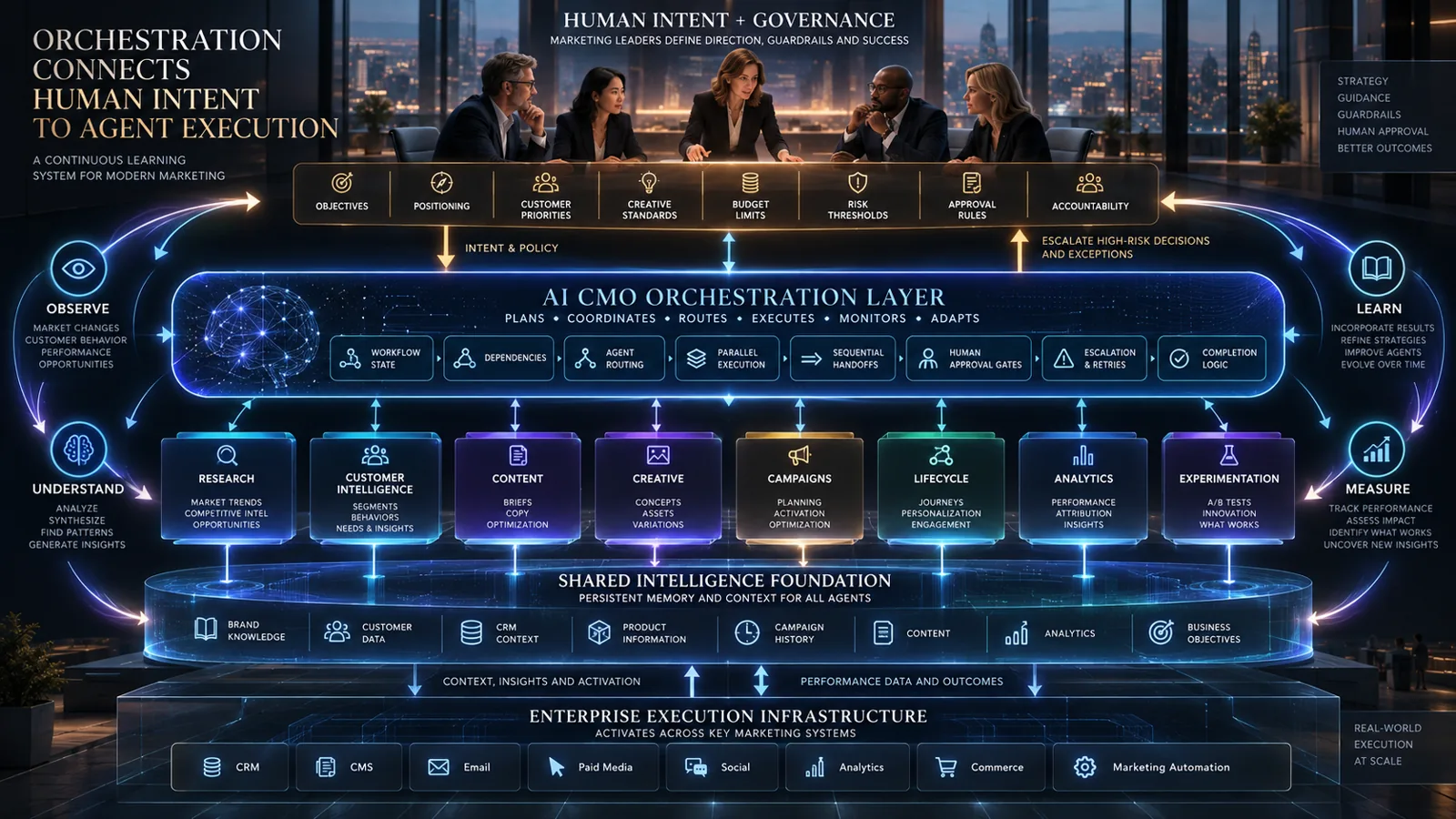
OBSERVE → UNDERSTAND → DECIDE → ACT → MEASURE → LEARN
continuously.
McKinsey calls this always-on orchestration and describes it as replacing disconnected campaign cycles with continuously managed marketing through human-agent teams. It reports that, when implemented effectively, this model can materially improve ROI and reduce the share of marketers' time consumed by execution work.
This is a much deeper change than campaign automation.
It turns marketing into a persistent operating loop.
Orchestration Is the Bridge Between Insight and Execution
Marketing has historically had a large gap between knowing and doing.
Analytics identifies something.
Then:
someone writes a report,
someone schedules a meeting,
someone assigns a task,
someone produces an asset,
someone updates the campaign.
Orchestration compresses that distance.
Consider:
Signal
Creative fatigue.
↓
Diagnosis
Analytics Agent confirms.
↓
Handoff
Creative Agent receives structured context.
↓
Creation
Approved alternatives generated.
↓
Experiment
Experimentation Agent prepares test.
↓
Execution
Campaign Agent activates.
↓
Measurement
Analytics evaluates.
Humans enter only where necessary.
This is why orchestration can become one of the most strategically important layers in an AI marketing architecture.
Orchestration Needs Shared Intelligence
An orchestrator cannot coordinate effectively if every agent operates from a different reality.
Agents need access to consistent:
- customer definitions
- brand guidelines
- product information
- campaign objectives
- analytics
- current priorities
Otherwise, orchestration simply coordinates inconsistency faster.
Shared intelligence therefore becomes a prerequisite.
The orchestration layer decides who gets which context when.
Orchestration Needs Governance
The second prerequisite is governance.
The system needs rules governing:
- data access
- tool permissions
- publishing
- campaign activation
- budget changes
- customer communication
- escalation
- audit trails
Salesforce's 2026 orchestration guidance emphasizes that structured orchestration must manage both collaboration and authority—ensuring agents operate under shared governance rather than acting independently.
The more coordinated the system becomes, the more important this becomes.
Orchestration Needs Observability
If multiple agents are acting across marketing, humans need visibility into what happened.
A strong orchestration system should make it possible to answer:
Which agent acted?
Why?
Which data did it use?
Which tools did it call?
What changed?
Was an approval bypassed?
Where did the workflow fail?
How long did each step take?
This is observability.
It becomes critical when agentic systems move from demos into business-critical workflows.
Orchestration Should Be Deterministic Where Possible
There is a temptation to let AI manage absolutely everything.
That is usually unnecessary.
Some orchestration decisions are known in advance.
For example:
Campaign cannot launch without approval.
Customer data cannot be shared with Content Agent.
Consent suppression cannot be overridden.
Those should be hard rules.
Use AI where dynamic reasoning adds value.
Use deterministic orchestration where predictability matters.
The best systems mix both.
Why More Agents Increase the Need for Orchestration
At first, one or two agents can be managed manually.
But imagine:
10 agents.
Then 30.
Then agents embedded in:
CRM,
analytics,
content,
media,
sales,
customer experience.
Without coordination, the organization develops:
duplicated agents,
conflicting actions,
different customer definitions,
multiple recommendation queues,
inconsistent permissions.
This is agent sprawl.
The answer is not necessarily fewer agents.
It is clearer architecture.
Adobe is moving in this direction as well: its 2026 agentic marketing model increasingly treats agents as parts of connected workflows rather than isolated assistants, with systems designed to turn marketing briefs into executable plans and move work through connected stages.
The Orchestrator Should Not Become a Bottleneck
There is another design risk.
If every action routes through one giant central agent, the orchestrator itself can become:
slow,
expensive,
difficult to debug,
overly powerful.
Good architectures can combine:
central governance
with
distributed execution.
The orchestration layer defines:
- standards
- state
- boundaries
- dependencies
Specialized agents retain ownership of their domains.
This creates coordination without turning the entire system into one giant AI brain.
A Good Orchestration Layer Answers Seven Questions
At any point in a marketing workflow, it should be able to answer:
1. What is the objective?
Why does this workflow exist?
2. What is the current state?
What has happened already?
3. What needs to happen next?
Which step is ready?
4. Who or what should do it?
Human, agent, automation, or enterprise system?
5. What context is required?
Which information should be passed?
6. Is the action allowed?
What do permissions and governance say?
7. What happens afterward?
Continue, branch, retry, escalate, or stop?
If the system cannot answer these questions, orchestration is incomplete.
How Orchestration Changes the Marketing Team
Agent orchestration also changes human roles.
CMO
Moves toward:
- objectives
- decision rights
- strategy
- governance
- system oversight
Marketing Operations
Moves toward:
- workflow design
- orchestration architecture
- agent governance
- permissions
- integrations
Campaign Managers
Move toward:
- exception management
- campaign quality
- performance oversight
Analysts
Move toward:
- measurement design
- experimentation
- validating AI diagnosis
Creative Leaders
Move toward:
- standards
- concept
- taste
- brand differentiation
People move upward because the system coordinates more execution underneath.
Orchestration Is Not the Same as Full Autonomy
This point matters.
You can have sophisticated orchestration without allowing every decision to happen automatically.
A well-orchestrated system might still require humans at:
strategy approval,
creative approval,
launch approval,
major budget changes.
The value comes from everything that happens between those gates without requiring constant human coordination.
That can already transform marketing.
AI Agent Orchestration Inside an AI CMO
This is also why orchestration sits at the center of the AI CMO concept.
An AI CMO needs to coordinate:
- shared intelligence
- research agents
- strategy
- content
- creative
- campaign operations
- lifecycle marketing
- analytics
- experimentation
- enterprise tools
- human approvals
Without orchestration, the AI CMO becomes a collection of AI features.
With orchestration, it becomes an operating model.
How to Start With AI Agent Orchestration
You do not need 25 agents.
Start with one end-to-end workflow.
For example:
Campaign creation.
Map:
Objective → Research → Strategy → Content → Approval → Launch → Analytics
Then ask:
Which steps require AI reasoning?
Which require ordinary automation?
Which should remain human?
Which can happen in parallel?
Where should state be stored?
Where should the workflow pause?
What happens if something fails?
That creates your first orchestration design.
Then add complexity only where it produces measurable value.
Do Not Start by Asking “Which Orchestration Platform?”
Technology comes after workflow design.
First determine:
- business outcome
- agents required
- data required
- tools required
- human decision rights
- dependencies
- permissions
- failure conditions
Otherwise, you risk buying orchestration technology and simply automating a poorly designed process.
McKinsey's 2026 marketing research emphasizes precisely this: the real opportunity comes from redesigning complete workflows, not bolting AI onto existing process fragments.
How to Measure Whether Orchestration Is Working
Do not measure success by:
number of agents,
number of workflows,
number of AI actions.
Measure:
- campaign cycle time
- human handoffs
- time waiting for approvals
- manual coordination hours
- error rates
- cost
- conversion
- decision speed
- agent escalation rate
- business outcomes
The purpose of orchestration is not to make the architecture look sophisticated.
It is to make marketing work better.
AI Agent Orchestration Is the Missing Coordination Layer
Marketing has spent years connecting software with integrations.
Agentic AI adds another challenge.
Now the organization needs to coordinate not only software systems but also intelligent actors.
Those actors can:
reason,
choose,
generate,
act.
That makes coordination more important than ever.
AI agent orchestration provides the layer that determines:
which intelligence acts
on which objective
with which information
using which systems
under which rules
with which human oversight.
That is what turns:
a Research Agent,
a Content Agent,
an Analytics Agent,
and a Campaign Agent
from four useful AI applications into one functioning marketing system.
The Future of Marketing Is Not Agent-Driven. It Is Orchestrated.
This may be the more useful way to think about the next phase.
The future is not simply:
more agents.
Because more agents without coordination can create the same fragmentation marketers already experience with too many tools.
The deeper shift is:
isolated agents → orchestrated workflows
static campaigns → continuous operating loops
manual handoffs → structured agent handoffs
human coordination → human governance
fragmented intelligence → shared context
reports → actions
The agent may be the visible breakthrough.
But orchestration is what allows agents to become an operating model.
And that may make orchestration one of the most important layers in the future marketing organization.
Frequently asked questions
What is AI agent orchestration in marketing?
AI agent orchestration in marketing is the structured coordination of AI agents, humans, data, enterprise tools, and automation across marketing workflows. It manages routing, sequencing, shared context, permissions, approvals, state, escalation, and completion.
What is the difference between an AI agent and AI orchestration?
An AI agent performs specialized work such as research, analytics, content generation, or campaign configuration. Orchestration coordinates how multiple agents and systems work together toward a broader outcome.
How is AI orchestration different from traditional automation?
Traditional automation generally follows predefined rules. AI orchestration can coordinate agents that dynamically interpret changing conditions and choose actions, while still using deterministic automation for predictable steps.
What does an orchestration layer do?
An orchestration layer manages agent selection, task sequencing, parallel execution, workflow state, context routing, permissions, human approval gates, retries, escalation, and workflow completion.
What is workflow state?
Workflow state records where a process currently stands—for example, whether research is complete, strategy has been approved, creative is under review, or campaign launch is blocked.
How do AI agents hand work to each other?
Agents can pass structured outputs through an orchestration layer. A handoff typically includes the objective, relevant evidence, prior decisions, constraints, confidence, and expected next output.
Does agent orchestration require multiple AI agents?
It is most valuable in multi-agent and multi-system workflows, but orchestration can also coordinate one agent with humans, enterprise systems, and deterministic automation.
What is always-on marketing orchestration?
Always-on orchestration continuously monitors marketing signals and coordinates insight, execution, experimentation, and optimization rather than relying entirely on periodic campaign cycles.
Should AI orchestration remove humans from marketing workflows?
No. Good orchestration places humans at strategically meaningful points such as positioning, high-risk claims, major budgets, creative judgment, launch decisions, and accountability.
Why does an AI CMO need orchestration?
An AI CMO must coordinate research, customer intelligence, content, creative, campaigns, analytics, experimentation, automation, and human approvals. Orchestration is the layer that makes those capabilities operate as one marketing system.