What Is an AI CMO? How AI Is Redefining Marketing Leadership in 2026
But giving marketers more AI tools does not necessarily create a better marketing organization.
Marketing has spent the past few years adding AI to almost everything.
AI can write copy.
AI can analyze customer data.
AI can generate images.
AI can recommend audiences.
AI can optimize campaigns.
AI can summarize dashboards.
AI can automate workflows.
But giving marketers more AI tools does not necessarily create a better marketing organization.
The bigger transformation begins when AI moves beyond individual tasks and starts helping coordinate the entire marketing system.
That is where the idea of the AI CMO emerges.
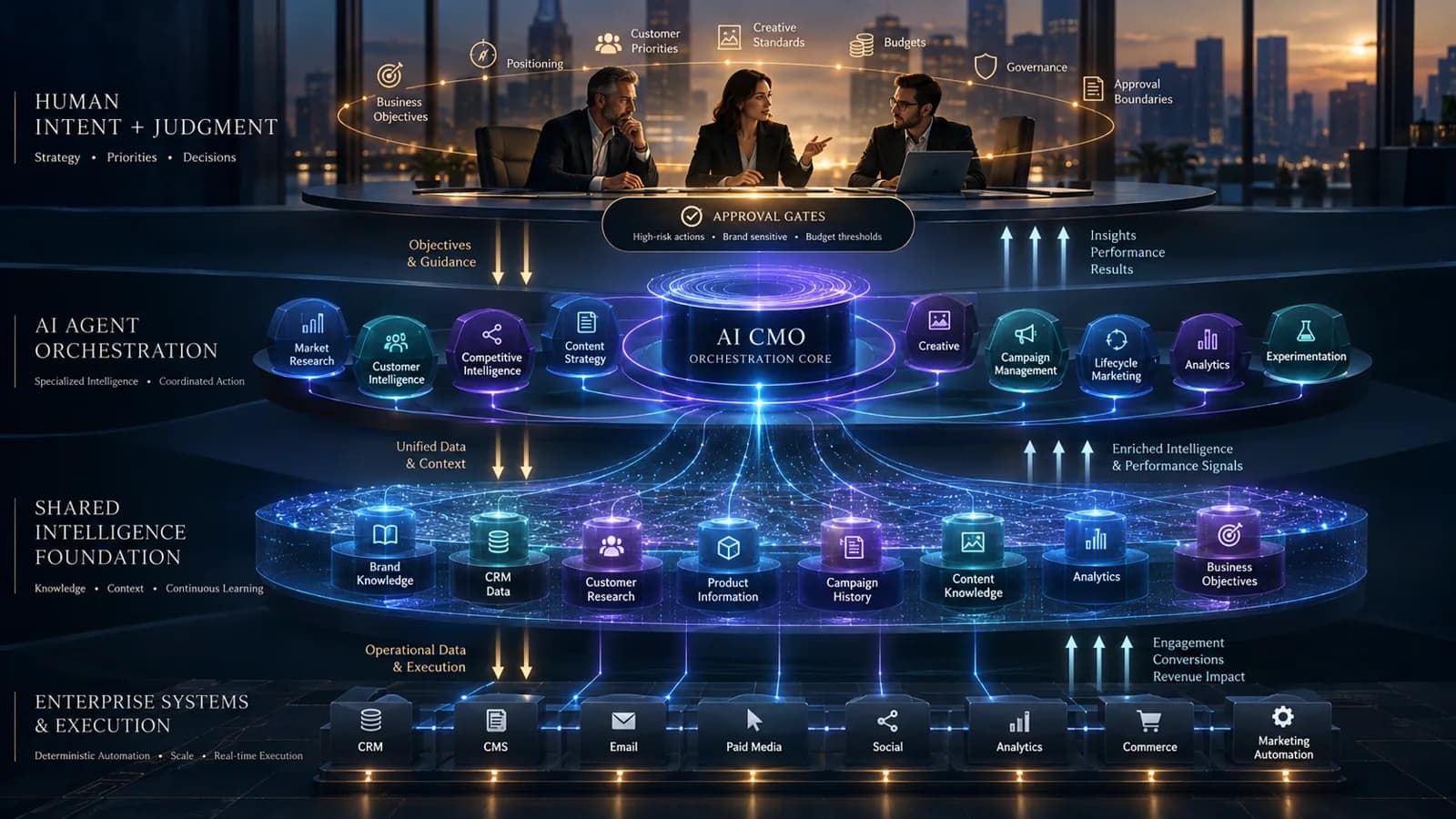
An AI CMO is an AI-powered marketing operating system that combines business context, customer intelligence, specialized AI agents, automation, analytics, orchestration, and human governance to support marketing strategy, execution, measurement, and optimization.
It is not simply an AI-generated version of a human Chief Marketing Officer.
It is not one giant chatbot running marketing.
And it does not eliminate the need for human marketing leadership.
Instead, the AI CMO represents a new operating model in which humans increasingly define intent, strategy, standards, judgment, and accountability, while AI manages more of the intelligence, coordination, execution, monitoring, and optimization required underneath them.
That distinction matters.
The future of marketing leadership may not be humans competing against AI.
It may be humans working above increasingly capable AI systems.
Why the Traditional Marketing Operating Model Is Under Pressure
Modern marketing organizations have accumulated enormous operational complexity.
A typical marketing team may work across:
- CRM systems
- content management platforms
- advertising platforms
- email tools
- marketing automation
- social media management
- analytics systems
- project management software
- customer-data platforms
- SEO tools
- creative platforms
- reporting dashboards
Each system solves a particular problem.
But the human team is usually responsible for connecting all of them.
Someone has to move information from research into strategy.
Someone turns strategy into briefs.
Someone turns briefs into content.
Someone prepares creative.
Someone configures campaigns.
Someone checks approvals.
Someone watches performance.
Someone exports reports.
Someone decides what should happen next.
The technology stack may be sophisticated, but the orchestration layer is often still human.
AI is beginning to change that.
The shift is moving from:
AI inside individual marketing tools
to:
AI coordinating marketing workflows across tools.
This is the conceptual foundation of an AI CMO.
What Does an AI CMO Actually Do?
An AI CMO helps coordinate marketing as a connected system rather than a collection of isolated tasks.
Depending on the architecture and level of autonomy, it could support activities across the entire marketing lifecycle.
For example:
Market intelligence
AI agents can continuously analyze competitors, customer conversations, search trends, market changes, campaign performance, industry developments, and internal data.
Customer intelligence
AI can combine CRM information, behavioral data, customer research, support conversations, purchase history, and segmentation data to build richer customer understanding.
Marketing strategy support
An AI CMO can help analyze business objectives, market opportunities, previous campaigns, audience behavior, and constraints before recommending strategic priorities.
Content strategy
The system can identify topics, audience questions, search opportunities, content gaps, campaign narratives, formats, and distribution opportunities.
Creative production
Specialized AI systems can create drafts of articles, emails, advertisements, landing pages, social content, visual concepts, scripts, and campaign assets.
Campaign orchestration
AI agents can coordinate briefs, content, creative, audiences, channels, approvals, launch preparation, and performance monitoring.
Lifecycle marketing
AI can identify customer states and recommend or execute personalized communication across acquisition, onboarding, activation, retention, expansion, and re-engagement.
Analytics and decision intelligence
Instead of requiring executives to inspect dozens of dashboards, AI can interpret performance data and surface:
- what changed
- why it changed
- what matters
- what is underperforming
- what opportunity exists
- what action should happen next
Continuous optimization
Campaigns no longer need to operate as entirely static sequences.
AI systems can monitor signals and continuously recommend adjustments to content, audience selection, budget allocation, journeys, timing, and messaging.
The important change is therefore not simply that AI performs more tasks.
It is that AI can begin connecting previously fragmented marketing decisions.
The AI CMO Is a System, Not a Single Model
One of the biggest misconceptions about AI-powered marketing leadership is that an AI CMO could be built by giving a powerful large language model access to a company's marketing information.
That would create an intelligent assistant.
It would not create a complete AI CMO.
A more useful architecture consists of several connected layers.
1. Intelligence Layer
The intelligence layer provides the context the system needs to understand the business.
It might contain:
- brand positioning
- brand guidelines
- customer research
- customer personas
- CRM information
- product knowledge
- campaign history
- previous content
- sales information
- market intelligence
- competitor research
- analytics
- business objectives
- pricing
- strategic priorities
Without persistent business context, AI must repeatedly infer the organization from individual prompts.
With shared intelligence, multiple AI agents can operate from the same understanding of the company.
This creates something marketing teams rarely achieve with disconnected tools:
shared organizational context.
2. Agent Layer
Different marketing functions require different forms of reasoning.
That makes specialized AI agents more useful than asking one universal AI assistant to perform everything.
A future AI-powered marketing organization might include:
- Market Research Agent
- Competitive Intelligence Agent
- Customer Intelligence Agent
- SEO Agent
- Content Strategy Agent
- Content Creation Agent
- Creative Agent
- Campaign Agent
- Lifecycle Marketing Agent
- Analytics Agent
- Experimentation Agent
Each agent owns a narrower responsibility but operates using common business context.
An Analytics Agent, for example, might detect that a campaign's landing-page conversion rate has fallen.
Instead of merely adding that information to a dashboard, the system could route the issue to the appropriate agents.
The Customer Intelligence Agent investigates whether audience quality changed.
The Content Agent evaluates message alignment.
The Campaign Agent checks traffic sources.
The Experimentation Agent proposes tests.
The AI CMO coordinates the system.
That is fundamentally different from simply asking ChatGPT:
"Why did conversions fall this week?"
3. Orchestration Layer
This may become the most important layer.
Marketing consists of dependencies.
Research happens before strategy.
Strategy informs content.
Content requires creative.
Creative may require approval.
Campaigns require channel configuration.
Performance generates new information.
New information should affect future decisions.
An orchestration layer manages those relationships.
It determines:
- which agent should act
- in what sequence
- with what context
- what dependencies exist
- whether tasks can run simultaneously
- when human approval is required
- what happens after completion
- where results should be stored
Without orchestration, companies may simply create another generation of fragmented AI tools.
With orchestration, AI can begin operating across complete marketing workflows.
AI CMO vs Traditional CMO
A traditional CMO is a human executive responsible for marketing leadership.
An AI CMO should not be interpreted as a synthetic executive that simply replaces that person.
A better comparison is between two different operating models.
Traditional Marketing Leadership
The CMO and marketing leadership team often spend time coordinating:
- teams
- agencies
- campaigns
- dashboards
- meetings
- briefs
- approvals
- reports
- technology
- channel owners
A significant portion of leadership therefore becomes operational coordination.
AI-Powered Marketing Leadership
In an AI CMO model, more operational coordination can move into the system.
AI manages increasingly large parts of:
- monitoring
- research
- synthesis
- workflow routing
- content production
- reporting
- recommendations
- personalization
- optimization
Human leaders can move upward toward:
- business strategy
- positioning
- customer priorities
- creative judgment
- resource allocation
- governance
- risk management
- major trade-offs
- organizational alignment
- accountability
The CMO therefore does not necessarily disappear.
The role may become more strategic because less leadership capacity is consumed by coordination.
AI CMO vs AI Marketing Assistant
These terms are also easy to confuse.
An AI marketing assistant responds primarily when someone asks it to perform a task.
For example:
"Write five LinkedIn posts."
"Summarize this campaign."
"Give me ten headline variations."
"Analyze this CSV."
The workflow begins with the human.
An AI CMO system can operate more continuously.
It may detect events, interpret signals, initiate workflows, delegate work to specialized agents, request approvals, execute permitted actions, measure results, and trigger subsequent actions.
The difference is:
Assistant → helps a marketer perform a task
AI CMO → helps operate the marketing system
This distinction will become increasingly important as marketing moves from prompt-driven AI toward agent-driven AI.
AI CMO vs Marketing Automation
Marketing automation is already widely used, so another important question is:
How is an AI CMO different from marketing automation?
Traditional automation usually follows predefined logic.
For example:
IF a customer downloads an ebookTHEN add them to a sequence.
Or:
IF a lead score exceeds a thresholdTHEN notify sales.
These systems are extremely useful because they are predictable.
AI agents introduce something different.
They can interpret ambiguous information, reason about context, generate new outputs, evaluate alternatives, and choose between actions.
Consider a struggling campaign.
Traditional automation might detect:
CTR < predefined threshold
and trigger a predefined response.
An AI CMO could potentially investigate:
- which segment declined
- whether creative fatigue exists
- whether search intent changed
- whether competitor activity increased
- whether landing-page messaging is inconsistent
- whether budget allocation should change
It could then recommend or initiate a response.
Marketing automation executes rules.
Agentic marketing increasingly handles decisions within boundaries.
Both will coexist.
Reliable deterministic automation will remain important for predictable processes, while AI will increasingly sit above it as an intelligence and orchestration layer.
Why AI Marketing Leadership Is Emerging Now
Several technology shifts are happening simultaneously.
AI models are becoming more capable
Large language models can increasingly work across text, images, audio, video, structured data, documents, and software tools.
Enterprise data is becoming accessible to AI
Instead of operating only from prompts, AI systems can increasingly retrieve information from CRMs, knowledge bases, analytics platforms, content libraries, and other company systems.
AI agents can use tools
AI is moving from simply producing information toward interacting with software and completing multi-step tasks.
Context can persist
Marketing AI can increasingly retain shared business context instead of starting every conversation from zero.
Orchestration is improving
Multiple agents can increasingly collaborate across workflows rather than operating independently.
Together, these developments make something possible that earlier marketing automation could not easily achieve:
a marketing system capable of interpreting context and coordinating work across functions.
Why More AI Tools Alone Will Not Solve Marketing
This is an important point.
The marketing industry is rapidly adding AI features to existing software.
CRM platforms have AI.
Email platforms have AI.
Analytics platforms have AI.
Design platforms have AI.
Social platforms have AI.
Advertising platforms have AI.
Content systems have AI.
Every tool becoming more intelligent sounds like progress.
But it can also create another problem.
Each platform may contain its own:
- AI assistant
- data
- context
- recommendations
- workflow
- interface
The result can be AI fragmentation.
Marketing teams may end up managing twenty intelligent applications instead of twenty traditional applications.
That does not eliminate coordination.
It increases the need for it.
This is why the next important layer of marketing technology may not simply be another AI application.
It may be the orchestration layer connecting them.
From Dashboards to Decision Intelligence
Another major change will happen in marketing analytics.
Most organizations currently collect far more data than executives can meaningfully inspect.
Leaders move between dashboards for:
- website analytics
- advertising
- CRM
- social media
- SEO
- attribution
- revenue
- customer behavior
The problem is no longer simply access to information.
The problem is deciding what deserves attention.
AI can help move marketing from dashboards toward decision intelligence.
Instead of presenting 150 metrics, an AI CMO could tell leadership:
Paid acquisition efficiency declined 11% this week. The decline is concentrated in two audience segments and appears correlated with creative fatigue. Three replacement concepts are ready for approval.
That is different from reporting.
It combines:
signal → interpretation → recommendation → action.
The dashboard becomes infrastructure.
The decision becomes the interface.
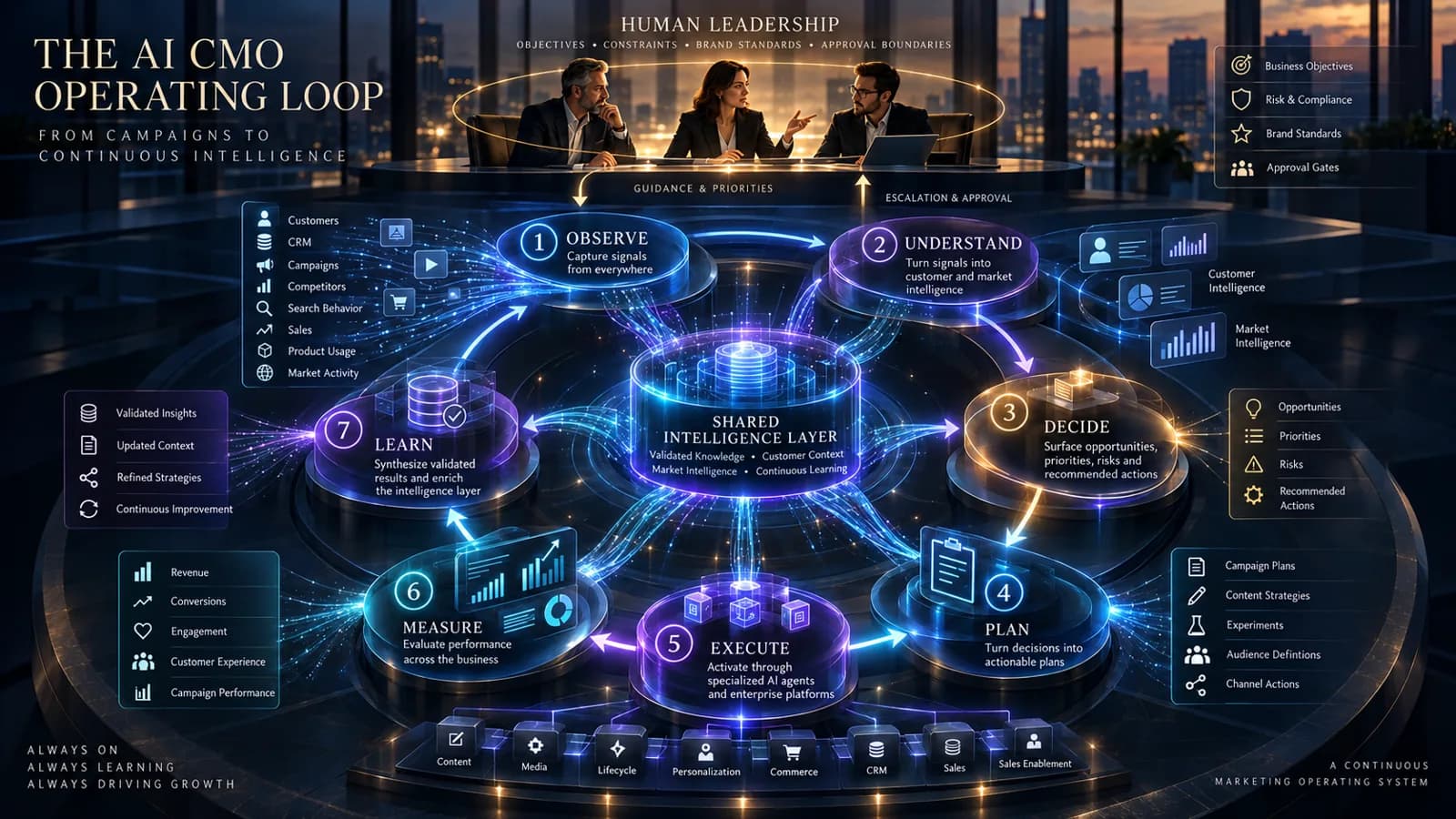
The AI CMO Operating Loop
The long-term power of an AI CMO becomes clearer when marketing is viewed as a continuous loop.
1. Observe
Collect signals from customers, competitors, campaigns, sales, search, product usage, and the market.
2. Understand
Interpret what those signals mean in the context of business goals.
3. Decide
Determine priorities, opportunities, problems, and possible actions.
4. Plan
Translate decisions into campaigns, experiments, content, audiences, and workflows.
5. Execute
Coordinate agents, automation, platforms, and human collaborators.
6. Measure
Evaluate performance against intended outcomes.
7. Learn
Update knowledge, recommendations, and future decisions based on results.
Then the system repeats.
Traditional marketing often performs this loop slowly through meetings, spreadsheets, dashboards, agencies, teams, and manual handoffs.
AI can compress the loop.
That may ultimately matter more than simply producing content faster.
What Should Humans Still Own?
As AI becomes more capable, this question becomes more important.
Not every decision should be delegated simply because delegation becomes technically possible.
Humans should remain responsible for areas involving high consequence, ambiguity, values, taste, strategy, and accountability.
Those include:
Business objectives
AI can recommend ways to achieve an objective.
Humans must decide which objectives matter.
Positioning
Competitive analysis can inform positioning.
But deciding what a company wants to stand for is ultimately a strategic choice.
Creative judgment
AI can generate thousands of possibilities.
It cannot eliminate the need for taste.
Customer empathy
Data can describe behavior.
Human understanding remains particularly important when interpreting emotional, cultural, and social context.
Governance
Organizations must determine what AI may access, generate, publish, spend, change, or communicate.
Risk
High-risk decisions should require appropriate review and escalation.
Accountability
An AI system cannot be the final accountable executive.
Organizations and their leaders remain responsible for the outcomes created by the systems they deploy.
The future therefore should not be framed as:
human marketing or AI marketing.
A more useful model is:
human intent + AI intelligence + agent execution + deterministic automation.
What Could a Marketing Team Look Like in the AI CMO Era?
Imagine a marketing organization with a relatively small strategic human team.
Leadership defines:
- growth objectives
- customer priorities
- positioning
- brand standards
- budget constraints
- risk thresholds
- creative direction
Underneath that team sits a shared intelligence layer containing everything the marketing organization knows.
Connected to it are specialized AI agents.
Those agents continuously handle research, customer intelligence, content planning, campaign preparation, analytics, lifecycle operations, experimentation, and reporting.
Below the agent layer sits deterministic automation and enterprise software.
Humans do not disappear.
They move higher in the operating model.
Instead of manually moving information between twenty platforms, they supervise the system responsible for coordinating those platforms.
Marketing leadership shifts from:
managing tasks
toward:
designing objectives, systems, standards, and decisions.
What Are the Benefits of an AI CMO?
When implemented correctly, the potential advantages extend well beyond content generation.
Faster decision cycles
Signals can be interpreted continuously instead of waiting for weekly or monthly reporting.
Greater marketing capacity
AI agents can perform operational work without requiring headcount to grow proportionally.
More consistent context
Shared intelligence can reduce the repeated explanation of brand, customer, product, and campaign context.
Better personalization
AI can reason over more customer signals and potentially adapt experiences at greater scale.
Continuous optimization
Campaigns can increasingly respond to performance rather than remaining static until the next manual review.
Reduced coordination overhead
Agents can coordinate tasks that previously required repeated handoffs between people and platforms.
More strategic human work
Human marketers can spend less time on repetitive execution and more time on strategy, creativity, relationships, judgment, and innovation.
That final benefit may ultimately be the most important.
The purpose of AI should not simply be to make marketers work faster.
It should allow marketers to work at a higher level.
What Are the Risks?
An AI CMO also introduces significant risks.
Bad data creates bad decisions
AI cannot compensate for fragmented, inaccurate, outdated, or poorly governed information.
Autonomous mistakes can scale quickly
A human mistake might affect one campaign.
An automated mistake can potentially propagate across many channels almost immediately.
Brand inconsistency
Without sufficient shared context and quality controls, generated communication can gradually drift away from the brand.
Security and privacy
AI systems working across customer and company data require robust permissions, security controls, and data governance.
Over-automation
Not everything should become autonomous.
Human interaction often creates value precisely because it is human.
Lack of accountability
Companies must never allow autonomous systems to create ambiguity about who is responsible for marketing decisions.
These risks make governance a core architectural layer rather than an afterthought.
How Should Companies Start Building Toward an AI CMO?
Organizations do not need to automate the entire marketing department on day one.
A more practical approach is incremental.
Step 1: Map the marketing workflow
Identify where information enters, who makes decisions, where handoffs occur, what systems are involved, and where delays happen.
Step 2: Build shared marketing intelligence
Organize brand, customer, product, campaign, content, analytics, and business information so AI systems can use reliable context.
Step 3: Identify high-value workflows
Look for processes that are frequent, repetitive, information-heavy, measurable, and constrained enough to automate safely.
Step 4: Introduce specialized agents
Assign narrow responsibilities before attempting broad autonomy.
Step 5: Add orchestration
Connect agents so that outputs from one part of marketing can intelligently trigger another.
Step 6: Establish approval boundaries
Define exactly which actions require human review.
Step 7: Measure business outcomes
Do not judge success by how much AI content the organization produces.
Measure outcomes such as:
- revenue
- conversion
- speed
- cost
- marketing capacity
- customer experience
- campaign performance
- decision quality
The objective is not maximum automation.
The objective is better marketing.
Will AI Replace the CMO?
Probably not in the simplistic way that question is usually framed.
What AI is much more likely to replace are parts of the traditional CMO operating model.
Manual reporting.
Repeated research.
Information synthesis.
Routine campaign coordination.
Certain approval flows.
Performance monitoring.
Some operational planning.
Large portions of execution.
As those responsibilities move into AI-powered systems, human marketing leadership can move toward work where humans remain particularly valuable:
strategy, judgment, creativity, relationships, values, leadership, and accountability.
The bigger risk for marketing executives may therefore not be being replaced by an AI CMO.
It may be competing with leaders who learn how to operate one.
The Next Evolution of Marketing Leadership
The first wave of AI marketing was about generation.
AI helped create content.
The next wave was about assistance.
AI copilots helped marketers complete individual tasks.
The emerging wave is about agency and orchestration.
AI systems increasingly observe information, reason over context, coordinate workflows, execute actions, and learn from results.
That changes what marketing leadership means.
The CMO of the future may spend less time managing the mechanics of marketing and more time defining the intelligence within which marketing operates.
Their responsibility becomes increasingly focused on questions such as:
What should the organization achieve?
Which customers matter most?
What should the brand stand for?
What standards must never be compromised?
Where can AI act independently?
Where must humans remain involved?
What decisions deserve executive attention?
And what should the marketing system optimize for?
The AI CMO is therefore not simply another marketing tool.
It represents the transition from using AI inside marketing tasks to designing marketing around AI-powered intelligence and execution.
The future of marketing leadership will not simply belong to whoever has the most AI tools.
It will belong to organizations that can combine:
human intent, shared intelligence, specialized AI agents, orchestration, automation, governance, and continuous learning.
That is the deeper idea behind the AI CMO.
And it may become one of the most important shifts in how modern marketing organizations are designed.
Frequently asked questions
What is an AI CMO?
An AI CMO is an AI-powered marketing operating system that combines shared business intelligence, specialized AI agents, automation, analytics, orchestration, and human governance to support marketing strategy, execution, measurement, and optimization.
Is an AI CMO the same as an AI marketing assistant?
No. An AI marketing assistant primarily helps users complete individual tasks. An AI CMO is a broader operating model designed to coordinate multiple marketing functions, systems, agents, and workflows.
Does an AI CMO replace a human Chief Marketing Officer?
Not necessarily. A more likely model is that AI increasingly manages operational intelligence and execution while human leaders retain strategy, judgment, governance, creativity, and accountability.
What is the difference between an AI CMO and marketing automation?
Marketing automation typically executes predefined rules. An AI CMO can use AI agents to interpret context, reason about information, recommend actions, and coordinate workflows while still using deterministic automation for predictable execution.
What technologies power an AI CMO?
An AI CMO may combine large language models, AI agents, CRM data, customer intelligence, knowledge systems, analytics, marketing automation, enterprise software integrations, orchestration technology, and governance controls.
What should humans control in an AI-powered marketing organization?
Humans should retain control over business objectives, positioning, high-consequence decisions, creative standards, budgets, governance, risk boundaries, values, and final accountability.
How can a company start implementing an AI CMO?
Start by mapping marketing workflows, organizing shared business context, selecting high-value use cases, deploying specialized agents, introducing orchestration, defining approval boundaries, and measuring business outcomes rather than AI output volume.