Why Adding Another AI Tool Can Make Your Marketing Worse: The Hidden Cost of AI Sprawl
An AI tool can be useful on its own and still make the marketing organization worse as a system.

A new AI tool appears.
It promises:
better content,
faster research,
smarter analytics,
more personalization,
better campaigns,
less manual work.
The demo looks impressive.
The subscription is inexpensive.
The team starts using it.
And individually, the tool may work exactly as advertised.
Yet three months later, marketing feels more complicated.
There is another login.
Another dashboard.
Another place where context lives.
Another stream of recommendations.
Another integration.
Another vendor.
Another approval process.
Another AI system that needs to understand the brand.
The tool was supposed to reduce work.
Instead, it created another layer that somebody has to manage.
This is becoming one of the biggest contradictions of AI adoption:
An AI tool can be useful on its own and still make the marketing organization worse as a system.
The problem is not necessarily the quality of the tool.
It is what the tool adds to the operating model.
Every new AI application introduces not only capability.
It can also introduce:
- another interface
- another data silo
- another context silo
- another recommendation stream
- another workflow
- another integration
- another governance surface
- another decision
That is the emerging problem of AI sprawl.
And the next generation of marketing leaders will need to become much more disciplined about when another AI tool actually deserves to enter the stack.
What Is AI Sprawl?
AI sprawl is the uncontrolled accumulation of AI tools, agents, copilots, models, and embedded AI features across an organization without sufficient coordination, integration, governance, or architectural planning.
It often starts innocently.
Content buys an AI writing platform.
SEO adopts another AI application.
Design adds image generation.
Paid media experiments with an optimization tool.
Sales has a different AI assistant.
Analytics starts using another platform.
Meanwhile, existing enterprise software introduces built-in AI.
CRM gets AI.
Project management gets AI.
Email gets AI.
Analytics gets AI.
Marketing automation gets AI.
Soon, the organization has intelligence everywhere.
But there is no common system coordinating it.
Adobe reported in 2026 that 94% of IT leaders believe AI sprawl is already increasing organizational complexity and risk, while only a small minority have centralized management in place.
This is the next evolution of SaaS sprawl.
Except AI systems do more than store information.
They also produce:
- recommendations
- content
- decisions
- actions
That makes fragmentation more consequential.
More Intelligence Can Create More Complexity
This seems paradoxical.
Surely adding smarter tools should simplify marketing.
Sometimes it does.
But intelligence and simplicity are not the same thing.
Imagine a marketing team with ten platforms.
Each platform now has AI.
Your CRM says:
Prioritize Account A.
Your analytics system says:
Conversion is declining.
Your advertising platform says:
Increase budget on Campaign B.
Your content tool says:
Publish Topic C.
Your SEO platform says:
Target Keyword D.
Your email tool says:
Change the send schedule.
Your social tool says:
This format is trending.
Every recommendation may be reasonable.
But who decides which one matters most?
Who understands the business objective connecting all of them?
Who notices that Campaign B targets a segment leadership has deprioritized?
Who knows that the content recommendation conflicts with a new positioning strategy?
The systems become smarter.
Humans inherit the job of reconciling their intelligence.
That is not necessarily lower workload.
It may be higher cognitive workload with better software.
AI Doesn't Eliminate Coordination. It Can Create More of It.
Consider what happens when a team adds one new AI content tool.
The company now needs to decide:
Who uses it?
Which prompts are approved?
Where does brand context come from?
Can it access customer data?
Where are outputs stored?
Who reviews them?
How does it connect to the CMS?
Does it replace an existing tool?
Can the content be published automatically?
What happens when the tool disagrees with another system?
What data can employees upload?
Each question creates coordination.
Then multiply that across:
AI research,
AI video,
AI analytics,
AI advertising,
AI customer intelligence,
AI campaign tools,
AI agents.
You quickly discover an important principle:
Every AI capability creates an operating-model requirement.
If the operating model does not keep pace with tool adoption, complexity grows faster than productivity.
The First Hidden Cost: Context Fragmentation
AI depends heavily on context.
A useful marketing AI should understand:
- your business
- your customers
- your products
- your positioning
- your brand voice
- your campaign history
- your objectives
- your previous performance
But every new tool may require this context separately.
You upload the brand guide here.
Paste the persona there.
Explain the campaign objective again.
Create another custom instruction.
Build another knowledge base.
Suddenly, your organization has multiple partial representations of the business.
One AI system knows the latest positioning.
Another does not.
One has updated product information.
Another still uses last quarter's version.
One understands campaign performance.
Another only understands content.
The result is not simply data fragmentation.
It is context fragmentation.
And as AI becomes more autonomous, fragmented context becomes increasingly dangerous.
The Second Hidden Cost: Recommendation Overload
Traditional software mostly waited for users.
AI software increasingly gives advice.
That creates a new category of organizational noise:
recommendation overload.
Imagine ten systems each producing five recommendations per day.
That is 50 decisions competing for attention.
Should the marketer act on:
the SEO recommendation?
the paid-media recommendation?
the analytics recommendation?
the CRM recommendation?
the content recommendation?
At some point, intelligence stops simplifying work and begins creating another queue.
This is why the future of AI marketing cannot simply be about generating more insights.
The organization needs a way to determine:
- what matters
- what has priority
- what conflicts
- what can execute automatically
- what requires human judgment
The solution is not more recommendations.
It is decision orchestration.
The Third Hidden Cost: Duplicate Capabilities
AI tools overlap heavily.
Several platforms may all be capable of:
- research
- summarization
- copywriting
- customer segmentation
- campaign analysis
- content planning
- image generation
This raises a deceptively simple question:
Which one should the team use?
When nobody has a clear answer, different people create different workflows.
One marketer writes with Tool A.
Another uses Tool B.
The agency uses Tool C.
The CRM contains Tool D.
The company pays for all four.
That creates:
- duplicate spend
- inconsistent outputs
- fragmented knowledge
- inconsistent governance
- training overhead
AI lowers the barrier to buying software.
That makes discipline more important, not less.
The Fourth Hidden Cost: Integration Debt
A new AI tool rarely operates alone.
It may need:
CRM access.
Analytics access.
CMS access.
Customer data.
Product information.
Campaign history.
Workflow triggers.
Every connection creates another dependency.
Dependencies require maintenance.
Permissions change.
APIs update.
Authentication expires.
Schemas change.
Platforms discontinue features.
The integration that worked six months ago may silently stop working.
That is integration debt.
AI tools can increase this debt rapidly because their value often depends on connecting to many other systems.
A tool that saves ten hours but creates five integrations requiring ongoing maintenance may be much less valuable than it initially appears.
The Fifth Hidden Cost: Governance Fragmentation
Every new AI system creates another governance surface.
Marketing leadership now needs to ask:
What data may this tool access?
Can employees upload customer information?
Does it retain prompts?
What permissions does the agent have?
Can it publish?
Can it modify campaigns?
Can it contact customers?
Can it change budgets?
What happens when an employee leaves?
Where are actions logged?
When AI only generated drafts, these questions were manageable.
Agentic AI changes the risk.
A system capable of acting across workflows needs stronger controls than a simple writing assistant.
Adobe's recent guidance to CIOs emphasizes exactly this point: agentic systems should operate within existing permissions and governance rather than creating another unmanaged layer.
That should become a core procurement requirement.
The Sixth Hidden Cost: Workflow Fragmentation
This is perhaps the largest cost.
Marketing outcomes happen across workflows.
A campaign might require:
Research → Strategy → Content → Creative → Approval → Distribution → Measurement → Optimization
Now imagine a different AI tool is added to each stage.
AI research.
AI strategy.
AI writing.
AI creative.
AI campaign optimization.
AI analytics.
The workflow appears highly advanced.
But someone still needs to move information between every stage.
The humans become responsible for:
- translating outputs
- moving files
- transferring context
- resolving contradictions
- triggering next steps
- checking status
You have created an AI-powered workflow that still depends entirely on manual orchestration.
McKinsey describes this pattern as a patchwork of disconnected pilots and systems: lots of AI activity without meaningful enterprise-level impact.
This is the difference between:
AI inside the workflow
and
an AI-native workflow.
The Seventh Hidden Cost: Human Attention
This is ultimately the most important one.
Marketing leaders have limited attention.
So do strategists.
Analysts.
Creative teams.
Managers.
Every new platform asks for some portion of that attention.
Another dashboard.
Another alert.
Another report.
Another recommendation.
Another workflow.
Another AI assistant asking for approval.
If technology repeatedly takes attention away from:
customers,
strategy,
creative judgment,
experimentation,
positioning,
then something has gone wrong.
The point of AI is not to create more software for humans to manage.
It is to reduce the amount of operational complexity humans have to manage.
How Another AI Tool Can Actually Make Performance Worse
The impact is not only productivity.
Tool sprawl can affect business performance.
Slower Decisions
More systems create more information that must be reconciled.
Inconsistent Messaging
Different AI systems may work from different brand context.
Poorer Customer Experience
Disconnected systems can optimize different customer interactions independently.
Conflicting Optimization
Paid media may optimize one metric while CRM optimizes another.
Reduced Trust
If different tools repeatedly provide contradictory answers, teams begin ignoring all of them.
Slower Adoption
Employees overwhelmed by the stack may retreat to familiar manual processes.
Lower ROI
Software spend rises while the underlying workflow remains unchanged.
This explains why simply measuring AI adoption can be misleading.
A company can adopt more AI while simultaneously making the marketing system less coherent.
A Great AI Tool Can Still Be the Wrong Tool
This is a critical procurement principle.
The question should not be:
Is this tool good?
The question should be:
Does this tool make our system better?
Those are very different standards.
A product could have:
excellent models,
beautiful UX,
impressive features,
great reviews,
and strong outputs.
But if your organization already has 80% of those capabilities elsewhere, it may still be the wrong purchase.
Or if it creates:
another data silo,
another workflow,
another integration,
another governance model,
the organizational cost may exceed the functional benefit.
The best individual technology is not always the best architectural decision.
Ask This Before Buying Another AI Tool
Marketing leaders should apply a much stricter test.
1. What Existing Problem Does It Remove?
Do not accept:
“It uses AI.”
What business or workflow problem disappears?
2. What Existing Tool Does It Replace?
If the answer is none, ask why you need another interface.
New capability can justify new technology.
Duplicated capability usually should not.
3. Does It Use Existing Business Context?
Can it access your existing:
- brand knowledge
- customer intelligence
- products
- campaigns
- analytics
Or must you maintain another isolated knowledge base?
4. Does It Fit Into Existing Workflows?
Does the output flow automatically into the next stage?
Or will humans copy it somewhere else?
Adobe's recent CIO guidance makes this a particularly useful criterion: a good agent should reduce handoffs within existing systems rather than adding another layer to manage.
5. Does It Reduce Human Handoffs?
Count them.
If the current workflow has seven manual handoffs and the new technology reduces that to three, that is meaningful.
If it creates an eighth, reconsider it.
6. Can Existing Governance Apply?
Can permissions, data controls, and approval policies carry across?
Or are you building another governance system?
7. Can Its Value Be Measured?
Do not measure:
logins,
prompts,
outputs.
Measure:
- cycle time
- human hours
- conversion
- cost
- revenue
- quality
- customer outcomes
The Most Important Metric: Complexity Removed
AI procurement needs a new metric:
Complexity Removed
For every AI tool, ask:
How many:
- tools does it replace?
- handoffs does it remove?
- reports does it automate?
- integrations does it eliminate?
- hours does it save?
- decisions does it simplify?
- workflows does it connect?
Then compare that with:
- new integrations
- new interfaces
- new governance
- new training
- new decisions
- new maintenance
A tool should ideally have a positive complexity balance.
It should remove more complexity than it creates.
That is a far better purchasing principle than:
“Everyone else is using AI.”
From AI Tools to Shared AI Capabilities
There is a deeper architecture shift happening.
Organizations currently purchase AI in application form.
One app for research.
One app for content.
Another for analytics.
But many underlying capabilities are reusable.
For example:
customer intelligence,
retrieval,
content generation,
classification,
summarization,
experimentation.
Future AI-native organizations may build or purchase these capabilities once and expose them across multiple workflows.
Instead of ten separate applications, the company may have reusable agents or intelligence services.
That creates:
- shared context
- consistent governance
- easier orchestration
- less duplication
The unit of design changes from the application to the capability.
The Real Future Is Orchestration
Once multiple AI capabilities exist, the question becomes:
How do they work together?
This is where orchestration matters.
An orchestration layer can determine:
- which agent acts
- what context it receives
- what comes next
- which tasks happen in parallel
- where approval is required
- what can execute automatically
- what result updates shared intelligence
Instead of:
Research Tool → Human → Content Tool → Human → Campaign Tool → Human → Analytics Tool
the workflow becomes:
Objective → Orchestration → Agents → Enterprise Systems → Measurement → Learning
Humans intervene where their judgment actually matters.
McKinsey's 2026 research emphasizes exactly this shift: organizations that capture greater AI value are redesigning end-to-end workflows rather than simply rolling out more tools.
The competitive advantage increasingly comes from architecture, not application count.
One AI Layer Is Better Than AI Everywhere
This does not mean every company literally needs one AI platform.
It means AI should increasingly behave as a coordinated layer, not dozens of unrelated features.
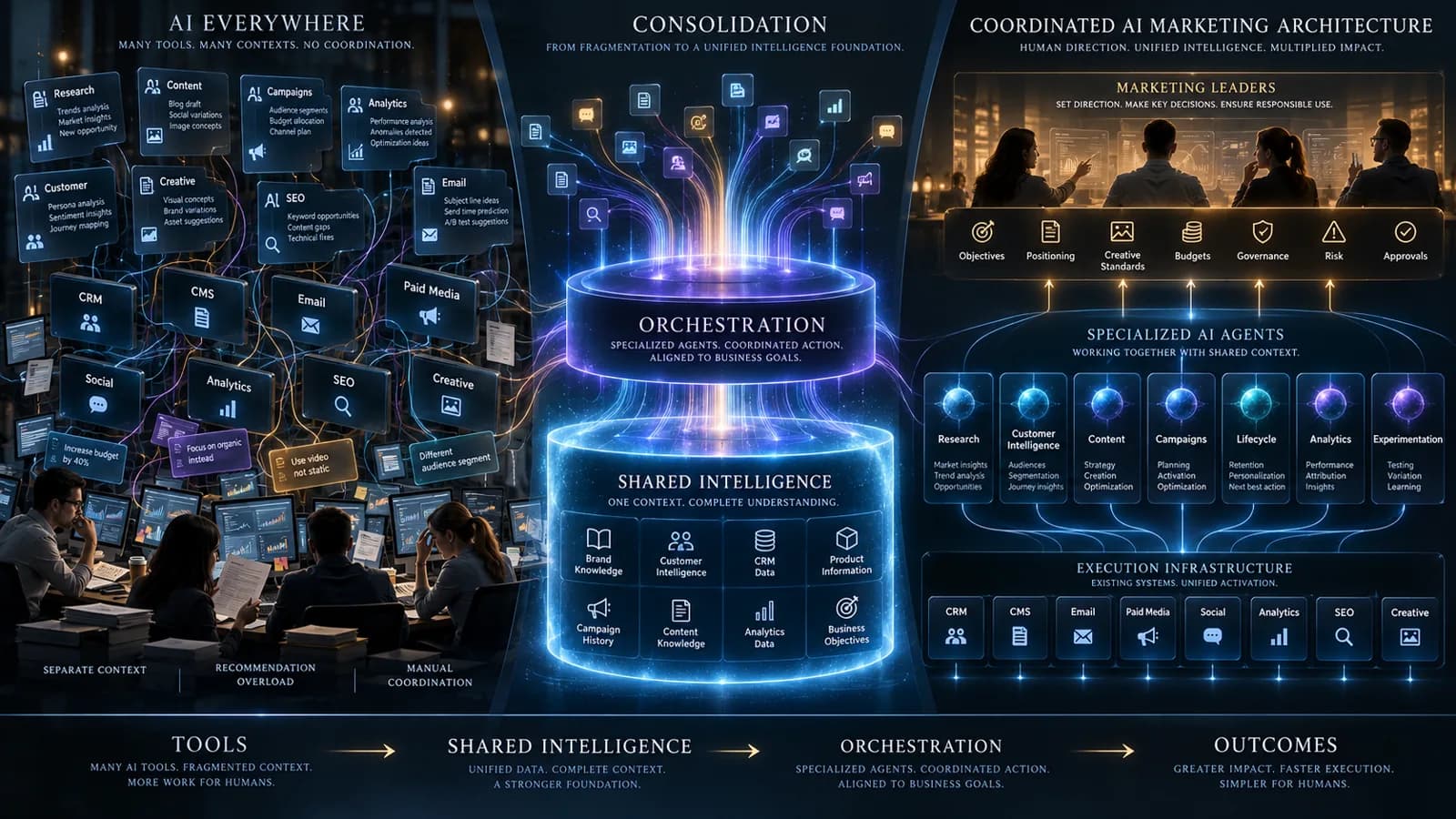
A coherent architecture might look like:
Human Leadership
Defines:
- objectives
- strategy
- positioning
- governance
- quality standards
Orchestration Layer
Coordinates workflows.
Shared Intelligence
Provides:
- customer context
- brand knowledge
- business context
- campaign history
- analytics
Specialized Agents
Handle:
- research
- content
- lifecycle
- campaigns
- analytics
- experimentation
Enterprise Systems
Execute through:
- CRM
- CMS
- advertising
- analytics
- commerce
AI becomes the connective tissue.
Not another isolated application.
When Should You Actually Add Another AI Tool?
There are good reasons.
Add a tool when it provides a capability that is:
Strategically Important
It materially improves something your business cares about.
Genuinely Differentiated
Existing platforms cannot perform it sufficiently well.
Integrable
It can participate in your current architecture without creating excessive manual work.
Governable
It can operate within your security and policy framework.
Measurable
Its impact can be connected to business outcomes.
Complexity-Reducing
Ideally, it replaces more operational complexity than it introduces.
That last criterion should become increasingly important.
When Should You Say No?
Say no when:
the feature already exists elsewhere,
the use case is vague,
the tool requires another isolated knowledge base,
employees will manually transfer its outputs,
the team cannot define who owns it,
its recommendations duplicate other systems,
governance is unclear,
or nobody can explain how success will be measured.
A useful AI product without a clear operating role becomes another source of organizational debt.
The Future Marketing Stack Should Feel Smaller
This is the paradox.
Future marketing technology may become much more sophisticated underneath.
There may be:
more models,
more agents,
more automation,
more APIs,
more intelligence.
But marketers should feel like they are using less software.
Instead of:
ten AI assistants,
eight dashboards,
six recommendation systems,
the human interface should become something closer to:
Three decisions require your attention.
One major opportunity has been identified.
Two optimizations executed automatically.
One exception requires approval.
Everything else happens underneath.
That is what technological sophistication should eventually produce:
less visible complexity.
More AI Is Not the Goal
Marketing teams need to stop measuring AI maturity by how many tools they have adopted.
More AI tools do not necessarily mean:
more intelligence,
more productivity,
or better marketing.
They can mean:
more silos,
more recommendations,
more decisions,
more integrations,
more security surfaces,
more coordination.
The goal is not:
AI everywhere.
The goal is:
the right intelligence in the right workflow with the right context and the right level of human oversight.
Sometimes that requires adding a tool.
Sometimes it requires connecting existing tools.
Sometimes it requires eliminating them.
And increasingly, the smartest AI decision a marketing leader can make may be:
not buying another AI tool at all.
Frequently asked questions
What is AI sprawl?
AI sprawl is the uncontrolled accumulation of AI tools, agents, copilots, and embedded AI capabilities without sufficient integration, governance, shared context, or orchestration.
Can too many AI tools reduce marketing productivity?
Yes. Multiple AI systems can create context switching, duplicate capabilities, conflicting recommendations, fragmented data, integration maintenance, and more decisions for marketers to manage.
Why do AI tools create fragmentation?
Different tools often maintain separate context, data, workflows, permissions, and recommendations. Without shared intelligence and orchestration, humans must reconcile their outputs manually.
How many AI tools should a marketing team use?
There is no ideal number. Teams should use as many as create meaningful differentiated value without creating excessive coordination and governance overhead.
What should companies evaluate before buying another AI marketing tool?
Evaluate whether the tool solves a specific problem, replaces existing functionality, integrates into workflows, uses existing context, reduces human handoffs, follows governance rules, and produces measurable business value.
What is recommendation overload?
Recommendation overload occurs when many AI systems generate more insights and suggested actions than humans can reasonably prioritize or evaluate.
What is AI orchestration?
AI orchestration is the coordination layer that manages how agents, models, data, humans, and enterprise applications work together across complete workflows.
Should companies consolidate AI tools?
Often, yes—particularly when multiple tools provide overlapping capabilities or require repeated context. Consolidation can improve governance, reduce cost, and simplify workflows.
What is the best measure of an AI tool's value?
Beyond business outcomes, an important measure is how much complexity the tool removes: fewer handoffs, less manual work, fewer integrations, fewer interfaces, and shorter workflow cycle times.