Why Marketing Still Feels Manual in the Age of AI: The Workflow Problem AI Tools Haven’t Solved
And your team probably has access to multiple general-purpose AI assistants on top of all of them.
Marketing has never had more technology.
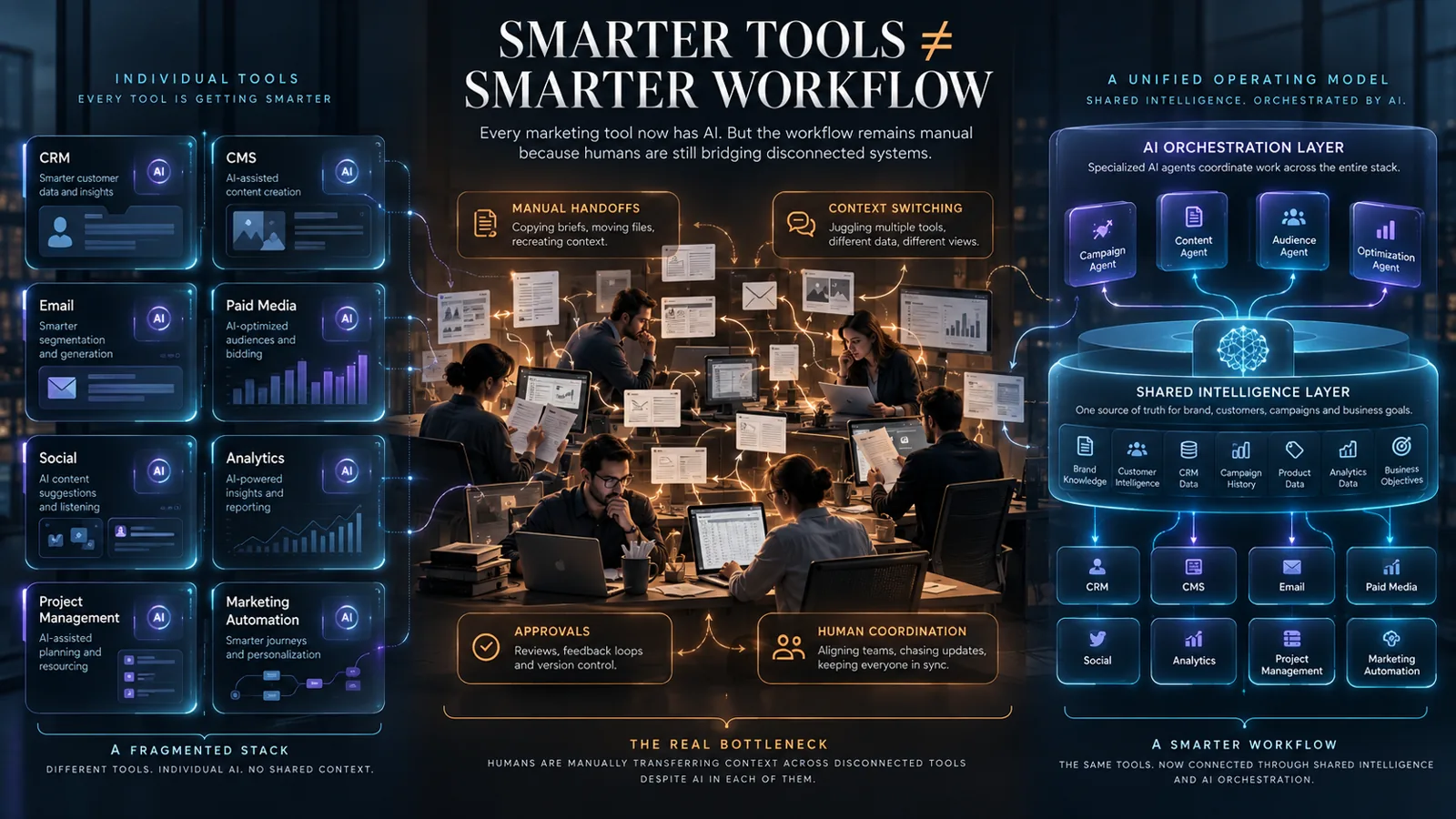
Almost every platform now promises AI.
Your CRM has AI.
Your email platform has AI.
Your analytics platform has AI.
Your advertising platforms have AI.
Your design software has AI.
Your project-management system has AI.
Your content tools have AI.
Your SEO stack has AI.
Your social tools have AI.
And your team probably has access to multiple general-purpose AI assistants on top of all of them.
So why does marketing still feel so manual?
Why are marketers still copying information between platforms?
Why are campaigns still moving through endless documents, Slack messages, spreadsheets and approval threads?
Why are teams still manually compiling reports?
Why does launching one campaign still require coordination between strategy, content, design, media, CRM, analytics and operations?
The answer is surprisingly simple:
Most companies have added AI to marketing tasks without redesigning the marketing workflow.
AI made individual steps faster.
But humans are still responsible for connecting those steps.
That is why the next stage of AI marketing will not be defined by how many AI tools a company buys.
It will be defined by whether the organization can transform isolated AI capabilities into connected, intelligent marketing workflows.
Marketing Has an AI Adoption Problem — But Not the One You Think
The problem is no longer access to AI.
AI adoption is already widespread.
The deeper problem is that adoption and transformation are two different things.
A marketer might use AI to:
- summarize research
- generate headlines
- draft an article
- create images
- analyze campaign data
- write emails
- suggest keywords
- prepare social posts
Every one of those activities may become faster.
But consider what happens around them.
Someone still has to:
- collect the brief
- find the relevant customer context
- explain the brand
- choose the audience
- ask AI for research
- review the research
- turn it into a strategy
- send the strategy to content
- move content into design
- request revisions
- obtain approvals
- upload assets
- configure the campaign
- coordinate channels
- monitor performance
- export results
- interpret the results
- decide what happens next
AI may improve steps 5, 7, 9 or 17.
But the workflow connecting those steps can remain almost entirely human.
That is the real bottleneck.
The Difference Between Automating Tasks and Automating Workflows
This distinction may be one of the most important ideas in AI marketing.
Task automation asks:
Can AI make this individual activity faster?
For example:
“Write this email.”
“Summarize this report.”
“Generate five ad variations.”
“Analyze these customer reviews.”
Workflow automation asks:
Can the entire sequence from objective to outcome operate more intelligently?
For example:
A campaign objective enters the system.
Customer and market intelligence is retrieved automatically.
An AI research agent identifies relevant opportunities.
A strategy agent builds the campaign approach.
A content agent prepares messaging.
Creative is produced.
Brand and compliance checks are performed.
High-risk decisions are routed for human approval.
Approved assets are prepared for channels.
Campaigns launch through marketing platforms.
Performance is continuously monitored.
Insights are interpreted.
Underperforming elements trigger new experiments.
Results become part of the system's future knowledge.
That is no longer simply AI assisting a marketer.
That is an AI-enabled marketing workflow.
The first model saves minutes.
The second can change how the organization operates.
AI Has Made the Middle of the Workflow Faster
Consider content production.
Before generative AI, producing an article might require several hours of research, outlining and writing.
AI can dramatically accelerate those activities.
But content creation is only one part of the content workflow.
The complete process may include:
Brief → Research → Strategy → Draft → Review → Revision → Compliance → Design → Approval → CMS → Distribution → Measurement → Optimization
AI might turn:
Draft: 4 hours → 20 minutes
Great.
But if the content then waits:
- one day for review
- two days for design
- another day for approval
- several hours for uploading
- another week before anyone analyzes performance
the organization has not created a fast marketing system.
It has created a fast writing step inside a slow workflow.
This explains one of the paradoxes of AI adoption:
AI can dramatically increase output without dramatically increasing organizational speed.
The Hidden Bottleneck Is Coordination
Most marketing teams do not think of coordination as a technology problem.
But coordination consumes enormous amounts of marketing capacity.
Think about how much time is spent asking questions such as:
“Has design seen the latest version?”
“Which creative was approved?”
“Did CRM get the new audience?”
“Where is the final brief?”
“Was the landing page updated?”
“Who is publishing this?”
“Did legal approve it?”
“What happened to the paid campaign?”
“Can somebody send me the latest numbers?”
“Which version is actually final?”
These are not necessarily difficult marketing problems.
They are state-management problems.
The organization needs to know:
- what has happened
- what is happening
- what should happen next
- who or what should act
- what context they need
- whether approval is required
- what dependencies remain
Historically, humans have provided this orchestration.
Meetings became orchestration.
Project managers became orchestration.
Slack became orchestration.
Spreadsheets became orchestration.
Status reports became orchestration.
AI agents introduce the possibility of moving part of that coordination into software.
The Marketing Stack Was Built Around Tools, Not Outcomes
Another reason marketing feels manual is architectural.
Most marketing technology was purchased by capability.
Need email?
Buy an email platform.
Need CRM?
Buy a CRM.
Need analytics?
Buy analytics software.
Need social scheduling?
Buy a social platform.
Need SEO?
Buy an SEO tool.
Need project management?
Buy another platform.
Each system may work perfectly well.
But customer outcomes do not happen inside individual systems.
A campaign moves across many of them.
That means marketing organizations have built sophisticated vertical capabilities while leaving the horizontal workflow between those capabilities largely manual.
AI is now being added in exactly the same way.
CRM gets AI.
CMS gets AI.
Analytics gets AI.
Email gets AI.
Design gets AI.
Social gets AI.
The stack becomes more intelligent.
But not necessarily more connected.
Adobe's 2026 research found that AI adoption is frequently occurring through existing martech tools, individual subscriptions and enterprise platforms simultaneously. Its conclusion is important: adoption without coordination keeps AI tactical rather than transformative.
The industry could therefore end up with an unexpected problem:
more intelligent tools, but an even more complicated marketing stack.
More AI Can Actually Create More Manual Work
This sounds counterintuitive.
But think about what happens when generation becomes nearly free.
A marketer who previously produced three campaign concepts can now generate thirty.
A content team that produced ten articles can theoretically generate one hundred.
A creative team can create hundreds of visual variations.
An advertising team can test dozens of messaging combinations.
AI removes the scarcity of production.
But every additional output can create downstream work:
- review
- prioritization
- editing
- brand checking
- compliance
- approval
- publishing
- measurement
If those surrounding systems do not change, AI can generate work faster than the organization can absorb it.
The bottleneck simply moves.
Before AI:
Creation was the bottleneck.
After AI:
Selection, coordination, governance and decision-making become the bottlenecks.
That is why measuring AI success by content volume is misleading.
Producing 10x more content does not create 10x more business value.
The question is whether the system can identify, create, approve, distribute and improve the right content with less organizational friction.
The Real Problem: AI Does Not Share Enough Context
There is another source of manual work hiding underneath AI adoption.
Every tool knows something.
But few tools know everything they need.
The CRM understands customer records.
Analytics understands website behavior.
The advertising platform understands paid campaigns.
The CMS understands published content.
The SEO tool understands search.
The project-management platform understands tasks.
The AI assistant understands whatever somebody pasted into the prompt.
Humans then become the context-transfer layer.
We constantly explain:
“This is our customer.”
“This is our positioning.”
“This campaign ran last month.”
“These are the brand guidelines.”
“This is what sales is hearing.”
“This is what performed previously.”
“This is the objective.”
“This audience is different.”
“This product changed.”
That repeated explanation is invisible manual labor.
An AI-native marketing architecture needs something different:
shared intelligence.
That could include:
- brand knowledge
- customer intelligence
- CRM data
- product information
- campaign history
- market research
- competitive intelligence
- content libraries
- performance data
- business objectives
- strategic priorities
- governance rules
Multiple AI agents can then operate from common organizational context rather than rebuilding context for every task.
From AI Tools to AI Agents
Traditional AI tools usually wait.
A human opens the tool.
A human gives it a prompt.
The AI responds.
The human reviews the response.
The human moves the output somewhere else.
This model is useful.
But it remains fundamentally human-orchestrated.
AI agents change the interaction model.
An AI agent is a software system capable of pursuing a goal by interpreting context, reasoning about what needs to happen, using tools, and performing actions within defined boundaries.
In marketing, specialized agents could include:
- Market Research Agent
- Customer Intelligence Agent
- Competitive Intelligence Agent
- Content Strategy Agent
- Creative Agent
- SEO Agent
- Campaign Agent
- Lifecycle Agent
- Analytics Agent
- Experimentation Agent
The important capability is not merely that these agents can perform tasks.
It is that they can potentially work together.
The Research Agent finishes its analysis.
The Strategy Agent receives the relevant findings.
The Content Agent creates assets using the strategy.
The Brand Agent evaluates them.
A human approves the campaign.
The Campaign Agent prepares distribution.
The Analytics Agent monitors results.
The Experimentation Agent launches the next learning cycle.
The workflow begins connecting itself.
That is where AI starts reducing manual marketing coordination rather than simply accelerating individual activities.
Orchestration Is the Missing Layer
If there is one word marketing leaders should pay more attention to over the next several years, it is:
orchestration.
Orchestration determines how intelligence, agents, humans, automation and software work together.
It answers questions such as:
- What needs to happen next?
- Which agent should handle it?
- What information should it receive?
- Can several tasks happen simultaneously?
- What needs human approval?
- What can execute automatically?
- What happens when something fails?
- Where should results be stored?
- What should trigger the next workflow?
Without orchestration, companies may create dozens of AI agents and simply recreate the fragmentation of the traditional martech stack.
McKinsey explicitly recommends thinking in terms of workflows rather than individual agents, noting that agentic AI creates greater value when it improves end-to-end processes rather than isolated steps.
That distinction is critical.
The objective is not:
more agents.
The objective is:
better workflows.
What an AI-Native Marketing Workflow Could Look Like
Imagine launching a new B2B product.
Traditional Workflow
Marketing leadership sets the objective.
Research manually gathers information.
Strategy writes a brief.
Content creates messaging.
Design produces creative.
Product reviews claims.
Leadership requests revisions.
Paid media configures campaigns.
Email prepares nurture.
Social prepares distribution.
Operations coordinates the launch.
Analytics builds reports.
Leadership reviews results days later.
Then the team discusses what to change.
Every stage involves meetings, documents and human handoffs.
AI-Native Workflow
Leadership defines:
- business objective
- customer priority
- positioning
- budget
- constraints
- approval requirements
The marketing system then activates the appropriate agents.
Research agents analyze customers, competitors and market signals in parallel.
A strategy agent combines those findings with historical campaign intelligence.
Content and creative agents produce coordinated assets.
Brand and policy agents validate outputs.
High-consequence decisions surface to humans.
Approved work flows into deterministic marketing automation and enterprise platforms.
Analytics monitors performance continuously.
Material changes trigger investigation.
The system recommends adjustments.
Low-risk adjustments may happen automatically.
High-risk changes return to humans.
Performance updates the shared intelligence layer.
The next campaign begins with better knowledge than the previous one.
Marketing becomes a learning system, not simply a sequence of projects.
Humans Should Not Be Removed From Marketing
Workflow automation does not mean eliminating marketers.
It means changing where human judgment creates the most value.
Humans are poorly used when their day is dominated by:
- copying data
- compiling dashboards
- chasing approvals
- moving files
- rewriting status reports
- manually routing tasks
- repeatedly explaining context
- recreating similar campaign structures
Human attention is far more valuable when applied to:
- business strategy
- positioning
- customer understanding
- creative direction
- judgment
- relationships
- major trade-offs
- brand standards
- ethics
- governance
- accountability
The future operating model is therefore not:
AI replaces the marketing team.
It is closer to:
humans move upward while AI operates increasingly underneath them.
Humans define intent.
AI interprets information.
Agents coordinate work.
Automation executes deterministic actions.
Humans supervise consequences.
Marketing Automation Was Only the First Step
Some marketers may reasonably ask:
Haven't we been automating marketing for years?
Yes.
But traditional marketing automation usually depends on predefined rules.
For example:
IF a lead downloads an ebookTHEN send email sequence A.
Or:
IF lead score > 80THEN notify sales.
These systems are extremely valuable.
But they execute decisions someone has already encoded.
AI agents introduce a new capability:
reasoning within boundaries.
Imagine performance declines.
Traditional automation may detect that a metric fell below a threshold.
An intelligent marketing workflow could investigate why.
It might examine:
- channel performance
- customer segments
- creative fatigue
- audience changes
- landing-page behavior
- competitive activity
- previous experiments
It could propose several actions.
Then another system could execute the approved response.
The future stack therefore does not replace automation.
It combines:
AI intelligence → agent reasoning → orchestration → deterministic automation.
From Campaigns to Continuous Marketing
Traditional marketing operates largely through campaigns.
Plan.
Build.
Launch.
Measure.
Report.
Repeat.
But customer behavior does not operate in campaigns.
Competitors do not wait for quarterly planning.
Search behavior changes continuously.
Performance changes continuously.
Customer intent changes continuously.
AI makes a different operating model possible.
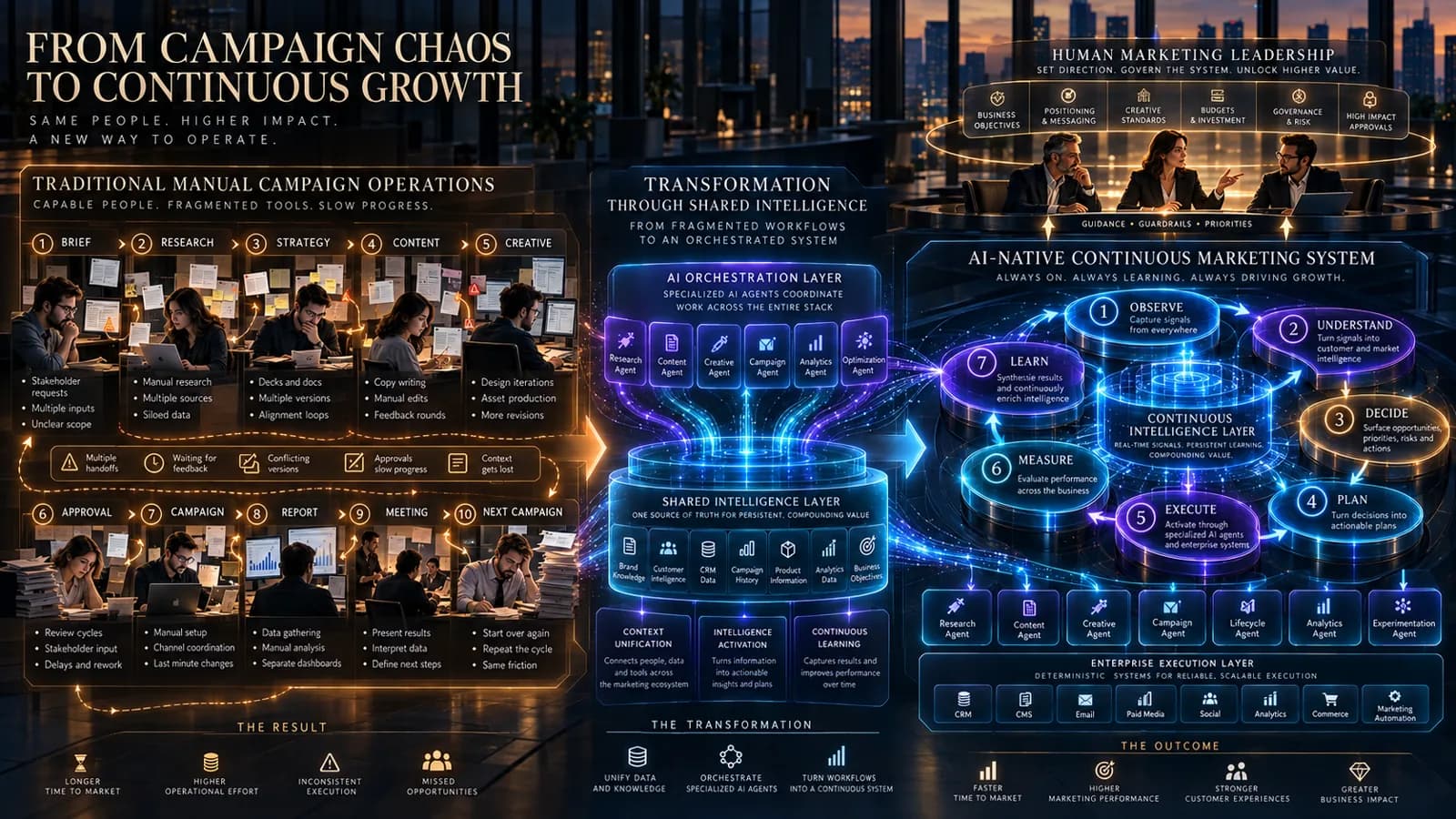
Marketing can increasingly become a persistent loop:
Observe
Monitor customers, competitors, campaigns, CRM, search behavior, sales and market signals.
Understand
Interpret what those signals mean.
Decide
Determine priorities, opportunities and problems.
Plan
Design campaigns, experiments, audiences and content.
Execute
Coordinate agents, humans, automation and platforms.
Measure
Evaluate performance and outcomes.
Learn
Feed validated insights back into shared intelligence.
Then repeat.
McKinsey describes a related movement toward always-on orchestration, where marketing shifts away from disconnected campaign cycles toward continuously managed human-agent workflows.
Dashboards Are Another Form of Manual Work
Marketing's manual nature is particularly visible in analytics.
Companies collect enormous amounts of data.
But humans still frequently have to:
open dashboards,
find changes,
compare periods,
interpret patterns,
identify anomalies,
form hypotheses,
send summaries,
schedule meetings,
and decide what happens next.
The software presents information.
The human performs the intelligence layer.
AI can reverse that relationship.
Instead of showing a CMO 47 charts, an intelligent system might say:
Pipeline from paid search declined 14% this week. Traffic remained stable, but conversion fell primarily among mid-market visitors. The decline began after the landing-page update on Tuesday. Restoring the previous value proposition or launching variant B are the highest-confidence next actions.
That is not another dashboard.
That is decision intelligence.
The interface changes from:
“Here is your data.”
to:
“Here is what changed, why it matters and what you should consider doing.”
That could remove an enormous amount of hidden manual work from marketing.
Why AI Adoption Often Fails to Produce AI Transformation
Salesforce's 2026 State of Marketing research illustrates the contradiction clearly.
It reported that 75% of marketers have adopted AI, yet 84% said they still run generic campaigns. Salesforce also found that disjointed or irrelevant data remains a major constraint on marketers' ability to use AI for more responsive customer engagement.
The issue is not simply technological capability.
It is operating architecture.
AI transformation requires several things to work together:
1. Shared Data
Agents need reliable access to relevant information.
2. Shared Context
The system must understand customers, brand, products, campaigns and objectives.
3. Connected Workflows
Outputs from one stage need to trigger the appropriate next stage.
4. Orchestration
Something must manage dependencies and state.
5. Governance
Organizations must determine where AI can act independently.
6. Human Oversight
Important strategic and high-risk decisions need accountable owners.
7. Measurement
Success must be evaluated against business outcomes rather than AI activity.
Without these foundations, AI remains another layer added on top of existing complexity.
The Biggest Mistake: Automating a Broken Workflow
There is an important principle every marketing leader should remember:
Automation does not automatically improve a process.
Sometimes it just makes a bad process happen faster.
If a campaign requires nine unnecessary approvals, adding AI does not solve the approval architecture.
If customer data is fragmented, AI does not magically unify it.
If teams disagree about positioning, an AI content generator does not resolve strategy.
If nobody knows which metric matters, AI analytics may simply produce more analysis.
If five teams own different parts of the customer journey without shared accountability, adding five agents can create agent silos instead of organizational alignment.
Before asking:
“Where can we use AI?”
marketing leaders should ask:
“How should this workflow operate if we designed it today?”
Then determine where humans, AI agents and deterministic software each belong.
How to Move From AI Tools to AI-Native Marketing
Companies do not need to rebuild their entire marketing organization overnight.
Start with one workflow.
Step 1: Map the Complete Workflow
Pick a high-value process such as:
- content production
- campaign launch
- lead nurturing
- customer research
- performance reporting
- lifecycle marketing
Map every step from initial trigger to final outcome.
Step 2: Identify Manual Handoffs
Look specifically for:
- copying
- uploading
- approvals
- status checking
- information retrieval
- repeated prompts
- report preparation
- task routing
These often represent larger opportunities than generation itself.
Step 3: Separate Human and Machine Work
Ask which activities require:
- strategy
- creativity
- judgment
- accountability
Keep those human-led.
Then identify activities better suited to:
- retrieval
- synthesis
- monitoring
- generation
- routing
- repetitive execution
- data processing
Step 4: Create Shared Intelligence
Stop forcing every AI interaction to begin from a blank prompt.
Build reusable brand, customer, product, campaign and business context.
Step 5: Add Specialized Agents
Give individual agents clearly defined responsibilities and boundaries.
Step 6: Orchestrate Them
Connect agent outputs so workflows can progress without constant human routing.
Step 7: Establish Human Approval Gates
Not every AI action should execute automatically.
Define risk-based boundaries.
Step 8: Measure Workflow Outcomes
Track:
- cycle time
- cost
- conversion
- human hours
- throughput
- error rates
- customer outcomes
- revenue impact
Do not simply count prompts or AI-generated assets.
The Future of Marketing Isn't More AI Tools
This is the larger strategic conclusion.
AI tools will continue multiplying.
Every major marketing platform will become more intelligent.
New agents will emerge.
Models will become more capable.
Content generation will become faster and cheaper.
But none of that guarantees better marketing.
Because marketing's core problem was never simply a lack of tools.
The problem is that increasingly complex organizations rely on people to manually coordinate fragmented systems.
AI becomes transformative when it starts reducing that coordination burden.
The shift is:
from tools to workflows
from prompts to agents
from isolated context to shared intelligence
from dashboards to decisions
from manual handoffs to orchestration
from periodic campaigns to continuous learning
from humans doing everything to humans governing intelligent systems
The companies that understand this distinction will approach AI very differently.
They will stop asking:
“Which AI tool should we buy next?”
And start asking:
“How should marketing work now that intelligence itself can become part of the operating system?”
That is the real AI marketing opportunity.
Not another tool.
A different way of working.
Frequently asked questions
Why does marketing still feel manual despite AI?
Marketing remains manual because most organizations use AI to accelerate individual tasks while humans still coordinate the workflow between research, strategy, content, creative, approvals, campaigns, analytics and optimization.
Are AI marketing tools actually reducing workload?
They can reduce workload for specific tasks, but task-level savings do not automatically reduce overall workload. If surrounding approvals, handoffs, data retrieval and coordination remain manual, the bottleneck simply shifts elsewhere in the workflow.
What is an AI marketing workflow?
An AI marketing workflow is a connected process in which AI, specialized agents, automation, enterprise software and humans collaborate from an initial marketing objective through execution, measurement and optimization.
What is the difference between AI tools and AI agents?
AI tools generally help users perform individual activities. AI agents can pursue objectives, reason over context, use tools and perform multi-step actions within defined boundaries.
What is marketing orchestration?
Marketing orchestration is the coordination layer that determines which tasks or agents should act, what context they require, what sequence work should follow, when humans need to approve decisions and how results trigger subsequent actions.
Will AI agents replace marketing automation?
No. AI agents and traditional automation are complementary. AI agents can interpret context and make bounded decisions, while deterministic automation remains useful for predictable and rules-based execution.
How can marketing teams reduce manual work with AI?
Teams should redesign complete workflows rather than automate isolated tasks. That requires shared data and context, specialized agents, orchestration, governance, appropriate human approval gates and measurement based on business outcomes.
What is the biggest barrier to AI transformation in marketing?
For many organizations, the biggest barrier is not access to AI models. It is fragmented data, disconnected workflows, manual coordination, unclear governance and an operating model designed before agentic AI existed.