Your Marketing Stack Is Getting Smarter — And More Complicated: Why AI Is Creating a New Martech Problem
And your team probably uses several general-purpose AI assistants on top of all of them.
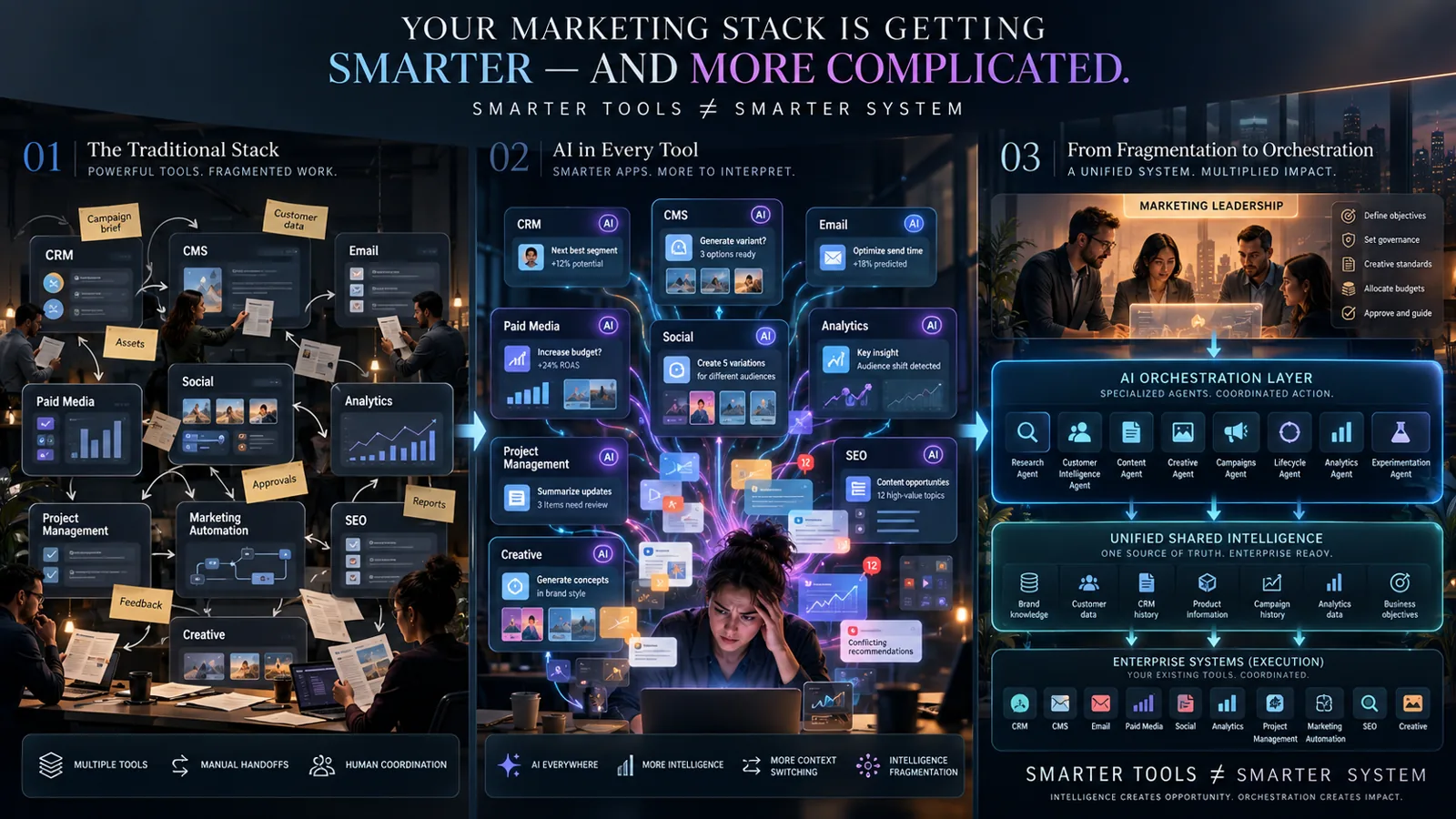
Something strange is happening inside modern marketing teams.
Almost every platform is getting smarter.
Your CRM has AI.
Your CMS has AI.
Your email platform has AI.
Your analytics platform has AI.
Your advertising platforms have AI.
Your social tools have AI.
Your design software has AI.
Your project-management platform has AI.
Your marketing automation platform has AI.
Your SEO stack has AI.
And your team probably uses several general-purpose AI assistants on top of all of them.
Individually, these systems are more capable than anything marketers had a few years ago.
Yet the overall marketing organization can feel more complicated.
There are more recommendations.
More interfaces.
More generated content.
More dashboards.
More AI assistants.
More automation.
More data.
More systems producing decisions.
And increasingly, somebody still has to connect all of it.
That creates a new problem:
The marketing stack is becoming smarter at the tool level without necessarily becoming smarter as a system.
This may become one of the defining challenges of AI-powered marketing.
The next stage of martech will not simply be about putting AI inside every application.
It will be about making all of those applications, agents, workflows, data sources, and human decisions operate as one coordinated system.
The Martech Stack Was Already Complicated Before AI
Marketing technology did not suddenly become complex because of generative AI.
Complexity accumulated over years.
Companies gradually added technology for:
- CRM
- marketing automation
- content management
- social publishing
- paid advertising
- SEO
- analytics
- customer-data management
- attribution
- personalization
- experimentation
- commerce
- project management
- creative production
Each tool solved a legitimate problem.
But very few companies designed the entire stack as one coherent system from the beginning.
Technology was usually added incrementally.
A problem appeared.
A platform was purchased.
Another team needed a capability.
Another platform was added.
An acquisition introduced a different stack.
A legacy system remained because replacing it was difficult.
Eventually, the modern marketing organization became a patchwork of applications.
McKinsey reported that 47% of martech decision-makers identify stack complexity and system/data integration challenges as significant barriers to getting value from their martech investments.
The issue is not that marketing lacks technology.
In many large organizations, it has too much technology that does not work together well enough.
AI is now entering that architecture.
And instead of automatically simplifying it, AI can amplify the underlying complexity.
Every Tool Is Becoming an AI Tool
The first phase of generative AI was relatively simple.
Marketers opened a separate AI assistant.
They typed prompts.
They generated copy.
They summarized research.
They brainstormed ideas.
Now AI is becoming embedded everywhere.
The CRM has a copilot.
Analytics has an AI assistant.
Creative software generates assets.
Advertising platforms recommend audiences and budgets.
Email platforms generate subject lines.
Marketing automation platforms build journeys.
CMS platforms suggest content.
Search tools analyze opportunities.
Project-management platforms summarize work.
The AI layer is disappearing into the application layer.
That sounds like progress.
And in many ways it is.
But it introduces a structural problem.
Each system increasingly has its own:
- AI model
- context
- memory
- recommendations
- interface
- workflow
- permissions
- objectives
The result may be a stack full of intelligent applications that still do not understand one another.
Smarter Tools Do Not Automatically Create a Smarter Organization
Imagine eight intelligent marketing systems.
The CRM knows that a customer account has entered a high-intent stage.
The analytics platform notices that enterprise conversion is declining.
The SEO platform identifies a major search opportunity.
The content platform recommends creating a new article.
The social platform identifies a trending customer question.
The advertising system recommends reallocating budget.
The email system recommends a new nurture sequence.
The project-management system reports that the campaign is behind schedule.
Every recommendation may be correct.
But who combines them?
Who decides which matters most?
Who determines whether the SEO opportunity supports the current business objective?
Who knows that sales has already changed its priority?
Who checks whether the content recommendation contradicts the new positioning?
Who determines whether the campaign delay makes the advertising recommendation irrelevant?
Usually:
a human.
That person becomes the integration layer.
This is why adding more intelligence to individual applications does not necessarily reduce work.
It can create more intelligence that humans must coordinate.
The New Martech Problem Is Intelligence Fragmentation
For years, marketers worried about data fragmentation.
Customer information lived in one platform.
Campaign information lived somewhere else.
Sales data lived in CRM.
Commerce data lived in another environment.
Now a second form of fragmentation is emerging:
intelligence fragmentation.
Different AI systems can independently analyze different pieces of the organization.
But their recommendations may lack shared context.
One AI knows the customer.
Another knows content.
Another knows campaigns.
Another knows search.
Another knows paid media.
Another knows project status.
Each produces a useful answer.
But marketing does not need eight answers.
It needs one coherent understanding of what should happen next.
This is the difference between:
distributed intelligence
and
coordinated intelligence.
The future marketing stack needs the second.
AI Can Automate Complexity Without Removing It
This is where many AI implementations go wrong.
Companies take an existing complicated process and add AI to it.
The process becomes faster.
But it remains complicated.
McKinsey describes this as a common “bolt-on” approach to AI. Its 2026 research found that while 90% of CMOs were experimenting with AI, fewer than 10% had scaled it or captured value across marketing workflows.
Only 28% of surveyed organizations were fundamentally rewiring teams and workflows.
That distinction matters.
Consider a campaign workflow:
Research → Strategy → Content → Design → Approval → Channel Setup → Launch → Reporting
A company may add AI to every step:
AI Research → AI Strategy Support → AI Content → AI Design → Approval → AI Channel Recommendations → Launch → AI Reporting
There is now much more AI.
But the workflow architecture is almost unchanged.
Humans still move work between systems.
Humans still reconnect context.
Humans still manage approvals.
Humans still resolve contradictions.
Humans still determine what happens next.
The organization has automated parts of complexity without removing the complexity itself.
The Stack Has Become a Context-Switching Machine
Another hidden cost of the modern martech stack is context switching.
A marketer may move throughout the day between:
CRM.
Analytics.
Email.
Advertising.
CMS.
Slack.
Project management.
AI assistant.
Spreadsheet.
Social platform.
Every transition creates friction.
But the deeper problem is not simply switching browser tabs.
It is switching mental models.
The marketer has to remember:
What campaign are we discussing?
Which audience?
Which version?
What objective?
What happened previously?
What did the customer say?
What did leadership approve?
What data is current?
What changed yesterday?
Software stores information.
Humans often maintain the connective tissue.
AI does not automatically remove that problem.
If every application receives its own isolated AI assistant, marketers may simply end up context-switching between smarter interfaces.
That is not transformation.
Shared Intelligence Becomes More Important Than Another AI Feature
The solution begins with context.
An AI-native marketing architecture needs a common intelligence layer containing relevant organizational knowledge.
That could include:
- brand positioning
- customer intelligence
- CRM data
- product knowledge
- sales insights
- campaign history
- content libraries
- market research
- competitor intelligence
- performance data
- business objectives
- governance policies
Instead of every AI system working from a narrow slice of information, specialized agents can access shared organizational context.
Salesforce's 2026 State of Marketing research reinforces why this matters.
It found that marketers with satisfactorily unified customer data were 42% more likely to regularly respond to customers and 60% more likely to use AI agents to scale their efforts than marketers without similarly unified data.
The underlying lesson is simple:
AI becomes more useful as context becomes more connected.
Without shared intelligence, companies can end up with extremely capable AI systems making narrow decisions from incomplete information.
Then Comes the Next Problem: Who Coordinates the AI?
Suppose the company successfully connects its data.
It now creates specialized agents for:
- market research
- competitive intelligence
- customer intelligence
- content strategy
- SEO
- creative
- campaigns
- lifecycle marketing
- analytics
- experimentation
That sounds powerful.
But it creates another question:
Who coordinates the agents?
An agentic marketing organization can recreate exactly the same problem as the traditional martech stack.
Instead of ten disconnected software tools, you have ten disconnected intelligent agents.
The Content Agent produces something.
The SEO Agent disagrees.
The Customer Agent recommends a different message.
The Campaign Agent needs approval.
The Analytics Agent identifies another priority.
Without coordination, agents become another source of complexity.
That is why orchestration matters.
Orchestration Is the Layer the Martech Stack Has Been Missing
Marketing orchestration coordinates the relationships between:
- business objectives
- shared intelligence
- AI agents
- human teams
- automation
- enterprise systems
It answers questions such as:
What should happen next?
Which agent should act?
Which information does it need?
Can tasks happen in parallel?
Which recommendation has priority?
When is human approval required?
Which system should execute the action?
What happens if something fails?
Where should the result be stored?
What should trigger the next workflow?
This converts a collection of intelligent capabilities into a coordinated operating system.
McKinsey identifies orchestration as one of five foundational capabilities shaping the future marketing organization, alongside insights, creativity, personalization, and agentic commerce.
That is a fundamental architectural change.
The marketing stack stops being primarily:
a collection of applications.
It becomes:
a coordinated network of capabilities.
The Future Stack May Have More Technology but Fewer Interfaces
This sounds contradictory.
The future marketing architecture could technically contain more intelligence than today's stack.
More agents.
More models.
More APIs.
More automation.
More data connections.
But marketers themselves may interact with fewer interfaces.
Today, work often looks like:
Open analytics.
Check CRM.
Open ad manager.
Check project management.
Message someone.
Open AI assistant.
Copy data.
Prepare report.
Request approval.
In an orchestrated environment, the system could instead surface:
Three decisions require your attention.
Enterprise conversion declined 11%. Root cause analysis suggests messaging misalignment rather than traffic quality.
Two low-risk optimizations executed automatically within approved limits.
The content agent identified four new customer questions from sales and search data. One requires strategic review.
The marketer no longer has to manually inspect every layer of the stack.
The system increasingly manages complexity underneath the interface.
That is what intelligent infrastructure should do.
From Systems of Record to Systems of Action
Traditional enterprise software largely stores information.
CRM stores customer records.
CMS stores content.
Analytics stores performance data.
Project management stores tasks.
These are often described as systems of record.
AI creates the possibility of another layer:
systems of action.
A system of action does not simply know that something happened.
It can determine that the change matters.
It can investigate.
It can route work.
It can recommend action.
Within defined limits, it may execute.
Consider an analytics system detecting that conversion has declined.
Traditional model:
Dashboard shows decline → marketer notices → analyst investigates → meeting occurs → team decides → campaign changes.
Agentic model:
System detects decline → analytics agent investigates → customer and campaign agents contribute context → likely causes are ranked → recommended action is prepared → human approval requested if necessary → approved action executes → result is measured.
The technology stack moves from being a collection of destinations toward becoming part of an active workflow.
Dashboards Will Move Into the Background
Marketing has spent years building better dashboards.
But dashboards create another form of work.
Someone still has to interpret them.
The future marketing stack may move increasingly toward decision intelligence.
Instead of presenting:
Conversion rate: 2.7%
the system could say:
Enterprise landing-page conversion declined 13% over the past five days. The decline began after the new messaging went live. Traffic mix is stable and no comparable decline exists among SMB visitors. Restoring the previous headline or testing variant C are the highest-confidence next actions.
The marketer receives:
signal → explanation → recommendation
rather than:
metric → dashboard → investigation
That dramatically changes what the stack is supposed to do.
The Goal Should Be Fewer Handoffs, Not More Features
Marketing technology vendors naturally compete on features.
More AI.
More generation.
More recommendations.
More automation.
But marketing leaders should evaluate something different:
How many human handoffs does this remove?
Does this system reduce:
- copying data?
- transferring context?
- checking status?
- preparing reports?
- manually assigning work?
- moving assets?
- repeated approvals?
- switching interfaces?
A feature that creates another recommendation may add intelligence.
A system that removes five unnecessary coordination steps changes the workflow.
The second may ultimately create far more value.
The Best Stack May Actually Contain Fewer Tools
AI also creates an opportunity to simplify.
Over time, many companies have accumulated applications with overlapping functionality.
One platform handles segmentation.
Another handles journeys.
Another handles personalization.
Another handles reporting.
Another handles content generation.
Another provides recommendations.
As AI capabilities converge, some of these distinctions may become less important.
McKinsey has argued that organizations should rationalize existing martech stacks by streamlining overlapping tools, retiring legacy technology where appropriate, and consolidating capabilities into fewer, better-integrated systems.
The future is therefore not necessarily:
more tools + more AI.
It may be:
fewer core platforms + shared intelligence + reusable agents + orchestration.
That architecture can actually become more capable while becoming simpler for humans to operate.
What Should the Future AI Marketing Stack Look Like?
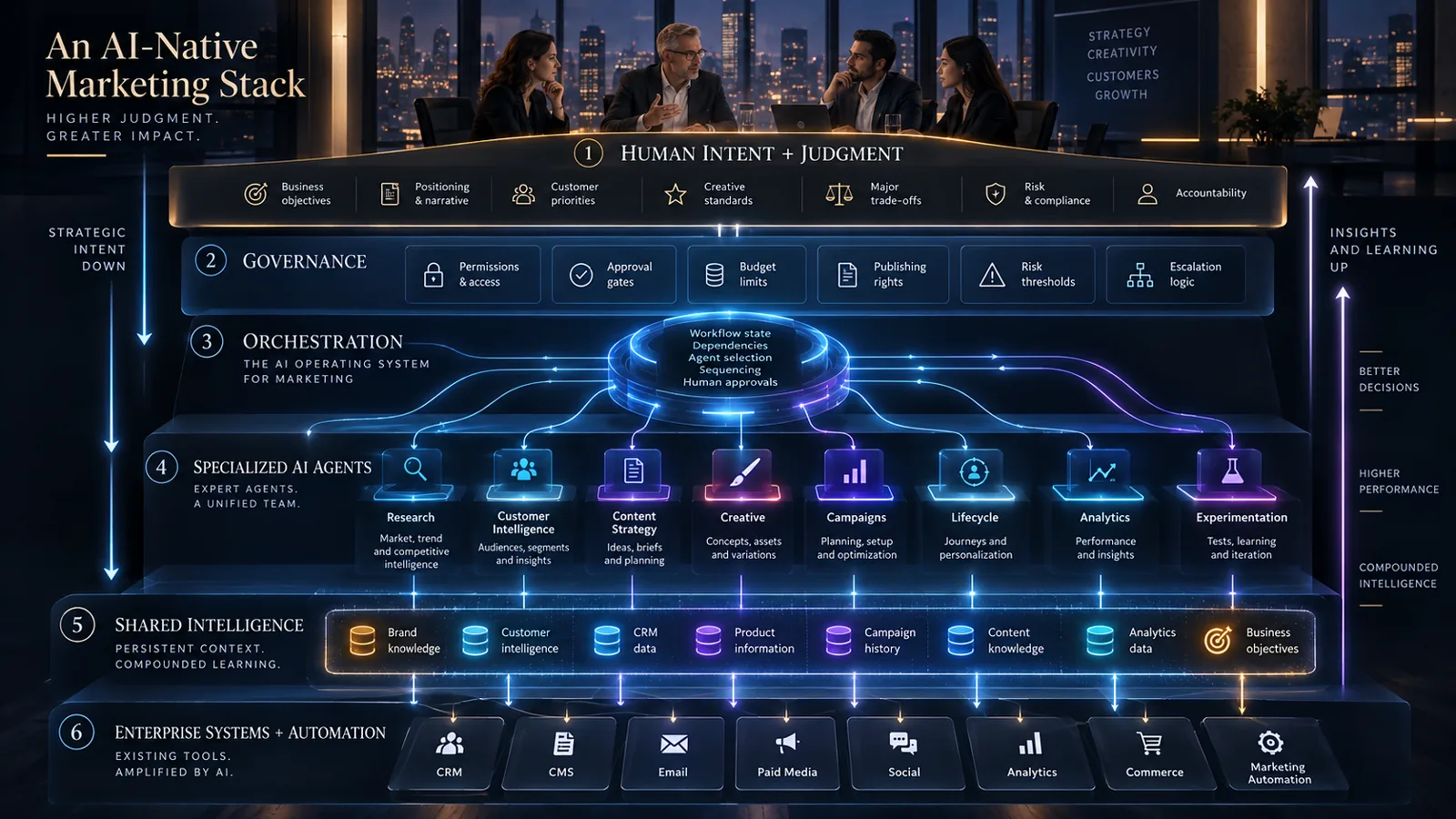
A useful future architecture can be understood in layers.
Layer 1: Enterprise Systems
The existing operational foundation:
- CRM
- CMS
- advertising
- social
- commerce
- analytics
- marketing automation
These platforms continue to perform important functions.
Layer 2: Shared Intelligence
A unified contextual layer containing:
- customers
- brand
- products
- campaigns
- content
- performance
- market intelligence
- business objectives
This prevents every agent from starting without context.
Layer 3: Specialized AI Agents
Agents perform defined functions such as:
- research
- audience intelligence
- content
- creative
- campaigns
- lifecycle
- analytics
- experimentation
Layer 4: Orchestration
This coordinates:
- agent selection
- task sequencing
- dependencies
- context
- workflow state
- approvals
- execution
Layer 5: Governance
Organizations define:
- permissions
- data access
- budgets
- risk limits
- publishing rights
- approval requirements
- escalation rules
Layer 6: Human Intent and Judgment
Humans retain responsibility for:
- business objectives
- positioning
- strategic priorities
- customer priorities
- creative standards
- major trade-offs
- values
- accountability
This turns the stack upside down.
Humans no longer need to operate every application.
They increasingly govern the system operating them.
Smarter Martech Requires Better Governance
As intelligence becomes embedded deeper into the stack, governance becomes more important.
A traditional tool mostly waits for a user to perform an action.
An AI agent may initiate one.
That means organizations need clear answers to questions such as:
Can the agent publish content?
Can it modify campaign budgets?
Can it contact customers?
Can it change targeting?
What customer information may it access?
Can it launch an experiment?
At what spend level is approval required?
What claims require legal review?
How is every action logged?
Intelligence without governance increases risk.
The smarter the stack becomes, the more explicit the operating boundaries need to become.
The Marketing Leader's Job Changes
The traditional marketing leader needed to understand the stack well enough to manage teams operating inside it.
The AI-era leader increasingly needs to understand the architecture of work.
The important questions become:
What should humans own?
What should agents own?
What should remain deterministic?
What context needs to be shared?
Which workflows matter most?
Where should approvals exist?
Which platforms should disappear?
Which systems need to connect?
How should learning move across the organization?
This is less about technology procurement.
It is more about operating-model design.
That is why the CMO increasingly becomes an orchestrator of people, intelligence, agents, data, and software.
How to Simplify a Smarter Marketing Stack
Companies do not need to rebuild everything at once.
Start with a systematic audit.
1. Map the Stack
List every major marketing platform.
Identify:
- purpose
- owner
- data
- AI capability
- integrations
- overlap
2. Map the Workflows
Then stop looking at platforms.
Look at outcomes.
How does a campaign actually move from idea to launch?
How does customer insight reach content?
How does performance trigger optimization?
How does sales intelligence reach marketing?
3. Identify Duplicate Capabilities
Look for overlapping:
- AI assistants
- analytics
- generation
- segmentation
- workflow
- reporting
- personalization
Consolidation can reduce complexity before adding anything new.
4. Identify Manual Context Transfer
Find every point where people have to explain something one system already knows to another system.
Those are opportunities for shared intelligence.
5. Add Orchestration Before More Agents
Do not build a fleet of autonomous agents without a clear coordination model.
Define:
- dependencies
- permissions
- workflow state
- escalation
- approvals
6. Design Human Attention Deliberately
Not every system event deserves a notification.
Not every AI recommendation deserves review.
Human attention should be concentrated on:
- consequential decisions
- uncertainty
- strategy
- creativity
- risk
- trade-offs
7. Measure Stack Complexity
Alongside campaign KPIs, measure:
- tool count
- duplicated capabilities
- workflow cycle time
- manual handoffs
- context switches
- approval delays
- human hours
- integration failures
You cannot simplify what you do not measure.
The Next Martech Advantage Is Not More Intelligence
AI will continue making marketing software smarter.
That is inevitable.
The CRM will get smarter.
The CMS will get smarter.
Advertising will get smarter.
Analytics will get smarter.
Automation will get smarter.
But eventually, almost every company will have access to powerful intelligence.
When that happens, the competitive advantage shifts.
It will not simply be:
Who has the smartest tools?
It will be:
Who has the smartest system?
Who connects customer context?
Who shares intelligence?
Who coordinates agents?
Who designs better workflows?
Who eliminates unnecessary handoffs?
Who has clearer governance?
Who gets the right decision to the right human at the right moment?
That is the next challenge.
Your Marketing Stack Doesn't Need to Think More. It Needs to Work Together.
The last era of marketing technology was built around specialization.
Every new problem created another application.
The first era of marketing AI followed the same pattern.
Every application received intelligence.
Now the consequences are becoming visible.
More intelligence.
More recommendations.
More automation.
More interfaces.
More complexity.
The next phase needs a different architecture.
Fragmented data becomes shared intelligence.
AI features become reusable capabilities.
Separate agents become orchestrated workflows.
Dashboards become decision intelligence.
Manual handoffs become coordinated execution.
Tool management becomes system governance.
And humans move upward—from operating every piece of software to directing the intelligent system beneath them.
That is what a truly smarter marketing stack looks like.
Not a stack with AI everywhere.
A stack where everything can finally work together.
Frequently asked questions
Why is the marketing technology stack becoming more complicated?
Marketing teams have accumulated specialized platforms over many years, often with overlapping functions and disconnected data. AI adds another layer of assistants, agents, recommendations, and automation unless the underlying architecture is simplified and integrated.
Does AI simplify the martech stack?
AI can simplify marketing operations, but only when it is combined with shared data, workflow redesign, integration, and orchestration. Adding isolated AI features to existing platforms can actually increase complexity.
What is an AI marketing stack?
An AI marketing stack combines existing enterprise marketing systems with AI models, shared business and customer intelligence, specialized agents, workflow orchestration, automation, governance, and human decision-making.
What is intelligence fragmentation?
Intelligence fragmentation occurs when multiple AI-powered systems independently analyze parts of the business without sufficient shared context or coordination, creating separate recommendations that humans must reconcile.
What is marketing orchestration?
Marketing orchestration is the coordination layer that manages how data, AI agents, humans, workflows, automation, and enterprise platforms work together toward marketing outcomes.
Should companies reduce the number of marketing tools they use?
In many organizations, rationalizing overlapping platforms can reduce cost and complexity. The goal should not necessarily be the smallest possible stack, but the simplest architecture capable of delivering required outcomes.
Will AI agents replace existing martech platforms?
Not necessarily. AI agents can increasingly operate across CRM, CMS, marketing automation, analytics, advertising, and other enterprise systems, turning existing platforms into execution infrastructure within a broader intelligent architecture.
What is the biggest risk of adding AI across every marketing platform?
One major risk is creating multiple intelligent silos. If every platform has its own context, recommendations, and workflow, marketers may have to coordinate even more outputs rather than experiencing less work.
How should companies simplify their AI marketing stack?
Start by mapping the current technology stack and end-to-end workflows, identifying overlapping functionality and manual handoffs, unifying important context, introducing orchestration, defining governance, and measuring whether technology actually reduces workflow complexity.