Your Marketing Team Doesn’t Need Another Dashboard. It Needs Decision Intelligence.
For the last decade, marketing technology has become extremely good at showing us information.
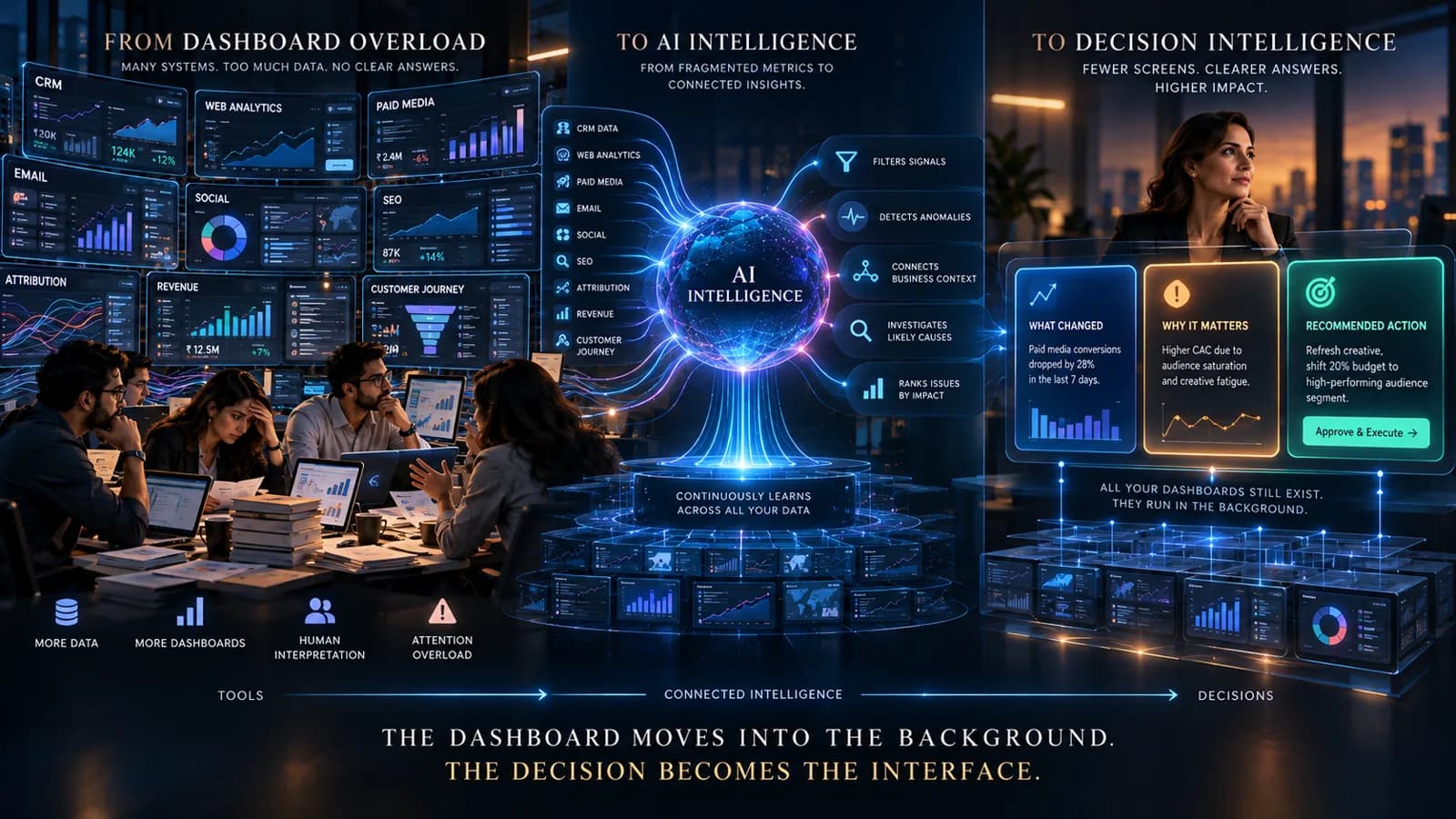
Marketing teams have never had more data.
Website traffic.
Conversion rates.
Customer acquisition cost.
ROAS.
Pipeline.
Revenue.
Email performance.
Search rankings.
Social engagement.
Customer journeys.
Lead velocity.
Attribution.
Retention.
Every platform has analytics.
Every marketing tool has a dashboard.
Every channel has metrics.
Every executive report contains charts.
And yet marketing leaders still ask the same questions:
What actually changed?
Why did it change?
Does it matter?
What should we do next?
That reveals an important problem.
Marketing does not have a dashboard shortage.
It has a decision problem.
For the last decade, marketing technology has become extremely good at showing us information.
The next generation needs to become better at helping us understand what that information means.
That is the shift from marketing dashboards to decision intelligence.
A dashboard tells you what happened.
Decision intelligence helps determine:
what happened, why it happened, how important it is, what may happen next, and what action deserves attention.
That may become one of the most important changes in marketing analytics in the AI era.
The Dashboard Era Solved an Important Problem
Marketing dashboards exist for a good reason.
Before modern analytics, marketers often lacked visibility.
Campaign data was fragmented.
Reports were manually prepared.
Performance arrived late.
Executives struggled to understand which channels were working.
Dashboards improved this dramatically.
They gave marketing teams access to:
- real-time metrics
- channel performance
- campaign comparisons
- funnel data
- audience behavior
- customer activity
- revenue signals
That was a major improvement.
But dashboards solved the problem of visibility.
They did not fully solve the problem of decision-making.
That distinction matters.
Seeing information is not the same as knowing what to do with it.
The Modern Marketing Problem Is Not Lack of Data
Imagine a CMO opens a marketing dashboard and sees:
Traffic: +11%
Conversion: -8%
Paid media spend: +6%
ROAS: -12%
Email engagement: stable
Pipeline: -4%
What should they do?
The dashboard provides information.
But the executive still needs to determine:
Is the conversion decline caused by traffic quality?
Did something change on the website?
Is one audience underperforming?
Did campaign mix change?
Is the decline statistically meaningful?
Is it temporary?
Does it affect every customer segment?
Should budget move?
Should creative change?
Should nothing happen yet?
The dashboard has not answered the actual business question.
It has created a diagnostic workflow.
Someone still has to investigate.
More Dashboards Can Actually Create More Work
This becomes worse as the marketing stack grows.
Paid media has a dashboard.
CRM has another.
Web analytics has another.
Marketing automation has another.
SEO has another.
Social has another.
Email has another.
Revenue reporting has another.
Then someone creates an executive BI dashboard combining several of them.
Now the organization has excellent visibility.
But the marketer still needs to:
open multiple platforms,
compare metrics,
reconcile differences,
identify anomalies,
form hypotheses,
ask analysts,
prepare summaries,
schedule meetings,
and decide what happens next.
The paradox is obvious:
More reporting infrastructure can create more interpretation work.
The team becomes data-rich and attention-poor.
Dashboard Overload Is Really Attention Overload
Dashboards are often designed around everything that can be measured.
But executives do not need everything that can be measured.
They need what deserves attention.
Consider two interfaces.
Dashboard A
Displays:
57 KPIs,
14 charts,
8 filters,
6 channel comparisons,
multiple time periods.
Interface B
Says:
Enterprise conversion declined 14% this week. The decline is concentrated in mobile paid-search visitors and began after Tuesday's landing-page update. Traffic quality remained stable. Reverting the new headline or testing Variant B are the two highest-confidence next actions.
Which one is more useful?
The first provides more data.
The second provides more intelligence.
This is the transition marketing analytics is beginning to make.
What Is Marketing Decision Intelligence?
Marketing decision intelligence is the use of connected data, analytics, AI, and business context to identify important performance signals, interpret their likely causes, evaluate possible actions, and help marketers make better decisions faster.
It sits between analytics and execution.
A useful system should be able to move through a sequence such as:
DATA → SIGNAL → INTERPRETATION → RECOMMENDATION → DECISION → ACTION → LEARNING
Traditional dashboards often stop after the first two steps.
Decision intelligence continues further.
That changes the role of analytics completely.
Reporting Answers “What Happened?”
Traditional marketing reporting is primarily descriptive.
Examples:
Traffic increased 18%.
Email conversion declined 4%.
Campaign A generated $310,000.
CAC increased 9%.
These are important facts.
But facts alone rarely determine action.
A useful marketing system needs to progress through several levels of intelligence.
Level 1: Descriptive Analytics
What happened?
Example:
Conversion declined 12%.
This is where many dashboards stop.
Level 2: Diagnostic Analytics
Why did it happen?
Example:
Conversion declined primarily among mobile paid-social visitors after the landing-page redesign.
Now the information becomes more useful.
Level 3: Predictive Analytics
What is likely to happen next?
Example:
If the current conversion trend continues, the campaign is likely to miss the monthly pipeline target by approximately 8%.
Now the business implication becomes clearer.
Level 4: Prescriptive Analytics
What should we consider doing?
Example:
Restore the previous mobile hero section or launch the already approved alternative variant.
Now analytics begins supporting decisions.
Level 5: Agentic Execution
What can the system safely do?
Example:
Launch a controlled experiment between the two already approved variants within the existing test budget.
Now the system moves from intelligence toward action.
That progression represents the future of marketing analytics.
AI Changes the Economics of Analysis
Traditional analytics requires people to investigate questions.
A marketer notices something.
An analyst pulls the data.
They compare segments.
They investigate possible causes.
They prepare an explanation.
Someone decides what to do.
This works.
But it is slow.
AI can dramatically reduce the cost of first-level analysis.
An analytics agent can continuously inspect:
- campaign performance
- customer segments
- historical baselines
- traffic sources
- creative performance
- landing pages
- CRM outcomes
- spend changes
Instead of waiting for a person to notice something unusual, the system can surface it automatically.
Instead of merely saying:
Conversion declined.
it can investigate:
where, when, and under what conditions.
That changes the analyst's starting point.
Humans begin with a hypothesis rather than a blank dashboard.
The Dashboard Should Become Infrastructure
Dashboards will not disappear completely.
They remain useful for:
- exploration
- validation
- detailed analysis
- auditability
- historical review
But they may move into the background.
Think about modern navigation software.
A navigation app contains an enormous amount of map data.
But it does not primarily say:
“Here is every road. Decide what to do.”
It says:
Turn left in 300 meters.
The underlying map still matters.
But the user's primary interface is the decision relevant to their objective.
Marketing analytics is moving in the same direction.
The dashboard becomes infrastructure.
The recommendation becomes the interface.
AI Should Filter Attention, Not Create More Alerts
There is a danger here.
Poorly designed AI analytics can simply create another stream of notifications.
“CTR changed.”
“Traffic increased.”
“Campaign performance declined.”
“Email engagement rose.”
Now marketers have dashboard overload and AI alert overload.
That is not progress.
Decision intelligence should reduce noise.
A good system should understand:
- magnitude
- business impact
- confidence
- novelty
- urgency
- reversibility
A small fluctuation that has no business impact should remain invisible.
A major unexpected shift should surface immediately.
The goal is not:
detect everything.
The goal is:
surface what deserves human attention.
Not Every Metric Deserves a Decision
Marketing organizations frequently track too many metrics because platforms make measurement easy.
Impressions.
Clicks.
Views.
Engagement.
Open rates.
Followers.
Session counts.
All may be useful in context.
But business decisions require hierarchy.
A good decision-intelligence system should understand how metrics relate to:
- revenue
- pipeline
- acquisition
- conversion
- retention
- customer value
- efficiency
- brand outcomes
That requires business context.
An AI system cannot reliably prioritize metrics if it does not understand what the organization is trying to achieve.
This is why shared business objectives are as important as analytics data.
Marketing Analytics Needs Business Context
Suppose social engagement increases 40%.
Is that good?
Maybe.
But what if:
pipeline is unchanged,
website conversion is declining,
and the engagement comes primarily from people outside the target customer segment?
The number itself looks positive.
The business interpretation is different.
Decision intelligence therefore needs access not only to performance data but also to:
- business objectives
- customer priorities
- product strategy
- campaign goals
- budgets
- historical performance
- channel roles
This converts measurement from:
metric interpretation
to:
business interpretation.
Why Unified Data Matters
Decision intelligence becomes difficult when data remains fragmented.
A campaign analytics system may see clicks.
CRM sees pipeline.
Commerce sees revenue.
Email sees engagement.
Web analytics sees behavior.
If those systems remain disconnected, each platform can produce a different interpretation.
That is why unified measurement continues to become more important.
Adobe's 2026 Marketing Campaign Analytics positioning explicitly emphasizes harmonizing marketing performance, spend, conversion, and business factors rather than analyzing each channel in isolation.
The objective is not simply one giant dashboard.
It is a more coherent understanding of performance.
From Attribution to Incrementality
Another major change is happening in marketing measurement.
Traditional attribution asks:
Which touchpoint should receive credit?
But credit assignment does not always answer the more valuable question:
What actually caused incremental business impact?
Imagine someone sees:
five ads,
three emails,
two search results,
and a sales conversation.
Which interaction deserves credit?
Attribution models can divide the result among them.
But a stronger business question is:
What would have happened if this marketing activity had not existed?
That leads toward incrementality and causal measurement.
Adobe's 2026 campaign analytics announcement reflects this direction, emphasizing causal AI and incremental measurement designed to help marketers understand which activities actually drive additional outcomes rather than merely correlate with conversions.
Decision intelligence becomes much stronger when it can reason about impact, not simply activity.
From Monthly Reports to Continuous Intelligence
Many organizations still operate through reporting cycles.
Weekly report.
Monthly report.
Quarterly business review.
But customer behavior does not wait for those meetings.
Campaign performance changes continuously.
Search behavior changes continuously.
Competitive conditions change continuously.
AI enables a more persistent analytics model.
The system continuously:
OBSERVES
performance.
DETECTS
material changes.
INVESTIGATES
likely causes.
EVALUATES
business impact.
RECOMMENDS
next actions.
ESCALATES
important decisions.
Then it continues monitoring.
Reporting becomes less of an event.
Intelligence becomes continuous.
The Weekly Marketing Report Should Almost Build Itself
Consider the traditional reporting workflow.
Monday:
Analyst downloads data.
Tuesday:
Data is reconciled.
Wednesday:
Charts are prepared.
Thursday:
Commentary is written.
Friday:
Leadership reviews what happened last week.
By then, the information may already be old.
A modern workflow should look very different.
Data is continuously ingested.
Metrics are validated.
Meaningful changes are detected.
Likely causes are investigated.
Insights are summarized.
Humans review important exceptions.
Leadership receives:
what changed
why
what matters
what requires a decision
That is a dramatically more efficient operating model.
Analytics Agents Will Change the Analyst Role
Does this eliminate marketing analysts?
No.
But it changes what valuable analysis looks like.
Analysts should spend less time:
- pulling numbers
- updating dashboards
- creating recurring charts
- reconciling basic reports
- describing obvious changes
And more time:
- designing measurement systems
- validating causal claims
- challenging AI conclusions
- creating experiments
- defining business metrics
- studying ambiguous behavior
- supporting strategic decisions
The analyst moves from:
report producer
toward:
decision architect.
That is a much more valuable role.
Decision Intelligence Needs Confidence, Not False Certainty
There is an important risk.
AI can produce explanations that sound convincing.
That does not mean they are correct.
A good analytics system should communicate uncertainty.
For example:
High confidence: conversion decline began immediately after the landing-page change and is isolated to that page.
Medium confidence: creative fatigue may be contributing to paid-social decline.
Low confidence: competitor pricing changes may be affecting enterprise conversion.
This matters.
Decision intelligence should not convert uncertain evidence into confident narratives.
A mature system should distinguish:
- observation
- correlation
- hypothesis
- causal evidence
Human analysts remain important precisely because high-impact conclusions need validation.
Decision Intelligence Should Connect Directly to Workflow
The true value appears when insight stops being the end of the process.
Imagine the system identifies creative fatigue.
Traditional model:
Dashboard shows decline.
Human notices.
Analyst confirms.
Manager creates a task.
Creative receives a brief.
New assets are developed.
Campaign manager launches a test.
Decision-intelligence model:
Analytics agent detects likely creative fatigue.
Campaign history confirms the asset has exceeded its normal performance window.
Creative agent generates alternatives based on the approved campaign concept.
Brand checks run.
Experimentation agent prepares a controlled test.
A marketer receives:
Creative fatigue detected. Three on-brand alternatives are ready. Approve test?
Now analytics is connected directly to execution.
That is a much more powerful operating model.
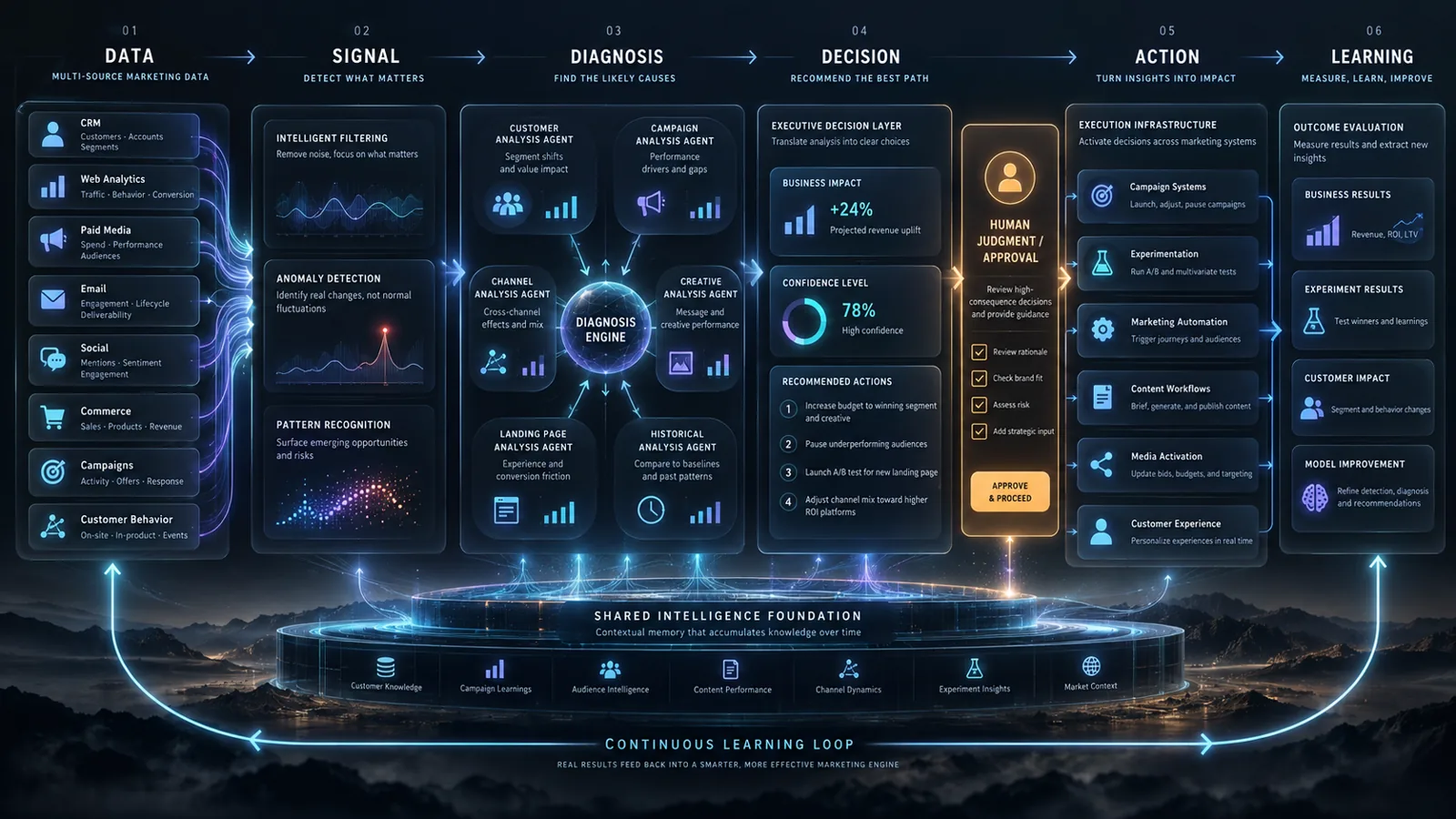
The Shift Is From Reporting to Decision Loops
This gives us a better mental model for future marketing analytics.
Traditional:
DATA → REPORT → MEETING
Future:
DATA → SIGNAL → INTERPRETATION → DECISION → ACTION → MEASUREMENT → LEARNING
Then the loop repeats.
The purpose of analytics becomes not simply explaining the past.
It becomes continuously improving future decisions.
What Should Still Require Human Judgment?
Decision intelligence should not mean automatic decision-making everywhere.
Humans should retain strong ownership of:
- major budget allocation
- strategic channel changes
- positioning
- pricing decisions
- brand risk
- customer-sensitive actions
- high-impact experiments
- ambiguous causal conclusions
- ethical trade-offs
The goal is not to remove the CMO from analytics.
It is to stop wasting the CMO's attention on finding the signal.
The system finds the signal.
Humans judge the consequence.
What Makes a Good Decision-Intelligence System?
A useful marketing decision system needs several layers.
1. Connected Data
Customer, campaign, spend, conversion, and business outcomes need sufficient integration.
2. Business Context
The system needs to understand goals, priorities, and constraints.
3. Continuous Monitoring
Important changes should be detected automatically.
4. Diagnostic Capability
The system should investigate likely drivers rather than simply flagging movement.
5. Prioritization
Signals should be ranked according to business significance.
6. Recommendation
The system should suggest reasonable next actions.
7. Confidence
It should communicate uncertainty.
8. Workflow Connection
Approved decisions should be able to trigger execution.
Without the final layer, marketing still has an insight-to-action gap.
Dashboard KPIs Need to Become Decision KPIs
Marketing teams should also rethink how they design measurement.
Instead of asking only:
What should we track?
Ask:
Which decisions do we repeatedly need to make?
Then work backward.
For example:
Decision:
Should we increase campaign spend?
Required intelligence:
- incremental return
- conversion quality
- marginal CAC
- audience saturation
- confidence interval
Decision:
Should we replace the creative?
Required intelligence:
- performance trend
- frequency
- fatigue
- audience breakdown
- alternative creative history
Decision:
Should we invest in this content topic?
Required intelligence:
- customer demand
- search opportunity
- conversion history
- strategic relevance
- content gap
This approach makes analytics decision-led rather than dashboard-led.
The Best Dashboard May Be No Dashboard at All
For many day-to-day marketing decisions, the ideal interface may ultimately be conversational.
A marketer asks:
Why did enterprise pipeline fall this week?
The system responds:
Enterprise pipeline declined 9%. Lead volume remained stable, but opportunity creation fell among paid-search accounts in financial services. The change began after the new demo qualification form launched. No comparable decline exists in organic or partner traffic.
Then:
What should we test?
The system responds:
The strongest first test is restoring the previous form length for 50% of qualified paid-search traffic. Estimated downside is limited because the previous form had a higher completion rate and similar lead quality.
The underlying analytics system may be extremely sophisticated.
But the human does not need to navigate it manually.
This is increasingly where analytics interfaces are heading. Adobe's current campaign analytics experience, for example, uses conversational AI to let marketers ask questions and receive analysis, recommendations, and actions rather than forcing them to navigate complex reports first.
Less Reporting. More Decisions.
The marketing analytics industry has spent years trying to create a single source of truth.
That remains useful.
But truth alone is not enough.
A company can have excellent data and still make slow decisions.
The next goal should be:
a single source of decision context.
What changed?
What matters?
Why?
What is uncertain?
What choices exist?
What requires human attention?
That is a more valuable interface between data and leadership.
Your Marketing Team Doesn't Need Another Dashboard
The dashboard era was necessary.
It gave marketers visibility.
But visibility is no longer the primary bottleneck.
The modern marketing organization is drowning in metrics while still competing for scarce human attention.
So the next generation of analytics must do more than display information.
It must:
filter
interpret
prioritize
recommend
connect
learn
The shift is:
from metrics to meaning
from dashboards to decisions
from reporting to continuous intelligence
from alerts to prioritized attention
from attribution to business impact
from analysis to action
The future marketing organization will still have data.
It may still have dashboards underneath.
But marketers should spend much less time looking for answers inside them.
The system should increasingly bring the decision to the marketer.
Because your marketing team does not need another dashboard.
It needs to know:
what changed, why it matters, and what to do next.
That is decision intelligence.
Frequently asked questions
What is marketing decision intelligence?
Marketing decision intelligence combines connected data, analytics, AI, and business context to identify important signals, investigate their causes, prioritize their importance, and recommend actions.
What is the difference between a marketing dashboard and decision intelligence?
A dashboard primarily displays metrics and trends. Decision intelligence goes further by interpreting those signals, explaining potential causes, evaluating business impact, and recommending next actions.
Are marketing dashboards becoming obsolete?
Not entirely. Dashboards remain useful for exploration, validation, historical analysis, and auditability. However, they may increasingly become infrastructure beneath more intelligent interfaces that surface prioritized decisions.
How can AI improve marketing analytics?
AI can continuously monitor performance, detect anomalies, investigate likely causes, summarize important changes, generate hypotheses, prioritize issues, and recommend next actions.
What is decision intelligence vs business intelligence?
Business intelligence primarily organizes and visualizes data for analysis. Decision intelligence focuses more directly on using data, analytics, AI, and context to improve specific decisions and connect insights to actions.
What is anomaly detection in marketing?
Anomaly detection identifies unexpected changes in metrics such as conversion, CAC, ROAS, pipeline, engagement, or customer behavior. AI can then help investigate where the change occurred and what may have caused it.
Will AI replace marketing analysts?
AI will likely automate more repetitive reporting, data synthesis, and first-level investigation. Human analysts remain important for measurement design, experimentation, causal validation, strategic interpretation, and challenging uncertain conclusions.
What is the future of marketing reporting?
Marketing reporting is likely to become more continuous, automated, prioritized, and action-oriented. Instead of receiving static reports periodically, teams can increasingly receive important insights and recommended actions as changes occur.
What should humans still decide?
Humans should continue to own major budget choices, strategy, positioning, high-risk experiments, ambiguous causal conclusions, ethical trade-offs, and decisions with significant brand or business consequences.